June 18, 2026
The Governance Architecture Behind Gold: How Reserve Managers Build Allocation Frameworks
Across monetary history, the assets that survive institutional scrutiny longest are rarely the most profitable ones. They are the ones that fail least catastrophically. This is not a trivial distinction. Reserve management is fundamentally a loss-prevention discipline, and understanding that framing is the prerequisite to understanding why gold continues to occupy a structurally growing share of the world's official reserves — and why the question of how central banks decide how much gold to hold is far more rigorous than most outside observers appreciate.
The 2026 World Gold Council Central Bank Gold Reserves Survey, drawing responses from 76 central banks at a 51% participation rate, provides the most comprehensive window yet into that decision-making architecture. What it reveals is not a story about market sentiment. It is a story about institutional governance frameworks evolving in real time.
When big ASX news breaks, our subscribers know first
The Sequential Mandate: Why the Order of Objectives Matters as Much as the Objectives Themselves
Reserve management institutions do not optimise across a single objective. They operate within a sequenced hierarchy: capital preservation first, convertibility second, purchasing power protection third. The sequencing is not cosmetic. It determines which assets qualify at all, and which get eliminated before any return calculation is performed.
Tier 1: Capital Preservation (Safety)
The baseline requirement for any reserve asset is zero counterparty risk. This means the asset cannot be defaulted on, cannot be devalued by a third party's monetary decision, and cannot be rendered inaccessible through geopolitical action. Gold satisfies all three conditions simultaneously. No other major reserve asset does.
The 2022 freezing of Russia's foreign currency reserves served as a decisive policy inflection point for reserve managers globally. What had previously existed as a theoretical risk — that currency-denominated reserves held in foreign jurisdictions could be politically immobilised — became operationally real. Institutions that had treated counterparty risk as a second-order concern were forced to reconsider. Physical gold held domestically carries none of that vulnerability. It is a claim on nothing except itself.
Tier 2: Convertibility at Scale (Liquidity)
Surviving capital preservation scrutiny is necessary but not sufficient. A reserve asset must also be convertible to cash at institutional scale without disrupting the market. Gold's over-the-counter market, centred in London and operating continuously across global time zones, provides depth comparable to the most liquid sovereign bond markets. The Bank for International Settlements accepts gold as eligible collateral, which functions as the highest institutional endorsement of liquidity quality available in the global financial system.
Tier 3: Purchasing Power Defence (Return)
Return ranks last — deliberately. Reserve managers are not yield-seekers. Their mandate is generational purchasing power protection across monetary regime changes, inflationary cycles, and geopolitical disruptions. Gold's approximately 60% price appreciation across 2025 is best understood as an environmental outcome produced by monetary conditions, not as a performance target.
That said, 37% of surveyed central banks now actively manage their gold allocation for return enhancement, up from a passive baseline. A further 42% cite risk management as their primary operational objective within gold, a sharp increase from 22% in 2025, according to the World Gold Council's 2026 Central Bank Gold Reserves Survey.
Three Methodologies: How Central Banks Determine Gold Allocation Levels
Featured Insight: Central banks use three primary methodologies to determine gold allocation levels. Executive board mandate governs 59% of institutions, formal Strategic Asset Allocation modelling applies at 46%, and legacy position maintenance drives 37%. The trend is strongly toward quantitative frameworks and away from passive historical holdings. (World Gold Council, Central Bank Gold Reserves Survey 2026)
Method 1: Executive Board Mandate
The most prevalent approach places gold allocation decisions within the strategic governance function of the central bank's senior executive layer. Governors and board members set reserve composition parameters through institutional policy documents, and gold's place within those parameters is defined at the highest level of organisational authority.
This top-down approach provides coherence and consistency but can be slower to respond to structural changes in the reserve environment. It remains dominant among smaller reserve institutions where the formal modelling infrastructure of larger peers is not available.
Method 2: Strategic Asset Allocation Modelling
Formal SAA processes treat gold as a competing asset class alongside sovereign bonds, agency securities, and other reserve instruments. Quantitative inputs include:
- Correlation matrices across reserve asset classes under both normal and stress conditions
- Volatility profiles and maximum drawdown analysis across historical monetary cycles
- Liquidity scoring frameworks that weight market depth, trading hours, and collateral acceptance
- Optimisation models that produce target percentage allocations within defined risk tolerance bands
The SAA methodology is adopted by 46% of central banks — a share that has grown materially over recent survey cycles as institutions invest in reserve management analytical infrastructure.
Method 3: Legacy Position Maintenance
A declining but still significant 37% of central banks cite historical position as their primary rationale for current gold holdings. This framing treats gold as something inherited from a prior monetary era rather than something deliberately chosen in the current one. The operational implication is passive management: the position is held but not actively sized, reviewed, or optimised.
The strategic significance of this metric lies in its trajectory. In 2021, 58% of institutions cited legacy framing as their primary rationale. That share has declined every year since, as the following table illustrates:
| Metric | 2021 | 2025 | 2026 |
|---|---|---|---|
| Central banks describing gold as a strategic asset | Minority | 64% | 75% |
| Central banks citing legacy position as primary rationale | 58% | Declining | 37% |
| Central banks planning to increase gold holdings in next 12 months | — | — | 45% (record) |
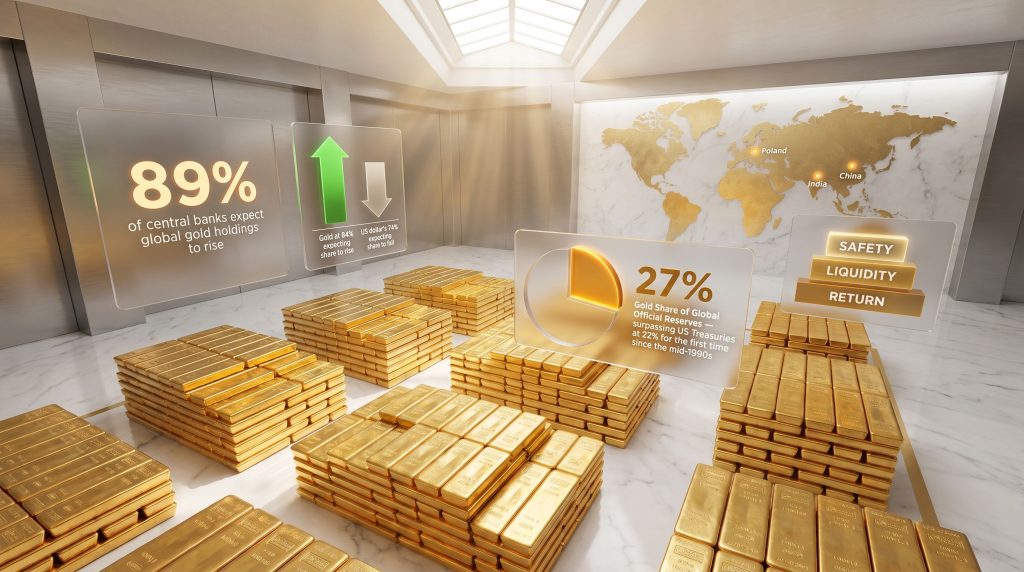
| Central banks expecting global gold reserves to rise | — | — | 89% |
Source: World Gold Council, Central Bank Gold Reserves Survey 2026 (76 respondents, 51% participation rate)
The transition from legacy framing to strategic framing carries a practical consequence that is easy to underestimate. A legacy asset is held passively and reviewed infrequently. A strategic asset, however, is sized deliberately, benchmarked against objectives, and managed actively. When 75% of surveyed institutions now describe their gold position as a strategic choice rather than a historical artefact, the analytical weight and ongoing institutional attention behind that position increases substantially. Understanding central bank gold reserves in this context reveals just how deliberate these decisions have become.
Five Institutional Rationales: Why Reserve Managers Hold Gold
Stress-Period Portfolio Resilience
90% of surveyed reserve managers rate gold's performance during market dislocations as highly or somewhat relevant — the highest reading recorded in the survey's history, according to the World Gold Council's 2026 findings. The mechanism behind this is well understood within institutional risk management: gold's correlation with equities and sovereign bonds is low during normal market conditions, but tends to invert during simultaneous portfolio drawdowns.
When diversified reserve portfolios face concurrent pressure across multiple asset classes, gold has historically moved counter-cyclically, providing precisely the offset that makes it valuable at the moment value is most needed.
Long-Term Store of Value and Inflation Defence
84% of central banks cite inflation hedging and long-term purchasing power preservation as core rationales. This is not a short-term trading thesis. Reserve managers think in decades and across monetary regime transitions. Gold's track record of maintaining real purchasing power across episodes of currency debasement, hyperinflation, and monetary system restructuring gives it a credibility for generational mandates that no fiat-denominated asset can replicate.
Portfolio Diversification Against Reserve Concentration Risk
83% of institutions identify diversification as a primary driver. The specific risk being managed is concentration exposure to any single currency bloc, financial system, or counterparty network. Gold's persistently low correlation with the major reserve currencies means that increasing its allocation mechanically reduces systemic concentration without sacrificing liquidity. Furthermore, this rationale has grown in institutional importance alongside the declining dollar share of global reserves.
Geopolitical Risk Buffering
The divergence between advanced economy and emerging market central banks on this dimension is among the most analytically significant findings in the 2026 survey:
- 85% of EMDE central banks cite gold as a geopolitical risk hedge
- 56% of advanced economy central banks share that view
- EMDE institutions are approximately 40% more likely to flag geopolitical instability as a top reserve management concern (95% vs 67%)
This divergence is behavioural as well as attitudinal. Countries with elevated exposure to dollar-system dependency and sanctions vulnerability have been the most active gold accumulators. China has added more than 350 tonnes since Russia's reserves were frozen in 2022. Poland added over 100 tonnes in 2025 alone, bringing its total to approximately 550 tonnes. Turkey has also been a significant buyer, though its position shifted with approximately 130 tonnes sold or loaned back in early 2026, according to ECB data published in June 2026.
Return Enhancement Through Active Management
The fifth rationale represents the newest institutional development. Central bank gold demand has consequently matured from passive custody toward active portfolio governance, with 37% of central banks now actively managing their gold position for return enhancement — up from 22% in 2025. This applies the same analytical frameworks used for bond portfolios to gold allocation decisions.
The Current Reserve Composition Landscape
Gold now constitutes approximately 27% of global official reserves by market value, surpassing US Treasuries at 22% for the first time since the mid-1990s, according to the European Central Bank's International Role of the Euro report published in June 2026. IMF COFER data places gold at approximately 26% of total reported reserves as of Q3 2025.
Two distinct forces are driving this shift simultaneously, and conflating them produces analytical error:
- Valuation-driven share expansion — Gold's approximately 60% price appreciation in 2025 mechanically elevated its proportional share of total reserves independent of any new purchases
- Volume-driven accumulation — Central banks have collectively purchased an average of approximately 1,000 tonnes annually over the past four years, roughly double the 500-tonne annual pace of the preceding decade
The dollar's concurrent relative decline reflects both deliberate diversification and a reduction in the volume of dollar-denominated holdings, though dollar assets still represent 42% of total global reserves. Looking five years forward, the directional expectations among reserve managers are unambiguous:
| Reserve Asset | % of Surveyed Central Banks Expecting Share to Rise | % Expecting Share to Fall |
|---|---|---|
| Gold | 84% | — |
| US Dollar | — | 74% |
Source: World Gold Council, Central Bank Gold Reserves Survey 2026
How Central Banks Finance and Execute Gold Purchases
The mechanics of acquisition reveal strategic dimensions that extend beyond simple portfolio rebalancing:
- 50% of central banks use domestic acquisition programmes denominated in local currency
- 38% reallocate from existing reserve assets
- 32% draw from newly accumulated foreign exchange reserves
Strategic Dimension: A central bank purchasing gold from domestic producers in its own currency acquires a non-dollar reserve asset without engaging the dollar settlement system at any point. The gold allocation decision simultaneously becomes a reserve composition decision and a monetary sovereignty decision, bypassing dollar intermediation entirely.
For new purchases, 62% of central banks specify LBMA-standard London Good Delivery bars — the 400-troy-ounce institutional benchmark — as their preferred format. The LBMA and COMEX gold markets underpin this standardisation, maximising counterparty acceptance, storage efficiency, and secondary market liquidity. Deviation from this standard introduces friction that is operationally significant at institutional scale.
76% of institutions manage gold separately from other reserve assets, a structural reflection of its distinct risk profile and the analytical framework applied to it.
The next major ASX story will hit our subscribers first
Vaulting Location Decisions: Where Gold Is Held and Why It Matters
Storage location decisions are themselves a form of risk management, applying the same diversification logic used for reserve asset composition to physical custody arrangements:
| Storage Location | 2025 Usage | 2026 Usage |
|---|---|---|
| Bank of England (London) | — | 57% |
| Domestic storage | — | 49% |
| Bank for International Settlements | — | 16% |
| Federal Reserve Bank of New York | — | 14% |
| Swiss National Bank | 12% | 6% |
Source: World Gold Council, Central Bank Gold Reserves Survey 2026
The Swiss National Bank's sharp decline from 12% to 6% is notable and warrants attention. The acceleration in vaulting diversification is equally significant. In 2025, just 2% of central banks diversified their overseas storage locations. By 2026, 10% had done so, and a further 9% plan to within the next twelve months. The same institutional instinct driving reserve asset diversification is now being applied to the physical location of the assets themselves.
The Reporting Gap: Why Official Data Understates Actual Accumulation
A critical dimension of how central banks decide how much gold to hold — and how much they actually acquire — is the divergence between IMF-reported figures and independently estimated actual purchases. IMF COFER data captures only reported, declared holdings. A significant portion of central bank gold buying occurs through channels that are not immediately disclosed in official statistics.
This includes delayed reporting, purchases through state-owned intermediaries, and acquisitions not categorised within standard reserve reporting frameworks. Published reports indicate that IMF data showed approximately 16 tonnes of net central bank purchases in Q1 2026, while independent research estimates placed the actual figure closer to 244 tonnes for the same period. Investors relying exclusively on official IMF data to assess central bank demand are consequently working with a materially incomplete picture of institutional accumulation.
Applying the Institutional Framework to Individual Portfolio Construction
The safety-liquidity-return hierarchy does not require a trillion-dollar balance sheet to be operationally relevant. The underlying logic scales directly to individual portfolio construction:
| Reserve Manager Criterion | Institutional Application | Individual Investor Equivalent |
|---|---|---|
| Safety | Zero counterparty risk; cannot be seized or devalued by third parties | Physical gold held outright, not paper claims or unallocated positions |
| Liquidity | Deep OTC market; BIS collateral eligible; 24-hour global access | Sufficient allocation to avoid forced selling at unfavourable prices |
| Return | Purchasing power preservation across generations; not yield-chasing | Long-term store of value orientation, not short-term price speculation |
| Diversification | Reduces concentration in dollar-denominated reserve assets | Reduces portfolio correlation with equities and credit |
| Geopolitical buffer | Hedges against sanctions risk and dollar-system dependency | Hedges against currency debasement and systemic financial disruption |
In addition, understanding gold in the monetary system more broadly helps individual investors contextualise why these institutional frameworks remain so enduring.
Analytical Perspective: The institutions conducting this analysis employ hundreds of economists and operate under mandates measured in generations. When 75% of them reclassify gold from a passive legacy holding to a deliberate strategic allocation, that consensus carries evidential weight that transcends market sentiment. It represents the output of the most rigorous reserve management due diligence processes in existence, conducted simultaneously across 76 independent institutions with different geographies, objectives, and political contexts — arriving at the same directional conclusion.
Frequently Asked Questions: How Central Banks Decide How Much Gold to Hold
Is there a universal formula for determining the correct gold allocation?
No standardised formula exists. Holdings vary significantly across institutions based on policy mandates, economic conditions, geopolitical exposure, and historical reserve structures. SAA modelling provides a quantitative framework, but outputs depend heavily on correlation assumptions, volatility inputs, and institutional risk tolerance. The trend is toward more formalised quantitative approaches, but executive mandate and legacy position remain significant determinants at many institutions.
Does the US Federal Reserve hold gold?
The Federal Reserve does not directly own gold. US gold reserves are held by the Treasury Department. The Federal Reserve holds gold certificates — financial instruments representing a claim on Treasury-held gold — rather than physical gold itself. This structural distinction is important for understanding how US gold reserves function within the broader monetary framework. Furthermore, how central banks buy gold and how those mechanics differ from Treasury operations is a distinction worth understanding for individual investors.
Is gold displacing the US dollar as the primary reserve asset?
Displacement overstates the current dynamic. Compositional rebalancing is more accurate. Dollar-denominated assets still represent approximately 42% of total global reserves. Gold surpassing US Treasuries by market value reflects both price appreciation and deliberate diversification. 74% of surveyed central banks expect the dollar's reserve share to decline further over the next five years, while 84% expect gold's share to increase — but the trajectory is gradual, not systemic replacement. Considering gold versus bonds within reserve portfolios further illustrates why gold continues to gain relative institutional favour.
What is a London Good Delivery bar and why does it matter?
A London Good Delivery bar is the LBMA-standardised 400-troy-ounce gold bar used for institutional transactions globally. Standardisation ensures consistent purity, weight, and assay certification across the over-the-counter market. 62% of central banks specify this format for new purchases because it maximises institutional liquidity, counterparty acceptance, and storage efficiency. Non-standard formats reduce marketability and introduce friction that is operationally significant at reserve management scale. Understanding how central banks decide how much gold to hold in this standardised form is essential to appreciating why format conventions matter at the institutional level.
This article is for informational and educational purposes only. It does not constitute financial or investment advice. Past performance is not indicative of future results. All investments involve risk, including the possible loss of principal. Readers should consult a qualified financial adviser before making any investment decisions.
Want to Know Which ASX Companies Could Be Sitting on the Next Major Mineral Discovery?
While central banks are quietly repositioning their reserves toward gold at a record pace, Discovery Alert's proprietary Discovery IQ model scans ASX announcements in real time, delivering instant alerts on significant mineral discoveries directly to subscribers — visit the Discovery Alert discoveries page to see the historic returns major discoveries have generated, and begin your 14-day free trial to position yourself ahead of the broader market.