May 11, 2026
What Makes HPAL Technology Revolutionary for Indonesian Nickel Processing?
The transformation of Indonesia's nickel industry represents one of the most significant technological shifts in modern metallurgy. High-Pressure Acid Leaching technology has fundamentally altered how laterite ores are processed, enabling extraction from previously uneconomical deposits and positioning Indonesia as the dominant force in global nickel production. Furthermore, this technological advancement has revolutionised the entire mining industry evolution across Southeast Asia.
The Chemistry Behind High-Pressure Acid Leaching
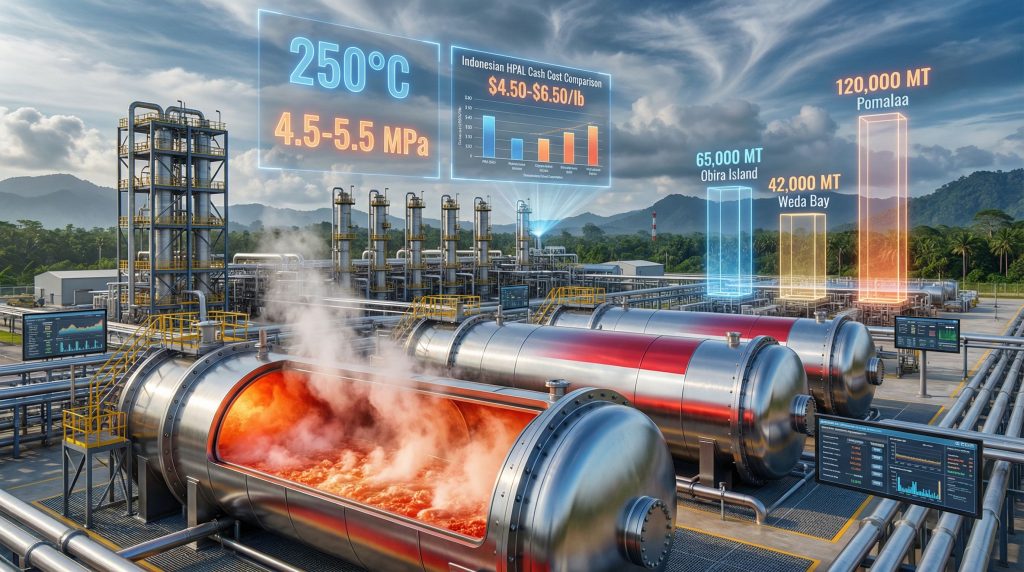
HPAL technology in Indonesia nickel production operates through precisely controlled chemical processes that break down laterite ore structures at the molecular level. The system maintains autoclave temperatures of 250°C whilst sustaining pressures between 4.5-5.5 MPa, creating conditions that dissolve nickel-bearing minerals into sulfuric acid solutions.
The process consumes approximately 0.8-1.2 tonnes of sulfuric acid per tonne of Mixed Hydroxide Precipitate produced, with limestone neutralisation requiring 0.3-0.4 tonnes of limestone per tonne of ore processed. Counter-current decantation systems achieve metal recovery rates exceeding 97%, representing industry-leading efficiency standards.
| Process Parameter | Specification | Industry Standard |
|---|---|---|
| Operating Temperature | 250°C | ±5°C tolerance |
| Operating Pressure | 4.5-5.5 MPa | ±0.3 MPa window |
| Retention Time | 0.5-2 hours | Varies by ore grade |
| Metal Recovery Rate | >97% | Best-in-class performance |
Mixed Hydroxide Precipitate formation occurs through selective precipitation, creating products with 20-30% nickel content and 1.5-3% cobalt content. For automotive-grade battery cathode precursors, purity requirements exceed 99.5%, with particle sizes controlled between 5-50 microns for optimal downstream processing.
Moreover, the strategic importance of nickel: uses & importance becomes evident when examining the precision required for these chemical processes.
Engineering Advantages Over Traditional Smelting Methods
HPAL technology demonstrates superior economics compared to traditional pyrometallurgical routes, particularly for processing lower-grade laterite deposits. The technology enables profitable extraction from saprolite ore grades as low as 1.0% nickel content, compared to rotary kiln electric furnace methods that require higher-grade feedstock.
Energy consumption analysis reveals HPAL operations consume 2-3 times less energy per unit of nickel produced compared to traditional smelting routes. This advantage stems from avoiding high-temperature calcination processes that require heating laterite to 700-900°C in conventional pyrometallurgical circuits.
Capital Expenditure Comparison:
• HPAL Greenfield Facility (50,000 MT capacity): $800-1,200 million
• Traditional Sulfide Smelter (equivalent capacity): $1,200-1,800 million
• RKEF Ferronickel Plant (equivalent output): $600-900 million
Operational Expenditure Analysis:
• Acid costs: 15-20% of total operating expenses
• Maintenance requirements: 40% lower than pyrometallurgical routes
• Labour requirements: 25-30% fewer specialised operators needed
When big ASX news breaks, our subscribers know first
How Do Indonesia's HPAL Facilities Compare in Global Production Capacity?
Indonesia's HPAL infrastructure development has accelerated dramatically since 2020, establishing the country as the global centre for laterite-based nickel processing. Current operational capacity represents a fundamental shift in global nickel supply chains, with Indonesian facilities now producing the majority of battery-grade nickel intermediates worldwide.
Current Operational HPAL Plants and Their Specifications
| Facility | Operator | Annual MHP Capacity | Status (2025) | Commissioning | Ore Grade |
|---|---|---|---|---|---|
| Obira Island | Harita/TBP | 65,000 MT | Operational | 2021 | <1.5% Ni |
| Weda Bay | Eramet/Tsingshan JV | 42,000 MT | Operational | 2022 | 1.3-1.8% Ni |
| Pomalaa | Vale-Huayou JV | 120,000 MT | Under Development | Delayed from 2023 | 1.2-1.6% Ni |
| Additional Projects | Various | 200,000+ MT | Planning/Construction | 2025-2027 | Variable |
Indonesia's confirmed operational HPAL capacity totals approximately 107,000 MT MHP annually from the Obira Island and Weda Bay facilities. With additional projects under development, total capacity could exceed 400,000 MT annually by 2027, representing nearly 60% of projected global MHP demand.
The Weda Bay Nickel project processes 3.5-4.0 million tonnes of ore annually, combining saprolite and limonite blends with saprolite comprising 60-70% of feedstock to maintain recovery efficiency above 90%. This operational approach demonstrates the strategic importance of ore blending in HPAL optimisation.
Notably, projects like the tamarack nickel-copper project showcase similar advanced processing techniques being implemented in other global locations.
Processing Efficiency Metrics Across Different Ore Types
Laterite ore classification directly impacts HPAL processing efficiency and economics. Indonesian deposits primarily consist of saprolite (upper weathered layer) and limonite (lower iron-rich layer), each requiring different processing approaches to optimise nickel and cobalt recovery.
Saprolite Processing Characteristics:
• Ore grade range: 1.0-2.5% nickel content
• Iron content: 8-12% (relatively low)
• Moisture content: 15-30% in-situ
• Recovery efficiency: 92-96% nickel extraction
• Processing advantage: Lower neutralisation requirements
Limonite Processing Challenges:
• Ore grade range: 0.8-1.5% nickel content
• Iron content: 15-25% Fe₂O₃ (significantly higher)
• Processing complexity: Requires additional precipitation stages
• Recovery efficiency: 82-88% nickel extraction
• Economic consideration: Often blended with saprolite for optimisation
| Ore Classification | Ni Grade | Recovery % | Fe Content | Process Complexity |
|---|---|---|---|---|
| High-Grade Saprolite | 1.8-2.5% | 92-96% | 8-12% | Low |
| Medium-Grade Saprolite | 1.3-1.8% | 88-92% | 12-18% | Moderate |
| Limonite Blend | 0.8-1.3% | 82-88% | 18-25% | High |
| Low-Grade Mixed | <0.8% | 75-82% | 25-35% | Very High |
Cobalt co-recovery optimisation represents a critical economic factor for Indonesian HPAL operations. Recovery rates vary significantly by ore source, with Indonesian saprolite typically achieving 50-65% cobalt extraction. Economic viability depends on cobalt price premiums, which ranged $15,000-$25,000 per tonne above nickel prices during 2023-2024.
According to industry analysis from Wood Mackenzie, HPAL operations generate 1.2-1.6 tonnes of waste per tonne of nickel, requiring sophisticated tailings management systems in seismically active regions with high rainfall.
This waste-to-product ratio encompasses multiple components: iron hydroxide precipitation (0.4-0.6 tonnes/tonne Ni), aluminium silicate residues (0.3-0.5 tonnes/tonne Ni), unreacted silica and minerals (0.2-0.4 tonnes/tonne Ni), and moisture content in tailings (0.3-0.5 tonnes/tonne Ni).
Why Are Chinese Engineering Firms Dominating HPAL Implementation?
The rapid expansion of HPAL technology in Indonesia reflects the strategic advantages Chinese engineering firms possess in technology transfer, construction efficiency, and supply chain integration. This dominance represents a fundamental shift in global mining infrastructure development, with Chinese entities controlling over 70% of new HPAL capacity development financing and execution.
Technological Transfer and Rapid Deployment Capabilities
Chinese engineering firms have revolutionised HPAL deployment through standardised modular designs and integrated supply chains. Construction timelines for Chinese-led projects average 18-24 months for greenfield HPAL facilities, compared to 28-36 months for Western engineering firms, representing 33-50% faster project delivery.
Construction Timeline Advantages:
• Engineering & Procurement: 6-9 months (Chinese) vs 12-15 months (Western)
• Equipment Manufacturing: Parallel processing vs sequential procurement
• Site Construction: Modular pre-fabrication reduces on-site complexity by 35-40%
• Commissioning Period: 4-6 months vs 6-9 months for Western counterparts
Equipment sourcing represents a critical competitive advantage for Chinese firms. Titanium-lined autoclaves, specialised high-pressure pumps, and heat exchangers are manufactured within integrated Chinese supply networks, reducing lead times by 50% compared to international procurement processes. This integration eliminates lengthy international tendering requirements that traditionally extended project timelines.
Modular construction approaches enable pre-fabricated autoclave units, counter-current decantation systems, and supporting infrastructure to be manufactured off-site and assembled in-country. This methodology reduces on-site construction complexity and enables concurrent manufacturing whilst site preparation proceeds.
In addition, the implementation of ai in mining innovations has further accelerated Chinese firms' technological advantages in process optimisation.
Investment Flow and Joint Venture Structures
Chinese Foreign Direct Investment in Indonesian nickel processing has exceeded $15 billion in committed capital across multiple facilities and operators between 2018-2024. Major Chinese investors include Tsingshan Holding Group, China Hongqiao Group, and Huayou Cobalt, representing vertical integration strategies from raw material processing to battery precursor manufacturing.
Investment Concentration Analysis:
• Chinese-backed financing: 70-75% of new HPAL capacity development
• Technology licensing: Predominantly Chinese process optimisation and equipment supply
• Joint venture structures: Required local Indonesian partnership compliance
• Vertical integration: Mine-to-battery supply chain control strategies
The strategic rationale extends beyond traditional mining investment patterns. Chinese entities are establishing comprehensive supply chain control from laterite extraction through MHP production to downstream battery chemical processing. This vertical integration approach ensures feedstock security for China's dominant position in lithium-ion battery manufacturing.
Risk mitigation occurs through mandatory local partnership structures required by Indonesian foreign investment regulations. These joint ventures typically feature Chinese technical and financial control with Indonesian partners providing regulatory navigation, land access, and local operational expertise.
What Are the Environmental Engineering Challenges of HPAL Operations?
Environmental management represents one of the most complex aspects of HPAL technology implementation in Indonesia's tropical archipelago setting. The combination of high rainfall, seismic activity, and sensitive marine ecosystems creates unprecedented engineering challenges for tailings management, water treatment, and emissions control.
Tailings Management and Waste Processing Systems
HPAL operations face unique tailings management challenges due to the substantial waste volumes generated and Indonesia's environmental conditions. Each facility must engineer systems capable of safely containing and processing 1.2-1.6 tonnes of waste per tonne of nickel produced, whilst accounting for monsoon rainfall patterns and seismic risk factors.
Tailings Composition and Characteristics:
• Iron hydroxide precipitate: 35-40% of total waste volume
• Aluminium silicate residues: 25-30% of waste stream
• Unreacted mineral content: 15-20% of tailings
• Process water content: 20-25% by weight (requiring management)
Seismic considerations require specialised tailings dam engineering in regions with elevated earthquake risk. Indonesian HPAL facilities must design containment systems capable of withstanding seismic events whilst preventing environmental contamination of surrounding watersheds and coastal areas.
Consequently, implementing comprehensive waste management solutions becomes paramount for sustainable HPAL operations in Indonesia's challenging environmental conditions.
Water Management and Acid Recovery Systems
Process water recycling represents both an environmental imperative and economic optimisation opportunity for Indonesian HPAL operations. Facilities achieve 80-90% process water recycling rates through multi-stage treatment systems that remove dissolved metals and neutralise acidity before reuse in the circuit.
Water Management System Components:
• Primary clarification: Solid-liquid separation achieving 70-85% solids density
• Secondary treatment: Chemical precipitation and pH adjustment
• Filtration systems: Pressure and vacuum filters reducing moisture to 5-8%
• Recycled water quality: Meeting process specifications for reuse
Sulfuric acid recovery from neutralisation circuits provides both cost savings and environmental benefits. Advanced HPAL facilities implement acid recovery systems that recapture 15-25% of consumed sulfuric acid through process optimisation and waste heat recovery integration.
Groundwater protection measures require comprehensive monitoring and containment systems in tropical environments with high permeability soils. Facilities implement multiple containment barriers, leak detection systems, and continuous groundwater quality monitoring to prevent contamination of local aquifers.
Air Quality Control and Emissions Management
Atmospheric emissions control represents a critical environmental engineering challenge for HPAL operations, particularly regarding autoclave off-gas treatment and particulate matter management during ore preparation and handling phases.
Emission Control Technologies:
• Autoclave off-gas treatment: Acid scrubbing systems for sulfur compound removal
• Particulate control: Baghouse filtration systems in ore preparation areas
• Sulfur dioxide management: Emission control from acid plant operations
• Fugitive dust control: Water spray systems and covered conveyors
Carbon footprint analysis reveals significant energy intensity differences between HPAL facilities depending on power source selection. Coal-fired captive power plants, commonly used in Indonesian industrial parks, generate 2-3 times higher carbon emissions per unit of nickel produced compared to hydroelectric or renewable energy sources.
| Power Source | Carbon Intensity (kg CO₂/kg Ni) | Energy Cost ($/MWh) | Reliability |
|---|---|---|---|
| Captive Coal | 25-35 | $45-65 | High |
| Grid Power | 15-25 | $65-85 | Variable |
| Hydroelectric | 3-8 | $35-55 | Seasonal |
| Solar + Storage | 5-12 | $75-95 | Weather-dependent |
Research from the Association of Energy and Environmental Research Indonesia indicates that environmental considerations have become increasingly critical for HPAL technology implementation, particularly regarding long-term ecological impacts in tropical ecosystems.
How Does HPAL Technology Impact Indonesia's Position in Global Nickel Markets?
Indonesia's mastery of HPAL technology has fundamentally restructured global nickel market dynamics, transforming the country from a raw ore exporter to the world's dominant processor of battery-grade nickel intermediates. This technological capability, combined with abundant laterite resources, has created a competitive advantage that extends far beyond traditional cost considerations.
Production Cost Analysis and Competitive Positioning
Indonesian HPAL operations have achieved production costs that significantly undercut traditional nickel processing routes, creating sustainable competitive advantages in global markets. Current cash costs range $4.50-$6.50 per pound with all-in sustaining costs between $7.00-$9.00 per pound, representing approximately 40-50% lower costs than Australian laterite operations.
| Production Method | Cash Cost ($/lb) | All-in Sustaining Cost ($/lb) | Primary Location |
|---|---|---|---|
| Indonesian HPAL | $4.50-$6.50 | $7.00-$9.00 | Sulawesi |
| Australian Laterite | $8.00-$10.00 | $11.00-$13.00 | Western Australia |
| Canadian Sulfide | $6.00-$8.00 | $9.50-$11.50 | Ontario/Manitoba |
| Russian Sulfide | $5.50-$7.50 | $8.50-$10.50 | Norilsk Region |
This cost advantage stems from multiple factors: abundant low-cost laterite ore, integrated smelting and refining operations, economies of scale in new facilities, and optimised energy costs through captive power generation. The combination creates sustainable competitive moats that are difficult for other regions to replicate.
Labour cost advantages further enhance Indonesian competitiveness, with skilled technical operators earning 60-70% less than equivalent positions in developed mining jurisdictions, whilst maintaining comparable productivity levels through modern automation and process control systems.
Supply Chain Integration with Battery Manufacturing
HPAL technology in Indonesia nickel production has created unprecedented integration opportunities with the global battery supply chain. MHP produced by Indonesian facilities meets stringent specifications required for automotive-grade nickel sulfate production, with purity levels exceeding 99.5% and controlled impurity profiles optimised for lithium-ion battery cathode materials.
MHP Specification Requirements:
• Nickel content: 20-30% (battery-grade specifications)
• Cobalt content: 1.5-3% (valuable co-product for cathode materials)
• Impurity control: Iron <0.005%, Copper <0.002%, Lead <0.001%
• Particle size: 5-50 microns (optimal for downstream processing)
• Moisture content: <12% (shipping and handling requirements)
Contract structures with battery manufacturers and chemical processors reflect long-term supply security priorities. Indonesian MHP producers typically secure 5-10 year offtake agreements with major battery chemical companies, providing revenue stability whilst ensuring feedstock security for buyers.
Logistics optimisation between Indonesian ports and Asian battery manufacturing hubs has reduced transportation costs by 25-30% compared to traditional nickel supply routes. The geographic proximity to major battery production centres in China, South Korea, and Japan creates natural supply chain efficiencies that enhance overall competitiveness.
Quality control systems implemented at Indonesian HPAL facilities exceed international standards for battery-grade materials. Automated sampling and analysis systems ensure consistent MHP quality, whilst real-time process monitoring enables immediate adjustments to maintain specification compliance throughout production cycles.
What Technical Innovations Are Emerging in Indonesian HPAL Operations?
The rapid evolution of HPAL technology in Indonesia reflects continuous process optimisation driven by operational experience, technological advancement, and competitive pressure to improve efficiency whilst reducing environmental impact. Current innovations focus on energy integration, automation enhancement, and process intensification to maintain cost leadership.
Next-Generation Process Improvements
Advanced process control systems represent the cutting edge of HPAL optimisation, incorporating artificial intelligence and machine learning algorithms to predict and prevent process deviations before they impact production efficiency. These systems analyse thousands of process variables simultaneously to optimise autoclave performance, acid consumption, and metal recovery rates.
Technology Implementation Areas:
• AI-driven optimisation: Predictive algorithms for autoclave temperature and pressure control
• Enhanced materials science: Corrosion-resistant alloy development for extended equipment life
• Separation technology: Advanced solid-liquid separation improving recovery by 2-3%
• Energy recovery systems: Waste heat capture from high-temperature process streams
Autoclave material science continues advancing through development of specialised corrosion-resistant alloys that extend equipment lifecycles by 50-75% whilst reducing maintenance requirements. These materials, primarily titanium-based composites, add 15-20% to initial capital expenditure but generate substantial long-term operational savings through reduced downtime and replacement costs.
Improved solid-liquid separation technologies focus on enhanced thickener designs and advanced filtration systems that increase metal recovery rates whilst reducing moisture content in final products. These improvements typically generate 2-5% increases in nickel recovery with corresponding reductions in waste generation.
Renewable Energy Integration Projects
Energy transition initiatives at Indonesian HPAL facilities address both cost reduction objectives and environmental compliance requirements as Western automakers implement stricter carbon footprint standards for battery supply chains.
The Neo Energy Morowali Industrial Estate represents Indonesia's most ambitious renewable energy integration project for nickel processing. The development combines hydroelectric power generation with solar installations and battery storage systems to provide clean energy for multiple HPAL facilities within the industrial complex.
Renewable Integration Specifications:
• Hydroelectric capacity: 200 MW continuous baseload power
• Solar installations: 100 MW peak generation capacity
• Battery storage: 150 MWh grid stabilisation and peak shaving
• Grid integration: Hybrid system with backup coal generation for reliability
Economic analysis demonstrates renewable energy integration achieves 15-25% reduction in power costs over 20-year project lifecycles, whilst reducing carbon emissions by 60-75% compared to captive coal-fired generation. However, initial capital requirements increase by $200-300 million per integrated facility.
Grid stability requirements for continuous autoclave operation create unique challenges for renewable energy integration. HPAL processes cannot tolerate power interruptions without risking equipment damage and production losses, necessitating sophisticated energy storage and backup systems that add complexity and cost to renewable installations.
The next major ASX story will hit our subscribers first
How Will HPAL Technology Evolution Shape Future Nickel Production?
The trajectory of HPAL technology development in Indonesia suggests fundamental changes in global nickel production economics, with implications extending beyond current market structures to reshape entire supply chains and competitive dynamics. Future evolution centres on scalability improvements, downstream integration, and sustainability optimisation.
Scalability and Modular Design Trends
Standardised HPAL module designs enable faster deployment of new capacity whilst reducing engineering and construction costs through economies of replication. These modular approaches allow facilities to be constructed in standardised 25,000-50,000 MT annual capacity increments, enabling flexible capacity expansion based on market demand evolution.
Modular Design Advantages:
• Construction timeline: 12-18 months per module vs 24-36 months for custom designs
• Capital efficiency: 20-30% reduction in engineering and procurement costs
• Operational flexibility: Staged commissioning and capacity optimisation
• Risk mitigation: Proven designs reduce technical and execution risk
Capacity optimisation strategies balance economies of scale against operational flexibility requirements. Larger individual modules achieve lower unit costs but reduce operational flexibility during maintenance periods, whilst smaller modules provide operational redundancy at higher unit costs.
Automation levels continue advancing toward fully autonomous operation for routine processes, with workforce requirements projected to decrease by 30-40% over the next decade through implementation of advanced process control, predictive maintenance, and robotic material handling systems.
Integration with Downstream Processing
Direct nickel sulfate production from HPAL circuits represents the next evolution in Indonesian processing capabilities, eliminating intermediate MHP production stages to produce battery-grade chemicals directly from laterite ore. This integration reduces processing costs by 15-25% whilst improving quality control and supply chain efficiency.
Downstream Integration Opportunities:
• Direct nickel sulfate production: Eliminating MHP intermediate processing steps
• Cobalt separation enhancement: Advanced purification for battery-grade cobalt sulfate
• Rare earth recovery: Economic extraction from laterite processing residues
• Circular economy approaches: Waste minimisation and byproduct utilisation
Cobalt separation and purification enhancements focus on advanced solvent extraction and ion exchange technologies that increase cobalt recovery rates from current 50-65% to projected 75-85% whilst producing battery-grade cobalt sulfate meeting automotive industry specifications.
Rare earth element recovery from laterite processing residues presents emerging economic opportunities as global demand for permanent magnet materials increases. Indonesian HPAL facilities generate substantial volumes of rare earth-bearing residues that could become economically viable secondary revenue streams through specialised recovery circuits.
What Are the Key Performance Indicators for HPAL Facility Success?
Performance measurement in Indonesian HPAL operations extends beyond traditional mining metrics to encompass battery industry supply chain requirements, environmental compliance standards, and financial optimisation across volatile commodity price cycles. Success metrics reflect the unique challenges of processing tropical laterite ores for technology applications.
Operational Excellence Metrics
Plant availability and utilisation rates represent critical performance indicators for capital-intensive HPAL operations, with industry-leading facilities targeting >90% availability whilst maintaining consistent product quality and environmental compliance. Unplanned downtime directly impacts financial viability due to high fixed costs and contracted delivery obligations.
Performance Benchmarks:
• Plant availability: >90% (industry standard for profitable operations)
• Metal recovery efficiency: >95% nickel recovery, >60% cobalt recovery
• Energy consumption: <45 MWh per tonne of nickel produced
• Safety performance: Zero significant incidents, <2.0 LTIFR (Lost Time Injury Frequency Rate)
Metal recovery efficiency benchmarks reflect continuous process optimisation efforts, with leading facilities achieving 95-97% nickel recovery and 60-70% cobalt recovery from laterite feedstock. These metrics directly impact facility profitability through maximised revenue from processed ore tonnage.
Energy consumption per unit of production represents a critical cost component and environmental performance indicator. Best-in-class Indonesian HPAL facilities target <45 MWh per tonne of nickel produced through process optimisation, waste heat recovery, and energy management systems.
Financial Performance Drivers
Capital payback period analysis for HPAL investments typically ranges 8-12 years depending on facility size, ore grade, and nickel price assumptions. Indonesian facilities generally achieve faster payback periods due to lower construction costs, favourable ore characteristics, and integrated supply chain positioning.
Financial Metrics Overview:
• Capital payback period: 8-12 years (varies by facility scale and ore grade)
• Operating margin sensitivity: ±$1/lb nickel price = ±15-20% margin impact
• Currency exposure: 60-70% USD revenue, 40-50% local currency costs
• Regulatory compliance costs: 3-5% of annual operating expenses
Operating margin sensitivity to nickel price volatility creates significant financial risk for HPAL operations, with ±$1 per pound nickel price changes typically generating ±15-20% operating margin impacts. This sensitivity necessitates sophisticated hedging strategies and flexible cost structures to maintain profitability across commodity price cycles.
Currency hedging strategies address the fundamental mismatch between USD-denominated nickel revenues and Indonesian rupiah-denominated local operating costs. Facilities typically hedge 40-60% of projected revenues through forward contracts, options, and natural hedging approaches to manage exchange rate volatility.
Environmental provisioning and regulatory compliance costs continue increasing as Indonesian environmental standards evolve and international customers implement stricter supply chain sustainability requirements. These costs typically represent 3-5% of annual operating expenses but are projected to increase as carbon pricing mechanisms and environmental regulations strengthen.
The success of HPAL technology in Indonesia nickel production ultimately depends on maintaining competitive cost positions whilst meeting increasingly stringent quality, environmental, and sustainability requirements from global battery supply chain participants. Facilities achieving operational excellence across all these dimensions will continue capturing market share in the rapidly growing battery materials sector.
Ready to Discover the Next Major Nickel Investment Opportunity?
Indonesia's HPAL technology revolution is creating unprecedented opportunities in the global nickel markets, but identifying the right investment timing requires real-time insights into mineral discoveries and market developments. Discovery Alert's proprietary Discovery IQ model delivers instant notifications on significant ASX nickel discoveries, empowering investors to capitalise on market-moving announcements before broader market awareness develops. Begin your 30-day free trial today to position yourself ahead of Indonesia's expanding influence on global nickel supply chains.