June 3, 2026
The Industrial Logic Behind Africa's Battery Minerals Transformation
The global battery supply chain has never been purely about mining. The real economic leverage sits several steps downstream, in the refineries and chemical processing plants that convert raw ore into the precise compounds feeding lithium-ion cells. For decades, African nations supplied the feedstock while watching the majority of value creation occur on other continents. That structural imbalance is now facing its most serious challenge yet, and Zimbabwe sits at the centre of the shift.
The emergence of the Huayou lithium carbonate plant in Zimbabwe is best understood not as a single corporate project, but as the most visible expression of a deliberate policy transformation unfolding across southern Africa. It reflects the intersection of Chinese industrial strategy, African resource nationalism, and the accelerating global competition for battery mineral supply chains.
When big ASX news breaks, our subscribers know first
Zimbabwe's Ascent as a Lithium Powerhouse
From Feedstock Nation to Processing Hub
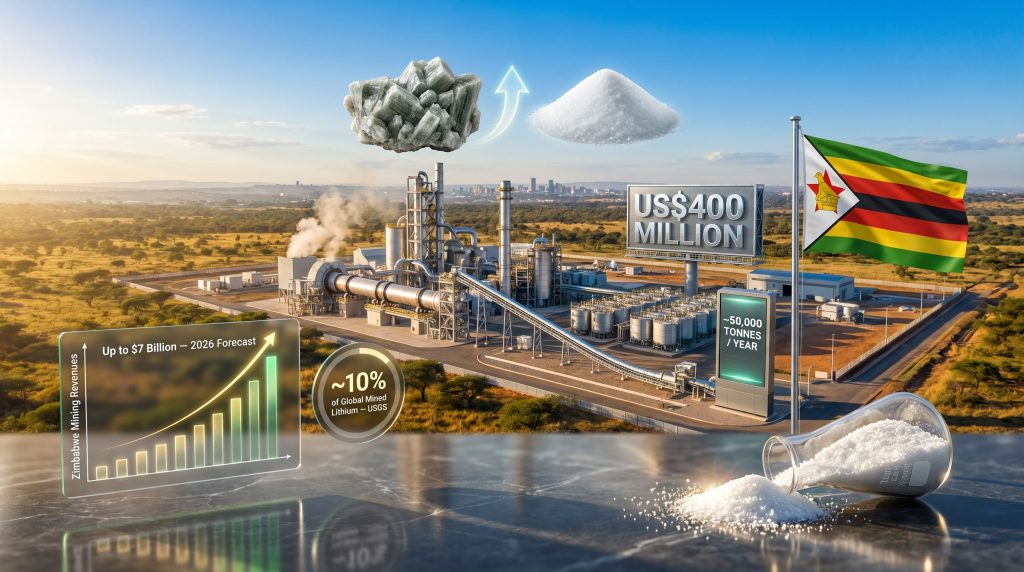
Zimbabwe's lithium story has unfolded with remarkable speed. From a country that barely registered in global lithium production statistics before 2020, the nation now accounts for approximately 10% of global mined lithium output according to the most recent US Geological Survey data. This rapid ascent was driven almost entirely by Chinese capital flowing into the country's pegmatite-hosted spodumene deposits, particularly concentrated in the Harare region and the broader Midlands lithium belt.
The geology underpinning this boom is noteworthy. Zimbabwe's lithium deposits are hosted in hard-rock pegmatite formations, which typically yield spodumene concentrate with lithium oxide content ranging from around 1.0% to 1.8%. While these grades are broadly comparable to Australia's world-class operations at Greenbushes and Pilgangoora, Zimbabwe's deposits have the added advantage of relatively shallow mineralisation in many areas, reducing initial capital requirements for early-stage extraction. Spodumene extraction processes, furthermore, are well understood at an industrial scale, lowering the technical barriers to rapid production ramp-up.
However, possessing significant geological endowment has historically been insufficient to translate mineral wealth into sustained national prosperity. The critical variable is where in the processing chain a country sits. Zimbabwe's government recognised this calculus explicitly, implementing mandatory value-addition requirements that oblige foreign mining investors to establish local processing capacity within a defined timeframe of receiving operational licences. This policy framework has fundamentally reshaped the investment environment, converting what might otherwise have been straightforward extractive arrangements into agreements requiring substantial downstream industrial commitment.
The Revenue Equation Driving Policy
The financial stakes of this transformation are substantial. Zimbabwe's Mines Minister Polite Kambamura confirmed in June 2026 that the country's mining sector is projected to generate up to $7 billion in total revenues during 2026, with approximately $2 billion already recorded across the first half of the year alone. Gold remains the largest single contributor to these figures, but lithium's growing share reflects both expanded production volumes and the gradual shift toward higher-value refined outputs.
The government's explicit goal is straightforward: retain a greater portion of the economic value generated by Zimbabwe's mineral endowment by ensuring that refining and processing activity occurs within the country rather than abroad.
The price differential between raw spodumene concentrate and refined lithium carbonate illustrates precisely why this matters. Battery-grade lithium carbonate commands significantly higher prices per tonne than unprocessed concentrate, meaning that even modest processing capacity translates into materially improved export revenue per unit of mineral extracted. This arithmetic underlies the entire policy architecture Zimbabwe has built around its lithium sector.
What the Huayou Arcadia Project Actually Involves
Project Structure and Location
The Huayou lithium carbonate plant in Zimbabwe is situated within the Arcadia lithium mining area located near Harare, operated through Huayou's Zimbabwean subsidiary Prospect Lithium Zimbabwe (PLZ). The complex is structured as an integrated operation, combining a lithium concentrate processing plant with an adjacent sulphate processing unit, designed to progressively move material up the value chain on a single operational footprint.
Understanding the product hierarchy is essential for evaluating the facility's strategic significance:
| Product Stage | Description | Indicative Value Position |
|---|---|---|
| Spodumene Concentrate | Raw mined feedstock (5-6% Li₂O) | Baseline |
| Lithium Sulphate | Intermediate refined compound | Mid-tier |
| Lithium Carbonate | Battery-grade refined chemical | High value |
| Lithium Hydroxide | Premium cathode-grade chemical | Highest value |
According to Reuters, the Arcadia sulphate plant is designed to produce approximately 50,000 tonnes of lithium sulphate annually, with the facility reaching partial commissioning following kiln ignition, marking the transition from construction into early-stage production. The total investment committed to the Arcadia complex is estimated at approximately US$400 million, making it one of the most capital-intensive battery minerals processing projects on the African continent.
The Carbonate vs. Sulphate Distinction
A technically important clarification surrounds the precise output designation of the facility. Mines Minister Kambamura publicly confirmed that the plant would produce lithium carbonate, a higher-value product. Independent technical reporting on the Arcadia complex has primarily described the initial operational phase as targeting lithium sulphate production, which serves as an intermediate product requiring further refinement to reach carbonate specification.
This distinction carries real economic weight. The conversion from sulphate to carbonate requires additional process steps including carbonation reactions conducted at temperatures between 80-95°C with careful pH management to achieve the crystal structure and purity levels exceeding 99.5% required for battery applications. The carbonate designation in ministerial communications likely reflects either a planned downstream conversion stage to be added as the project matures, or the aspirational product-grade target articulated at the policy level for public communication purposes.
The energy requirements of this processing chain are also non-trivial. Producing one tonne of lithium carbonate requires approximately 10-12 megawatt-hours of electricity, creating meaningful exposure to Zimbabwe's historically unreliable power grid infrastructure. Water consumption presents a further operational consideration, with the carbonation process requiring substantial volumes per tonne of product. These infrastructure dependencies represent real constraints on the pace at which full-scale carbonate production can be realised. The broader lithium extraction technologies being deployed globally, however, continue to improve energy efficiency, which may consequently reduce these constraints over time.
China's Midstream Calculus in Zimbabwe
Why Processing Capacity Is the Strategic Prize
Zhejiang Huayou Cobalt is not simply a mining company that happens to be operating in Africa. It is one of China's most strategically positioned vertically integrated battery materials companies, with operations spanning cobalt, lithium, and nickel processing across multiple continents. China currently controls an estimated 60-70% of global lithium refining capacity, a structural advantage that gives Chinese companies downstream leverage regardless of where raw materials are physically extracted.
The Zimbabwe investment extends this midstream dominance geographically through a model that simultaneously satisfies host-government localisation demands and preserves Chinese control over refined product flows. This dual-benefit structure is worth examining carefully:
- Feedstock security: By owning both the mine and the processing plant, Huayou locks in a captive supply of refined lithium compounds for its downstream battery materials operations.
- Regulatory compliance: The processing investment satisfies Zimbabwe's mandatory value-addition requirements, protecting the operating licence from regulatory challenge.
- Geopolitical positioning: Embedding industrial operations within the local economy reduces the sovereign risk associated with purely extractive foreign investment models.
- Competitive exclusion: A $400 million processing facility creates substantial barriers to entry for any competitor seeking to replicate the integrated operation.
Cumulative Chinese investment into Zimbabwe's lithium sector has been reported at approximately $2.8 billion, according to mining.com coverage of China's expanding African battery minerals commitments. This scale of capital deployment represents a comprehensive claim on Zimbabwe's lithium future, not merely a passive investment in individual projects.
The Vertical Integration Imperative
What is less commonly appreciated about Chinese battery mineral strategy is that control of midstream processing is arguably more valuable than control of the mine itself. Mining operations are geographically fixed and subject to host-country regulatory risk. Processing plants, by contrast, can in theory source feedstock from multiple geographic origins, providing operational flexibility and supply chain resilience.
By establishing processing capacity within Zimbabwe, Huayou creates an asset that could theoretically accept spodumene from other regional sources as they develop, amplifying the strategic value of the initial investment beyond the Arcadia deposit alone. Understanding the global lithium market dynamics, furthermore, makes clear why securing this midstream position is so strategically compelling for Chinese operators.
Economic Implications for Zimbabwe's Development Trajectory
What Value Addition Actually Means in Practice
The concept of value addition is frequently invoked in resource policy discussions but rarely examined with precision. In Zimbabwe's context, the distinction between exporting spodumene concentrate versus lithium carbonate represents a meaningful per-tonne revenue uplift, the scale of which fluctuates significantly with prevailing market conditions.
Mines Minister Kambamura was direct in acknowledging that the full revenue benefit of this transition depends on the recovery of global lithium prices, which declined sharply from their extraordinary 2022-2023 peaks when lithium carbonate prices briefly exceeded $80,000 per tonne before retreating dramatically. This candid acknowledgement of price dependency reflects a sophisticated understanding of commodity market dynamics and represents a more honest policy framing than is typically offered by governments promoting resource processing initiatives.
The projected revenue metrics for Zimbabwe's mining sector put the stakes in sharp relief:
| Metric | Figure | Source |
|---|---|---|
| Zimbabwe's share of global mined lithium | ~10% | US Geological Survey |
| Projected total mining revenues, 2026 | Up to $7 billion | Ministerial statement, June 2026 |
| First-half 2026 mining revenues | ~$2 billion | Ministerial statement, June 2026 |
| Huayou Arcadia complex investment | ~US$400 million | Independent reporting estimate |
| Lithium sulphate plant annual capacity | ~50,000 tonnes/year | Huayou project specifications |
| Total Chinese lithium investment in Zimbabwe | ~US$2.8 billion | Mining.com reporting |
Structural Challenges That Cannot Be Ignored
Acknowledging the transformative potential of the Huayou investment does not require ignoring its material risks. Three structural challenges deserve serious analytical attention:
1. Power infrastructure constraints. Energy-intensive lithium processing requires reliable, high-volume electricity supply. Zimbabwe's grid has historically struggled with outages and capacity shortfalls. The Arcadia facility's 10-12 megawatt-hours per tonne processing requirement creates chronic exposure to this vulnerability unless dedicated power solutions are installed.
2. Technical workforce development. Operating sophisticated chemical processing plants demands a level of technical expertise that takes years to develop within a local workforce. The transition from mining labour to industrial chemistry operations represents a genuine capability gap that requires sustained investment in training and knowledge transfer.
3. Commodity price dependency. The entire value-addition logic is predicated on lithium carbonate prices recovering sufficiently to make the processing premium economically meaningful. In a prolonged low-price environment, the economics of processing can deteriorate to the point where simplified operations become preferable, potentially undermining the policy rationale. The ongoing lithium market downturn consequently remains one of the most significant variables in the Arcadia project's long-term success.
Africa's Continental Processing Ambitions: Zimbabwe in Regional Context
A Blueprint Being Replicated Across Southern Africa
The significance of the Huayou lithium carbonate plant in Zimbabwe extends beyond its direct economic impact. The facility has become a reference point for what is increasingly emerging as a regional resource governance model, combining mandatory processing requirements with state equity participation to maximise domestic economic capture from foreign mining investment.
Mozambique, which holds the world's third-largest graphite reserves, recently enacted legislation requiring 15% state equity stakes and mandatory local processing for mining operations within its territory. The structural parallels with Zimbabwe's approach are unmistakable, suggesting these two neighbouring nations are converging on a similar framework for managing foreign investment in strategic minerals.
This regulatory convergence across southern Africa carries important implications for global battery supply chain planners:
- Processing operations cannot simply be located wherever costs are lowest; they must increasingly satisfy host-country localisation requirements.
- State equity participation means national governments become co-investors in processing facilities, aligning their interests with operational success while also introducing governance complexity.
- The emergence of multiple African processing jurisdictions introduces new geographic diversification options for battery supply chains, but also new geopolitical variables.
The Western Supply Chain Diversification Dimension
A frequently overlooked dimension of the Zimbabwe processing story involves the growing tension between Chinese control of African lithium processing and Western battery supply chain security objectives. Policy frameworks such as the US Inflation Reduction Act and the EU Critical Raw Materials Act have created incentives for battery manufacturers to source refined materials from non-Chinese-controlled supply chains.
This creates a structural tension at the heart of Zimbabwe's lithium strategy. Processing facilities controlled by Chinese companies satisfy the government's value-addition requirements, but the refined product flows predominantly back into Chinese-controlled battery supply chains. According to CNBC Africa, if Zimbabwe's objective is to maximise long-term economic benefit, diversifying the investor base for processing operations to include Western-aligned capital could unlock access to battery market premiums unavailable through Chinese offtake arrangements alone.
The Arcadia project may ultimately serve as both a template for what African lithium processing can achieve and a test case for whether resource-rich nations can balance Chinese investment with the geopolitical imperatives increasingly shaping global battery supply chains.
The next major ASX story will hit our subscribers first
Three Scenarios for Zimbabwe's Lithium Processing Future
Scenario 1: Full Commissioning and Industrial Consolidation
The base case trajectory sees the Arcadia sulphate plant achieve full 50,000-tonne annual capacity, followed by the commissioning of downstream carbonate conversion capability. Lithium prices recover gradually from post-peak lows, validating the processing premium thesis. Zimbabwe's mining sector revenues approach the $7 billion government target, with lithium processing emerging as a primary contributor alongside gold.
The Huayou model attracts replication from other Chinese-invested lithium operations across the country, accelerating the broader processing infrastructure build-out.
Scenario 2: Price Suppression Delays Value Realisation
A prolonged period of weakness in global lithium carbonate and sulphate prices, driven by oversupply from expanded Australian and South American production, constrains the revenue uplift from processing investment. Huayou prioritises operational stability over accelerated production ramp-up, delaying the transition to full carbonate output. Zimbabwe's revenue targets are partially met through gold export growth, while lithium processing delivers more modest returns than the policy framework anticipated. The political pressure for processing investment remains intact but the economic vindication is deferred.
Scenario 3: Geopolitical Realignment Creates New Market Opportunities
Western battery supply chain diversification initiatives generate premium pricing for lithium compounds sourced outside Chinese-controlled processing networks. Zimbabwe consequently faces pressure from international battery manufacturers to create non-Chinese processing pathways to unlock these premiums. New investment bids from Western and Japanese processors emerge, competing with Huayou's established position. The result is a more complex but potentially more economically advantageous processing landscape for Zimbabwe, though one requiring significant political navigation.
Key Investment and Market Considerations
Investors tracking the battery metals investment landscape should note several dynamics the Zimbabwe processing story illuminates:
- Processing premiums are real but volatile. The economic case for lithium carbonate over concentrate depends entirely on the spread between product prices, which compresses dramatically during oversupply periods.
- Chinese midstream strategy is durable. The $2.8 billion committed to Zimbabwe's lithium sector reflects long-term industrial planning rather than speculative capital, suggesting Chinese presence in the country's processing sector will persist through price cycles.
- African resource nationalism is structural, not cyclical. Zimbabwe and Mozambique's mandatory processing policies reflect a permanent shift in host-country expectations, not a temporary negotiating posture. Mining investors must now price this reality into project economics from the outset.
- Infrastructure risk is consistently underpriced. Energy and water constraints in sub-Saharan African processing operations have repeatedly proven more challenging and expensive to resolve than initial project assessments suggest.
- The carbonate-hydroxide distinction matters for end-market positioning. Lithium carbonate serves iron phosphate cathode chemistries dominant in Chinese EVs, while lithium hydroxide serves high-nickel chemistries prevalent in Western and Korean battery manufacturing. Zimbabwe's processing trajectory toward carbonate aligns it more closely with Chinese battery demand than with Western markets.
Disclaimer: This article is intended for informational purposes only and does not constitute financial or investment advice. Lithium price projections, revenue forecasts, and production capacity estimates involve inherent uncertainty and should not be relied upon as the basis for investment decisions. Readers should conduct independent due diligence before making any investment-related decisions.
Want to Stay Ahead of the Next Major Battery Minerals Discovery?
Discovery Alert's proprietary Discovery IQ model scans ASX announcements in real time, instantly identifying significant mineral discoveries across lithium, battery metals, and over 30 other commodities — transforming complex data into actionable investment insights before the broader market reacts. Explore historic discovery returns on the Discovery Alert discoveries page and begin your 14-day free trial to position yourself ahead of the market.