
June 14, 2026
When Commercial Contracts Become the Weakest Link in Metal Supply Chains
Primary aluminium supply chains are routinely stress-tested against physical disruptions: energy shortfalls, logistics bottlenecks, extreme weather, and geopolitical instability affecting shipping corridors. Risk management frameworks built around these variables have become increasingly sophisticated over the past decade. Yet the Hydro force majeure as Qatalum terminates agreement exposes a category of risk that receives comparatively little attention in procurement planning.
This is the failure of commercial governance within joint ventures, specifically the breakdown of marketing and distribution agreements between co-equal partners at major smelting operations. Understanding this vulnerability is now critical for buyers, traders, and supply chain professionals across the sector.
The situation unfolding at the Qatalum aluminium smelter in Qatar during 2026 exposes precisely this weakness. When Norsk Hydro declared a second force majeure within a three-month window at the same facility, the cause was not another energy crisis or physical production failure. It was the termination of a commercial agreement by Qatalum itself, the joint venture that Hydro co-owns with Qatar Aluminum Manufacturing Company (QAMCO).
Understanding why this matters, and what it signals for the broader Gulf aluminium supply ecosystem, requires examining both the mechanics of the disruption and the structural features of the joint venture that allowed it to occur. Furthermore, it raises important questions about how marketing risk management frameworks need to evolve across the mining and metals sector.
When big ASX news breaks, our subscribers know first
The Qatalum Joint Venture: Scale, Structure, and Strategic Significance
Before unpacking the sequence of events, it is worth establishing the commercial weight of what is at stake. Qatalum is not a peripheral facility within the global aluminium supply network.
| Metric | Detail |
|---|---|
| Annual Production Capacity | 648,000 tonnes |
| Ownership Structure | 50/50 split between Norsk Hydro and QAMCO |
| Regional Classification | One of the largest primary aluminium smelters in the Middle East |
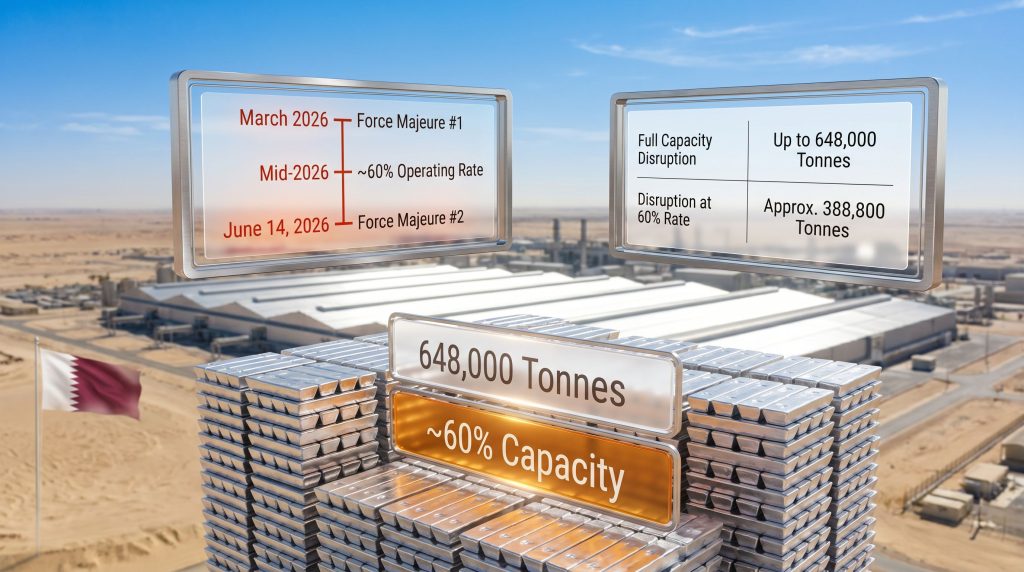
| Current Operating Rate | Approximately 60% of nameplate capacity (as of mid-2026) |
| Active Force Majeure Declarations | Two, issued in March 2026 and June 2026 respectively |
At full operating capacity, Qatalum contributes a material volume to the Gulf region's primary aluminium output. The Gulf itself occupies a structurally important position in global aluminium production, with facilities in Qatar, Bahrain (Alba), and the UAE (EGA) collectively representing a significant share of internationally traded primary metal.
These operations are underpinned by access to comparatively low-cost natural gas, which provides a substantial energy cost advantage relative to smelters in Europe, North America, and parts of Asia. For context on how major producers are navigating this environment, it is worth examining how aluminium industry leaders are adapting their strategies across global operations.
Market Context: At 60% of its 648,000-tonne annual capacity, Qatalum's current effective production rate sits at approximately 388,800 tonnes per year. If Hydro cannot access or distribute this metal under existing commercial terms, the volume gap in its customer network becomes a structural problem rather than a temporary operational hiccup.
A Ninety-Day Sequence: How Two Force Majeures Accumulated at One Facility
Phase One: Energy Infrastructure Disruption (March 2026)
The first disruption originated from the operational side of the business. Regional geopolitical instability in the Middle East interrupted natural gas supply pipelines serving Qatalum's smelting operations in March 2026. Aluminium smelting is an extraordinarily energy-intensive process, with electrolytic reduction cells requiring uninterrupted power and heat inputs to maintain molten metal at the temperatures necessary for continuous production.
When gas supply becomes unreliable, smelter operators face a difficult choice: attempt to maintain output at risk of equipment damage, or initiate a controlled production curtailment. Hydro chose the latter, implementing a managed shutdown that brought production to a sustainable level given constrained energy availability.
Following stabilisation of gas supply conditions, output was maintained at approximately 60% of nameplate capacity. Critically, the original force majeure notice issued in March 2026 was never formally withdrawn. It remained legally active as a standing declaration.
Phase Two: Commercial Agreement Termination (June 2026)
Three months later, an entirely different category of disruption emerged. Qatalum formally notified Hydro that it was terminating the long-standing marketing and sales agreement, the contractual arrangement under which Hydro distributes and commercialises Qatalum's aluminium output to downstream customers.
Simultaneously, Qatalum indicated it would not deliver metal under the terms of the relevant existing agreements. Hydro formally contested the termination, requesting that Qatalum withdraw the notice. Qatalum declined. This triggered Hydro's second force majeure declaration within a three-month period, this time grounded not in physical production failure but in commercial contract breakdown.
The timeline below illustrates how these two distinct risk events compounded:
March 2026      → Natural gas supply interrupted → Controlled smelter shutdown
                → Force Majeure Declaration #1 issued (never withdrawn)
                → Production stabilises at ~60% of 648,000-tonne capacity

June 14, 2026   → Qatalum terminates marketing and sales agreement with Hydro
                → Hydro disputes the termination; requests withdrawal
                → Qatalum refuses and confirms non-delivery under existing agreements
                → Force Majeure Declaration #2 issued (commercial/contractual basis)
What makes this sequence structurally significant is that the two force majeures are legally independent of each other. The resolution of one does not automatically resolve the other. Even if natural gas supply were to be fully restored and Qatalum's production returned to 100% of capacity, Hydro's inability to market and distribute that metal under the terminated agreement would remain an active commercial obstruction.
According to Norsk Hydro's official announcement, Qatalum has initiated a controlled shutdown of aluminium production, further compounding the supply uncertainty for buyers across the region.
Defining the Difference: Physical vs. Commercial Force Majeure
The distinction between these two force majeure categories is not widely understood outside specialist legal and procurement circles, yet it carries enormous practical implications for aluminium buyers.
Physical or operational force majeure arises when an extraordinary event prevents a party from physically performing its contractual obligations. Classic examples include:
- Natural disasters disrupting production infrastructure
- Armed conflict affecting logistics corridors or energy supply
- Extreme weather events damaging processing facilities
- Utility failures preventing smelter operations
Commercial or contractual force majeure is more nuanced. It arises when the legal or commercial framework underpinning a party's ability to perform is itself removed or rendered inoperative. In Hydro's case, the termination of its marketing agreement by Qatalum means Hydro no longer has the contractual authority to access, move, or sell the metal it was previously distributing, regardless of whether the physical metal exists and is being produced.
Critical Distinction for Buyers: A company can invoke commercial force majeure even when physical production is running normally. This means that standard contingency planning, which typically focuses on production outages, smelter damage, or logistics disruption, may be entirely insufficient when the disruption is rooted in contract termination between joint venture partners.
Quantifying the Supply Risk: Volume Scenarios Under Dual Disruption
The following table maps the range of potential supply volume impacts across different disruption scenarios:
| Scenario | Annual Volume Affected | Key Driver |
|---|---|---|
| Full capacity disruption (worst case) | Up to 648,000 tonnes | Complete loss of production and distribution |
| Current operating rate disruption | Approximately 388,800 tonnes | 60% capacity with no marketing access |
| Commercial disruption only (marketing terminated) | Variable | Depends on alternative distribution arrangements |
| Negotiated resolution with revised terms | Minimal | Agreement reinstated or restructured |
For context, 648,000 tonnes represents a volume roughly comparable to the annual primary aluminium consumption of a mid-sized European economy. While the global aluminium market measures annual production in the tens of millions of tonnes, concentrated supply disruptions at single nodes of this magnitude still carry the potential to create regional price dislocations, particularly in markets where Qatalum metal has historically flowed.
Consequently, the broader aluminium market impact from this disruption compounds an already complex trading environment shaped by tariff pressures and shifting supply dynamics.
The Joint Venture Governance Problem: Why 50/50 Structures Are Inherently Fragile
The Qatalum situation illustrates a rarely discussed vulnerability in the architecture of major industrial joint ventures. In a 50/50 ownership structure, neither partner holds majority control. Strategic and commercial decisions require either explicit mutual agreement or pre-established contractual frameworks that allocate specific functions to specific partners.
Hydro's role as the marketing and distribution agent for Qatalum's output was one such pre-established function. Under this arrangement, QAMCO and Hydro each contributed different capabilities to the venture: QAMCO provided access to Qatar's low-cost energy infrastructure and sovereign backing, while Hydro contributed its established commercial network, downstream customer relationships, and aluminium marketing expertise.
When Qatalum chose to terminate this arrangement, it did not merely cancel a contract. It effectively removed one partner's core functional contribution to the joint venture's value chain. The reasons behind this decision have not been publicly disclosed by either Qatalum or QAMCO, which itself is an analytically significant data point.
Possible Drivers Behind the Termination (Unconfirmed)
Without official explanation, market observers are left to assess the situation through structural inference. Several scenarios are plausible, though none has been confirmed:
- Strategic realignment toward direct-to-market distribution, reflecting a broader Qatar industrial policy shift toward capturing more value domestically from aluminium production
- Pricing or margin disputes between partners over the commercial terms under which Hydro distributes Qatalum metal to its customer network
- Force majeure-linked contractual disagreements, where Qatalum's interpretation of its obligations under the existing marketing agreement differs materially from Hydro's
- Renegotiation leverage, where the termination notice functions as a negotiating instrument rather than a final decision, designed to force a renegotiation of commercial terms
Speculative but Structurally Informed: Qatar's broader economic strategy, as reflected in the activities of sovereign-linked industrial entities, has increasingly emphasised moving up the value chain and capturing distribution and marketing margins domestically. If QAMCO's strategic objectives have evolved beyond the original terms under which the Qatalum joint venture was established, a commercial renegotiation of the marketing arrangement would align with that directional shift. This remains speculative until either party provides formal clarification.
The next major ASX story will hit our subscribers first
Strategic Implications for Norsk Hydro
Immediate Exposure: Revenue, Customer Commitments, and Reputational Risk
Hydro's commercial exposure here is multi-dimensional. As the marketing agent for Qatalum's output, the company was responsible for channelling a significant aluminium volume through its downstream customer network. The loss of access to this volume, even temporarily, creates a delivery gap that Hydro's own primary production may not be able to bridge at short notice.
Hydro has acknowledged that it may be unable to fulfil contractual delivery obligations to customers even if physical operating conditions at Qatalum improve. The company has also confirmed it cannot estimate the duration of the disruption or its full impact on its supply chain, a disclosure that is both legally prudent and commercially concerning for buyers who rely on Hydro as a primary metal source.
This is not an isolated development. Geomechanics.io's analysis of Hydro's second force majeure highlights how the Hydro force majeure as Qatalum terminates agreement represents a growing class of supply risk that mine planners and downstream buyers must now account for in their operational models.
Scenario Analysis: Three Resolution Pathways
| Scenario | Description | Likely Market Impact |
|---|---|---|
| Negotiated Resolution | Partners reach revised commercial terms; marketing function reinstated | Supply risk contained; market stabilises relatively quickly |
| Arbitration and Prolonged Dispute | Legal proceedings extend uncertainty across 12 to 24+ months | Sustained disruption; buyers accelerate alternative sourcing |
| Structural Realignment | QAMCO assumes direct marketing control or engages alternative agent | Permanent change to Qatalum's commercial model; Hydro loses volume permanently |
What Procurement Teams and Aluminium Buyers Should Do Now
The concurrent existence of two active force majeure declarations, one operational and one commercial, at a facility of Qatalum's scale creates a set of contingency planning challenges that standard supply chain protocols may not adequately address. Buyers reliant on Hydro as a primary aluminium source should consider the following steps:
- Audit existing contract language to understand how force majeure clauses are defined and whether commercial contract termination by a third party is explicitly covered
- Activate secondary sourcing protocols and assess lead times for alternative suppliers across Gulf, European, and Australian production sources
- Engage Hydro's account management teams directly to understand the specific volume and timing implications for their contracted deliveries
- Review hedging positions on aluminium forward contracts, given that commercial disruptions of this nature can persist longer than operational outages
- Monitor arbitration and legal proceedings if Hydro pursues formal dispute resolution, as outcomes will directly affect the duration and scale of the supply disruption
Gulf Aluminium Supply: A More Complex Risk Profile Than Previously Modelled
The Gulf region's aluminium production base, which includes Qatalum in Qatar, Alba in Bahrain, and EGA in the UAE, has historically been assessed through a relatively narrow risk lens focused on energy input costs and geopolitical disruptions to logistics and shipping. The Qatalum situation introduces a third risk dimension that has received inadequate attention in most supply chain risk frameworks: joint venture partner relationship failure.
This is not a risk that is visible in standard operational data. Smelter utilisation rates, energy cost benchmarks, and logistics disruption indices do not capture the quality of the commercial relationship between co-equal joint venture partners. Yet as the Qatalum case demonstrates, the breakdown of that relationship can render physical production commercially inaccessible, creating a supply disruption that is structurally distinct from, and potentially more durable than, a conventional operational outage.
In addition, broader shifts across the sector, including changes to aluminum and alumina markets driven by Alcoa's strategic repositioning, and the repowering of aluminium operations by Rio Tinto in Gladstone, suggest a global aluminium industry in the midst of significant structural reconfiguration.
Aluminium market participants, including buyers, traders, and investors with exposure to Gulf production, should incorporate partner relationship risk as a standalone variable in supply chain risk models going forward. Key indicators worth monitoring include partner governance disclosures, changes in marketing and distribution arrangements, and signals of strategic realignment from sovereign-linked industrial entities within the Gulf region.
This article is intended for informational purposes only and does not constitute financial, legal, or procurement advice. Forward-looking assessments, scenario projections, and speculative analysis reflect the author's interpretation of publicly available information and should not be relied upon as predictions of future outcomes. Readers should conduct independent due diligence and consult qualified advisors before making commercial or investment decisions based on the information presented here.
Want To Stay Ahead of Major ASX Mineral Discoveries Before the Broader Market?
Discovery Alert's proprietary Discovery IQ model delivers real-time alerts on significant ASX mineral discoveries, transforming complex data across 30+ commodities into clear, actionable insights for traders and investors at every experience level — begin your 14-day free trial today and explore historic discovery returns on Discovery Alert's discoveries page.