Modern steelmaking operations face unprecedented pressure to reduce carbon emissions while maintaining production efficiency and cost competitiveness. The fundamental chemistry of iron extraction has remained largely unchanged for centuries, relying on carbon-based reduction processes that generate substantial CO₂ emissions. However, emerging hydrogen-based ironmaking technology presents a revolutionary pathway that could transform the entire steel production ecosystem through clean chemical reduction processes, offering significant decarbonisation benefits for industrial operations.
The thermodynamic principles underlying hydrogen reduction offer compelling advantages over traditional blast furnace operations. While conventional steelmaking depends on coke-derived carbon monoxide for iron ore reduction, hydrogen-based systems utilise pure H₂ gas to extract metallic iron, producing only water vapour as a direct byproduct. This fundamental shift in reduction chemistry eliminates the primary source of process-related carbon emissions at the molecular level.
Understanding the Chemical Foundation of Green Steel Production
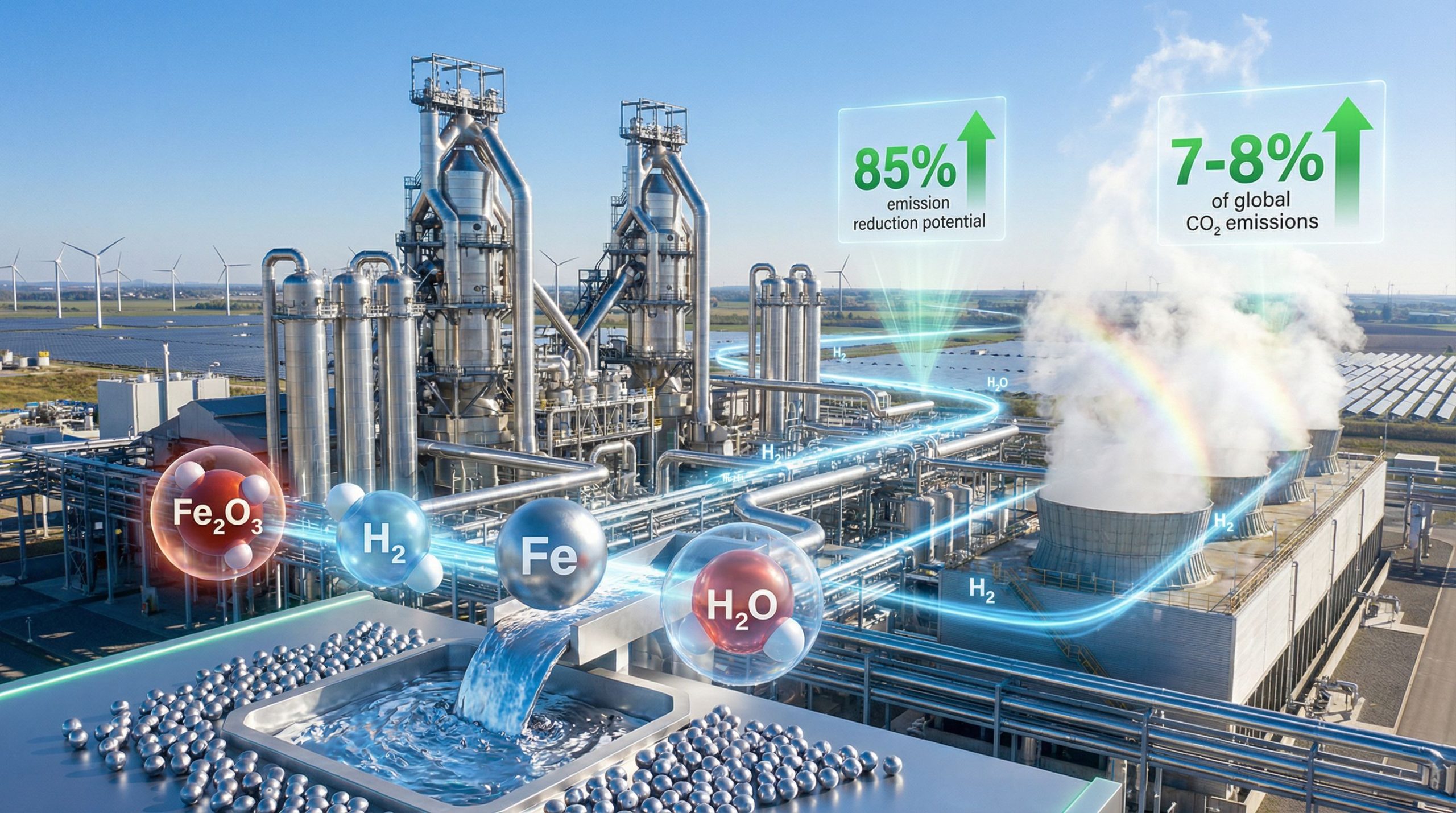
The core reaction driving hydrogen-based ironmaking technology involves the direct reduction of iron oxides using hydrogen gas: Fe₂O₃ + 3H₂ → 2Fe + 3H₂O. This process operates through entirely different thermodynamic pathways compared to traditional carbon reduction, where iron oxides react with carbon monoxide (Fe₂O₃ + 3CO → 2Fe + 3CO₂).
Key reaction characteristics include:
• Temperature requirements: 400-900°C depending on specific furnace design
• Pressure conditions: Atmospheric to moderate pressures (1-5 bar)
• Reaction kinetics: Faster reduction rates at optimal temperature ranges
• Energy balance: Lower radiation losses due to reduced operating temperatures
The thermodynamic driving force remains consistent across both reduction methods, but hydrogen-based systems demonstrate superior energy efficiency at lower temperature ranges. Research from metallurgical institutions indicates that hydrogen reduction becomes thermodynamically favourable at temperatures significantly below those required for carbon-based processes, reducing overall energy consumption through decreased heat losses.
Energy consumption comparisons reveal:
| Process Route | Energy per Tonne (MWh) | Operating Temperature (°C) | Direct CO₂ Emissions |
|---|---|---|---|
| Blast Furnace-BOF | 11-13 | 1200-1600 | 2.0-2.3 tonnes CO₂ |
| Hydrogen-DRI-EAF | 9-10 | 400-900 | 0.1-0.2 tonnes CO₂ |
| Coal-based DRI | 10-12 | 800-1100 | 1.5-1.8 tonnes CO₂ |
The water vapour byproduct from hydrogen reduction presents both opportunities and challenges for process optimisation. Unlike CO₂, water vapour can be condensed and potentially recycled within the system, creating closed-loop water management opportunities that enhance overall process efficiency.
The Environmental Case for Hydrogen Reduction
Global steel production accounts for approximately 8% of total anthropogenic CO₂ emissions, representing roughly 2.6 billion tonnes of CO₂ annually according to International Energy Agency assessments. The steel industry's carbon intensity creates both regulatory pressure and market demand for cleaner production technologies.
Emission reduction potential varies by hydrogen source:
• Green hydrogen (renewable electricity): 95% emission reduction
• Blue hydrogen (natural gas + CCS): 70-85% emission reduction
• Grey hydrogen (steam methane reforming): 10-20% emission reduction
Current hydrogen production remains heavily dependent on steam methane reforming, which generates approximately 10 tonnes of CO₂ per tonne of hydrogen produced. This dependency underscores the critical importance of scaling renewable electricity-powered electrolysis infrastructure alongside hydrogen-based ironmaking facilities.
The Institute for Energy Economics and Financial Analysis notes that green ironmaking project development across Australia is progressing slower than required for the nation to lead emerging global green iron markets. This development gap represents both a challenge and an opportunity for strategic positioning in clean steel value chains.
Lifecycle assessment considerations include:
• Scope 1 emissions: Direct furnace operations (near-zero with green hydrogen)
• Scope 2 emissions: Electricity consumption for hydrogen production and processing
• Scope 3 emissions: Transportation, ore preparation, and downstream processing
How Does Hydrogen Direct Reduction Technology Actually Work?
Shaft Furnace Operations and Process Engineering
Hydrogen-based shaft furnaces represent the most mature technology pathway for commercial-scale hydrogen-based ironmaking technology implementation. These systems operate through counter-current gas flow principles, where ascending hydrogen-rich gas contacts descending iron ore pellets or lumps, creating optimal mass and heat transfer conditions.
Critical operational parameters include:
• Gas utilisation efficiency: 85-95% hydrogen utilisation in optimised designs
• Temperature profiles: Precisely controlled zones from 400°C (top) to 900°C (bottom)
• Residence time: 4-8 hours depending on ore characteristics and reduction targets
• Gas composition control: H₂/H₂O ratios maintained for optimal reduction kinetics
Iron ore preparation requirements differ significantly from blast furnace specifications. Hydrogen-DRI systems demonstrate higher compatibility with pelletised ore and certain fine concentrates, potentially eliminating expensive sintering operations required for traditional steelmaking.
Process control systems must monitor:
• Real-time gas composition analysis (H₂, H₂O, CO, CO₂)
• Temperature distribution throughout the furnace height
• Material flow rates and burden distribution
• Pressure differentials across furnace sections
Recent industrial developments include Fortescue's collaboration with Taiyuan Iron and Steel Group to trial plasma-enhanced hydrogen reduction technology. Their pilot facility targets 5,000 tonnes per annum of molten iron production, testing compatibility between Pilbara iron ores and advanced hydrogen metallurgy processes.
Alternative Hydrogen Reduction Pathways
Beyond traditional shaft furnace designs, several emerging technologies offer distinct advantages for specific applications and feedstock characteristics. Furthermore, these innovation trends are driving significant advances in metallurgical processing capabilities.
Plasma-enhanced reduction technology represents a particularly promising development pathway. Fortescue's partnership with TISCO focuses on hydrogen-based plasma systems that generate localised temperatures exceeding 5,000K, creating highly reactive environments that accelerate iron oxide reduction while maintaining lower overall furnace temperatures.
Key advantages of plasma technology include:
• Elimination of sintering and pelletising requirements
• Compatibility with lower-grade iron ore concentrates
• More compact facility footprint compared to conventional shaft furnaces
• Enhanced energy efficiency through targeted heating
Fluidised bed reactor (FBR) configurations offer alternative pathways for processing fine ore materials. These systems provide superior heat transfer efficiency and enable continuous feeding of concentrate materials without agglomeration requirements.
Flash ironmaking processes utilise rapid heating techniques that dramatically reduce residence time compared to conventional direct reduction. These systems enable continuous processing of fine concentrates while maintaining high reduction efficiency and product quality.
Technology comparison matrix:
| Technology Type | Feedstock Compatibility | Energy Intensity | Capital Cost | Development Stage |
|---|---|---|---|---|
| Shaft Furnace-DRI | Pellets, lumps | Moderate | Medium | Commercial |
| Plasma-Enhanced | Concentrates, pellets | High | High | Pilot |
| Fluidised Bed | Fine concentrates | Moderate-High | Medium-High | Demonstration |
| Flash Reduction | Ultra-fine concentrates | High | High | Research |
What Are the Major Technical Challenges Facing Hydrogen Ironmaking?
Hydrogen Supply Chain Infrastructure Requirements
The scalability of hydrogen-based ironmaking technology depends fundamentally on developing robust hydrogen supply chain infrastructure. Current global hydrogen production totals approximately 120 million tonnes annually, with green hydrogen representing only 0.1% of dedicated hydrogen output.
Industrial-scale hydrogen requirements are substantial:
• Typical 1 million tpa DRI facility: 50-70 kg H₂ per tonne of iron
• Annual hydrogen demand: 50,000-70,000 tonnes
• Renewable electricity requirement: 500-800 MW continuous capacity
• Electrolyser capacity needed: 300-500 MW installed
Storage and transportation challenges include:
• High-pressure gaseous storage: 200-700 bar compression requirements
• Liquid hydrogen storage: Cryogenic systems at -253°C
• Pipeline infrastructure: Specialised materials for hydrogen compatibility
• Parasitic energy losses: 15-30% additional energy for compression/liquefaction
Global electrolyser capacity additions reached approximately 5 GW in 2023, with projections targeting 20+ GW by 2030. However, this scaling trajectory remains insufficient to support widespread adoption of hydrogen-based ironmaking technology without accelerated deployment.
Integration with renewable energy systems requires:
• Grid stability measures for intermittent renewable generation
• Energy storage systems for continuous hydrogen production
• Power purchase agreements for long-term electricity supply
• Backup systems for maintaining continuous steel production
Metallurgical Quality and Process Optimisation
Direct reduced iron (DRI) quality specifications determine compatibility with downstream electric arc furnace (EAF) operations. Premium hydrogen-DRI typically requires greater than 65% metallic iron content and less than 5% oxygen content for optimal EAF performance.
Quality advantages of hydrogen-DRI include:
• Superior metallurgical properties compared to coal-based DRI
• Lower gangue content reducing EAF slag volumes
• Improved reducibility for re-melting operations
• Consistent chemical composition enabling predictable EAF performance
Hydrogen embrittlement concerns require careful metallurgical management, particularly in high-strength steel applications. Mitigation strategies include controlled thermal processing and optimised alloy chemistry to prevent hydrogen-induced cracking.
EAF integration modifications include:
• Specialised charging practices for DRI materials
• Electrode management protocols adapted for DRI melting
• Slag chemistry optimisation for efficient impurity removal
• Energy management systems for variable DRI charging rates
Quality assurance protocols specific to hydrogen-based production:
• Real-time chemical analysis during reduction processes
• Microstructural characterisation of finished products
• Hydrogen content measurement in final steel grades
• Long-term storage stability assessment for DRI materials
Energy Intensity and Economic Viability Analysis
Current electrolyser technology operates at 50-65 kWh per kilogram of hydrogen produced, establishing the primary energy cost driver for hydrogen-based ironmaking technology. Advanced electrolyser designs target efficiency improvements reaching 45-50 kWh per kg H₂ by 2030.
Economic breakeven analysis indicates:
• Hydrogen price threshold: $1.50-2.00 per kg for cost competitiveness
• Renewable electricity cost: <$30-40 per MWh required
• Carbon pricing impact: $50-100 per tonne CO₂ improves relative economics
• Capital payback period: 8-12 years for plant conversion projects
The Australian Federal Government announced a $1 billion green iron investment fund to support facility development and supply chain establishment for domestic green iron manufacturing. This funding represents recognition of the strategic importance and financial requirements for hydrogen-based ironmaking technology deployment.
Capital expenditure requirements vary by pathway:
| Project Type | Capex per Tonne Capacity | Total Project Cost (1M tpa) | Development Timeline |
|---|---|---|---|
| Greenfield H2-DRI | $1,000-1,200 | $1.0-1.2 billion | 4-6 years |
| BF Conversion | $800-1,000 | $800M-1.0 billion | 3-5 years |
| Integrated H2-EAF | $1,200-1,500 | $1.2-1.5 billion | 5-7 years |
Operating expense breakdowns include:
• Hydrogen procurement: 40-50% of variable costs
• Electricity consumption: 25-30% of variable costs
• Iron ore and materials: 15-20% of variable costs
• Labour and maintenance: 10-15% of variable costs
Which Companies and Projects Are Leading Hydrogen Steel Development?
European Industrial Initiatives
HYBRIT (Hydrogen Breakthrough Ironmaking Technology) represents Europe's most advanced hydrogen steel development program. The Swedish consortium, comprising SSAB, LKAB, and Vattenfall, operates demonstration facilities in Luleå targeting commercial deployment in the mid-2030s.
HYBRIT project specifications:
• Technology pathway: Hydrogen-based DRI coupled with EAF melting
• Demonstration capacity: 1.3 million tonnes annually when fully operational
• Hydrogen supply: Renewable electricity-powered electrolysis
• Commercial timeline: First commercial facilities by 2035
ArcelorMittal Hamburg facility represents a major European conversion initiative, focusing on hydrogen-DRI integration within existing steel complex infrastructure. The multi-phase development strategy targets initial hydrogen-based operations by the late 2020s.
According to World Steel Association data, the technical feasibility of hydrogen-based iron and steelmaking is well-established, with commercial deployment dependent primarily on economic factors and infrastructure development.
ThyssenKrupp's Duisburg direct reduction plant planning indicates potential annual CO₂ savings of 3.5 million tonnes when fully converted to hydrogen-based operations. This facility represents one of Europe's largest single decarbonisation projects in heavy industry.
European policy support mechanisms include:
• EU Emissions Trading System providing carbon price signals
• Carbon Border Adjustment Mechanism protecting clean steel competitiveness
• Innovation Fund grants supporting demonstration projects
• State aid frameworks enabling national government support
Asian Market Developments
Nippon Steel's hydrogen reduction development includes plans for a demonstration shaft furnace facility targeting 2025 operational startup. The project focuses on integrating hydrogen-based reduction with existing steelmaking infrastructure.
China's steel industry hydrogen adoption occurs within the context of national carbon neutrality commitments by 2060. Major steel producers are evaluating hydrogen pathways alongside other decarbonisation technologies.
Key Chinese developments include:
• China Baowu's hydrogen metallurgy research programs
• HBIS Group's demonstration projects in hydrogen-based reduction
• Ansteel's pilot facility development for hydrogen steelmaking
Recent developments include BHP and POSCO's partnership to advance hydrogen-based ironmaking technology, focusing on reducing carbon emissions across the steel value chain.
Australia-India Green Steel Partnership collaboration focuses on developing complementary hydrogen steel value chains, leveraging Australian renewable energy resources and Indian manufacturing capabilities.
Australian Mining Sector Integration
Fortescue's Christmas Creek project represents a $75 million demonstration facility in the Pilbara, targeting high-purity green metal production using renewable energy for hydrogen-based reduction and smelting technologies.
Rio Tinto's ZESTY technology investment involves more than $35 million commitment supporting construction of Calix's Zero Emissions Steel Technology demonstration plant in Western Australia. The ZESTY process demonstrates compatibility with lower-grade iron ore abundant in the Pilbara region.
Key advantages of Pilbara integration:
• High-quality iron ore reserves with optimal chemistry for hydrogen reduction
• Abundant renewable energy potential from solar and wind resources
• Existing mining infrastructure enabling rapid project development
• Strategic export positioning for Asian steel markets
Fortescue-TISCO collaboration specifics:
• Pilot capacity: 5,000 tonnes per annum molten iron production
• Technology focus: Hydrogen-based plasma-enhanced metallurgy
• Ore compatibility: Testing with Fortescue Pilbara ores
• Operational targets: Continuous production reliability assessment
These developments align with Australia's broader strategy for green iron production, positioning the nation as a leader in clean metallurgy technologies.
How Will Hydrogen Ironmaking Scale Commercially by 2030?
Production Capacity Projections and Market Timeline
International Energy Agency forecasts indicate 44% of global iron production could utilise hydrogen-based routes by 2050, representing a fundamental transformation in steelmaking technology. However, commercial deployment by 2030 will likely remain limited to demonstration and early commercial facilities.
Current pilot project capacities versus commercial requirements:
• Existing pilots: 1,000-10,000 tpa typical capacity
• Commercial facilities: 1-3 million tpa minimum economic scale
• Scaling factor: 100-1000x capacity increase required
• Development timeline: 5-8 years from pilot to commercial operation
Global investment pipeline analysis reveals:
| Region | Number of Projects | Total Capacity (Mtpa) | Investment Value | Target Timeline |
|—|—|—|—|
| Europe | 15 | 25-30 | €50-70 billion | 2028-2035 |
| Asia-Pacific | 12 | 20-25 | $40-60 billion | 2030-2040 |
| North America | 8 | 10-15 | $25-35 billion | 2032-2042 |
| Middle East | 5 | 8-12 | $20-30 billion | 2035-2045 |
Technology readiness levels vary significantly:
• Hydrogen-DRI shaft furnaces: TRL 7-8 (demonstration to commercial)
• Plasma-enhanced reduction: TRL 4-5 (laboratory to pilot scale)
• Fluidised bed systems: TRL 5-6 (pilot to demonstration scale)
• Integrated hydrogen-EAF: TRL 6-7 (demonstration scale)
Supply Chain Infrastructure Development
Green hydrogen production facility requirements for supporting commercial-scale hydrogen-based ironmaking technology include massive electrolyser deployments and renewable energy integration. These infrastructure needs support broader energy transition security objectives across industrial sectors.
Infrastructure development needs:
• Electrolyser manufacturing capacity: 50-100 GW annually by 2030
• Renewable energy deployment: 200-400 GW dedicated to hydrogen production
• Hydrogen storage facilities: 10-20 million tonnes capacity globally
• Pipeline infrastructure: 10,000-20,000 km of new hydrogen pipelines
Transportation and storage network expansion requires substantial capital investment and technological standardisation across multiple jurisdictions.
Regional infrastructure development priorities:
• Europe: Pipeline network integration and renewable energy expansion
• Australia: Export-oriented hydrogen production and shipping infrastructure
• Middle East: Large-scale solar-powered electrolysis facilities
• North America: Industrial cluster development and grid integration
What Are the Economic Drivers and Barriers for Adoption?
Cost Structure Analysis for Hydrogen Steel Production
Hydrogen procurement represents the primary variable cost in hydrogen-based ironmaking technology, typically accounting for 40-50% of total operating expenses. Current hydrogen pricing varies dramatically by production method and regional electricity costs.
Hydrogen cost breakdown by production pathway:
• Grey hydrogen (SMR): $1.00-2.00 per kg
• Blue hydrogen (SMR + CCS): $1.50-3.00 per kg
• Green hydrogen (electrolysis): $3.00-8.00 per kg (current)
• Future green hydrogen: $1.50-3.00 per kg (2030 target)
Capital expenditure considerations differ significantly between greenfield development and existing facility conversion. Plant retrofitting typically requires $800-1,200 per tonne of annual DRI capacity, while greenfield facilities may reach $1,200-1,500 per tonne including complete infrastructure development.
Operating expense comparisons with traditional methods:
| Cost Component | Hydrogen-DRI-EAF | Blast Furnace-BOF | Coal-DRI-EAF |
|---|---|---|---|
| Raw materials | $350-450/tonne | $400-500/tonne | $380-480/tonne |
| Energy costs | $200-350/tonne | $150-250/tonne | $180-280/tonne |
| Labour | $80-120/tonne | $100-150/tonne | $90-130/tonne |
| Maintenance | $60-100/tonne | $80-120/tonne | $70-110/tonne |
| Total Cash Cost | $690-1,020/tonne | $730-1,020/tonne | $720-1,000/tonne |
Policy Support and Carbon Pricing Impact
Government funding initiatives worldwide recognise the strategic importance of establishing domestic green steel capabilities. Australia's $1 billion green iron investment fund represents one of the largest national commitments to hydrogen-based ironmaking technology development.
Carbon pricing mechanisms create critical economic incentives:
• EU ETS carbon prices: €70-90 per tonne CO₂ (2024 levels)
• California carbon allowances: $25-35 per tonne CO₂
• China national ETS: $5-15 per tonne CO₂
• UK carbon support prices: £25-35 per tonne CO₂
Carbon credit implications for hydrogen steel production:
• Emission reduction certificates: $10-50 per tonne CO₂ avoided
• Renewable energy certificates: $5-25 per MWh
• Clean steel premiums: $50-150 per tonne finished steel
International trade implications include:
• Carbon border adjustments protecting clean steel competitiveness
• Green procurement policies by major steel consumers
• Supply chain transparency requirements driving demand
• Export credit facilities supporting clean technology deployment
How Does Hydrogen Technology Compare to Other Decarbonisation Methods?
Technology Pathway Comparison Matrix
Hydrogen-DRI-EAF route competes with several alternative decarbonisation technologies, each offering distinct advantages and limitations depending on regional circumstances and resource availability. This competition is shaping Australia's approach to green metals leadership globally.
Carbon capture and storage (CCS) integration with traditional blast furnaces can reduce emissions by 60-80% while maintaining existing production infrastructure. However, CCS requires substantial additional capital investment and permanent CO₂ storage infrastructure.
Scrap-based electric arc furnace recycling provides immediate emission reductions but faces fundamental limitations in available scrap supply. Global scrap availability can support approximately 30-35% of total steel demand, requiring primary steelmaking for the remainder.
Biomass and alternative reductant feasibility varies significantly by regional resource availability and competing uses for biomass materials.
Comprehensive technology comparison:
| Technology Pathway | Emission Reduction | Capital Requirements | Resource Constraints | Technology Readiness |
|---|---|---|---|---|
| Hydrogen-DRI-EAF | 85-95% | High | Green hydrogen supply | Medium-High |
| BF-BOF + CCS | 60-80% | Medium-High | CO₂ storage capacity | Medium |
| Scrap-EAF | 70-80% | Low-Medium | Scrap availability | High |
| Biomass-DRI | 70-90% | Medium | Sustainable biomass | Low-Medium |
| Electrolytic iron | 95%+ | Very High | Renewable electricity | Low |
Regional Suitability Factors
Renewable energy availability and grid integration capabilities determine regional competitiveness for hydrogen-based ironmaking technology deployment. Australia's Pilbara region offers exceptional solar and wind resources capable of supporting large-scale green hydrogen production.
Iron ore quality requirements favour regions with high-grade ore suitable for hydrogen reduction. Pilbara iron ore demonstrates excellent compatibility with hydrogen-based reduction processes, offering potential competitive advantages.
Regional suitability assessment:
• Australia: Excellent renewable resources, high-quality ore, established infrastructure
• Middle East: Abundant solar resources, access to markets, capital availability
• Northern Europe: Strong policy support, technical expertise, market demand
• North America: Mixed renewable resources, established steel markets, policy uncertainty
Existing industrial infrastructure and workforce considerations significantly impact development timelines and costs. Regions with established steel and mining industries can leverage existing capabilities and human resources.
What Are the Long-Term Implications for the Global Steel Industry?
Market Structure Transformation Scenarios
Competitive advantages for early adopters include preferential access to green steel market premiums and establishment of technological expertise before widespread deployment. First-mover advantages may persist for 10-15 years as hydrogen-based ironmaking technology matures.
Geographic shifts in steel production centres could favour regions with abundant renewable energy resources and supportive policy frameworks. Traditional steel-producing regions may face competitive pressure without adequate decarbonisation strategies.
Impact on iron ore mining operations includes potential changes in ore specification requirements and processing methods. Hydrogen-compatible ore characteristics may command price premiums in future markets.
Market transformation scenarios:
• Scenario 1 – Accelerated adoption: 30-40% hydrogen-based production by 2040
• Scenario 2 – Moderate deployment: 15-25% hydrogen-based production by 2040
• Scenario 3 – Delayed transition: 5-15% hydrogen-based production by 2040
Technology Evolution and Innovation Pipeline
Next-generation hydrogen reduction processes under development include advanced plasma technologies, microwave-assisted reduction, and electrochemical iron production methods. These emerging technologies may further improve efficiency and reduce costs beyond current hydrogen-DRI capabilities.
Integration with circular economy principles enables closed-loop material flows and waste minimisation. Hydrogen-based systems can potentially integrate with recycling processes and alternative material streams.
Innovation pipeline developments:
• Advanced electrolyser technologies: Solid oxide and advanced alkaline systems
• Process intensification: Compact reactor designs and integrated systems
• Digital optimisation: AI-driven process control and predictive maintenance
• Material science advances: Hydrogen-resistant materials and catalyst development
Potential for fully automated hydrogen steel facilities includes integration of robotic systems, autonomous material handling, and remote operation capabilities. These developments could reduce labour requirements and improve operational consistency.
Frequently Asked Questions About Hydrogen Ironmaking
Technical Implementation Questions
What types of iron ore work best with hydrogen reduction?
High-grade iron ore with low silica and alumina content demonstrates optimal performance in hydrogen reduction systems. Pilbara iron ore, with typical iron content of 60-65%, provides excellent compatibility. Pelletised ore often performs better than lump ore due to improved gas permeability and consistent size distribution.
How much renewable energy is needed for commercial-scale operations?
A typical 1 million tonne per annum DRI facility requires 500-800 MW of continuous renewable electricity supply for green hydrogen production. This translates to approximately 1,500-2,500 MW of installed solar capacity or 800-1,200 MW of wind capacity accounting for capacity factors and energy storage requirements.
What are the main safety considerations for hydrogen steel plants?
Hydrogen safety protocols require specialised detection systems, ventilation design, and emergency response procedures. Key considerations include hydrogen leak detection, explosion prevention through proper facility design, materials compatibility with hydrogen exposure, and worker training for hydrogen handling procedures.
Economic and Timeline Questions
When will hydrogen steel become cost-competitive?
Cost competitiveness depends primarily on green hydrogen pricing reaching $1.50-2.00 per kilogram and carbon pricing mechanisms that reflect the environmental value of clean steel. Industry projections suggest potential competitiveness in select markets by 2028-2030, with broader competitiveness by 2035-2040.
Which regions are best positioned for early adoption?
Regions combining excellent renewable energy resources, high-quality iron ore, existing industrial infrastructure, and supportive policy frameworks demonstrate optimal positioning. Australia's Pilbara, Middle East solar-rich countries, and Northern European regions with strong carbon pricing mechanisms lead early adoption potential.
How will this technology affect steel prices globally?
Initial hydrogen steel production will likely command premium pricing of $50-150 per tonne above conventional steel. As production scales and technology costs decrease, price premiums should diminish. Long-term effects depend on carbon pricing evolution and consumer willingness to pay for low-carbon steel products.
The Future of Zero-Carbon Steel Production
Key Success Factors for Industry Transformation
Critical milestones for technology maturation include demonstration of reliable commercial-scale operation, achievement of target hydrogen costs below $2.00 per kilogram, and establishment of robust supply chain infrastructure supporting widespread deployment.
Investment requirements and financing mechanisms necessitate innovative approaches combining government support, private capital, and international development financing. Project finance structures must account for long development timelines and technology risks while enabling competitive cost of capital.
Policy frameworks needed to accelerate adoption include:
• Carbon pricing mechanisms that reflect true environmental costs
• Green procurement policies creating demand for clean steel products
• Research and development support for continued technology advancement
• Infrastructure investment in renewable energy and hydrogen systems
Strategic Implications for Stakeholders
Mining companies must adapt ore specification and processing to optimise compatibility with hydrogen reduction systems. Investment in ore beneficiation and product development can capture value premiums in emerging green steel markets.
Steel producers face conversion strategies and competitive positioning decisions that will determine market position for decades. Early investment in hydrogen-based ironmaking technology capabilities may provide sustained competitive advantages.
Investor risk assessment and opportunity evaluation frameworks must incorporate technology development risks, regulatory evolution, and market transformation timelines. Successful investment strategies require deep understanding of both technical and economic factors driving hydrogen steel deployment.
Note: The information in this analysis includes forward-looking statements and projections that involve inherent uncertainties. Technology development timelines, cost projections, and market adoption rates may vary significantly from current estimates based on technological breakthroughs, policy changes, and market conditions. Investors and stakeholders should conduct independent due diligence and consider multiple scenarios when making strategic decisions.
The transformation of global steel production through hydrogen-based ironmaking technology represents one of the most significant industrial decarbonisation opportunities of this century. While technical and economic challenges remain substantial, the convergence of environmental imperatives, technological advancement, and supportive policy frameworks creates unprecedented momentum toward clean steel production systems.
Ready to Capitalise on the Green Steel Revolution?
The transformation of steel production through hydrogen technology creates significant investment opportunities across mining, energy, and industrial sectors. Discovery Alert's proprietary Discovery IQ model delivers real-time alerts on major ASX mineral discoveries, including companies developing critical materials for the green steel transition. Begin your 30-day free trial today to position yourself ahead of the market as clean technology reshapes global commodity demand.