
June 18, 2026
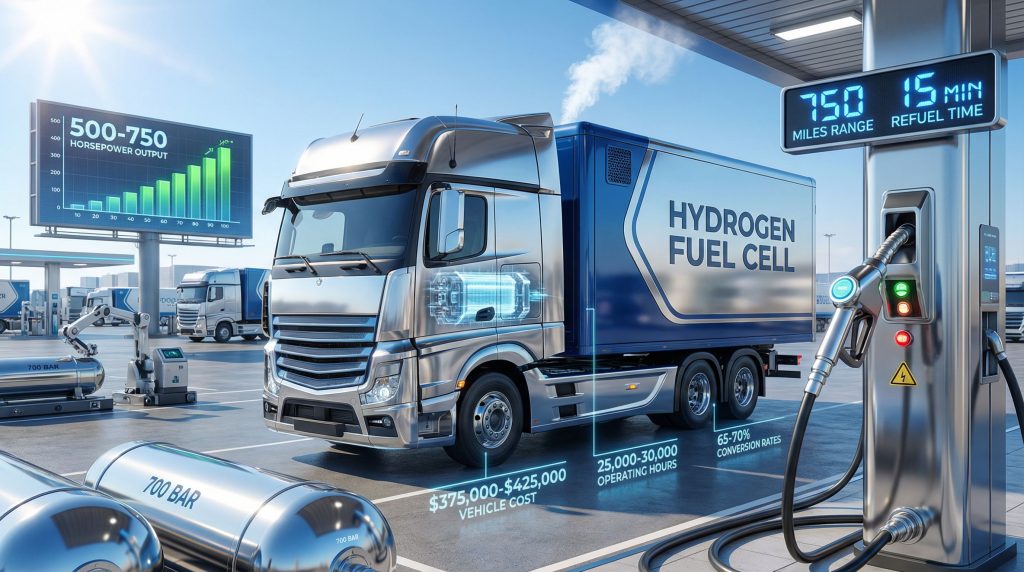
The commercial transportation sector faces unprecedented challenges as operational costs surge and environmental regulations tighten globally. This transformation has created an urgent demand for hydrogen-powered commercial vehicles that can deliver operational efficiency while meeting stringent compliance requirements. Furthermore, the convergence of volatile fuel prices, emission standards, and infrastructure limitations represents one of the most significant technological shifts in commercial transportation since diesel engine introduction.
Fuel Cell Architecture Delivers Superior Heavy-Duty Performance
Hydrogen-powered commercial vehicles utilise two primary technological approaches: fuel cell electric systems and hydrogen combustion engines. Each architecture offers distinct advantages for different operational requirements, with manufacturers increasingly focusing on application-specific optimisation rather than universal solutions.
Fuel cell electric vehicle powertrains generate electricity through electrochemical conversion, producing only water vapour as a byproduct. These systems typically deliver between 500-750 horsepower output while maintaining operational ranges of 450-750 miles per hydrogen fill. The refuelling process completes within 10-15 minutes, providing significant advantages over battery-electric alternatives that require extended charging periods.
Key Performance Metrics for Hydrogen Fuel Cell Systems:
- Power output: 500-750 horsepower for heavy-duty applications
- Operational range: 450-750 miles per refuelling cycle
- Refuelling time: 10-15 minutes versus 8+ hours for battery charging
- Payload maintenance: Equivalent capacity to diesel counterparts
- Cold weather performance: Superior operation in extreme temperatures
Norwegian electrolyser specialist Nel ASA has developed breakthrough pressure-based alkali technology that promises to reduce space requirements by up to 80% while cutting total system costs by 40-60%. This advancement addresses critical infrastructure deployment challenges that have historically limited hydrogen adoption in commercial applications.
Hydrogen Combustion Engines Offer Alternative Pathway
Hydrogen combustion engines represent a more familiar technological approach for fleet operators, utilising modified internal combustion engines optimised for hydrogen fuel compatibility. High Pressure Direct Injection systems enable efficient combustion while maintaining performance specifications comparable to diesel engines.
This approach offers reduced complexity compared to fuel cell powertrains and requires lower initial capital expenditure for fleet conversion. Consequently, manufacturers can leverage existing engine manufacturing capabilities while providing fleet operators with familiar maintenance procedures and operational characteristics.
The technology demonstrates particular promise for applications where fuel cell systems may present operational challenges. For instance, this includes remote locations with limited hydrogen infrastructure or operations requiring extended service intervals between maintenance cycles.
When big ASX news breaks, our subscribers know first
Market Deployment Reveals Application-Specific Adoption Patterns
Commercial vehicle segments show varying adoption rates based on operational requirements, infrastructure availability, and economic considerations. Moreover, long-haul freight operations lead deployment due to range requirements that favour hydrogen's rapid refuelling capabilities over battery-electric alternatives.
| Application Segment | Daily Range Requirements | Current Deployment Status | Primary Advantages |
|---|---|---|---|
| Long-haul freight | 500+ miles | Active pilot programs | Zero downtime refuelling |
| Port operations | 200-300 miles | Demonstration projects | Emissions compliance |
| Urban delivery | 100-200 miles | Early testing phase | Noise reduction benefits |
| Mining transport | Variable routes | Initial adoption | Operational flexibility |
Pure One demonstrates integrated approach advantages through its comprehensive service model. The company supplies zero-emission commercial vehicles powered by electricity or hydrogen while operating hydrogen production facilities and storage infrastructure. This vertical integration addresses compatibility concerns that historically complicated hydrogen adoption for fleet operators.
Partnership agreements with Advanced Manufacturing Queensland for vehicle assembly in Brisbane and marketing rights for the Ford F-150 Lightning in Australia illustrate strategic market positioning. Additionally, agreements with US company Utility Global open American market opportunities, with Pure One supplying fuel cell vehicles while Utility Global provides hydrogen supply infrastructure.
Total Cost of Ownership Analysis Reveals Economic Transition
Current hydrogen-powered commercial vehicle acquisition costs range from $375,000-$425,000 for fuel cell electric models, representing significant premiums over diesel equivalents. However, operational cost structures demonstrate improving economics as hydrogen fuel costs stabilise between $8-12 per kilogram, roughly equivalent to diesel at current pricing levels.
Economic Factors Driving Adoption:
- Initial vehicle cost: $375,000-$425,000 for current FCEV models
- Hydrogen fuel pricing: $8-12 per kilogram (diesel equivalent)
- Maintenance cost reduction: 40-50% lower than diesel systems
- Infrastructure investment: $1-2 million per high-capacity refuelling station
- Government incentives: 30-50% offset for deployment costs
Maintenance cost advantages emerge from simplified powertrain designs with fewer moving parts compared to diesel engines. Fuel cell systems require less frequent service intervals and eliminate traditional maintenance items including oil changes, filter replacements, and exhaust system maintenance.
Daimler Truck's operational experience demonstrates real-world viability. Despite facing freight recession challenges in North America with group-wide sales declining 8% to approximately 422,500 vehicles, the company maintained operational margins of 7.8% while advancing alternative powertrain development.
Infrastructure Development Accelerates Through Public-Private Partnerships
Hydrogen production capacity expansion targets exceed 1,000 MW installations globally as manufacturers scale electrolysis operations to meet anticipated demand. Industrial hydrogen production costs project reduction from current $6 levels to $3 per kilogram by 2030 through technological improvements and economies of scale.
Nel ASA's new production platform demonstrates infrastructure scalability advantages. Standardised container solutions enable rapid installation and prove ideally suited for supplying hydrogen to trucks, ships, and heavy-duty vehicles. The company received EUR 135 million support from the EU Innovation Fund for new production line development, indicating institutional confidence in technology viability.
Furthermore, these energy transition strategies require substantial infrastructure development to support widespread commercial deployment. The shift towards clean commercial transportation mirrors broader electric vehicles transformation across multiple industry sectors.
Regional Hydrogen Clusters Emerge Across Key Markets
Hydrogen production and distribution networks concentrate in regional clusters that connect production facilities to refuelling hubs. California leads North American development through Zero Emission Vehicle mandates and infrastructure investment programmes. European initiatives focus on industrial hydrogen production integration with renewable energy sources.
Infrastructure Requirements for Fleet Operations:
- High-pressure storage systems (350-700 bar) for rapid dispensing
- Automated refuelling protocols reducing driver interaction time
- Fleet-specific refuelling stations with multiple dispensing positions
- Mobile refuelling units serving remote operational areas
- Integration with existing truck stop networks and logistics hubs
Refuelling infrastructure requires 2,000-3,000 square feet of space for hydrogen storage and dispensing equipment, with most existing truck stops having adequate space for integration alongside diesel facilities. This compatibility enables phased infrastructure deployment without requiring entirely new facility development.
Pure One's Australian operations benefit from strategic positioning within existing pipeline infrastructure through Eastern Gas Corporation assets in the Cooper Basin. The Australian grid operator AEMO warns of structural supply gaps starting in 2028 as depleted Bass Strait offshore fields reduce production while gas-fired power plants compensate for coal phase-out.
Regulatory Frameworks Drive Market Transformation
Emissions regulations accelerate hydrogen vehicle adoption through compliance requirements that make alternative powertrains economically attractive. EU CO2 emission standards for heavy-duty vehicles create mandatory targets that traditional diesel engines cannot achieve without significant operational modifications.
Zero Emission Vehicle mandates in California and expanding jurisdictions establish minimum percentages of clean commercial vehicles in fleet operations. These regulations provide predictable demand signals that justify infrastructure investment and vehicle development costs.
Carbon pricing mechanisms increasingly favour hydrogen economics by imposing costs on traditional fossil fuel operations. Low Emission Zone restrictions in urban areas limit diesel vehicle access, creating operational advantages for hydrogen-powered alternatives that maintain unrestricted access privileges.
The decarbonisation benefits extend beyond regulatory compliance to include operational advantages and cost reductions over traditional fossil fuel systems.
Government Procurement Policies Establish Market Foundation
Public sector procurement policies prioritise clean commercial vehicles for government fleet operations, creating stable demand foundations for hydrogen vehicle manufacturers. These programmes often include performance guarantees and maintenance support that reduce private sector adoption risks.
Federal infrastructure funding provides $7.5 billion in the United States specifically for alternative fuel infrastructure development, with significant portions allocated to hydrogen refuelling station construction and equipment subsidies.
European Union hydrogen strategy allocates €470 billion through 2030 for comprehensive hydrogen economy development, including production capacity, distribution networks, and end-use applications across commercial transportation sectors.
Technology Roadmap Indicates Rapid Performance Evolution
Hydrogen commercial vehicle technology development follows aggressive timelines that project significant performance improvements through 2030. Second-generation fuel cell systems entering development demonstrate improved durability and efficiency ratings that address current operational limitations.
Technology Development Timeline:
- 2026: Second-generation fuel cell systems with enhanced durability
- 2027: Hydrogen combustion engines reaching commercial availability
- 2028: Liquid hydrogen storage enabling 1,000+ mile operational ranges
- 2029: Autonomous hydrogen vehicles for dedicated logistics routes
- 2030: Cost parity achievement with diesel commercial vehicle alternatives
Fuel cell system efficiency improvements target 65-70% conversion rates, representing substantial advances over current generation technology. Weight reduction through advanced materials and integrated system designs enables higher payload capacities while maintaining performance specifications.
Modular fuel cell architectures provide scalable power output options that allow fleet operators to optimise vehicle specifications for specific operational requirements. This flexibility addresses diverse commercial applications from urban delivery to long-haul freight transportation.
Predictive Maintenance Systems Optimise Operational Uptime
Vehicle-to-grid capabilities enable hydrogen commercial vehicles to provide energy storage services during periods when vehicles remain stationary. This functionality creates additional revenue opportunities for fleet operators while supporting electrical grid stability during peak demand periods.
Predictive maintenance systems utilise sensor networks and data analytics to optimise service scheduling and prevent unplanned downtime. These systems prove particularly valuable for hydrogen-powered commercial vehicles operating in remote locations where maintenance accessibility presents challenges.
Daimler Truck's TruckCharge initiative demonstrates infrastructure innovation through semi-public charging network development designed to solve chicken-and-egg problems regarding infrastructure availability. This approach combines vehicle deployment with supporting infrastructure to accelerate market adoption.
In addition, renewable energy innovations integrate seamlessly with hydrogen production systems to create sustainable fuel generation cycles. The Volvo Group's hydrogen fuel cells demonstrate industry commitment to comprehensive clean transport solutions.
Investment Landscape Attracts Significant Capital Commitments
Private sector hydrogen investment commitments exceed $300 billion globally for hydrogen projects across production, distribution, and end-use applications. This capital flow indicates institutional confidence in hydrogen technology viability for commercial applications.
Venture capital investment focuses on hydrogen technology startups developing specialised components, software solutions, and infrastructure equipment. These investments target breakthrough technologies that address specific operational challenges in commercial hydrogen deployment.
Investment Opportunities by Market Segment:
- Fuel cell component manufacturing: 25-30% annual growth projections
- Hydrogen production and distribution: Infrastructure development requirements
- Fleet management services: Specialised maintenance and optimisation
- Refueling equipment systems: Automation and safety technologies
- Carbon credit generation: Verified emission reduction programmes
Corporate fleet conversion commitments from major logistics companies provide demand certainty that supports investment decisions. These commitments often include multi-year purchase agreements and infrastructure development partnerships that reduce market risks.
Pure One's recent corporate restructuring illustrates strategic positioning for growth opportunities. Eastern Gas Corporation's independent stock exchange listing at AUD 0.20 per share was significantly oversubscribed, with Pure One shareholders receiving shares in the gas explorer while the parent company focuses on cleantech business development.
The next major ASX story will hit our subscribers first
Operational Safety Standards Exceed Traditional Fuel Systems
Hydrogen safety considerations incorporate multiple redundancy systems including automatic shut-off valves, leak detection sensors, and crash-resistant storage tanks. These safety measures meet stringent standards that exceed those required for diesel fuel systems.
Current fuel cell systems demonstrate 25,000-30,000 operating hours durability, equivalent to 500,000-750,000 miles of commercial vehicle operation before major maintenance requirements. This longevity matches or exceeds diesel engine service intervals while providing superior environmental performance.
Hydrogen systems maintain consistent performance across temperature ranges from -40°F to 120°F, providing operational advantages over battery-electric vehicles in extreme climate conditions. This capability proves essential for commercial operations in diverse geographic regions and seasonal conditions.
However, comprehensive sustainability transformation requires integration of multiple clean technologies alongside hydrogen solutions to achieve optimal operational efficiency.
What are the key performance advantages of hydrogen fuel cells?
Hydrogen fuel cells maintain consistent performance in temperatures ranging from -40°F to 120°F, providing significant operational advantages over battery-electric vehicles in extreme climates. Cold weather operation particularly favours hydrogen systems as battery performance degrades substantially in low temperatures.
How do hydrogen vehicle safety systems compare to traditional fuels?
Hydrogen systems incorporate multiple safety redundancies including automatic shut-off valves, leak detection sensors, and crash-resistant storage tanks meeting stringent safety standards that exceed requirements for diesel fuel systems. Hydrogen dissipates rapidly in atmosphere, reducing fire risks compared to liquid fuels.
Can existing truck stops accommodate hydrogen refuelling infrastructure?
Retrofit installations require 2,000-3,000 square feet of space for hydrogen storage and dispensing equipment, with most truck stops having adequate space for integration alongside existing diesel facilities. This compatibility enables phased infrastructure development without complete facility replacement.
The Australian government's hydrogen vehicle information provides comprehensive guidance for fleet operators considering hydrogen adoption.
What is the expected service life of hydrogen fuel cells in commercial applications?
Current fuel cell systems demonstrate 25,000-30,000 operating hours durability, equivalent to 500,000-750,000 miles of commercial vehicle operation before major maintenance requirements. This service life matches or exceeds traditional diesel engine longevity while providing superior emission performance.
This analysis incorporates technical specifications, market data, and industry developments in hydrogen-powered commercial vehicle deployment across global markets. Investment decisions should consider individual risk tolerance and operational requirements.
Looking to Capitalise on the Hydrogen Transport Revolution?
Discovery Alert's proprietary Discovery IQ model delivers real-time alerts on significant ASX mineral discoveries in critical sectors like lithium, rare earths, and hydrogen technology, instantly empowering subscribers to identify actionable opportunities ahead of the broader market. Begin your 14-day free trial today and secure your market-leading advantage in the clean energy transformation.