
July 22, 2026
The Architecture of a Global Energy Crisis: How Supply Systems Adapt Under Extreme Pressure
Every decade or so, the global energy system faces a pressure test that exposes the true limits of its redundancy. The ongoing disruption affecting the Strait of Hormuz is not merely a regional geopolitical episode — it is a live stress test of the most consequential piece of energy infrastructure on the planet. Understanding how markets have remained functional, and where the hidden vulnerabilities still lie, requires looking well beyond crude oil price trends on any given trading day.
The resilience visible in headline benchmarks masks a far more complex reality beneath the surface. IEA alternative oil supplies supporting markets despite Strait of Hormuz escalation has become the defining energy story of 2026, but that framing risks oversimplifying a situation where multiple stabilisation mechanisms are simultaneously operating near their practical ceilings.
When big ASX news breaks, our subscribers know first
Why the Strait of Hormuz Is Unlike Any Other Chokepoint
The Strait of Hormuz occupies a category of its own in global energy infrastructure. Under normal operating conditions, roughly 20% of all globally traded crude oil moves through this narrow passage daily. No single canal, pipeline, or sea lane comes close to this throughput concentration.
What makes the current disruption structurally different from previous Hormuz tension events is the simultaneous degradation of the Bab el-Mandeb Strait, the Red Sea chokepoint that connects the Gulf of Aden to the Suez Canal corridor. In past crises, the Bab el-Mandeb served as a critical fallback routing option for tankers seeking to avoid Gulf exposure. Furthermore, with renewed threats now targeting that corridor as well, tanker operators face a compressed set of geographic alternatives that was simply not the case in prior episodes.
"The convergence of two threatened major chokepoints simultaneously represents a structurally unprecedented logistics challenge for global energy markets — one that no prior crisis management playbook was fully designed to address."
This dual-chokepoint dynamic is one of the most underappreciated dimensions of the current crisis. Most historical models for supply disruption planning assumed that at least one major alternative routing corridor would remain accessible. Oil market disruptions of this scale have consistently challenged that assumption, and the current episode confirms it no longer holds.
How Pipeline Bypass Infrastructure Is Filling the Gap
The first line of defence against a Hormuz disruption has always been the overland pipeline infrastructure that major Gulf producers constructed specifically to reduce their dependence on the strait. These systems were designed decades ago with exactly this risk scenario in mind.
| Bypass Route | Operator / Country | Current Throughput | Destination Port |
|---|---|---|---|
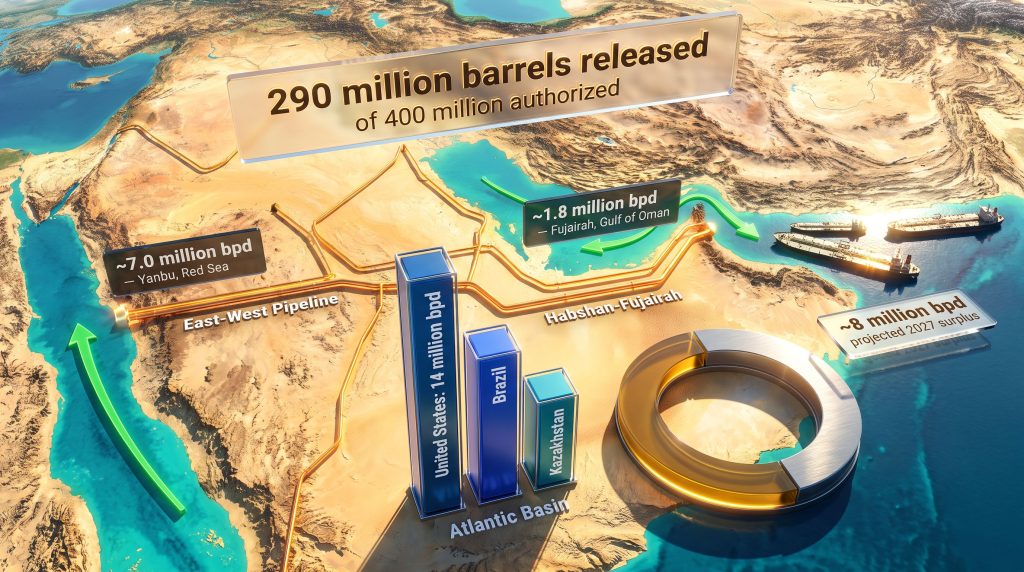
| East-West Pipeline | Saudi Arabia | ~7.0 million bpd | Yanbu (Red Sea) |
| Habshan-Fujairah Pipeline | UAE (ADCOP) | ~1.8 million bpd | Fujairah (Gulf of Oman) |
| Kirkuk-Ceyhan Pipeline | Iraq / Turkey | Resumed operations | Ceyhan (Mediterranean) |
| Combined Spare Bypass Capacity | GCC | ~2.6 million bpd additional headroom | Multiple |
Saudi Arabia's East-West Pipeline, capable of moving approximately 7 million barrels per day to the Red Sea port of Yanbu, represents the single largest bypass asset available. The UAE's Habshan-Fujairah pipeline adds a further 1.8 million bpd of capacity, routing crude directly to a Gulf of Oman terminal that sits entirely outside the strait's geographic risk zone.
Crucially, Iraq's Kirkuk-Ceyhan pipeline — connecting northern Iraqi production fields to the Turkish Mediterranean port of Ceyhan — has resumed operations, adding a supply stream that bypasses both threatened chokepoints entirely. This route is geopolitically significant because it provides Western-facing markets with a Gulf-origin crude stream that is entirely insulated from the Hormuz-Bab el-Mandeb risk corridor.
However, the numbers reveal an important limitation. The combined spare bypass headroom across GCC infrastructure is approximately 2.6 million bpd of additional capacity. During a complete strait closure scenario, this falls dramatically short of replacing full Hormuz transit volumes, which historically move between 17 and 21 million barrels per day during periods of peak Gulf export activity. The pipeline systems soften the impact but cannot substitute for the strait in any full-closure scenario.
The Two-Speed Market: Crude vs. Refined Products
One of the least-discussed dynamics of the current disruption is the divergence between crude benchmarks and refined product markets. While alternative supply mechanisms have maintained reasonably adequate crude flows to major consuming nations, the downstream refining system has not recovered at the same pace.
Refinery throughput, which depends on consistent feedstock delivery, operational scheduling, and logistical predictability, has lagged behind the recovery in raw crude deliveries. The practical result is that diesel and gasoline markets remain structurally tighter than crude benchmarks suggest — a two-speed market where pump prices at forecourts in consuming nations stay elevated even as headline Brent or WTI prices may appear to stabilise.
"For energy consumers and policymakers focused only on crude futures as a proxy for energy market health, this divergence creates a misleading sense of stability that the refined product supply chain does not yet support."
The Emergency Reserve Mechanism: Scale, Mechanics, and Limits
The International Energy Agency's coordinated emergency response, announced on March 11, 2026, represents the largest collective strategic petroleum reserve release in the organisation's history. Understanding how this mechanism actually works is essential to appreciating both its effectiveness and its inherent limitations. The IEA's Middle East energy assessments provide important context for how geopolitical risks are factored into these emergency decisions.
How a Coordinated SPR Release Operates
-
Authorisation Phase: IEA member governments collectively assess the market shortfall and authorise a defined total release volume across the member nation group.
-
Drawdown Phase: Each participating country's national strategic petroleum reserve operator begins physical drawdown from storage facilities, typically large salt caverns, hard rock caverns, or purpose-built tank farms.
-
Cargo Scheduling Phase: Released volumes are allocated to commercial buyers through tender processes or direct government-to-government arrangements, with tanker scheduling initiated concurrently.
-
Market Entry Phase: Physical barrels reach commercial supply chains. The typical lag between authorisation and market delivery runs 2 to 6 weeks, depending on storage location and destination port.
-
Replenishment Planning: Governments begin planning for eventual reserve rebuilding. This future demand signal influences oil forward curves, as markets price in the anticipated buying programme.
| Reserve Metric | Volume |
|---|---|
| Total IEA-authorised emergency release | ~400 million barrels |
| Already released into market (as of July 2026) | ~290 million barrels |
| Remaining government-controlled emergency stocks globally | >1 billion barrels |
| Estimated daily supply contribution from releases | ~2.5 to 3.0 million bpd |
With approximately 290 million of the 400 million authorised barrels already delivered to market, the coordinated release buffer is approaching its authorised ceiling. While more than 1 billion barrels of government-controlled emergency stocks remain available globally beyond the current authorisation, accessing those additional reserves requires fresh political coordination across member governments — a process that carries its own lead time and uncertainty.
"Emergency reserves function as a finite bridge, not a permanent supply alternative. They are engineered to buy time for markets to adjust and for geopolitical situations to evolve — not to substitute indefinitely for the world's most critical transit corridor."
Atlantic Basin Producers and the Non-OPEC+ Supply Response
Beyond emergency reserves and bypass infrastructure, a third major stabilising force has been the surge in production and exports from Atlantic Basin producers operating entirely outside the Gulf supply ecosystem. An oil price shock of this magnitude has consequently accelerated production decisions among non-Gulf producers seeking to fill the void.
- United States: Domestic crude production reached a record 14 million barrels per day in April 2026, with incremental export volumes redirected toward Asian markets via longer routing around the Cape of Good Hope.
- Brazil: Recorded its third consecutive production record during this period, adding meaningfully to Atlantic Basin export volumes.
- Venezuela: Despite persistent infrastructure constraints, contributed additional export volumes to the global supply pool.
- Kazakhstan: Increased export flows through alternative routing, adding to non-Gulf supply availability.
Collectively, Atlantic Basin producers added approximately 3.5 million bpd of incremental export volumes since February 2026, partially compensating for reduced Gulf throughput. This is a remarkable achievement in a short timeframe, though it comes with cost implications: longer voyage distances translate into higher freight rates, larger tanker fleet utilisation demands, and increased per-barrel delivered costs for importing nations.
China's Demand Contraction as an Unintentional Market Stabiliser
Perhaps the least-discussed variable in the current market balance is the role of reduced Chinese crude import demand. A contraction in Chinese purchasing volumes has effectively lowered the total volume that alternative supply mechanisms need to replace. This demand-side cushion has provided indirect relief to an already stretched global supply logistics network.
This dynamic illustrates an important and often overlooked principle in commodity market analysis: demand-side contractions can function as passive stabilisers during acute supply-side crises, reducing the pressure on alternative supply mechanisms that might otherwise be overwhelmed. Whether China's reduced import activity reflects economic slowdown, strategic inventory drawdown decisions, or deliberate purchasing deferrals remains a subject of ongoing debate among energy analysts.
Natural Gas and LNG: The 30% Problem
The crisis has not been limited to crude oil markets. Natural gas supply chains have faced parallel disruption, with Gulf gas flows interrupted alongside crude. The global LNG supply response has been substantial but incomplete.
Increased LNG export volumes from the United States and Canada have replaced approximately 70% of lost Gulf natural gas supplies — an impressive offset given the logistical complexity of redirecting LNG cargo flows globally. However, the remaining 30% gap represents a structural market tightness that carries particular seasonal risk. In addition, the natural gas price outlook for the coming months suggests further volatility if this gap is not adequately addressed before winter.
The Winter Vulnerability Scenario
European gas storage replenishment programmes are currently proceeding, but at elevated cost as competition for available LNG cargoes intensifies. The critical risk window is the Northern Hemisphere winter heating season, which typically drives peak gas demand from October through February.
"If Strait of Hormuz disruptions persist through Q3 2026 without meaningful restoration of Gulf gas flows, European storage injection rates could fall short of winter adequacy targets. The consequence would be elevated LNG spot prices, intensified industrial demand rationing, and heightened energy cost-of-living pressures across price-sensitive European economies."
This scenario is not a certainty, but it represents a non-trivial tail risk that markets may be underpricing given current focus on crude supply dynamics.
The next major ASX story will hit our subscribers first
The 2027 Surplus Projection: What It Assumes and Why It May Not Materialise
The IEA's forward outlook includes a projection for a global oil supply surplus of approximately 8 million bpd in 2027. This figure has attracted considerable attention, but its underlying assumptions deserve careful scrutiny before it is interpreted as evidence that the crisis will self-resolve.
| Market Metric | Current Status (July 2026) |
|---|---|
| June supply recovery vs. pre-war levels | Still 9.4 million bpd below pre-conflict baseline |
| Emergency reserve buffer remaining | >1 billion barrels in government-controlled stocks |
| LNG supply offset of lost Gulf gas | ~70% replacement achieved |
| Projected 2027 surplus (if Hormuz normalises) | ~8 million bpd |
The surplus projection rests on three primary supply assumptions:
- Global supply expanding by an estimated 7.5 million bpd year-on-year
- Demand growth of only 2 million bpd, reflecting slowing economic momentum in major consuming regions
- Meaningful restoration of Strait of Hormuz transit flows as the foundational enabling condition
The June 2026 interim ceasefire period demonstrated just how rapidly supply can recover when the strait partially reopened: global oil supply rose by 4.1 million bpd in a single month. This snapback capacity is encouraging, but it also underscores how much hinges on the strait's operational status. As of July 2026, supply volumes remain approximately 9.4 million bpd below pre-conflict baselines, despite all the alternative mechanisms operating simultaneously.
Escalating US-Iran tensions in July 2026 have introduced material downside risk to this outlook. A renewed full closure scenario would invalidate the primary assumption underpinning the entire 2027 surplus projection, effectively resetting the supply recovery clock. Fresh Strait of Hormuz attacks have consequently deepened global oil security fears, as the IEA chief has noted publicly.
Five Structural Vulnerabilities That Current Stability Is Obscuring
Understanding the genuine risk profile of the current situation requires looking past the apparent stability of crude benchmarks. Five structural vulnerabilities remain unresolved beneath the surface.
-
Emergency Reserve Exhaustion: With 290 million of 400 million authorised barrels already released, the coordinated IEA buffer is nearing its ceiling. Continued drawdown at current rates without strait normalisation will require fresh political authorisation for additional releases.
-
Refined Product Market Lag: Crude supply resilience has not translated into equivalent recovery in diesel and gasoline markets. Refinery throughput constraints are maintaining elevated product prices independent of crude benchmark movements.
-
Bab el-Mandeb Secondary Degradation: Renewed threats to this Red Sea corridor are progressively eliminating the geographic fallback option that was absorbing significant tanker rerouting pressure. Each incremental restriction on this route compresses the options available to cargo operators.
-
LNG Seasonal Tightness: The unresolved 30% gap in Gulf gas replacement via LNG creates a time-sensitive seasonal vulnerability that amplifies as Northern Hemisphere winter approaches.
-
Geopolitical Escalation Tail Risk: The partial supply recovery achieved during the June ceasefire window remains reversible. Further deterioration in US-Iran relations could rapidly unwind the progress made during that period.
"IEA Executive Director Fatih Birol has explicitly warned against treating current crude price stability as confirmation that the crisis has passed. The mechanisms currently holding markets together are each operating near their practical limits, and their continued function is conditional on the geopolitical situation not deteriorating further."
Frequently Asked Questions: IEA Emergency Response and Hormuz Market Dynamics
What is the IEA doing to support oil markets during the Strait of Hormuz disruption?
The IEA coordinated the largest emergency strategic petroleum reserve release in the organisation's history, with total authorised volumes reaching approximately 400 million barrels across member nations. As of July 2026, roughly 290 million barrels have been delivered to market, with additional volumes continuing to enter commercial supply chains. The agency is also actively monitoring LNG market developments and advising governments on gas supply adequacy ahead of the European winter heating season.
Can pipeline bypasses replace Strait of Hormuz transit volumes entirely?
No. While the combined bypass infrastructure from Saudi Arabia and the UAE provides substantial capacity, the total additional headroom across GCC pipeline systems is approximately 2.6 million bpd beyond current utilisation levels. This falls well short of compensating for a full strait closure, which would eliminate transit volumes historically ranging from 17 to 21 million barrels per day at peak Gulf export periods.
Why are fuel prices still elevated if crude markets appear stable?
The divergence between crude benchmarks and refined product prices reflects a two-speed recovery dynamic. Refinery throughput has not recovered at the same pace as raw crude deliveries due to logistical disruptions, scheduling uncertainty, and feedstock supply variability. Diesel and gasoline consumers are experiencing this refinery constraint directly at the pump, independent of what headline crude futures indicate.
What happens to European energy supplies if disruptions continue through winter?
Approximately 70% of lost Gulf gas supplies have been offset by increased LNG exports from North America. The remaining 30% shortfall, combined with the requirements of European gas storage injection programmes, creates a scenario where prolonged disruption could produce LNG market tightness, elevated spot gas prices, and potential demand rationing in energy-intensive industrial sectors during peak winter demand periods.
When could global oil supply return to pre-conflict levels?
The June 2026 partial strait reopening demonstrated that supply can recover with impressive speed, adding 4.1 million bpd in a single month. However, IEA alternative oil supplies supporting markets despite Strait of Hormuz escalation can only do so much, as current volumes remain approximately 9.4 million bpd below pre-war baselines. A durable return to pre-conflict supply levels is directly contingent on meaningful and sustained restoration of Strait of Hormuz transit — which the IEA has identified as the single most consequential variable for global energy market stability.
Disclaimer: This article contains forward-looking projections and market forecasts drawn from IEA assessments and publicly available data. Energy market conditions are subject to rapid change, particularly in response to geopolitical developments. Nothing in this article constitutes financial or investment advice. Readers should conduct independent research before making any investment or commercial decisions.
Want to Capitalise on the Commodity Volatility Unleashed by Global Energy Disruptions?
When geopolitical shocks reshape energy and resource markets at speed, Discovery Alert's proprietary Discovery IQ model scans ASX announcements in real time, instantly identifying significant mineral discoveries across more than 30 commodities — ensuring subscribers can act on actionable opportunities before the broader market catches on. Explore historic examples of extraordinary discovery returns and begin your 14-day free trial today to position yourself ahead of the next major market move.