June 3, 2026
The Hidden Architecture of Energy Transition Vulnerability
Most industrial economies frame their energy transition risks in terms of technology readiness, financing gaps, or grid infrastructure. Fewer examine what sits beneath all of these concerns: the mineral supply chains that make decarbonisation physically possible. Without lithium, cobalt, nickel, copper, and graphite flowing reliably into manufacturing systems, no amount of policy ambition translates into actual clean energy capacity. For India, this foundational layer of the energy transition carries a structural fragility that deserves far more analytical attention than it typically receives.
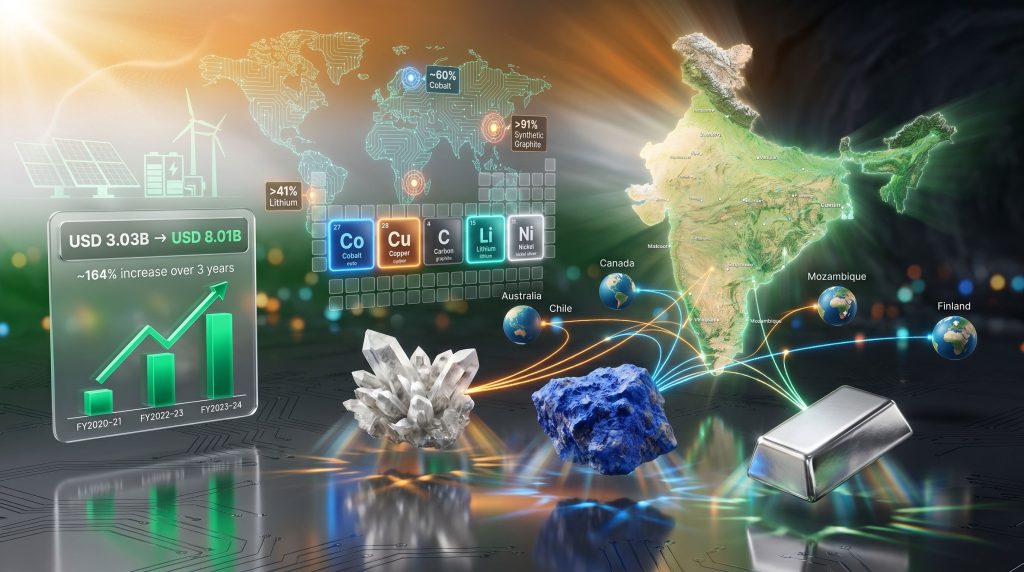
India critical mineral imports diversification has become one of the most consequential strategic challenges facing the country's industrial planners. The numbers tell a sobering story. According to an Institute for Energy Economics and Financial Analysis (IEEFA) briefing note published in April 2026, India's expenditure on critical mineral imports climbed from approximately USD 3.03 billion in FY2020-21 to USD 8.01 billion in FY2023-24, representing growth of roughly 164% across just three fiscal years. This trajectory is not a temporary anomaly driven by commodity price spikes. It reflects the structural acceleration of demand from electric vehicle manufacturing, grid-scale battery storage deployment, and solar panel production scaling simultaneously.
The core vulnerability embedded in this picture is total import dependence. India currently sources 100% of its lithium, cobalt, and nickel requirements from international markets, according to IEEFA. These three minerals are foundational to lithium-ion battery technology, which underpins both the EV ecosystem and stationary energy storage. No commercially viable domestic alternatives exist at the scale required to materially offset imports in the near term, making supply chain architecture a matter of genuine critical minerals and energy security rather than a peripheral logistics consideration.
When big ASX news breaks, our subscribers know first
Understanding the Five Minerals That Actually Drive India's Clean Energy Ambitions
India's government has designated 30 minerals as critical across its industrial policy framework. Within this broader list, five carry direct and disproportionate relevance to the country's renewable energy technology infrastructure: cobalt, copper, graphite, lithium, and nickel. Each performs a distinct and largely non-substitutable function within clean energy systems.
-
Lithium functions as the primary charge carrier within lithium-ion battery cells, essential for both electric vehicles and grid storage applications. It is commercially sourced in two primary compound forms: lithium carbonate, which is more common in older battery chemistries, and lithium oxide or hydroxide, which is gaining adoption in higher-performance formulations.
-
Cobalt improves cathode structural stability and energy density in lithium-ion batteries. It is used at meaningful concentrations in nickel-based cathode chemistries and is technically difficult to eliminate entirely without compromising battery performance or longevity.
-
Nickel increases energy density and enables reduced cobalt content in modern battery chemistries such as NCM and NCA formulations, making it central to next-generation battery cost reduction.
-
Copper serves as the critical electrical conductor across every layer of clean energy infrastructure: motor windings in EVs, battery pack interconnects, power electronics, and grid transmission systems. Demand accelerates proportionally with both EV manufacturing volume and renewable energy infrastructure deployment.
-
Graphite is the predominant anode material in lithium-ion batteries, used in both natural and synthetic forms. Synthetic graphite commands premium pricing and carries a supply concentration risk profile that deserves separate analysis.
What Makes a Mineral Critical Within India's Policy Framework?
A mineral earns critical designation when it is essential to key technological applications, lacks a viable near-term domestic substitute, and carries meaningful supply chain risk due to geographic concentration or geopolitical exposure.
A Mineral-by-Mineral Map of Where India's Supply Risk Actually Lives
The IEEFA briefing note reveals a supply concentration picture that varies significantly by mineral and by value-chain stage. Understanding the geometry of this concentration is essential for designing effective diversification strategies.
| Mineral | Dominant Supplier(s) | Concentration Risk | Key Vulnerability |
|---|---|---|---|
| Lithium Carbonate | Ireland (~40% share) | High | Single-country dependency |
| Lithium Oxide/Hydroxide | Chile (>41% share) | Moderate-High | Price volatility exposure |
| Cobalt Oxide/Hydroxide | Finland (~60% in FY25) | High | Refiner dependency |
| Copper Ore and Concentrate | Tanzania (>50% share) | High | Logistics and political risk |
| Copper Cathodes | Japan, Norway | Moderate | Value-chain positioning |
| Natural Graphite | Mozambique (overtook China) | Moderate | Emerging-market reliability |
| Synthetic Graphite | China (>91% share in FY25) | Critical | Export restriction risk |
| Nickel | Concentrated suppliers | High | Refining bottleneck |
What this table obscures is arguably more important than what it reveals. Concentration exists at two distinct levels simultaneously: at the raw material extraction stage and at the refining and processing stage. India's exposure is compounded because China holds dominant positions not merely in certain ore types but across the processing and refining infrastructure that converts raw materials into battery-grade compounds. Diversifying ore sources without addressing processing dependency delivers only partial resilience.
The Graphite Market: Where Price Signals Create False Confidence
Natural graphite presents a particularly instructive case study in how commodity market dynamics can obscure structural risk. Prices for natural graphite have fallen more sharply than for synthetic graphite in recent periods, driven by oversupply conditions, export friction, and softening near-term demand. Mozambique has overtaken China as India's leading natural graphite supplier, which on the surface represents progress toward geographic diversification.
However, this apparent diversification achievement carries important caveats. Synthetic graphite, rather than natural graphite, is the form most commonly used in battery anodes for high-performance applications. China retained more than 91% of India's synthetic graphite supply in FY25, according to IEEFA data. Furthermore, progress on natural graphite source diversification provides minimal protection against the supply chain risk that most directly affects battery manufacturing capacity.
There is also a subtler risk embedded in Mozambique's emergence as a leading supplier. As an emerging-market economy, Mozambique carries operational risks that developed-economy suppliers do not: infrastructure constraints, political instability, currency volatility, and regulatory unpredictability. A lower commodity price does not compensate adequately for a higher supply disruption probability.
Industry insight: Oversupply in commodity markets often signals a consolidation phase ahead, where marginal producers exit and supply becomes concentrated among fewer, larger operators. For India, locking in long-term offtake agreements during periods of price weakness may represent a strategic opportunity that current policy frameworks are not structured to capture quickly.
Chile and China: A Dual-Axis Dependency
Chile is India's largest cumulative critical mineral supplier by volume, accounting for approximately 2.8 million tonnes of imports between FY2019 and FY2025, predominantly driven by copper ore, according to IEEFA. Chile also supplies more than 41% of India's lithium oxide and hydroxide imports. This concentration reflects Chile's exceptional geological endowment: the country holds roughly 27-28% of global proven copper reserves and anchors the Lithium Triangle alongside Argentina and Bolivia.
China's role is structurally different and in many ways more difficult to address. Where Chile's importance is concentrated in raw material extraction, China's position spans multiple points along multiple value chains simultaneously: synthetic graphite processing, battery-grade lithium compound refining, cobalt compound processing, and copper cathode manufacturing. In addition, this systemic embedding means that raw material diversification strategies, however well-designed, cannot resolve India's China exposure without complementary investment in alternative processing and refining capacity in third countries.
Belgium, Germany, and Japan function as important secondary suppliers across mid-value-chain mineral compounds, providing diversified access to processed materials but also illustrating that India's import dependency on developed-economy refiners is already well-established.
India's Strategic Architecture for Supply Chain Diversification
India's policy response to this structural vulnerability operates across two parallel tracks: building domestic capability and acquiring overseas assets. Neither track alone is sufficient, and the speed at which both advance will determine how exposed India remains through the critical 2025-2035 decade of energy transition acceleration.
KABIL and the Overseas Acquisition Model
Khanij Bidesh India Ltd (KABIL), a government-mandated consortium comprising the National Aluminium Company (NALCO), Hindustan Copper Limited (HCL), and Mineral Exploration and Consultancy Limited (MECL), serves as India's primary institutional vehicle for securing overseas critical mineral assets. KABIL's mandate covers identification, acquisition, and development of foreign mineral deposits aligned with India's strategic supply requirements.
The model carries genuine strengths. Government backing enables risk tolerance at exploration-stage investments that private capital cannot sustain given the long timelines and geological uncertainty involved. However, the limitations are equally real: government-to-government frameworks tend to move slowly, are sensitive to diplomatic variables outside the mineral sector, and are structurally difficult to scale at the pace that India's import growth trajectory demands.
Analysts have observed that while institutional frameworks like KABIL provide a necessary foundation for overseas mineral acquisition, achieving durable supply chain resilience will require the development of deep industry-level collaboration, joint exploration arrangements, technology transfer programs, and integrated recycling frameworks that extend well beyond the reach of diplomatic agreements alone. (IEEFA, April 2026)
The National Critical Mineral Mission: Scope and Limitations
India's National Critical Mineral Mission (NCMM) establishes a strategic framework with a 2031 target horizon, encompassing domestic geological survey expansion, mining law reform through amendments to the Mines and Minerals (Development and Regulation) Act, exploration incentives, and geological data sharing protocols.
The honest gap analysis, however, reveals that for lithium, cobalt, and nickel specifically, domestic production cannot realistically substitute for imports within the NCMM's planning horizon. India's geological endowment of these minerals is limited, and even identified deposits would require years of exploration, permitting, and infrastructure development before contributing meaningfully to supply. International sourcing will remain structurally necessary across all five priority minerals for the foreseeable future, making the overseas acquisition pillar at least as important as domestic development. India's lithium supply strategy, for instance, illustrates how complex this balancing act has become at the bilateral level.
Partner Country Priorities: A Strategic Scoring Framework
Not all potential supply partners offer equivalent value. A structured assessment across geopolitical stability, mineral endowment, existing relationship depth, and logistics viability reveals a clear tier hierarchy.
| Partner Country | Key Minerals | Geopolitical Risk | Partnership Maturity | Strategic Priority |
|---|---|---|---|---|
| Australia | Lithium, Cobalt | Low | High (2022 MoU) | Tier 1 |
| Canada | Cobalt, Nickel | Low | Moderate | Tier 1 |
| Chile | Lithium, Copper | Low-Moderate | Established | Tier 1 |
| Finland | Cobalt | Low | Active supplier | Tier 2 |
| Argentina | Lithium | Moderate | Developing | Tier 2 |
| Brazil | Nickel, Cobalt | Moderate | Developing | Tier 2 |
| Philippines | Nickel | Moderate-High | Early-stage | Tier 3 |
| Mozambique | Natural Graphite | Moderate-High | Emerging | Tier 3 |
| Ghana and South Africa | Various | Moderate | Early-stage | Tier 3 |
Australia and Canada represent the most strategically compelling partnership opportunities. Both offer large mineral endowments across multiple priority minerals, established rule of law, investment frameworks compatible with Indian capital deployment, and low geopolitical risk profiles. Australia's 2022 memorandum of understanding with India covering lithium and cobalt exploration provides a template for structured bilateral mineral diplomacy. Furthermore, India's lithium supply strategy continues to deepen through this bilateral framework, reflecting the growing urgency of securing long-term arrangements with trusted partners.
Argentina deserves particular attention despite its Tier 2 classification. As a member of the Lithium Triangle alongside Chile and Bolivia, it holds vast lithium reserves. However, Argentina's history of regulatory unpredictability and currency policy volatility elevates investment risk materially, requiring robust contractual and hedging frameworks before meaningful capital commitment.
Building True Resilience: Five Structural Pillars
Genuine supply chain resilience for India's critical mineral ecosystem requires moving beyond diplomatic agreements and geological surveys. A comprehensive framework rests on five structural pillars:
-
Geographic diversification of source countries across all five priority minerals, reducing single-country dependencies to below 30% for any individual supplier.
-
Value-chain integration moving beyond raw material sourcing to secure refining and processing capacity, either domestically or through binding arrangements with allied-nation processors. Technologies such as direct lithium extraction may also play a meaningful role in improving extraction efficiency from unconventional sources.
-
Strategic stockpiling to build national mineral reserves capable of buffering supply disruptions lasting six to twelve months without affecting manufacturing continuity.
-
Long-term offtake agreements locking in volume and pricing commitments that reduce spot market exposure and provide manufacturing cost predictability.
-
Recycling and circular economy infrastructure developing domestic battery recycling infrastructure to recover lithium, cobalt, nickel, and copper from end-of-life products, progressively reducing import requirements over the medium to long term.
The recycling pillar is frequently underweighted in policy discussions despite its structural importance. Extended producer responsibility frameworks, recycling mandates, and secondary material recovery incentives can create a domestic supply of battery-grade minerals that operates independently of geopolitical dynamics. Peer economies including Japan and South Korea have invested in this infrastructure for over a decade; India's current recycling capacity remains significantly underdeveloped by comparison.
The next major ASX story will hit our subscribers first
How India's Position Compares Globally
India is not unique in facing critical mineral supply chain vulnerability, but the characteristics of its exposure are distinct from those of peer economies.
| Economy | Primary Mineral Risk | Diversification Maturity | Key Strategic Advantage |
|---|---|---|---|
| India | Lithium, Cobalt, Nickel (100% import dependent) | Early-stage | Large domestic demand base |
| European Union | Rare earths, Lithium | Intermediate | Critical Raw Materials Act framework |
| Japan | Broad mineral exposure | Advanced | Long-term bilateral agreements |
| United States | Rare earths, Cobalt | Intermediate | Domestic production revival underway |
| South Korea | Lithium, Cobalt | Intermediate | Strong battery industry leverage |
India's most underutilised strategic asset is its demand scale. One of the world's largest and fastest-growing EV markets, combined with an ambitious renewable energy capacity expansion program, gives India substantial negotiating leverage in bilateral mineral partnerships that it has not yet fully deployed. Peer economies with smaller domestic markets have nonetheless secured more favourable long-term supply agreements by acting earlier and more systematically.
The processing infrastructure gap remains India's most critical comparative weakness. Japan, South Korea, and increasingly European nations have established or contracted refining and processing capacity, either domestically or through allied partners. India's processing infrastructure remains largely underdeveloped, meaning the country is structurally dependent on third-party processing even where it successfully diversifies raw material sources. Understanding the broader battery metals landscape helps contextualise how far India still needs to travel along this path relative to more advanced economies.
With global demand for critical minerals projected to approximately double by 2030 as energy transitions accelerate across major economies, the window for securing preferred supply arrangements is narrowing. Early movers in partnership consolidation will face lower costs, better terms, and greater supply security than late entrants competing in a seller's market for constrained mineral volumes.
India critical mineral imports diversification is consequently not merely a supply chain management challenge — it is a foundational condition for whether India's energy transition ambitions translate into industrial reality. The analytical clarity now exists to design interventions that address vulnerability at both extraction and processing stages simultaneously, leverage India's demand-scale negotiating power, and build institutional capability that can operate at the pace the energy transition actually requires.
This article contains forward-looking analysis, projections, and strategic assessments. Readers should note that supply chain conditions, geopolitical dynamics, commodity prices, and policy frameworks are subject to change. The information presented is intended for informational purposes only and does not constitute investment, financial, or policy advice.
Want to Track the Next Major Mineral Discovery Before the Market Does?
As India's critical mineral import bill surpasses $8 billion and global demand for battery metals accelerates, identifying significant ASX mineral discoveries early has never been more valuable — Discovery Alert's proprietary Discovery IQ model delivers real-time alerts on significant lithium, cobalt, nickel, and copper discoveries the moment they hit the ASX, turning complex mineral data into actionable investment insights. Explore how historic discoveries have generated substantial returns on Discovery Alert's dedicated discoveries page, and begin your 14-day free trial today to position yourself ahead of the market.