
May 12, 2026
When Sovereign Economics Collides With Cultural Tradition
Few forces in global commodity markets are as resistant to government intervention as India's relationship with gold. For centuries, the metal has occupied a position in Indian society that transcends its monetary value entirely. It functions simultaneously as a bridal asset, a harvest-season ritual, a household savings instrument, and a generational wealth transfer mechanism. Understanding this structural reality is essential before evaluating what India's emerging policy response to forex pressure in 2026 actually means for markets, investors, and the global gold trade.
The current situation is not simply a story about import duties or central bank reserves. It is a case study in what happens when macroeconomic necessity meets deeply embedded cultural behaviour, and the outcome is far from predictable. India gold buying curbs sit at the intersection of these two forces, making this one of the most consequential policy debates in the global commodities market right now.
When big ASX news breaks, our subscribers know first
Why India's Foreign Exchange Position Is Driving the Push for India Gold Buying Curbs
The Import Bill Problem at the Heart of Policy
India's current account deficit has widened significantly under the weight of elevated energy costs tied to the ongoing Middle East conflict. Rising oil prices have compounded the pressure on foreign exchange reserves at a time when the rupee requires active defence. Policymakers examining the structure of India's import bill quickly arrive at two dominant categories: energy and gold.
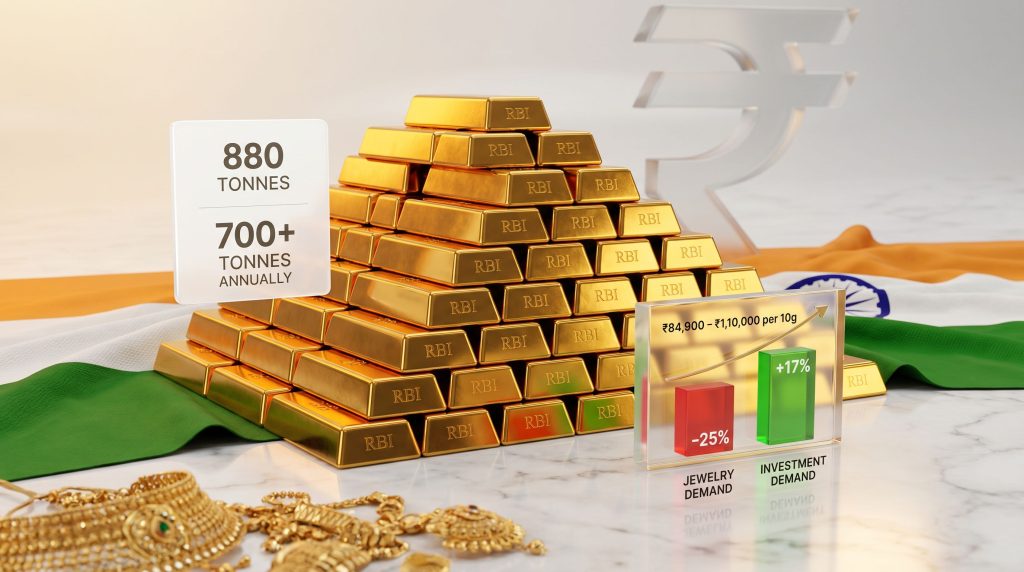
Unlike energy, which underpins industrial and consumer activity across the entire economy, gold occupies a more ambiguous position in policy terms. India imports more than 700 tonnes of gold annually, a volume that places it among the most consequential single-country demand centres in the world. For a government managing a widening current account deficit, this number is an obvious target.
Prime Minister Narendra Modi issued a rare public appeal urging Indian citizens to voluntarily reduce gold purchases, limit overseas travel, cut fuel consumption, and work remotely where feasible. The appeal was unusual in its directness and its scope. According to reporting by the Wall Street Journal, officials have categorised gold alongside electronics as a category of non-essential imports that can be compressed during periods of macroeconomic stress.
The Reserve Bank of India has already moved on the forex side of the equation, implementing preliminary controls that include capping banks' daily foreign exchange positions at $100 million and restricting activity in non-deliverable forward markets. These measures signal that the policy response is already underway, even before any formal legislative action on gold imports has been confirmed.
As of early May 2026, no formal restrictions on gold imports had been officially legislated by the Finance Ministry or the RBI, though multiple intervention mechanisms are understood to be under active review.
A Toolkit of Potential Interventions: What the Government Could Actually Do
Policy Mechanisms India Has Used Before and Could Use Again
India is not approaching this situation without historical precedent. The 2013 current account deficit crisis, which reached approximately 4.8% of GDP, produced a rapid policy escalation that remains instructive today. Import duties on gold were raised to 10%, and the controversial 80:20 import rule was implemented, requiring exporters to re-export a portion of imported gold before new consignments could be cleared.
The 2013 episode produced a critical lesson: quota-based restrictions tend to redirect demand through informal channels rather than eliminating it. India experienced a measurable surge in gold smuggling following the introduction of those measures, a dynamic that any 2026 policy design must account for explicitly.
| Policy Tool | Mechanism | Historical Precedent |
|---|---|---|
| Import duty increases | Raises landed cost, suppressing price-sensitive demand | Applied at 10% during the 2013 CAD crisis |
| Import quotas | Caps total official import volumes | The 80:20 scheme (2013-2014) |
| RBI forex directives | Accelerates foreign currency repatriation by exporters | Partially activated in May 2026 |
| Bank speculation limits | Restricts speculative forex positions held by financial institutions | $100M daily cap already in effect |
| Voluntary demand suppression | Appeals to cultural and patriotic sentiment | Modi's public address, May 2026 |
The structural evidence from 2013 supports the argument that price-based instruments, such as duty increases, are more durable than volume-based restrictions in suppressing genuine demand. However, they carry their own risks: higher duties increase the margin incentive for smuggling and drive consumption into informal markets where it cannot be tracked or taxed.
Furthermore, the gold price forecast for the coming period suggests that global tailwinds may render purely domestic interventions insufficient to meaningfully alter India's aggregate demand picture.
Historical Insight: When India raised gold import duties to 10% in 2013 and introduced the 80:20 rule, official import data fell sharply but informal trade expanded substantially. The net demand reduction was significantly smaller than the official figures suggested.
How Indian Gold Demand Has Already Contracted Before Any Official Policy Action
The Price Effect: Demand Compression Without Government Intervention
One of the most analytically significant aspects of the current situation is that meaningful demand destruction has already occurred organically, driven entirely by price. Gold prices surged approximately 60% year-on-year, with retail prices reaching a range of ₹84,900 to ₹110,000 per 10 grams in India, pricing out a substantial segment of the price-sensitive jewellery buyer.
The consequences are visible in festival season data. The April 2026 Akshaya Tritiya festival, one of the single most important gold-buying occasions on the Indian calendar, saw demand fall approximately 30% by volume compared to the same period a year earlier. For an occasion that reliably generates some of the highest single-day gold retail volumes in the world, a 30% volume decline represents a materially significant shift in consumer behaviour.
Longer-term trend data reinforces the picture:
- Full-year 2025 jewellery demand declined 24-25% compared to 2024 levels
- Q1 2026 jewellery consumption fell approximately 15% year-on-year, according to World Gold Council data
- Investment demand moved in the opposite direction, rising approximately 17% in Q1 2026 as geopolitical uncertainty drove households toward gold as a store of value rather than an adornment
The Jewellery-Investment Demand Split: A Structural Insight Often Overlooked
This divergence between jewellery and investment demand is one of the most important analytical distinctions in understanding India's gold market. The two categories behave very differently in response to price and policy signals.
Jewellery demand is highly price-elastic. Consumers in this segment make purchasing decisions tied to affordability thresholds and ceremonial calendars. When prices surge beyond those thresholds, demand contracts, sometimes sharply. This is the category already experiencing contraction.
Investment demand, by contrast, is driven by risk sentiment and store-of-value logic. In environments of geopolitical uncertainty, inflation pressure, and currency instability, investment buyers often increase their gold allocation precisely because prices are rising. Consequently, they interpret the appreciation as confirmation of gold as a safe haven in uncertain times.
Key Distinction: Any government intervention that applies uniform restrictions across both jewellery and investment categories risks suppressing the wrong segment, driving investment demand underground while failing to acknowledge that price has already done much of the demand-compression work in the jewellery sector.
What India's Largest Jeweller Says About the Road Ahead
Industry Confidence Despite Near-Term Uncertainty
Titan Co. Ltd., India's largest jewellery retailer, has publicly indicated through its chief financial officer Ashok Sonthalia that the company anticipates only a temporary period of softness in consumer demand should formal curbs be introduced. Bloomberg's coverage of the story confirms that the firm does not expect supply chain disruptions to emerge within a four-month window, with inventory and sourcing pipelines described as stable through that horizon.
Sonthalia stated that the company is monitoring the situation while awaiting formal policy announcements, characterising the firm's expectation as one where a short-term slowdown is possible but permanent demand destruction is not anticipated. This view is grounded in the structural characteristics of gold consumption in India, where wedding seasons, religious festivals, and intergenerational savings traditions create recurring, deeply embedded demand cycles.
The geopolitical conflict has also directly affected Titan's international footprint. The company has paused planned expansion across Gulf markets until conditions stabilise, with March and April 2026 described as particularly challenging months for Middle East operations. Despite this, the company's medium and long-term outlook for the region remains constructive.
Equity market reaction as a sentiment gauge:
- Titan shares fell as much as 2.2% in a single session following Modi's public appeal on May 12, 2026
- This extended a prior 6% decline that had already been registered when the PM's initial announcement circulated
- The combined drawdown reflects investor uncertainty about policy duration and severity rather than a fundamental reassessment of Titan's long-term earnings trajectory
The RBI Reserve Position and the Sovereign Gold Bond Liability Problem
Record Holdings, Reduced Buying, and an Unhedged Legacy
The Reserve Bank of India dramatically slowed its gold purchasing activity in 2025, acquiring only 4 tonnes across the year compared to 73 tonnes in 2024. Despite this sharp deceleration, India's total gold reserves reached a record 880 tonnes, driven primarily by mark-to-market valuation gains as global gold prices surged.
The central bank gold reserves position provides macroeconomic credibility but does not directly address the current account pressures created by the private sector's ongoing appetite for physical gold imports.
A more structurally complex problem sits inside the Sovereign Gold Bond (SGB) scheme, a programme originally designed to channel household demand for gold into paper instruments and thereby reduce the volume of physical metal that needed to be imported. The concept was sound in theory: offer investors a gold-linked return without requiring the import of physical bullion.
In practice, the programme generated an estimated ₹1.12 lakh crore liability by 2032 because the government failed to adequately hedge its price exposure at issuance. As gold prices surged, the cost of honoring bond redemptions at appreciated gold prices created a substantial fiscal obligation. The programme has since been discontinued, but its legacy liability remains a constraint on the government's fiscal flexibility.
Warning for Policymakers: The SGB programme demonstrates the danger of demand-management instruments that create contingent liabilities without corresponding hedges. Any new gold curb mechanism must be stress-tested against second-order effects, including informal market expansion and unintended fiscal exposure.
The next major ASX story will hit our subscribers first
Global Macro Forces Sustaining the Gold Bull Market
Why External Tailwinds May Outlast India's Domestic Pressures
India's policy response is occurring against a backdrop of globally constructive conditions for gold prices. Several structural forces have combined to create a sustained bull market environment that will not be easily reversed by one country's import controls, however significant India's demand footprint is.
The four pillars of the current gold bull market:
-
Central bank accumulation: Sustained central bank gold demand from emerging market institutions, including both India and China, has established a structural demand floor beneath spot prices. This demand is not price-sensitive in the conventional retail sense.
-
Geopolitical risk premium: The Middle East conflict has elevated safe-haven demand across institutional and retail segments globally. Uncertainty events of this scale tend to create durable, not just episodic, shifts in portfolio allocation toward gold.
-
Inflation hedging: Persistent above-target inflation in major economies has reinforced the role of gold as a real asset protection instrument, particularly for investors seeking to preserve purchasing power.
-
Dollar dynamics: Periods of US dollar weakness or uncertainty around US fiscal and monetary policy have historically correlated with gold price appreciation, and those underlying structural tensions remain active.
India and China together account for the majority of global physical gold consumption. Any sustained compression of Indian demand, whether from policy action or price-driven organic contraction, carries the potential to influence global spot prices during seasonally sensitive periods.
Three Scenarios for India's Gold Demand Trajectory
Projecting the Range of Outcomes
The range of possible outcomes for Indian gold demand over the next twelve months is wider than usual, given the combination of policy uncertainty, elevated prices, and geopolitical risk. Three credible scenarios deserve consideration.
Scenario 1: Temporary Curbs, Rapid Recovery
The government introduces moderate duty increases or relies primarily on voluntary restraint messaging. Demand softens for three to six months before rebounding as geopolitical tensions ease and price volatility stabilises. The jewellery sector recovers ahead of the next major festival cycle, and investment demand remains elevated but stable.
Scenario 2: Structural Policy Tightening
Formal import quotas or materially higher duties are imposed and maintained beyond the immediate crisis window. Official import volumes fall in measured data, but informal trade and smuggling activity expands to partially offset the recorded decline. The long-term demand trajectory remains intact, but official statistics significantly understate actual consumption.
Scenario 3: Price-Driven Structural Downgrade
Gold prices remain at or above ₹100,000 per 10 grams for an extended period without government intervention playing a decisive role. Price-sensitive jewellery buyers shift toward lighter-weight or lower-karat products rather than exiting the category entirely. Total import volumes decline organically, however investment demand continues growing, and the composition of consumption shifts durably toward lower-value units.
Key Statistics: India's Gold Market at a Glance (2025-2026)
| Metric | Data Point |
|---|---|
| Annual gold import volume | 700+ tonnes |
| RBI gold reserves (record high) | 880 tonnes |
| RBI gold purchases in 2025 | 4 tonnes (vs. 73 tonnes in 2024) |
| Gold price increase year-on-year | Approximately 60% |
| Retail gold price range per 10g | ₹84,900 to ₹110,000 |
| Akshaya Tritiya demand decline (April 2026) | Approximately 30% by volume |
| Jewellery demand decline, full-year 2025 | 24-25% |
| Jewellery demand decline, Q1 2026 | Approximately 15% |
| Investment demand growth, Q1 2026 | Approximately 17% |
| SGB scheme liability by 2032 | ₹1.12 lakh crore |
| RBI daily forex position cap | $100 million |
| Titan share decline post-Modi appeal | 2.2% single session, 6% prior |
What This Means for Investors Watching India's Gold Policy
Reading the Signals Without Overreacting to the Noise
For investors monitoring India's gold market, the critical interpretive challenge is distinguishing between cyclical demand suppression and structural demand destruction. The evidence strongly supports the former. India gold buying curbs are best understood as a forex defence mechanism deployed under acute macroeconomic pressure, not a fundamental change in how Indian households perceive gold's role in wealth preservation.
Several leading indicators are worth tracking to assess when normalisation is likely to resume:
- RBI monthly import data for volumes and value of gold entering the country through official channels
- Festival season retail sales figures from major jewellery chains, particularly Akshaya Tritiya, Dhanteras, and the wedding season between October and January
- Rupee stability against the US dollar as the most direct indicator of whether the broader forex pressure that triggered the policy response has eased
- Informal market intelligence through trade body reports and smuggling seizure data, which historically provide early signals of whether formal restrictions are redirecting rather than reducing actual consumption
The gold market outlook remains structurally bullish regardless of the near-term Indian policy environment. Central bank demand, inflation dynamics, geopolitical risk premiums, and de-dollarisation trends are all medium-to-long-term forces that transcend any single country's import policy. India's situation adds a layer of near-term uncertainty without altering the underlying architecture of the gold market's current cycle.
Disclaimer: This article is intended for informational purposes only and does not constitute financial or investment advice. Forecasts, scenario analyses, and demand projections discussed herein involve significant uncertainty and should not be relied upon as the basis for investment decisions. Readers should consult independent financial advisers before making any investment decisions related to commodities or equity markets.
Want to Stay Ahead of the Next Major Mineral Discovery on the ASX?
While India's gold policy debates play out across global commodity markets, Discovery Alert's proprietary Discovery IQ model delivers real-time alerts on significant ASX mineral discoveries — instantly translating complex data into actionable insights for both traders and long-term investors. Explore historic discoveries and their exceptional returns on Discovery Alert's dedicated discoveries page, and begin your 14-day free trial today to position yourself ahead of the broader market.