
June 16, 2026
When Retail Demand Retreats, What Actually Drives Gold Prices?
Gold markets are frequently misread through a single lens: consumer demand. When jewellery buyers step back, headlines suggest the bull market is under threat. But this framing misses a structural reality that experienced investors understand well. The gold price is not a function of one demand channel. It is the aggregate output of retail consumption, institutional allocation, and official-sector purchasing, each operating on entirely different decision timelines and with fundamentally different sensitivities to price and policy. Understanding how these layers interact, particularly when one of them contracts sharply, is essential for accurately interpreting what the India gold import duty hike of 2026 actually means for the market.
When big ASX news breaks, our subscribers know first
What the India Gold Import Duty Hike Actually Changed, and Why
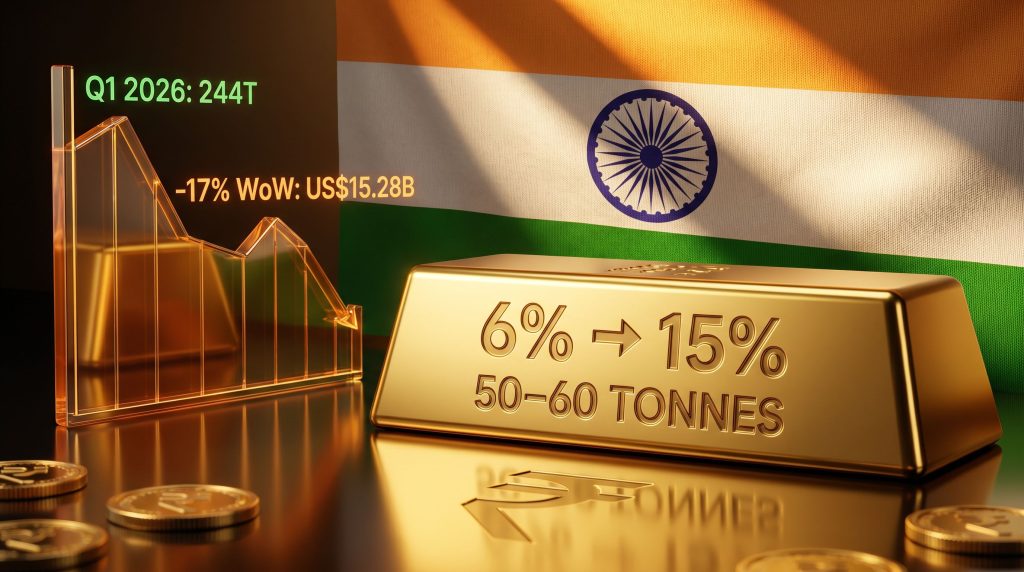
In May 2026, India's Ministry of Finance lifted the basic customs duty on gold imports from 6% to 15%, a nine-percentage-point increase that took effect on May 13 and represents the steepest single adjustment to India's gold import duty on record. The decision reversed a liberalisation measure introduced in July 2024, compressing the policy cycle to under two years.
The macroeconomic trigger was currency weakness. The Indian rupee had depreciated more than 7% year-to-date ahead of the announcement, placing sustained pressure on India's foreign exchange reserves. Because gold consistently ranks among India's largest non-oil import categories, raising the cost of imported gold is a direct policy lever for reducing foreign currency outflows and stabilising the current account.
India's gold import duty history follows a recognisable pattern of liberalisation and re-restriction tied to macroeconomic cycles:
| Year | Basic Customs Duty | Policy Direction |
|---|---|---|
| Pre-2024 | ~15% | Restrictive |
| July 2024 | 6% | Liberalisation |
| May 2026 | 15% | Re-restriction |
"The oscillation between openness and restriction reflects a structural tension that India has never fully resolved: gold is simultaneously a cultural asset embedded in centuries of tradition, a household savings instrument for hundreds of millions of people, and a persistent source of macroeconomic vulnerability through its impact on the current account."
How the Duty Increase Flows Through the Gold Supply Chain
The transmission from a policy decision to visible market impact is not instantaneous. A step-by-step understanding of the mechanism helps explain why the duty hike's consequences are only beginning to appear in trade data.
- Duty applied at the point of entry – importers pay 15% on the declared value of all new gold shipments crossing the border.
- Higher landed costs passed upstream – wholesale distributors absorb a per-gram cost increase immediately on newly imported inventory.
- Existing inventory buffers the consumer price – gold imported at the prior 6% rate remains in circulation, temporarily suppressing the full retail price impact.
- Consumer demand responds to widening affordability gaps – as higher-cost inventory gradually replaces legacy stock, retail buyers face meaningfully elevated prices.
- The statistical demand effect becomes measurable – as the 6%-duty inventory depletes, official import volumes begin to reflect the behavioural shift among consumers.
This lag is critical for investors monitoring Indian gold demand through near-term trade statistics. The World Gold Council projects a 50 to 60 tonne reduction in Indian jewellery and bar-and-coin demand for 2026, representing approximately a 10% year-on-year decline, but this contraction is not yet fully visible in current data. The full statistical picture will emerge as legacy inventory clears.
Investor warning: Analysts evaluating near-term import data may significantly underestimate the structural demand shift already embedded in the supply chain. The damage is happening now; the data will confirm it later.
What Does the Duty Hike Mean for Indian Consumers?
According to reporting on India's gold duty increase, the government's primary motivation was arresting the rupee's slide. However, the downstream effect on Indian households is significant. Elevated import costs translate directly into higher retail prices, reducing the affordability of gold jewellery for millions of middle-income buyers who have historically treated gold purchases as a form of savings.
Furthermore, India's tightened import environment has also affected bullion banks and refiners that depend on licensed import channels, creating operational adjustments across the formal supply chain. Consequently, the effects of the India gold import duty hike extend well beyond the immediate consumer market.
Quantifying the Demand Impact: Where the Pressure Is Concentrated
Not all demand channels respond equally to a duty-driven price increase. The table below maps the sensitivity of each segment:
| Demand Channel | Price Sensitivity | Policy Sensitivity | Short-Term Outlook |
|---|---|---|---|
| Jewellery consumption | Very High | Very High | Significant contraction expected |
| Bar and coin investment | High | High | Retail investors deterred |
| Gold ETF flows | Moderate-High | Moderate | First net outflows in over a year |
| Central bank purchases | Low | Low | Structurally insensitive |
The ETF market reaction was immediate and measurable. Several of India's largest mutual fund houses, including HDFC, ICICI Prudential, Tata, and Nippon India, imposed temporary caps on large Gold ETF investments following the duty increase and a concurrent gold price rally that accelerated profit-taking among domestic investors.
India recorded its first month of net ETF outflows in over a year, reversing a sustained inflow trend that had run through most of 2025 and into early 2026. At the global level, gold investment demand fell 17% week-on-week to US$15.28 billion, down from US$18.46 billion in the prior period. The gold safe-haven demand narrative, however, remains intact at the institutional level, where macroeconomic uncertainty continues to support allocation decisions.
The 2013 Precedent: What History Tells Us About High Import Duties
India's relationship with punitive gold import duties is not new. In 2013, facing a sharp current account deficit, the government raised duties to approximately 10–15% in successive steps. The consequences were instructive. Official import volumes fell sharply, but a significant unintended consequence emerged: informal import channels expanded rapidly. Gold smuggling surged as the domestic price premium over international benchmarks widened, partially neutralising the policy's intended foreign exchange benefits.
The 2026 episode begins from different starting conditions. Gold prices are substantially higher in absolute terms, India's domestic ETF market is more developed than it was in 2013, and the global investment backdrop is shaped by a stronger institutional bid. However, the core economic incentive for smuggling — a meaningful price differential between official and unofficial channels — remains structurally unchanged. If the domestic premium widens substantially, history suggests a portion of suppressed official demand will re-emerge through informal routes.
Additionally, revised duty provisions also tightened the UAE trade channel, through which certain gold imports had previously benefited from preferential bilateral trade arrangements. Closing this pathway reduces the scope for duty arbitrage, but simultaneously increases the attractiveness of unofficial alternatives for price-sensitive participants.
Central Bank Buying: The Structural Floor That Retail Data Misses
While Indian retail demand contracts, central bank gold demand has remained robust and structurally insulated from the same pressures. According to the World Gold Council, central banks globally purchased 244 tonnes of gold in Q1 2026, exceeding both the previous quarter and the five-year quarterly average.
Notable central bank activity during the quarter included:
- Poland added 31 tonnes, continuing its systematic accumulation toward a stated national reserve target of 700 tonnes total.
- Uzbekistan added 25 tonnes, elevating gold to approximately 87% of its total national reserves, an extraordinarily high concentration that reflects a deliberate sovereign strategy to minimise exposure to fiat currency holdings.
Central bank gold purchasing is driven by reserve diversification, long-term currency risk management, and geopolitical hedging objectives. These factors are almost entirely disconnected from short-term retail price dynamics or consumer purchasing power. As a result, official-sector demand provides a structural demand floor that does not erode during periods of retail contraction.
"When retail demand retreats, the relative weight of institutional and official-sector buying increases, not because those flows expand, but because the retail component shrinks as a proportion of total demand. This compositional shift matters for price direction."
A 50 to 60 tonne reduction in Indian demand is meaningful in isolation, but it is modest relative to a global annual demand base that consistently exceeds 4,000 tonnes. Central banks alone purchased 244 tonnes in a single quarter of 2026. The net price impact depends far more on how Western institutional ETF flows and official-sector purchasing evolve than on whether Indian jewellery buyers step back.
The next major ASX story will hit our subscribers first
Gold's Demand Architecture: A Shifting Composition for 2026
India and China have historically accounted for roughly half of global gold demand when combining jewellery, bar-and-coin investment, and ETF flows. A sustained reduction in Indian demand, even a partial one, increases the relative weight of other demand drivers in determining price outcomes. This compositional shift has meaningful implications for how investors should think about the gold market outlook through the remainder of 2026.
| Demand Source | Price Sensitivity | Structural Stability | 2026 Trajectory |
|---|---|---|---|
| Indian jewellery | Very High | Low | Contracting |
| Asian ETF flows | High | Low | Weakening |
| Western institutional ETFs | Moderate | Medium | Holding/growing |
| Central bank purchases | Low | High | Above average |
The practical implication is that gold's price support is increasingly resting on institutional and sovereign foundations rather than consumer foundations, at least in the near term. This is not inherently bearish. Institutional flows tend to be larger in absolute scale and less volatile than retail-driven demand. However, they are also driven by different catalysts — including macroeconomic uncertainty, currency concerns, and portfolio allocation decisions — rather than seasonal jewellery demand or festival-driven buying cycles.
Why Execution Milestones Matter More Than Demand Headlines for Gold Equities
For investors holding or evaluating gold equities, the India gold import duty hike is a useful macro data point but rarely a primary valuation driver. Individual gold company valuations are shaped predominantly by company-specific catalysts: permitting outcomes, feasibility study completion, resource conversion rates, construction progress, and financing milestones.
The development stage of a project determines which milestones are most relevant to its valuation:
| Development Stage | Primary Valuation Driver | Sensitivity to Indian Demand |
|---|---|---|
| Exploration | Resource growth, drill results | Very Low |
| Resource definition | Mineral resource estimate updates | Very Low |
| Feasibility and permitting | NPV, IRR, permit status | Low |
| Construction and near-production | Capex delivery, throughput targets | Low-Medium |
| Cash-flowing production | Free cash flow, cost per ounce | Medium |
Projects targeting near-term production provide the clearest execution-driven investment case. Cabral Gold's Phase 1 gold-in-oxide heap leach operation at its Cuiú Cuiú district in Brazil is targeting commercial production in the fourth quarter of 2026. Recent infill drilling at the project returned intercepts including 25 metres at 7.47 grams per tonne gold from surface, supporting resource conversion ahead of the production decision.
The company's leadership has outlined a strategy whereby initial cash flow from the Phase 1 heap leach operation, designed to process approximately 3,000 tonnes per day, would fund exploration and development of the broader district, reducing dependence on external capital markets to advance the larger Phase 2 opportunity.
New Found Gold's Hammerdown project in Newfoundland is targeting commercial production in the second half of 2026, with mill throughput already exceeding its 700-tonne-per-day design rate during commissioning. The project is expected to generate approximately US$40 to US$50 million in annual free cash flow, which would fund corporate overhead and ongoing exploration at the broader Queensway project, reducing the need for future equity dilution.
The company's leadership has stated publicly that its available funding of approximately US$185 million exceeds the preliminary economic assessment capital requirement of US$155 million, confirming full funding to advance Queensway through to production without requiring additional capital raises.
How Do Feasibility Studies Affect Project Valuations?
For projects at the permitting and feasibility stage, jurisdictional quality and existing infrastructure become critical differentiators. Definitive feasibility studies provide the rigorous economic underpinning that investors and lenders require before committing capital, and their completion often serves as a direct re-rating catalyst for gold equities.
Hycroft Mining Holding Corporation's Nevada operation, with its existing crushing circuits, heap leach pads, and Merrill-Crowe processing facilities, benefits from infrastructure that would cost substantially more to replicate on a greenfield basis. The company's June 2026 S-K 1300 Technical Report Summary reported a post-tax net present value of US$4.3 billion at a base case gold price of US$3,600 per ounce, rising to US$10.0 billion at spot prices, across a 51-year mine life.
U.S. Gold Corp's CK Gold project in Wyoming reported an after-tax net present value of US$632 million and an internal rate of return of 27% at a base case gold price of US$3,250 per ounce, while maintaining a positive net present value at gold prices as low as US$2,000 per ounce. With major permits secured and access road construction underway, the project's remaining catalysts are financing-related rather than regulatory. Furthermore, the gold price impact on equities at this stage of development is meaningfully amplified, as higher spot prices directly improve project NPV and financing terms.
Resource Growth and District-Scale Exploration: The Longer-Term Gold Equity Case
Earlier-stage developers offer greater leverage to resource expansion but carry correspondingly higher execution risk. Tudor Gold's Treaty Creek project in British Columbia hosts a 24.9 million ounce indicated Goldstorm deposit, and the 2026 drill program is focused on expanding the resource beyond this already substantial base.
A key detail often overlooked is the grade differentiation within the resource: at a higher net smelter return cutoff, the project yields an indicated resource grading 2.33 grams per tonne gold and an inferred component grading 4.02 grams per tonne gold, suggesting that the higher-grade portions of the deposit represent significant potential upside as conversion drilling advances.
Multi-commodity projects introduce an additional dimension. At Cobra Resources' Manna Hill project in South Australia, recent drilling returned intercepts of 74 metres at more than 1% copper and approximately 0.25 grams per tonne gold, alongside 84 metres at 0.6% copper and 0.14 grams per tonne gold, supporting efforts to define a multi-million tonne porphyry system. In a supportive gold price environment, even modest gold credits within a large-scale porphyry deposit contribute meaningfully to project economics.
P2 Gold's Gabbs project in Nevada continues advancing drill programs across its Lucky Strike and Sullivan zones, both of which remain open for expansion. An updated mineral resource estimate is targeted for the third quarter of 2026, with the company evaluating throughput scenarios ranging from 9 million tonnes per year at approximately 110,000 ounces of gold annually to expanded scenarios targeting 12 million tonnes per year at closer to 150,000 ounces of gold annually.
Frequently Asked Questions: India Gold Import Duty Hike 2026
Why did India raise its gold import duty in 2026?
India increased the basic customs duty on gold from 6% to 15% in May 2026 to reduce pressure on its foreign exchange reserves at a time when the rupee had weakened more than 7% year-to-date. Gold is one of India's largest non-oil import categories, making it a logical target for demand suppression when the current account comes under pressure. The measure reversed a liberalisation step taken less than two years earlier in July 2024.
How much will Indian gold demand fall because of the duty hike?
The World Gold Council projects a reduction of approximately 50 to 60 tonnes in Indian jewellery and bar-and-coin demand for 2026, equivalent to roughly a 10% year-on-year decline. The full impact remains partially obscured in current trade data because inventory imported at the prior 6% rate continues to circulate through the supply chain.
Will weaker Indian demand push global gold prices lower?
A 50 to 60 tonne reduction in Indian demand is significant but represents a relatively small share of global annual gold demand, which exceeds 4,000 tonnes. Central banks purchased 244 tonnes in Q1 2026 alone, providing a structural offset. The net price impact will depend substantially on how Western institutional flows and official-sector purchasing evolve through the remainder of the year.
Does the duty hike risk encouraging gold smuggling?
Historical evidence from India's 2013 high-duty period suggests a meaningful risk. When official gold prices rise substantially above international benchmarks, informal import channels become economically attractive. If the domestic price premium widens sufficiently, a portion of demand suppressed through official channels may re-emerge through smuggling, partially offsetting the policy's intended macroeconomic benefits.
What should gold equity investors focus on given weaker Indian demand?
Company-specific execution milestones — including permitting outcomes, feasibility study completion, resource conversion, construction progress, and financing milestones — remain more direct drivers of gold equity valuations than short-term shifts in regional retail demand. Investors should evaluate projects against measurable advancement criteria rather than demand-side macro assumptions.
Key Takeaways: India Gold Import Duty Hike 2026
- India raised its gold import duty from 6% to 15% in May 2026, the steepest single adjustment on record, primarily to reduce foreign exchange pressure from a rupee that had weakened more than 7% year-to-date
- The World Gold Council projects a 50 to 60 tonne reduction in Indian jewellery and bar-and-coin demand, representing approximately 10% year-on-year, with the full statistical impact lagged by existing supply chain inventory
- India recorded its first month of net ETF outflows in over a year, while global gold investment demand declined 17% week-on-week to US$15.28 billion from US$18.46 billion
- Central banks purchased 244 tonnes in Q1 2026, exceeding the five-year average and providing a structural demand floor that is insensitive to retail price fluctuations
- Historical precedent from 2013 demonstrates that large official price premiums incentivise smuggling, which could partially undermine the policy's macroeconomic objectives
- The compositional shift in demand — away from Asian retail and toward institutional and official-sector flows — increases the relative importance of Western ETF activity and central bank purchasing in determining price direction
- For gold equity investors, project-specific catalysts including permitting, financing readiness, resource conversion, and production milestones remain far more direct valuation drivers than short-term regional demand fluctuations
Disclaimer: This article is intended for informational purposes only and does not constitute financial advice. Projections and forecasts referenced, including those from the World Gold Council, involve inherent uncertainty and should not be relied upon as predictions of future outcomes. Investors should conduct their own due diligence and consider their individual risk tolerance before making investment decisions. References to specific companies and their project economics are based on publicly available information and do not constitute an endorsement or recommendation to buy or sell any security.
Want to Know When the Next Major Gold Discovery Hits the ASX?
While macro forces like India's import duty hike reshape global gold demand, the real wealth-creating moments often come from being first to act on a significant new discovery — Discovery Alert's proprietary Discovery IQ model scans ASX announcements in real time, delivering instant, actionable alerts on high-potential mineral discoveries across gold and 30-plus other commodities, just as historic finds like those by De Grey Mining and WA1 Resources demonstrated. Start your 14-day free trial today and position yourself ahead of the broader market.