
July 13, 2026
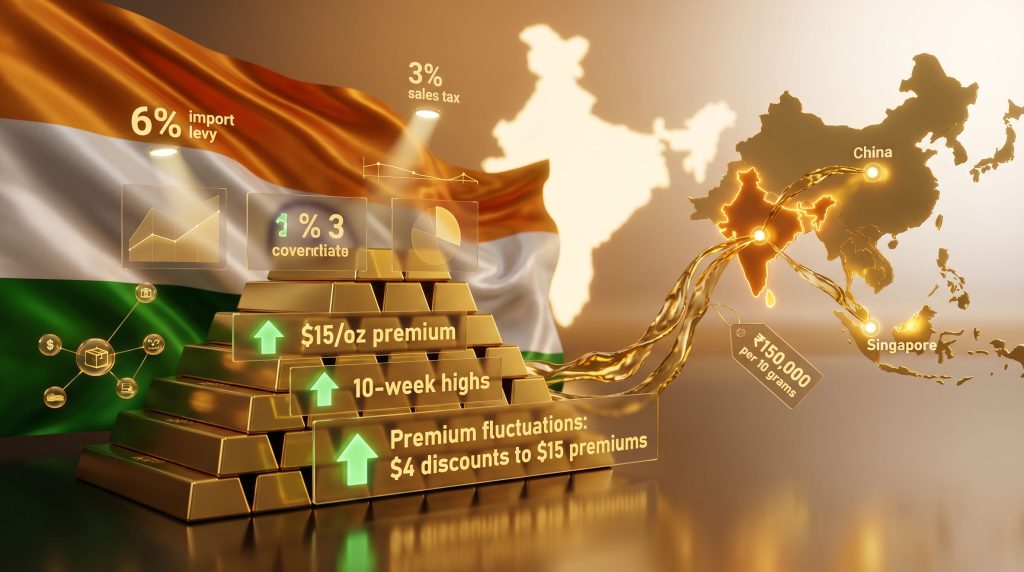
Global precious metals markets operate within complex interconnected systems where supply chain disruptions can cascade across continents within days. When import authorization delays emerge in major consumer nations, the ripple effects extend far beyond domestic pricing structures, creating arbitrage opportunities and reshaping regional demand patterns that can persist for months after initial bottlenecks resolve.
Understanding India's Gold Premium Surge: Market Forces at Play
What Drives Gold Premium Volatility in Major Consumer Markets?
India gold premiums on tight supply have reached their most elevated levels in over 10 weeks, climbing to $15 per ounce above domestic prices as of April 2026. This premium structure includes the compound effect of India's 6% import levy and 3% sales tax, creating a cumulative tax burden that amplifies during supply constraints.
Furthermore, gold prices as inflation hedge considerations become particularly relevant during such market volatility. Gold premiums represent the differential between international spot prices and local market rates, adjusted for:
• Import duties and taxes (9.18% compound effect in India's case)
• Logistics and handling costs including customs clearance
• Dealer markups that fluctuate based on inventory availability
• Currency hedging costs for international transactions
• Regulatory compliance expenses during uncertain tax periods
The premium calculation methodology reveals how supply bottlenecks amplify price distortions. When London spot gold trades at $4,713 per ounce, India's landed cost reaches approximately $4,996 per ounce after import duties. However, the current $15 premium suggests dealers are pricing in additional risk factors beyond standard logistics costs.
Historical data shows India gold premiums on tight supply can swing from $4 discounts to $15 premiums within a single week, representing a $19 total differential. This volatility pattern indicates that Indian gold markets exhibit higher price elasticity than most other major consuming regions.
The premium structure becomes particularly volatile when regulatory uncertainty coincides with festival demand periods, creating dual pressure on available inventory.
How Do Import Authorization Delays Create Market Bottlenecks?
India's gold import mechanism operates through a centralised banking system where only authorised financial institutions can legally import precious metals. When the Reserve Bank of India delays authorization orders, the entire supply chain experiences immediate disruption.
The authorization delay process creates multiple constraint layers:
- Initial Authorization Hold – RBI postpones formal import permission
- Customs Backlog Development – Existing shipments accumulate at ports
- Banking Sector Hesitation – Even post-authorization, institutions remain cautious
- Tax Uncertainty Extension – Unresolved classification questions persist beyond authorization resolution
Moreover, according to Reuters reports on Asian gold markets, Mumbai-based traders report that banks continue avoiding gold imports despite authorization being eventually issued, citing uncertainty over applicable tax rates. This institutional hesitation creates a confidence lag effect where supply constraints persist even after formal regulatory bottlenecks clear.
The technical mechanics of import authorization delays involve regulatory capital treatment considerations for banking institutions. When tax classification remains ambiguous, banks face potential balance sheet reclassification risks that extend beyond immediate transaction costs.
Current Market Data (April 2026):
| Metric | Current Level | Previous Week | Change |
|---|---|---|---|
| Premium Range | $15/oz | $4 discount to $14 premium | +$19/oz swing |
| Authorization Status | Issued (delayed) | Pending | Resolved |
| Banking Participation | Limited | Suspended | Cautious |
When big ASX news breaks, our subscribers know first
Why Are Indian Gold Premiums Reaching 10-Week Highs?
What Role Do Festival Cycles Play in Premium Formation?
Akshaya Tritiya, celebrated on April 19, 2026, traditionally generates 15-25% of annual retail gold demand within a concentrated 1-2 day period. However, the 2026 festival demonstrated how price sensitivity can overcome cultural buying impulses when psychological thresholds are breached.
In addition, gold bull market catalysts often include cultural and seasonal factors like festival demand cycles. Festival Demand Mechanics:
• Pre-festival inventory building by retailers (1-2 weeks prior)
• Concentrated consumer purchasing during auspicious periods
• Post-festival demand cliff as both retailers and consumers exhaust purchasing capacity
• Price elasticity activation when costs exceed cultural motivation thresholds
Ahmedabad jewellers report that retail buying slowed after Akshaya Tritiya, with demand recovery contingent on prices falling below ₹150,000 per 10 grams. Current domestic prices at ₹151,200 per 10 grams exceed this psychological barrier by approximately ₹1,200.
Consequently, the ₹150,000 threshold represents more than psychological resistance; it functions as a demand switching point where consumer behaviour shifts from active purchasing to deferred accumulation. Historical patterns suggest that round-number price levels (typically 50,000 rupee multiples) create similar behavioural responses in Indian gold markets.
Price Sensitivity Analysis:
| Price Range (₹/10g) | Consumer Response | Market Behaviour |
|---|---|---|
| Below ₹145,000 | Accelerated buying | Premium compression |
| ₹145,000-₹150,000 | Normal demand | Stable premiums |
| Above ₹150,000 | Deferred purchases | Premium expansion |
| Above ₹155,000 | Demand destruction | Maximum premiums |
How Do Tax Structures Amplify Supply Constraints?
India's compound tax structure creates unique market dynamics where uncertainty over applicable rates generates risk premiums beyond the actual tax burden. The 6% import levy combined with 3% sales tax creates a 9.18% cumulative cost structure that dealers must navigate during supply disruptions.
Tax Impact Cascade Analysis:
The taxation mechanism operates through multiple layers:
• Import stage: 6% duty applied to landed gold value
• Retail stage: 3% GST on final consumer transactions
• Dealer margin compression: Inability to fully pass through tax costs during tight supply
• Consumer price resistance: Reduced buying power at elevated total cost levels
Current market conditions reveal how tax uncertainty amplifies supply constraints beyond the numerical rate impact. When banks cannot confidently assess tax classification, they halt import activities even after formal authorization resolves, creating artificial scarcity.
Premium Expansion Under Tax Uncertainty:
The shift from $4 discounts to $15 premiums within one week directly correlates with unresolved tax questions rather than pure supply-demand mechanics. This suggests that regulatory clarity carries significant value in precious metals markets, potentially worth $10-15 per ounce in premium compression.
Tax uncertainty creates an inventory holding problem where dealers widen premiums to create safety margins against potential retroactive reclassification.
Mumbai traders specifically cite "uncertainty over the applicable tax on gold" as the primary reason for continued banking sector hesitation, even after import authorization was eventually issued. This reveals how tax policy ambiguity can extend supply chain disruptions far beyond initial regulatory delays.
What Do Regional Premium Variations Reveal About Global Gold Flows?
How Does China's Demand Recovery Affect Asian Gold Markets?
Shanghai Gold Exchange premiums doubled from $3-6 per ounce to $9-12 per ounce within a single week, indicating renewed physical demand as gold prices approached the $4,700 psychological accumulation zone. Peter Fung from Wing Fung Precious Metals observed that this price level triggers "renewed physical demand and fresh buying interest."
Shanghai Premium Dynamics:
The Shanghai Gold Exchange operates as China's primary domestic precious metals platform, with premiums serving as real-time indicators of local demand intensity versus international supply availability.
Weekly Premium Progression:
| Region | Current Premium | Previous Week | Percentage Change |
|---|---|---|---|
| Shanghai | $9-12/oz | $3-6/oz | +100-200% |
| India | $15/oz | $4 discount to $14/oz | Variable |
| Hong Kong | Par to $1.80/oz | Similar range | Stable |
| Singapore | $0.50 discount to $1.80/oz | $1-3/oz | Compressed |
The doubling of Shanghai premiums suggests that Chinese demand responds elastically to specific price thresholds. At approximately $4,700 per ounce, institutional and retail buyers appear to view gold as attractively priced for accumulation, creating upward pressure on local premiums.
Regional Gold Flow Interconnectedness
Cross-Border Arbitrage Mechanics:
Premium differentials across Asian markets create arbitrage opportunities, though physical gold transportation logistics limit rapid equilibration. The current spread between India's $15 premium and Hong Kong's maximum $1.80 premium represents a $13.20 differential that would normally attract cross-border flows.
However, India's import authorization system prevents direct trader imports, limiting arbitrage to authorised banking channels. This regulatory constraint allows premium differentials to persist longer than would occur in fully liberalised markets.
Furthermore, insights from gold market surge analysis demonstrate similar patterns across different timeframes. Supply Chain Vulnerability Mapping:
Regional premium variations reveal how global gold supply chains maintain interconnected dependencies:
• Singapore as Regional Hub: Narrow premium ranges indicate efficient distribution infrastructure
• Hong Kong as Price Discovery Centre: Premiums near par suggest liquid market conditions
• China as Demand Driver: Premium expansion signals renewed accumulation interest
• India as Constrained Market: Wide premiums reflect regulatory and supply bottlenecks
How Do Geopolitical Tensions Influence Precious Metals Supply Chains?
What Impact Do Middle East Tensions Have on Gold Market Sentiment?
Elevated oil prices resulting from Middle East tensions create compound effects on precious metals markets through multiple transmission mechanisms. When crude oil exceeds $100 per barrel, inflation expectations typically increase, enhancing gold's appeal as an inflation hedge while simultaneously raising logistics costs for physical gold distribution.
Geopolitical Risk Transmission Channels:
• Direct Safe-Haven Demand: Investors seek gold during geopolitical uncertainty
• Indirect Inflation Pressure: Energy costs increase transportation and processing expenses
• Currency Volatility: Geopolitical tensions often weaken emerging market currencies
• Supply Route Disruption: Physical shipping lanes may face delays or rerouting
Current conditions show international spot gold tracking toward a weekly decline after a four-week rally, suggesting that supply chain constraints are competing with geopolitical safe-haven demand. This creates a complex dynamic where physical premiums rise even as spot prices moderate.
Supply Chain Vulnerability Assessment
Banking Sector Risk Management:
Import authorization delays in India demonstrate how banking institutions reassess precious metals strategies during uncertain regulatory environments. Banks face multiple risk layers when importing gold:
- Regulatory Compliance Risk – Tax classification changes affecting import approval
- Balance Sheet Impact – Inventory valuation volatility during holding periods
- Customer Demand Risk – Reduced retail buying when prices exceed psychological thresholds
- Operational Risk – Customs delays and storage costs during authorization gaps
Alternative Supply Route Development:
Sustained supply disruptions typically incentivise market participants to develop alternative channels. However, India's regulatory framework limits import pathways to authorised banking institutions, reducing supply chain resilience compared to markets with multiple import channels.
The concentration of import authority within the banking system creates systemic vulnerability where sector-wide hesitation can constrain entire national markets.
What Investment Implications Emerge from Current Market Dynamics?
How Should Investors Interpret Premium Volatility Signals?
Premium-to-spot ratios function as market health indicators, providing insight into physical demand intensity and supply chain efficiency. India gold premiums on tight supply reaching $15 per ounce suggest significant physical market stress that may not be fully reflected in international spot pricing.
Investment Strategy Framework:
During Premium Expansion Periods:
• Physical acquisition costs increase – Consider timing of purchases relative to premium cycles
• Regional arbitrage opportunities emerge – Geographic diversification may enhance returns
• Supply chain constraints signal underlying demand – Physical scarcity often precedes spot price adjustments
For instance, gold investment strategies often emphasise timing considerations during volatile premium environments. Premium Compression Indicators:
• Regulatory clarity restoration – Tax uncertainty resolution typically reduces premiums
• Banking sector confidence return – Increased institutional import activity normalises supply
• Consumer price resistance breakdown – Demand recovery below psychological thresholds
Strategic Positioning During Volatile Premium Environments
Dollar-Cost Averaging Approaches:
Premium volatility suggests that lump-sum physical gold purchases may benefit from timing strategies. When premiums exceed $10-12 per ounce historically, subsequent compression often occurs within 4-6 weeks as supply chains adapt.
Portfolio Allocation Considerations:
| Market Condition | Physical Gold | Gold ETFs | Regional Exposure |
|---|---|---|---|
| High Premiums | Reduced allocation | Increased weight | Diversify geographically |
| Normal Premiums | Standard allocation | Balanced weight | Focus on efficient markets |
| Premium Discounts | Increased allocation | Reduced weight | Concentrate in discount regions |
Risk-Adjusted Return Calculations:
During premium spikes, physical gold acquisition costs increase by the premium amount, effectively reducing expected returns. A $15 premium on $4,713 spot gold represents a 0.32% immediate cost that must be recovered through future price appreciation or premium compression.
Warning: Premium volatility creates timing risk for physical gold investments. Investors should consider their investment horizon and ability to hold through premium cycles when making allocation decisions.
The next major ASX story will hit our subscribers first
Market Outlook: Navigating Premium Volatility in Gold Markets
Short-term Scenario Analysis (Next 30 Days)
Supply Normalisation Timeline Expectations:
Based on current market conditions and historical patterns, several factors will determine premium compression timing:
• Tax Classification Resolution – Clear guidance from Indian tax authorities could reduce premiums by $5-8 per ounce within 2-3 weeks
• Banking Sector Confidence Recovery – Institutional import resumption typically requires 3-4 weeks after regulatory clarity
• Inventory Rebuilding Phase – Normal stock levels generally restore within 4-6 weeks of supply chain normalisation
Premium Compression Probability Assessment:
Historical data suggests that premiums exceeding $12-15 per ounce typically compress within 30-45 days as:
- Arbitrage pressures increase with wider spreads
- Consumer demand destruction accelerates at elevated premiums
- Alternative supply channels develop to capture premium opportunities
- Regulatory clarity eventually emerges to resolve uncertainty
Medium-term Strategic Implications (3-6 Months)
Structural Changes in Import Channel Management:
The current authorization delays may prompt Indian authorities to reassess import procedures, potentially creating:
• Streamlined authorization processes to prevent future supply disruptions
• Alternative import pathways beyond the current banking monopoly
• Enhanced regulatory clarity on tax classification to reduce uncertainty
• Strategic inventory management by authorised importers to buffer future delays
Consumer Behaviour Evolution Under Price Pressure:
Extended periods above psychological price thresholds typically create behavioural adaptations where consumers:
- Adjust accumulation patterns toward smaller, more frequent purchases
- Shift timing preferences toward festival and seasonal discount periods
- Increase price sensitivity with more careful comparison shopping
- Consider alternative forms such as gold ETFs during high physical premiums
In addition, gold price forecast 2025 analysis indicates similar market adaptation patterns during extended volatility periods. Future Scenario Modeling:
Scenario 1: Rapid Resolution (30-60 days)
- Tax clarity provided within 4 weeks
- Banking imports resume at normal levels
- Premiums compress to $3-6 per ounce range
- Consumer demand recovers below ₹150,000 threshold
Scenario 2: Extended Uncertainty (90-120 days)
- Tax questions remain unresolved
- Banking sector maintains cautious approach
- Premiums stabilise at $10-12 per ounce
- Alternative supply channels develop gradually
Scenario 3: Structural Reform (6+ months)
- Import system redesigned for greater resilience
- Multiple authorised import channels established
- Premium volatility reduces permanently
- Market efficiency improves through competition
Disclaimer: The analysis above involves forward-looking statements and scenario modelling based on historical patterns and current market conditions. Actual outcomes may vary significantly due to unforeseen regulatory changes, geopolitical developments, or macroeconomic factors not considered in this analysis. Past performance and historical premium patterns do not guarantee future results.
Understanding India gold premiums on tight supply requires recognition that precious metals markets operate within complex regulatory, cultural, and economic frameworks where short-term disruptions can create lasting structural changes. According to additional analysis from TradingView's market coverage, investors and market participants benefit from monitoring premium differentials as leading indicators of physical demand intensity and supply chain health across the world's largest gold-consuming regions.
Want to Stay Ahead of Precious Metals Market Movements?
Discovery Alert's proprietary Discovery IQ model delivers real-time alerts on significant ASX mineral discoveries, including precious metals opportunities that could benefit from market conditions like India's current supply constraints. Subscribers gain immediate insights into actionable trading and investment opportunities, ensuring they can capitalise on market dislocations before the broader market reacts.