Strategic shifts in global manufacturing often emerge from crisis moments rather than gradual planning. When supply chains fracture and dependencies become liabilities, nations scramble to rebuild industrial foundations that seemed secure just months earlier. India's recent commitment to developing India's domestic rare earth magnet factories represents precisely this type of strategic pivot, born from vulnerability and shaped by the harsh realities of modern supply chain warfare.
The convergence of electric vehicle growth, renewable energy expansion, and geopolitical tensions has created unprecedented demand for permanent magnet materials. Yet this demand exists within a market structure dominated by a single nation's processing capabilities, creating systemic risks that extend far beyond individual companies or sectors. Understanding India's response to this challenge requires examining not just the immediate policy decisions, but the deeper industrial logic driving a fundamental reorientation of the critical minerals transition.
India's Strategic Response to Supply Chain Vulnerabilities
The foundation of India's domestic rare earth magnet initiative rests on stark numerical realities that became impossible to ignore during 2025. China maintains control over approximately 90% of global rare earth element processing capacity, a concentration that creates single-point-of-failure risks across multiple strategic industries. This dominance extends beyond raw material processing to encompass the sophisticated metallurgical capabilities required for producing sintered neodymium-iron-boron (NdFeB) magnets, the highest-performance permanent magnets currently available.
India's current position within this supply chain reflects decades of industrial development focused on other priorities. The nation's rare earth processing infrastructure consists primarily of limited oxide production through Indian Rare Earths Limited (IREL), with negligible metal conversion capacity and near-total dependence on imported finished magnets. This dependency became acutely problematic when China implemented rare earth magnet export controls in April 2025, forcing Indian policymakers to confront the strategic implications of their supply chain architecture.
The immediate policy response revealed the depth of this vulnerability. Furthermore, the executive order on minerals approach adopted by various nations highlighted global awareness of these dependencies. India's ₹10,900 crore PM E-Drive scheme required emergency modifications to allow electric truck and bus manufacturers to import Chinese magnet-laden motors while still collecting government incentives. This explicit acknowledgment that domestic alternatives were unavailable highlighted the gap between India's electrification ambitions and its industrial capabilities.
Current data underscores the scale of this challenge. India's EV penetration stands at 7.66%, significantly below the global average of 16.5%, indicating both substantial growth potential and structural adoption barriers. The nation's EV market exhibits particular strength in two-wheeler segments, where permanent magnet motors provide optimal power-to-weight ratios for urban mobility applications.
Financial Architecture of the Manufacturing Initiative
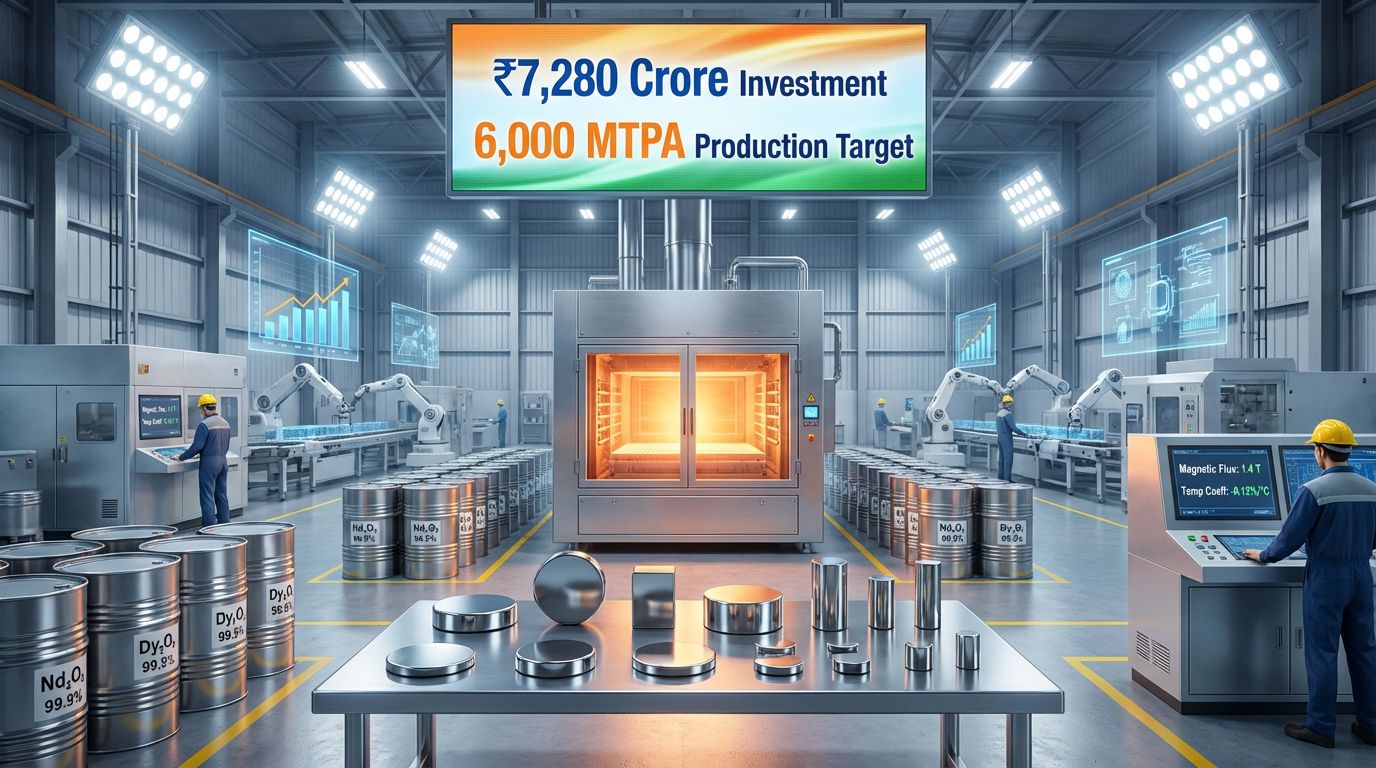
India's response centres on a ₹7,280 crore investment commitment (approximately $870 million USD) structured to establish five domestic rare earth magnet factories with combined capacity targeting 6,000 metric tons per annum. This financial framework represents more than capital allocation; it embodies a comprehensive industrial policy shift toward materials security as a prerequisite for technological sovereignty.
The investment architecture reflects lessons learned from other strategic manufacturing initiatives. Rather than concentrating production in a single mega-facility, the five-factory model distributes both risk and capabilities across multiple locations. This approach provides redundancy against technical failures, natural disasters, or targeted disruptions whilst enabling regional specialisation and workforce development.
Competitive bidding structures for these facilities will likely prioritise technical capability and execution timelines over lowest-cost proposals. The selection criteria must balance domestic control with access to international expertise, particularly in metallurgical processes where India's domestic rare earth magnet factories currently lack commercial-scale experience. Technology transfer arrangements will prove critical, as sintering capabilities and magnetic property optimisation require specialised knowledge developed over decades by established producers.
The financial incentive structure combines capital subsidies with sales-linked benefits, creating performance-based returns that align government objectives with private sector execution. This approach addresses the classic challenge of industrial policy: ensuring that protected domestic producers achieve international competitiveness rather than becoming permanently dependent on government support.
Manufacturing Capabilities and Technical Challenges
Transforming India's rare earth processing infrastructure from oxide production to finished magnet manufacturing requires developing capabilities across multiple sophisticated industrial processes. The technical complexity of permanent magnet production helps explain China's enduring dominance and the challenges facing nations attempting to establish alternative supply chains, particularly considering the broader trade war impacts on global manufacturing.
Oxide-to-metal conversion represents the first critical bottleneck in India's planned manufacturing chain. This process typically employs metallothermic reduction using calcium or similar reducing agents at temperatures exceeding 1000°C under carefully controlled atmospheric conditions. The technology requires specialised refractory materials, precise temperature control systems, and expertise in handling reactive rare earth metals that oxidise rapidly when exposed to air.
Alloy production presents the next technical hurdle, involving the formation of neodymium-iron-boron precursor materials with precisely controlled stoichiometric ratios. Manufacturing the Nd2Fe14B magnetic phase requires high-temperature melting above 1200°C, rapid solidification techniques such as strip casting, and subsequent processing to achieve optimal microstructural properties. Small variations in composition or processing parameters can significantly impact final magnetic performance.
Sintering processes determine the ultimate quality and performance characteristics of finished magnets. This stage involves compacting pre-alloyed powder, sintering at temperatures around 1080°C in controlled atmospheres, and post-sintering heat treatments to optimise magnetic properties. The sintering environment must exclude oxygen and moisture whilst maintaining precise temperature profiles across the entire furnace load.
India's current manufacturing infrastructure lacks commercial-scale experience in these processes. Although IREL possesses competency in rare earth separation and oxide production, the metallurgical expertise required for magnet manufacturing represents a substantial technological leap. International technology partnerships will prove essential, but such arrangements must balance knowledge transfer with reasonable licensing costs and acceptable dependency relationships.
Production Capacity Benchmarking and Global Positioning
India's 6,000 metric tons per annum target capacity positions the nation within global magnet production hierarchies whilst remaining significantly below China's estimated total capacity. This scale reflects realistic assessments of market absorption capacity and technical execution constraints rather than attempts to immediately challenge established producers. The approach aligns with broader industry evolution trends toward supply chain diversification.
Current benchmarking reveals the magnitude of India's manufacturing gap:
| Manufacturing Stage | Current Indian Capacity | Planned Capacity (2030) | Technical Readiness |
|---|---|---|---|
| Rare Earth Oxides | Limited (IREL facilities) | Enhanced domestic processing | Established technology base |
| Metal Conversion | Negligible commercial capacity | 6,000 MTPA target | Requires technology transfer |
| Finished Magnets | Import-dependent | Self-sufficiency target | Comprehensive development needed |
The production timeline assumes successful technology acquisition, workforce development, and market conditions that support capacity utilisation. Realistic utilisation rates for newly commissioned rare earth processing facilities typically range from 60-70% during initial years, scaling to 85-90% as operators gain experience and market channels develop.
Quality consistency presents particular challenges for new entrants in permanent magnet manufacturing. Chinese producers benefit from 15+ years of process refinement and quality optimisation, whilst Indian facilities will require 3-5 years of operational experience to achieve comparable consistency. Meeting automotive-grade specifications for magnetic properties, temperature stability, and corrosion resistance demands sustained investment in process control and quality assurance systems.
Economic Implications and Market Disruption Potential
India's magnet manufacturing initiative operates within economic contexts that extend far beyond the immediate ₹7,280 crore investment. The strategic value proposition encompasses foreign exchange savings, industrial multiplier effects, and positioning within global supply chain diversification trends that have gained momentum following recent geopolitical tensions.
Foreign exchange impact calculations must account for both direct magnet imports and embedded magnet content in imported motors and components. India's current import dependency approaches 100% for finished sintered NdFeB magnets, representing substantial hard currency outflows that domestic production could offset. However, continued reliance on Chinese processed rare earth inputs limits the scope of import substitution until upstream capabilities develop.
Investment return modelling faces uncertainties around global pricing dynamics, technology acquisition costs, and market development timelines. The seven-year implementation horizon suggests payback expectations aligned with typical industrial policy timeframes rather than commercial venture capital returns. Government subsidies and sales-linked incentives will influence private sector participation and ultimate project economics.
Export opportunities primarily target Southeast Asian markets where manufacturers face similar supply chain vulnerabilities and welcome alternatives to single-source suppliers. Vietnam's electric vehicle expansion represents the type of customer seeking supply chain diversification for strategic rather than purely economic reasons.
Competitive Positioning Against Chinese Producers
India's cost competitiveness relies heavily on labour and energy advantages that partially offset continued raw material dependencies and initially higher capital costs. Indian manufacturing labour costs approximately 30-40% of developed country levels, whilst industrial energy rates range around 60-70% of European equivalents. These advantages provide meaningful cost cushions during initial production phases when efficiency remains below optimal levels.
However, Chinese producers maintain significant structural advantages developed over decades of market leadership. Capacity utilisation rates exceeding 85%, optimised supply chains, and integrated processing from rare earth separation through finished magnets create cost structures that Indian entrants will find challenging to match immediately.
Technology acquisition represents both opportunity and constraint for Indian producers. Licensing arrangements with established magnet manufacturers provide access to proven processes but typically include ongoing royalty obligations that affect long-term competitiveness. Developing indigenous technical capabilities reduces dependency but requires sustained research and development investments with uncertain timelines.
Market positioning will likely emphasise supply chain security and diversification rather than lowest-cost competition. Global automotive and electronics manufacturers increasingly value supplier diversity as risk management, creating market opportunities for competent alternative sources even at modest price premiums.
Industrial Applications and Demand Drivers
India's domestic magnet production targets multiple high-growth application sectors where supply security concerns intersect with expanding market opportunities. The electric vehicle sector provides the most immediate and substantial demand driver, whilst renewable energy and industrial applications offer longer-term growth potential that align with renewable energy transformations across global markets.
Electric Vehicle Market Transformation
India's EV market structure differs significantly from developed economies, with two-wheelers dominating electrification trends rather than passenger cars. This market characteristic favours permanent magnet motors that provide optimal power-to-weight ratios for urban mobility applications. Two-wheeler motors typically require 0.2-0.8 kg of rare earth magnets per vehicle, creating substantial aggregate demand as market penetration increases.
The ₹10,900 crore PM E-Drive scheme and related programs (PLI-Auto, PLI-ACC, FAME) represent substantial government commitment to EV ecosystem development. These initiatives create policy-driven demand that reduces market risk for domestic magnet producers whilst supporting broader electrification objectives.
Commercial vehicle electrification presents even larger per-unit magnet requirements, with electric trucks and buses requiring 5-15 kg of permanent magnets depending on power ratings and drive system configurations. India's focus on public transportation electrification and last-mile delivery applications creates concentrated demand centres that support domestic manufacturing viability.
Motor manufacturers represent the primary customer base for permanent magnets, requiring consistent quality, competitive pricing, and technical support for motor design optimisation. Developing these customer relationships will prove critical for India's domestic rare earth magnet factories seeking to establish market positions beyond government-supported applications.
Renewable Energy Infrastructure Applications
Wind power generation provides the largest renewable energy application for permanent magnets, with modern turbines requiring 200-600 kg of rare earth materials per megawatt of capacity. India's wind power expansion plans create predictable demand for permanent magnet generators, particularly in direct-drive configurations that eliminate gearboxes and improve reliability.
Solar tracking systems represent growing applications for smaller permanent magnet motors used in positioning mechanisms. Whilst individual unit requirements remain modest, the scale of India's solar deployment creates aggregate demand that supports domestic manufacturing economics.
Grid-scale energy storage systems increasingly incorporate permanent magnet motors in power conversion equipment and cooling systems. India's grid modernisation initiatives and renewable energy integration requirements drive demand for these applications.
Defence and Strategic Applications
Military and aerospace applications demand the highest-performance permanent magnets with stringent quality requirements and supply chain security considerations. Radar systems, guidance equipment, and communication devices require magnets with exceptional temperature stability and magnetic properties.
India's defence manufacturing initiatives prioritise supply chain independence for critical components, creating protected market segments where domestic producers can develop capabilities and establish technical credentials. These applications often accept premium pricing in exchange for supply security and performance assurance.
Space technology applications represent emerging opportunities as India's space sector expands. Satellite systems, launch vehicles, and ground support equipment require specialised permanent magnets designed for extreme environmental conditions.
Technical Barriers and Development Challenges
Establishing competitive permanent magnet manufacturing capabilities requires overcoming multiple technical barriers that help explain China's enduring market dominance. These challenges span raw material processing, metallurgical expertise, quality control systems, and environmental management.
Heavy rare earth dependency presents the most fundamental constraint on India's supply chain independence ambitions. Elements like dysprosium and terbium, essential for high-performance magnet applications, remain concentrated in Chinese deposits and processing facilities. India's domestic rare earth resources contain primarily light rare earth elements, necessitating continued imports for many applications.
Metallurgical processing expertise represents technical knowledge developed over decades by established producers. Sintering parameter optimisation, grain structure control, and magnetic property enhancement require specialised understanding of rare earth metallurgy that cannot be easily transferred or quickly developed. Universities and research institutions must develop this expertise alongside industrial capabilities.
Environmental management systems present increasingly important challenges as environmental regulations strengthen and public awareness grows. Rare earth processing generates radioactive waste streams and toxic byproducts that require sophisticated treatment and disposal systems. Indian facilities must meet international environmental standards whilst maintaining cost competitiveness.
Workforce Development and Knowledge Transfer
Building permanent magnet manufacturing capabilities requires developing technical workforce competencies across multiple specialised areas. Metallurgical engineering, materials science, and process control expertise represent core requirements that must be developed through education partnerships and industrial training programs.
International knowledge transfer arrangements provide essential technical foundations but must balance access with acceptable dependency relationships. Technology licensing agreements typically include training components and ongoing technical support, but developing indigenous capabilities reduces long-term vulnerability and licensing costs.
Research and development infrastructure supports both immediate manufacturing needs and longer-term competitiveness through process improvements and product innovations. University partnerships, government research facilities, and private R&D investments must work collectively to build technical capabilities that extend beyond licensed technologies.
Global Supply Chain Implications and Strategic Positioning
India's entry into permanent magnet manufacturing occurs within broader global efforts to reduce dependency on Chinese processing monopolies. The United States, European Union, and Japan have initiated substantial programs aimed at developing alternative supply chains, creating both opportunities and competition for Indian producers.
International Diversification Initiatives Comparison
Comparative analysis of global rare earth supply chain initiatives reveals different strategic approaches and investment scales:
| Country/Region | Investment Commitment | Production Targets | Strategic Emphasis |
|---|---|---|---|
| United States | $2.9B (Inflation Reduction Act) | 15,000 MTPA magnets | Defence applications priority |
| European Union | €1.7B (REPowerEU Plan) | 8,000 MTPA capacity | Renewable energy focus |
| Japan | ¥500B (partnership model) | 12,000 MTPA target | Technology integration |
| India | ₹7,280 crore ($870M) | 6,000 MTPA planned | EV market emphasis |
India's approach emphasises cost competitiveness and regional market access rather than technological leadership or defence applications. This positioning reflects economic development priorities and natural competitive advantages in manufacturing and regional market proximity.
Timeline advantages favour India's initiative compared to Western programs that face more complex regulatory environments and higher labour costs. Indian facilities could achieve production readiness 12-18 months ahead of equivalent U.S. or European projects, providing first-mover advantages in serving Asian markets seeking supply diversification.
Market Disruption Scenarios and Price Dynamics
Successful execution of global supply chain diversification initiatives could fundamentally alter permanent magnet market dynamics. Current Chinese pricing power relies partially on processing monopoly positions that alternative suppliers could erode through competitive pressure.
Price stability improvements represent potential benefits from increased supplier competition and reduced single-source dependencies. Historical rare earth price volatility stems partly from concentrated supply structures that create vulnerability to supply disruptions and market manipulation.
Technology innovation acceleration could result from competitive pressure and alternative approaches to magnet manufacturing. Competition drives process improvements, alternative alloy development, and recycling technology advancement that benefits entire industries.
Regional supply hub development transforms procurement strategies for manufacturers seeking to reduce transportation costs and supply chain complexity. India's strategic position enables competitive service to Southeast Asian markets whilst offering alternatives to Chinese suppliers.
Success Metrics and Performance Indicators
Evaluating India's domestic rare earth magnet factories requires establishing measurable success criteria that extend beyond simple production capacity metrics. Comprehensive assessment must encompass economic impact, strategic autonomy advancement, and competitive positioning achievements.
Production and Quality Achievement Benchmarks
Annual capacity utilisation rates provide fundamental measures of manufacturing success, with realistic targets progressing from 60-70% in initial years to 85-90% as facilities achieve operational maturity. These utilisation levels must occur whilst maintaining quality standards acceptable to automotive and electronics customers.
Magnetic property achievements require meeting international specifications for energy product (measured in MGOe), coercivity, and temperature stability. Indian-produced magnets must achieve performance parity with established suppliers to gain market acceptance beyond government-supported applications.
Cost competitiveness indicators track progress toward price parity with Chinese imports, accounting for quality differences and service advantages. Achieving cost competitiveness within 5-7 years of production commencement represents realistic performance expectations.
Economic Impact Measurements
Import substitution value quantifies foreign exchange savings from reduced magnet imports and embedded magnet content in imported components. This metric should account for continued raw material import dependencies that limit complete import substitution.
Employment generation encompasses direct manufacturing jobs and indirect opportunities across supporting industries, logistics, and technical services. High-quality manufacturing employment provides economic benefits beyond simple job quantity metrics.
Industrial growth multipliers measure downstream sector expansion and investment attraction resulting from secure magnet supply availability. Consequently, EV manufacturing growth, renewable energy project development, and export opportunities represent important multiplier effects.
Strategic Autonomy Indicators
Supply chain resilience scores assess reduced dependency ratios and alternative sourcing capabilities developed through domestic production. Complete supply chain independence remains unrealistic, but meaningful diversification provides strategic benefits.
Technology absorption rates measure indigenous capability development and reduced reliance on foreign technical support. Building domestic expertise reduces long-term vulnerability and licensing cost dependencies.
Export market penetration indicates competitive success and revenue diversification beyond domestic demand. Regional market share expansion validates technical capabilities and cost competitiveness achievements.
The government's comprehensive rare earth strategy demonstrates India's commitment to establishing sustainable manufacturing capabilities that extend beyond immediate supply security concerns.
In summary, India's ₹7,280 crore investment in India's domestic rare earth magnet factories represents a strategic response to supply chain vulnerabilities that became impossible to ignore. Success will depend on execution quality, technology acquisition effectiveness, and market development capabilities that extend beyond simple manufacturing establishment. The initiative positions India within global supply chain diversification trends whilst addressing domestic industrial development needs in a rapidly evolving strategic landscape.
Disclaimer: This analysis is based on publicly available information and government announcements. Actual implementation timelines, production capacities, and economic returns may vary significantly from current projections. Investment and strategic planning decisions should consider the speculative nature of government industrial policy initiatives and the technical complexities of establishing competitive rare earth processing capabilities.
Exploring Opportunities in Small-Cap Rare Earth Companies?
Discovery Alert's proprietary Discovery IQ model delivers real-time alerts on significant rare earth discoveries, instantly empowering subscribers to identify actionable opportunities ahead of the broader market. Begin your 30-day free trial today and secure your market-leading advantage.