
July 14, 2026
The Structural Gap at the Heart of Canada's Mining Economy
For decades, Nations Royalty indigenous mining royalties in Canada have sat at the centre of a fundamental paradox: the communities with the deepest historical and territorial connection to mineral wealth have consistently captured the smallest share of the value generated from that wealth. Understanding why this gap exists, and why it has proven so difficult to close, requires looking beyond politics and into the architecture of capital markets itself.
Indigenous communities across Canada sit on or adjacent to some of the most productive mineral belts on Earth. Yet the agreements designed to compensate them, known as Impact and Benefit Agreements (IBAs), created a structural trap. These agreements generated future royalty entitlements, but those entitlements were illiquid, non-diversified, and impossible to deploy as capital.
A royalty payment scheduled to arrive in year seven of a mine's production cycle cannot fund a school today, cannot finance a business incubator next year, and cannot be used as collateral for community infrastructure investment.
This is the core problem that Nations Royalty was built to solve, and the mechanism it uses is both elegant and historically unprecedented.
When big ASX news breaks, our subscribers know first
How a Royalty Company Transforms a Future Obligation Into an Owned Asset
The Royalty Model and Why It Suits Long-Term Wealth Preservation
A royalty company does not dig ore or manage workers. It holds contractual rights to receive a percentage of a mine's production revenue or profit, typically in perpetuity, without bearing any of the operational costs. This passive income structure generates high margins with minimal downside exposure to cost blowouts, labour disputes, or operational failures.
Historically, royalty companies trade at premium valuation multiples compared to direct mining operators. This premium reflects the quality of cash flows, the durability of the asset, and the absence of operational risk. Consequently, the same underlying royalty entitlement is worth more sitting inside a publicly listed royalty vehicle than it is as a raw IBA payment stream. The structure creates value simply by existing.
"The architecture of a royalty company converts a future obligation owed to a community into an asset that is actively owned and controlled by that community. This distinction matters enormously for long-term economic sovereignty."
Nations Royalty: A Company Built to Do What No Other Can
Canada's First Majority Indigenous-Owned Public Royalty Company
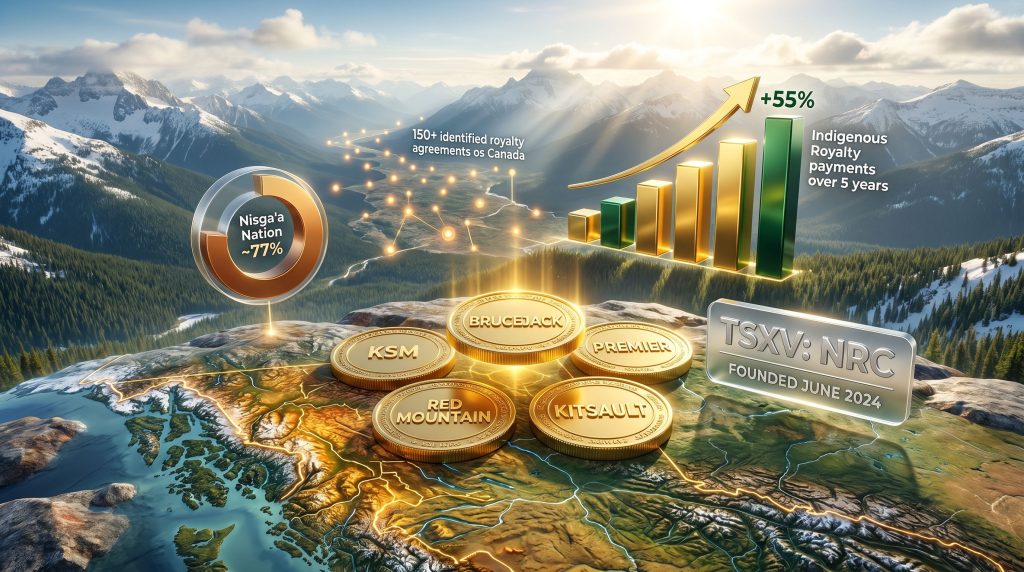
Nations Royalty (TSXV: NRC) was founded in June 2024, becoming the first time in Canadian history that an Indigenous group placed mineral royalty assets directly into a publicly traded company under Indigenous management and control. It is also recognised as Canada's largest majority Indigenous-owned public company, a designation that reflects both its founding ambition and its structural uniqueness.
The Nisga'a Nation is the founding partner and majority shareholder, holding approximately 76.8% to 77% of the company. The Nisga'a contributed five annual benefit payment entitlements sourced from mining operations located in British Columbia's Golden Triangle, one of the highest-grade gold-producing regions on the planet.
The founding architecture solved a specific capital markets problem: how to allow Indigenous communities to monetize future royalty entitlements without surrendering long-term ownership. The answer was to pool those entitlements into equity stakes within a publicly listed royalty company, converting future cash flows into tradeable shares. Furthermore, the evolving BC mining claims framework has increasingly shaped how these entitlements are structured and recognised.
Why Cultural Access Is a Durable Competitive Moat
The most important thing to understand about Nations Royalty is that its competitive advantage is not financial. It is cultural and relational. Conventional royalty companies entering Indigenous-held territories face extended consultation timelines, legal complexity, and community resistance that no balance sheet can resolve quickly.
Nations Royalty's Indigenous leadership and majority ownership structure creates a fundamentally different entry dynamic. The company's representatives are not outsiders negotiating on commercial terms. They are community members operating within shared cultural frameworks, building trust over years rather than quarters.
This mirrors the logic of highly specialised royalty companies in other sectors: the edge lies not in the royalty instrument itself, but in the proprietary access to deal flow that competitors simply cannot reach. In addition, the broader geopolitical mining landscape has heightened the strategic importance of securing stable, relationship-driven access to resource-rich territories.
One illustration of this dynamic involves the patient, relationship-first approach of the company's team. Building trust in Indigenous communities is not transactional. It involves cultural immersion, shared experience, and demonstrated long-term commitment. The kind of access this creates is not something that can be purchased or replicated by an external party, regardless of how much capital they deploy.
This mirrors how Rick Rule, one of the most respected voices in natural resource investing, has long framed competitive advantage in the royalty sector: the most durable moats are built on proprietary deal flow that others cannot access. Nations Royalty's Indigenous ownership structure is precisely that kind of moat.
The Current Portfolio: Golden Triangle Optionality With One Producing Engine
Five Royalties, One Revenue Source
Nations Royalty's existing portfolio spans five significant projects in British Columbia's Golden Triangle. The portfolio structure reflects the difference between current cash flow and long-term optionality.
| Project | Operator | Status | Royalty Type |
|---|---|---|---|
| Brucejack | Newmont Corporation | Producing | Annual benefit payment / NSR |
| KSM | Seabridge Gold Inc. | Advanced development | Annual benefit payment |
| Premier | Undisclosed | Development stage | Annual benefit payment |
| Red Mountain | Undisclosed | Development stage | Annual benefit payment |
| Kitsault | Undisclosed | Development stage | Molybdenum / benefit payment |
The Brucejack Mine, operated by Newmont, is the sole producing asset in the portfolio. Newmont is one of the world's largest gold producers, which provides operational credibility and counterparty strength to the royalty. However, it is important for investors to understand that Brucejack royalty revenue alone does not currently cover full corporate operating costs. This makes Nations Royalty an early-stage royalty platform, not a mature cash-flow business.
The remaining four assets carry no near-term revenue but represent meaningful optionality value. As these projects advance toward production over coming years, they could substantially increase the company's royalty income without any additional capital deployment on Nations Royalty's part.
"Investor consideration: Nations Royalty is best evaluated as an early-stage royalty platform with one producing asset and four development-stage positions. The investment thesis rests on portfolio expansion, not on existing cash generation alone."
The Growth Strategy: Three Pathways to Portfolio Expansion
The Proprietary Database Advantage
Nations Royalty has identified more than 150 Indigenous royalty agreements across Canada in a proprietary internal database. This is not publicly available information. It represents years of relationship-building and community engagement, and it forms the foundation of the company's forward growth strategy.
Royalty payments flowing to Indigenous groups across Canada have grown 55% over the last five years, driven by increased mining activity, stronger First Nation negotiating positions, and evolving consultation frameworks. The addressable market is large and expanding. Nations Royalty's position within that market is structurally privileged.
The Tahltan Nation Scenario: A Potential Portfolio Tripling
The most significant near-term growth catalyst involves the Tahltan Nation, whose traditional territory in northwestern British Columbia sits in the same mineral-rich corridor as Nisga'a lands. The geographic and cultural proximity between these two communities creates a natural partnership opportunity.
If the Tahltan Nation were to pool their royalty interests into Nations Royalty, analysts familiar with the company's asset base have suggested this single transaction could potentially triple the size of the current royalty portfolio. This is not a formal negotiation underway in any publicly announced sense. It is being pursued through the kind of relationship-building that is culturally appropriate and deliberate, on a timeline driven by community process rather than capital markets impatience.
The Abitibi Greenstone Belt: Geographic Diversification
Beyond British Columbia, Nations Royalty is pursuing expansion into Ontario and Quebec's Abitibi Greenstone Belt, one of the most historically prolific gold-producing regions in the world. The northern Abitibi is substantially Indigenous territory, and Nations Royalty's ownership structure provides a competitive entry point that external royalty companies cannot match through financial capital alone.
This geographic diversification would reduce the company's current concentration risk in the Golden Triangle while opening access to a second major gold-producing jurisdiction. For context, major mineral discoveries in similar greenstone belts have historically delivered transformative returns to royalty holders positioned early in development cycles.
Traditional vs. Nations Royalty Model: A Structural Comparison
| Dimension | Traditional IBA Structure | Nations Royalty Model |
|---|---|---|
| Ownership | Community holds future payments | Community holds equity in a royalty company |
| Liquidity | Illiquid until production triggers payment | Shares are publicly tradeable |
| Diversification | Single-mine exposure | Multi-asset royalty portfolio |
| Valuation basis | Face value of future cash flows | Premium royalty company multiples |
| Governance | Bilateral (community and miner) | Board-governed public company |
| Capacity building | None inherent | Indigenous professionals embedded in management |
The comparison to companies like Empress Royalty is instructive. Empress derives its deal flow advantage through its relationship with Endeavor Financial, which provides access to more small-company deal flow than most competitors. Nations Royalty derives its advantage through Indigenous ownership and community relationships. Both models rely on proprietary access, but Nations Royalty's access is non-replicable in a way that financial relationships are not.
The next major ASX story will hit our subscribers first
The U.S. Benchmark: What Energy-Rich Tribes Reveal About Mining Potential
The Council of Energy Resource Tribes as a Comparable Framework
In the United States, the Council of Energy Resource Tribes (CERT) has provided energy-rich Indigenous communities, particularly in Montana and Wyoming, with a sophisticated framework for monetizing mineral and energy rights. American tribes in these regions have achieved a degree of economic sovereignty through resource monetization that Canadian First Nations in mining regions are only beginning to approach.
| Dimension | United States | Canada |
|---|---|---|
| Primary resource focus | Oil and gas | Precious metals, critical minerals |
| Organisational vehicle | Council of Energy Resource Tribes (CERT) | Nations Royalty (public company model) |
| Maturity | Established over decades | Founded 2024 |
| Public market access | Limited | Full (TSXV listed) |
| Terminology used | Tribe, Indian country | First Nation, Band |
A mining-side equivalent of CERT does not currently exist in the United States. Nations Royalty's model, if it matures successfully in Canada, could serve as a template for cross-border replication in jurisdictions where similar structural gaps exist between Indigenous territorial presence and resource wealth capture. Indeed, turning royalties into sovereignty is a concept that has attracted international attention, with observers noting lessons that extend well beyond Canadian borders.
Key Risks Investors Should Evaluate Carefully
Single-Asset Revenue Concentration
With only Brucejack currently producing, Nations Royalty's near-term cash flow is entirely dependent on one asset operated by a third party. Any operational disruption, production shortfall, or sustained gold price weakness at Brucejack would have a disproportionate impact on company revenue compared to a diversified royalty portfolio.
Execution Risk on Community Expansion
The growth thesis is contingent on Nations Royalty successfully onboarding additional First Nations communities. Community decision-making processes operate on different timelines than capital markets expectations, and this creates inherent unpredictability around catalysts. Investors should approach timeline expectations with patience and apply probability-weighted scenario analysis to expansion milestones rather than assuming linear progression.
Early-Stage Valuation Considerations
At current pricing, Nations Royalty's share price reflects its existing asset base. According to commentary from experienced resource investors, the stock appears fully priced relative to its current assets at this stage of development. The re-rating catalyst is portfolio expansion, particularly the addition of Tahltan Nation royalties and Abitibi-region agreements.
Static discounted cash flow analysis on current revenues alone is unlikely to capture the forward value of the expansion pipeline. However, when assessed through the lens of mining private equity frameworks, the royalty model's structural advantages become clearer.
Market Liquidity and Awareness
As a TSXV-listed micro-cap company founded in 2024, Nations Royalty faces the typical challenges of early-stage public companies: limited institutional participation, potential price discovery inefficiency, and modest trading liquidity. These are features of the stage, not necessarily permanent characteristics. Furthermore, understanding the full spectrum of junior mining risks is essential context for evaluating any investment in this space.
FAQ: Nations Royalty and Indigenous Mining Royalties in Canada
What is Nations Royalty?
Nations Royalty (TSXV: NRC) is Canada's first and largest majority Indigenous-owned publicly traded mining royalty company, founded in June 2024 and majority-owned by the Nisga'a Nation.
How Does Nations Royalty Generate Revenue?
The company receives royalty payments from mining operations on which it holds royalty interests. Currently, the Brucejack gold mine operated by Newmont is the sole producing asset generating royalty revenue.
What Is an Impact and Benefit Agreement?
An IBA is a negotiated agreement between a mining company and an Indigenous community granting the community certain rights, including royalty payments based on production or profit, in exchange for community support for mining activity in traditional territory.
Why Can Conventional Royalty Companies Not Replicate Nations Royalty's Model?
The competitive advantage is rooted in Indigenous ownership, leadership, and cultural relationships. Financial capital alone cannot replicate the trust-based access to Indigenous royalty agreements that Nations Royalty's structure enables.
What Is the Largest Near-Term Growth Catalyst?
The potential onboarding of Tahltan Nation royalty interests represents the most significant near-term portfolio expansion scenario, with estimates suggesting it could approximately triple the current portfolio size.
How Large Is the Addressable Market?
Nations Royalty has identified over 150 Indigenous royalty agreements across Canada in its proprietary database. Royalty payments to Indigenous communities have grown 55% over the last five years.
Capacity, Sovereignty, and the Long-Term Significance of This Model
Solving the Capacity Gap That Has Always Existed
Historically, one of the most underappreciated disadvantages facing Indigenous communities in mining negotiations was not legal standing or territorial rights. It was technical capacity. Communities often lacked access to their own geologists, engineers, lawyers, and financial analysts.
Even when goodwill existed on the part of mining companies, Indigenous communities could not independently verify whether they were receiving fair value. They had no choice but to take the word of the party across the negotiating table.
Nations Royalty's Indigenous-led professional team represents a structural solution to this problem. Communities engaging with the company have access to expert representation embedded within their own cultural context. The expertise is not borrowed from outside. It originates from within.
A Model Built on Agency, Not Advocacy
The Nations Royalty framework is explicitly designed around economic agency rather than political advocacy. It does not seek government transfers, regulatory mandates, or preferential treatment. It deploys capital markets mechanics in service of Indigenous ownership. This distinction matters for the company's long-term durability: its foundation is economic participation on equal terms, not entitlement derived from policy frameworks.
The model's potential replicability — across additional First Nations, additional resource types including critical minerals and energy, and potentially across international borders — is what gives it strategic significance well beyond its current market capitalisation.
Key Statistics at a Glance
| Metric | Data Point |
|---|---|
| Company founding | June 2024 |
| Stock exchange | TSXV: NRC |
| Nisga'a Nation ownership stake | ~76.8% to 77% |
| Royalties in current portfolio | 5 |
| Currently producing assets | 1 (Brucejack, Newmont) |
| Indigenous royalty agreements identified in Canada | 150+ |
| Growth in Indigenous royalty payments over 5 years | +55% |
| Tahltan expansion scenario | Potential ~3x portfolio size |
This article is intended for informational purposes only and does not constitute financial advice. Nations Royalty is an early-stage public company, and all forward-looking statements regarding portfolio expansion, valuation re-rating, and community partnership outcomes involve material uncertainty. Investors should conduct independent due diligence and consult a qualified financial adviser before making investment decisions. Past performance of royalty sector companies is not indicative of future results.
Want to Track the Next Major Mineral Discovery Before the Market Does?
Discovery Alert's proprietary Discovery IQ model scans ASX announcements in real time, transforming complex mineral data into actionable insights for investors across every stage of experience — explore historic discoveries and their returns to understand what early positioning can mean, then begin your 14-day free trial at Discovery Alert to secure your market-leading edge.