June 28, 2026
The Hidden Cost of Fiscal Ambition: Why Mining Jurisdictions Walk a Razor's Edge
Resource nationalism has a long and turbulent history. From the copper nationalisation debates of 1970s Chile to the windfall profit controversies that reshaped Australia's mining investment landscape in the early 2010s, governments have repeatedly discovered the same uncomfortable truth: the moment a commodity boom creates excess profits, the political pressure to capture a larger share becomes almost irresistible. Yet the very act of reaching for that revenue can trigger the capital flight that undermines it.
This tension sits at the core of what unfolded in Indonesia in May 2026, when Indonesia delays higher mineral royalties and export duties became the defining story for commodity investors tracking the region. Energy and Mineral Resources Minister Bahlil Lahadalia announced a pause on plans to impose elevated royalties and export duties across key mineral commodities including coal. The decision, framed publicly as a search for an arrangement beneficial to both government and industry, reflects a dynamic that extends far beyond Indonesia's borders.
Understanding why Indonesia made this move, what the original proposals would have looked like, and what the delay signals for global commodity markets requires looking well beyond the headline announcement.
When big ASX news breaks, our subscribers know first
Indonesia Delays Higher Mineral Royalties and Export Duties: What Was Actually Proposed?
The Indonesian government had been working toward a dual-pronged revenue enhancement strategy: higher royalty rates applied to mining companies operating across a range of commodities, paired with export duties on outbound mineral shipments including coal. The overarching objective, consistent with statements from ministry officials over preceding months, was to increase the government's share of returns from the country's substantial natural resource base.
What makes this proposal particularly significant is its scope. Indonesia is not a marginal producer in global commodity markets. It holds one of the world's most substantial nickel endowments, is a major thermal coal exporter, and has growing significance in copper and other battery-relevant minerals. Furthermore, any revision to its fiscal framework carries downstream implications for supply chains stretching from Southeast Asia to European electric vehicle manufacturers.
A Snapshot of the Proposed Rate Adjustments
The proposed changes covered multiple commodities under a progressive royalty structure, where the applicable rate would scale with prevailing commodity prices. The table below illustrates the scope of adjustments that were placed on hold:
| Commodity | Previous Royalty Rate | Proposed Rate | Export Duty Status |
|---|---|---|---|
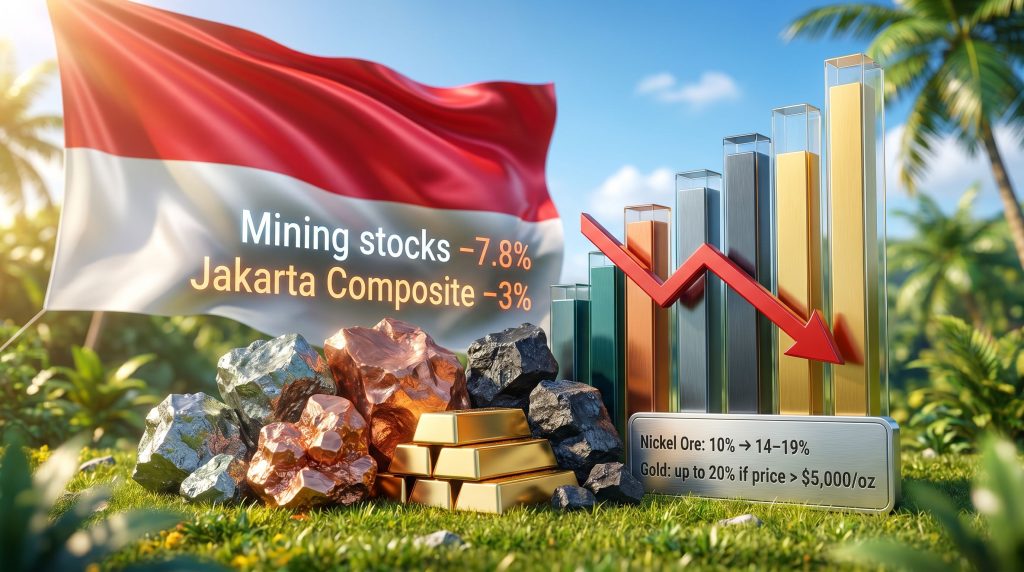
| Nickel Ore | 10% | 14–19% (price-linked) | Windfall surcharge proposed |
| Copper Concentrate | 7–10% | 9–13% | Under review |
| Gold | Variable | Up to 20% (if price exceeded $5,000/oz) | Under review |
| Coal | Existing rate | Higher progressive rate | Windfall tax delayed from April 1 |
| Nickel Pig Iron (NPI) | Existing rate | Windfall surcharge | Delayed indefinitely |
| Tin and Silver | Existing rate | Proposed increases | Pending formulation |
Note: The specific rate proposals in this table are drawn from pre-announcement reporting and industry analysis. The official final formulation had not been published at the time the delay was announced. Readers should treat these figures as indicative of the direction of policy rather than confirmed legislative text.
Understanding Progressive Royalties and Windfall Mechanisms
A standard flat-rate royalty applies a fixed percentage to the value of extracted minerals regardless of the prevailing price environment. A progressive royalty, by contrast, increases the applicable rate as commodity prices rise, creating a dynamic link between market conditions and government take.
A windfall levy takes this a step further. Rather than simply scaling with price, a windfall structure targets the portion of revenue or profit that exceeds a predetermined baseline, effectively treating high-price environments as generating surplus returns that should be partially redistributed to the public treasury. The logic is that mining companies bear fixed capital costs and that exceptional commodity prices represent a market windfall rather than a reward for additional risk or effort.
The distinction matters practically: a progressive royalty raises costs across the board during strong markets, while a windfall levy targets only the incremental gain above a threshold. Both create uncertainty, but windfall structures introduce a particularly sharp discontinuity at the trigger price level.
The Policy Reversal: Why the Ministry Stepped Back
Minister Bahlil Lahadalia's public statement to Reuters on May 8, 2026, described a process of consulting with businesses and public stakeholders before concluding that additional time was needed to develop a well-structured approach. The ministry emphasised that collecting feedback from miners was central to ensuring the final policy would not place undue strain on the sector.
The framing is notable for what it reveals about the Indonesian government's awareness of the limits of fiscal escalation. While officials had made clear they wanted to grow mining revenue contributions to national accounts, the language of a mutually beneficial formula signals recognition that the original timeline and rate structure may have pushed past what industry participants were prepared to absorb without recalibrating their investment plans.
The 2025 Foundation and the 2026 Escalation Problem
Context matters significantly here. The 2026 proposals did not emerge in isolation. Indonesia had already implemented royalty reforms in 2025 that raised nickel ore royalties to 10% and introduced cobalt royalties for the first time, establishing a new baseline fiscal framework. The 2026 proposals represented a second escalation within a roughly twelve-month window.
For mining investors, the pace of sequential increases is frequently as concerning as the absolute level. A single adjustment can be modelled and absorbed. However, repeated escalations at short intervals create a forward-looking uncertainty problem: if rates moved twice in twelve months, what prevents a third adjustment in another six? This trajectory risk tends to compress project valuations and lengthen decision timelines for new capital commitments. The Indonesian nickel industry has been particularly exposed to this dynamic, given the pace of regulatory change affecting long-cycle assets like smelters and processing facilities.
How Public Consultation Fits Into Indonesian Mineral Policy
Formal consultation processes in Indonesia's mineral sector typically involve structured input periods running from three to six months, providing industry participants, civil society groups, and affected communities the opportunity to submit feedback before policy is finalised. The March 2026 consultation round that preceded the May delay announcement reflected this procedural framework.
The ministry's acknowledgment that this feedback directly influenced the decision to pause represents an important institutional signal: that the consultative mechanism was functioning as intended rather than serving as a procedural formality. According to reporting from the Business Times, policy uncertainty has continued to weigh on the broader sector despite the delay announcement.
Indonesia's Strategic Position in Global Commodity Markets
Any analysis of this delay must account for Indonesia's outsize role in several commodity markets simultaneously. The country's significance spans both the traditional industrial supply chain and the energy transition materials complex, creating a dual exposure that amplifies the global relevance of its fiscal decisions.
Nickel and the Electric Vehicle Supply Chain
Indonesia holds one of the world's most significant nickel reserves and has become a central node in the global battery materials supply chain. Nickel is a critical input for high-energy-density lithium-ion cathodes, particularly in the nickel-manganese-cobalt (NMC) and nickel-cobalt-aluminium (NCA) chemistries favoured by premium electric vehicle manufacturers. The Indonesian nickel price environment has consequently attracted intense scrutiny from battery manufacturers and automakers alike.
The country's processing infrastructure spans multiple product types with different supply chain roles:
- Nickel Pig Iron (NPI): A lower-grade ferronickel product primarily used in stainless steel production, manufactured from laterite ores using rotary kiln electric furnace (RKEF) technology
- Ferronickel: A higher-purity intermediate used in stainless and specialty steel applications
- Mixed Hydroxide Precipitate (MHP): A battery-grade intermediate product used in cathode active material production, representing the highest-value end of Indonesia's nickel processing spectrum
- Nickel Matte: A high-grade nickel intermediate suitable for conversion to battery-quality nickel sulphate
The royalty regime affects these product streams differently depending on whether the levy applies at the ore extraction stage, the concentrate stage, or the processed intermediate stage. Industry analysts have noted that MHP operations may face comparatively limited direct exposure from delayed royalties, given their position further along the value chain, though this depends heavily on how any final formulation structures the rate application points.
Any sustained increase in Indonesian nickel production costs, whether through royalties, export duties, or processing levies, has the potential to flow through to battery-grade nickel pricing globally, affecting EV manufacturers across Asia, Europe, and North America.
Coal's Continued Fiscal Importance
Thermal coal remains a significant export revenue contributor for Indonesia, and any windfall tax applied to coal shipments carries both fiscal and geopolitical dimensions. Indonesia supplies substantial volumes to power generation markets across Asia, and coal export revenues have provided meaningful fiscal buffers during commodity price cycles. This dual role, as both a revenue source and a geopolitically sensitive export, makes coal-related tax decisions among the most politically complex components of the overall mineral royalty package.
How Other Resource Nations Have Navigated This Challenge
Indonesia is far from alone in grappling with the design of windfall and progressive royalty mechanisms. Comparable debates have played out across multiple major mining jurisdictions, with outcomes ranging from successful phased implementation to significant investor confidence damage.
| Country | Commodity Focus | Fiscal Mechanism | Outcome |
|---|---|---|---|
| Australia | Iron ore, coal, lithium | State royalties; federal super-profits tax debated | Major producers successfully lobbied against the 2010 federal proposal; state royalties remain primary instrument |
| Chile | Copper | Progressive royalty plus windfall surcharge (implemented 2023) | Initial industry resistance followed by phased adoption after sustained negotiation |
| Democratic Republic of Congo | Cobalt, copper | Revised Mining Code (2018) with elevated royalty rates | Documented investor concern and reported project delays, particularly among junior developers |
| Indonesia | Nickel, coal, copper, gold | Progressive royalties plus proposed windfall export duties | Policy delay announced May 2026 pending revised formulation |
Chile's Phased Approach as a Reference Model
Chile's 2023 copper royalty reform is frequently cited as an example of how a major producing nation managed the tension between revenue ambition and investor relations. After initial versions of the proposal met fierce industry resistance, Chilean legislators adopted a phased implementation timeline with higher rates delayed until new projects had achieved defined production milestones.
The result was a framework that ultimately secured broader acceptance without triggering the scale of capital flight that earlier drafts had risked. In addition, the Chilean approach demonstrated that transparent consultation timelines can meaningfully reduce the risk premium investors attach to a jurisdiction. Whether Indonesia's consultation process produces a similarly calibrated outcome remains to be seen.
The DRC's Cautionary Precedent
The Democratic Republic of Congo's 2018 revision of its mining code, which raised royalty rates and reclassified cobalt as a strategic mineral subject to higher levies, offers a contrasting case study. The speed and scope of changes, combined with uncertainty about retrospective application to existing agreements, generated sustained concern among foreign investors and contributed to reported project deferrals.
Indonesia's ministry appears to be attempting to avoid a comparable outcome by explicitly committing to further consultation before finalising any new structure. Consequently, the manner in which Jakarta manages the next phase of consultation will be closely watched by investors across the battery metals investment landscape.
Investor Framework: Reading the Policy Signal Correctly
For investors with exposure to Indonesian mining assets, the May 2026 delay creates a specific analytical challenge. The pause provides near-term relief from cost escalation pressures, but it does not eliminate the underlying fiscal ambition that drove the original proposals. Treating the delay as a permanent retreat would be a misreading of the policy direction.
Short-Term and Long-Term Implications
Short-Term Dynamics:
- Removal of immediate cost escalation pressure on nickel, copper, coal, and gold producers
- Potential stabilisation in mining sector valuations following the announcement
- Continued uncertainty over the timing and structure of eventual implementation
Long-Term Structural Questions:
- Repeated reform proposals followed by delays risk embedding a structural risk premium into Indonesian mining valuations
- New smelter and downstream processing investment decisions may be deferred pending policy clarity
- The government's credibility on fiscal reform depends on producing a transparent, consultative, and stable final framework within a defined timeframe
Investors in resource-heavy jurisdictions increasingly price not just the current royalty rate but the trajectory and predictability of the entire fiscal regime. A government that signals reform, delays, and re-signals creates compounding uncertainty even if the eventual policy is ultimately reasonable in absolute terms.
A Practical Monitoring Framework
Given the open-ended nature of the delay, investors should track the following indicators before repositioning on Indonesian mining exposure:
- Formal outcomes and timelines from the ongoing public consultation process
- New statements from the Energy and Mineral Resources Ministry on proposed rate structures and trigger mechanisms
- Global nickel, coal, and copper price movements, which directly influence windfall tax trigger thresholds and the government's fiscal urgency
- Downstream investment announcements, particularly for smelter expansions and battery precursor facilities, as a proxy for industry confidence in the regulatory environment
- Parallel fiscal measures under the Prabowo administration that may shift the timeline pressure on mining revenue targets
- Any credit rating or sovereign assessment commentary addressing Indonesia's fiscal position and commodity sector contributions
Furthermore, investors should consider how broader trade wars and tariffs in 2025 are compounding the complexity of commodity supply chains, including those originating from Indonesia. The interplay between royalty regimes and export duty structures does not occur in isolation from global trade policy shifts.
The next major ASX story will hit our subscribers first
Frequently Asked Questions
What minerals are affected by Indonesia's delayed royalty increases?
The delay covers a broad range of commodities including coal, nickel, copper, gold, tin, and silver. Coal was explicitly confirmed in the Reuters announcement. Other commodities were covered under the broader proposed progressive royalty structure.
Why did Indonesia delay the higher export duties on coal and nickel?
Minister Bahlil Lahadalia cited the need to consult with industry stakeholders and develop a formula that does not place excessive burden on the mining sector while still advancing the government's revenue objectives. The delay is framed as a pause for refinement rather than a withdrawal of the underlying policy intent.
What is a progressive royalty, and how does it differ from a flat-rate royalty?
A flat-rate royalty applies a single fixed percentage to mineral revenue regardless of commodity prices. A progressive royalty scales the applicable rate upward as commodity prices rise, capturing a larger government share during high-price environments. A windfall levy adds a further layer by applying specifically to revenues or profits exceeding a predetermined price threshold.
Will the delay affect global nickel or coal supply in the near term?
In isolation, the policy delay removes near-term cost uncertainty for Indonesian producers, which may support production continuity. However, it does not resolve the longer-term uncertainty about eventual rate levels, leaving capital allocation decisions for new capacity expansions in a holding pattern. The impact on copper supply chains is similarly contingent on how the final framework takes shape.
When is Indonesia expected to finalise its revised mining fiscal framework?
No specific timeline has been confirmed. The ministry's commitment to developing an ideal formulation through consultation suggests a multi-month process at minimum, though the absence of a stated deadline introduces additional uncertainty for planning purposes.
What the Indonesia Royalty Delay Signals for the Broader Mining Sector
The events of May 2026 illustrate a dynamic that defines resource sector investing across every major producing nation. Governments face genuine fiscal pressures, and commodity booms create genuine political incentives to capture a larger share of exceptional returns. The challenge is that the threshold between appropriate revenue capture and investment deterrence is difficult to identify in advance and only becomes apparent through market reactions and capital allocation decisions.
Indonesia delays higher mineral royalties and export duties in this instance not out of weakness, but out of a pragmatic recognition that the sequencing and structure of reform matters as much as its ambition. Investors tracking the battery metals investment landscape will find Indonesia's evolving fiscal posture a critical variable in their analysis of supply-side risk across the energy transition.
For global commodity markets, the outcome will carry implications well beyond Indonesia's borders. In a world where battery supply chains depend on Indonesian nickel processing capacity and Asian power grids depend on Indonesian coal, the predictability of Indonesia's regulatory environment is not merely a domestic investment concern. It is a factor in global energy transition economics and industrial supply chain planning across multiple continents.
This article is intended for informational purposes only and does not constitute financial advice. Forecasts, projections, and commentary on policy outcomes involve inherent uncertainty. Investors should conduct independent due diligence and consult qualified financial advisers before making investment decisions based on information discussed in this article.
Want to Stay Ahead of Major ASX Mineral Discoveries as They Happen?
Discovery Alert's proprietary Discovery IQ model delivers real-time alerts on significant ASX mineral discoveries, cutting through the complexity of commodity markets to surface actionable opportunities the moment they emerge — explore historic discoveries and the returns they generated to understand what early positioning can mean for your portfolio, and begin your 14-day free trial today.