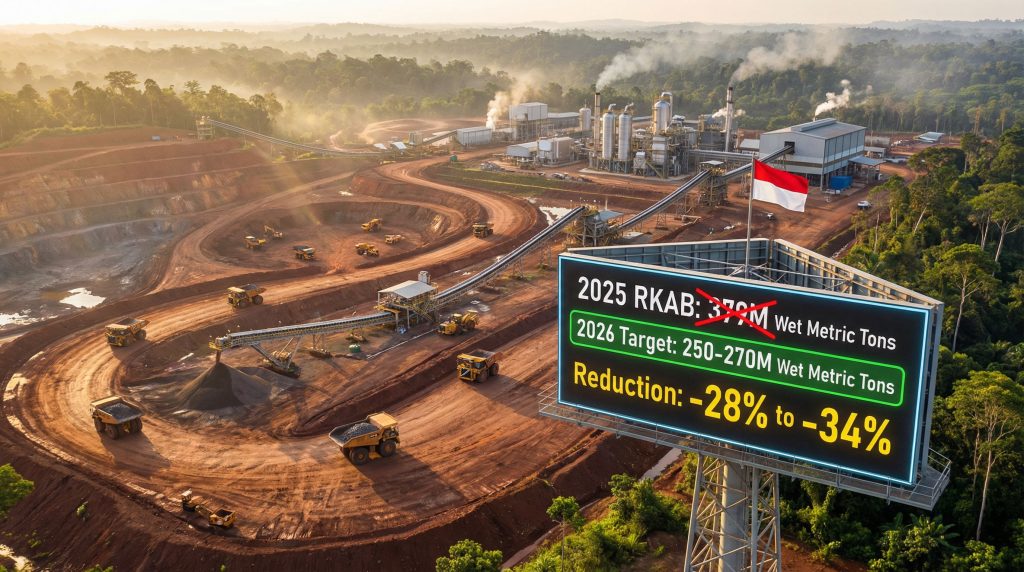
Indonesia's strategic approach to nickel resource management represents a fundamental shift in global commodity governance, with the Indonesia nickel permit 2026 framework demonstrating sophisticated supply control mechanisms. As the world's largest nickel producer commands approximately 70% of global supply, these regulatory adjustments reverberate through international markets, affecting everything from battery manufacturing to stainless steel production.
Understanding Indonesia's Strategic Mining Quota Framework
Global nickel markets operate within an intricate web of supply constraints, regulatory interventions, and strategic resource management. As demand for battery-grade metals intensifies across automotive and renewable energy sectors, resource-rich nations increasingly leverage production controls to maximise economic value extraction from mineral endowments. Understanding mining permitting basics becomes essential for stakeholders navigating this evolving landscape.
Indonesia's evolution toward annual nickel production approvals represents a sophisticated shift from traditional multi-year permit structures to dynamic market intervention capabilities. This regulatory transformation enables authorities to calibrate domestic ore availability against international pricing pressures whilst supporting downstream processing capacity expansion. Furthermore, the broader mining industry evolution reflects similar trends toward strategic resource management worldwide.
The archipelago nation's commanding position in global nickel supply chains positions these policy adjustments as critical market-moving events. The annual RKAB (Rencana Kerja dan Anggaran Biaya) system demonstrates how resource governance can function as both industrial policy tool and market stabilisation mechanism.
Market Dominance and Supply Control Mechanics
Indonesia's nickel sector operates under an increasingly centralised quota allocation system that replaced previous multi-year mining permits. The Energy and Mineral Resources Ministry (ESDM) now reviews production ceilings annually, creating structural uncertainty for permit holders whilst providing regulatory flexibility for market interventions.
This quota framework incorporates multiple policy objectives beyond simple extraction maximisation. Authorities target supply levels matching domestic smelter capacity requirements whilst maintaining adequate ore availability for local processing facilities. Consequently, the system integrates environmental compliance standards, operational capability assessments, and strategic industrial development goals.
Key Regulatory Features:
• Annual RKAB quota reviews by ESDM ministry
• Integration of environmental compliance requirements
• Alignment with domestic smelter capacity expansion
• Flexible adjustment mechanisms for market conditions
• Company-specific allocation methodologies
The transition from multi-year to annual permits fundamentally alters investment planning horizons for mining operators. Companies must navigate annual uncertainty regarding production ceilings, potentially affecting long-term capacity utilisation strategies and capital allocation decisions. Additionally, understanding the mining claims framework provides context for how different jurisdictions approach resource allocation.
When big ASX news breaks, our subscribers know first
What Do the 2026 Permit Reductions Actually Mean?
The Indonesian government has established 2026 nickel mining quotas totaling approximately 260-270 million wet metric tons, representing a substantial reduction from 2025 approved volumes. This constraint represents more than a simple supply adjustment – it signals deliberate policy recalibration toward value-added processing prioritisation. The Indonesia nickel permit 2026 framework reflects strategic alignment with domestic processing capacity.
According to mining ministry official Tri Winarno, as reported by Channel News Asia, the 2026 quota range reflects strategic alignment with domestic processing capacity. This supply-demand equilibrium approach demonstrates sophisticated resource management beyond traditional extraction maximisation models.
Production Ceiling Analysis:
| Metric | 2025 Framework | 2026 Target Range | Strategic Impact |
|---|---|---|---|
| Approved Volumes | Multi-year permits | 260-270M wet metric tons | Centralised control |
| Policy Structure | Extended planning horizon | Annual review system | Increased flexibility |
| Market Intervention | Limited real-time adjustment | Dynamic supply management | Enhanced leverage |
Individual Company Allocation Dynamics
Major nickel producers face varying degrees of quota adjustments under the revised framework. Eramet's PT Weda Bay Nickel joint venture exemplifies this trend, receiving an initial 12 million wet metric ton allocation for 2026 compared to its revised 42 million ton 2025 allowance.
This dramatic reduction from peak 2025 levels illustrates how the quota system affects different operational scales and partnership structures within Indonesia's nickel sector. However, the French mining company announced immediate plans to apply for upward revision of the volume, demonstrating the negotiable nature of initial allocations.
PT Weda Bay Allocation Timeline:
• 2025 Initial RKAB: 32 million wet metric tons
• 2025 Mid-Year Adjustment: Increased to 42 million wet metric tons (July)
• 2026 Initial RKAB: 12 million wet metric tons
• Net Change: 71% reduction from revised 2025 peak
• Company Response: Immediate application for upward revision
The mid-year 2025 increase followed by severe 2026 reduction demonstrates policy unpredictability and regulatory flexibility. For instance, this volatility pattern suggests quota allocations incorporate multiple variables beyond simple production history or technical capacity considerations.
Why Is Indonesia Implementing These Quota Restrictions?
The quota reductions align with Indonesia's broader industrial policy objectives, particularly accelerated development of domestic nickel processing capabilities. By constraining raw ore availability, authorities ensure adequate feedstock for local smelters whilst preventing oversupply conditions that could depress global commodity prices. This strategic approach represents part of a comprehensive critical minerals strategy.
This strategic approach represents a fundamental shift from volume-based resource extraction toward integrated value addition and supply chain control. Furthermore, the policy framework mirrors successful models in other commodity sectors where resource-rich nations leveraged supply constraints to capture greater economic value from natural endowments.
Domestic Processing Capacity Alignment
Ministry targets indicate quota levels should match domestic smelter capacity requirements, currently estimated at 250-260 million tons annually. This supply-demand equilibrium approach ensures consistent feedstock availability for local processing facilities whilst maintaining pricing power in international markets.
The strategic calculation involves balancing multiple competing objectives:
• Maximising domestic value addition through local processing
• Maintaining competitive pricing for Indonesian nickel products
• Supporting smelter capacity utilisation optimisation
• Preventing global market oversupply conditions
• Generating higher tax revenue from processing operations
Environmental Compliance Integration
The suspension of 190 mining permits in 2025 for non-compliance issues demonstrates the regulatory framework's emphasis on operational and environmental standards. The Indonesia nickel permit 2026 system incorporates these compliance requirements, potentially favouring operators with stronger environmental track records and technical capabilities.
This compliance-based allocation approach creates incentives for mining operators to invest in environmental management systems, safety protocols, and operational excellence. In addition, companies demonstrating superior compliance performance may receive preferential treatment in future quota allocations.
"The integration of environmental standards into quota allocation represents a sophisticated approach to resource governance that balances extraction economics with sustainability objectives."
How Are Global Nickel Markets Responding to These Changes?
London Metal Exchange three-month nickel contracts surged 2.2% to $17,880 per metric ton following quota announcements, with intraday peaks reaching $17,980 – the highest levels since January 30, 2026. This immediate price response reflects market recognition of Indonesia's supply influence and concerns about potential ore shortages.
The magnitude of market response demonstrates how deeply Indonesian policy dynamics have become integrated into global nickel price discovery mechanisms. Consequently, traders interpreted quota restrictions as signals of tightening worldwide nickel availability, triggering responsive position adjustments across commodity markets. For context, similar dynamics affect other nickel-copper project insights globally.
Market Response Timeline:
• Indonesia announces 260-270M ton 2026 quotas (February 10, 2026)
• Reuters reports quota reduction overnight
• LME nickel futures opening: +2.2% to $17,880/mt
• Intraday peak: $17,980/mt (+2.8% gain)
• Previous comparable high: January 30, 2026
Supply-Demand Imbalance Projections
The quota reductions expose potential vulnerabilities in global nickel supply chains, particularly for industries dependent on consistent feedstock availability. Projected 2026 ore demand could reach 330-350 million tons based on existing smelter capacity, creating a significant gap against reduced domestic supply quotas.
Supply Gap Analysis:
| Component | Volume Range | Market Implications |
|---|---|---|
| Projected Smelter Demand | 330-350 million tons | Based on operational capacity |
| Approved Quota Range | 260-270 million tons | Government allocation ceiling |
| Potential Shortfall | 60-100 million tons | May require imports or increases |
This structural imbalance suggests Indonesia may need to consider strategic adjustments to prevent market disruptions. Options include quota increases, strategic imports from other producers, or acceptance of higher global prices that naturally ration demand to available supply levels. Vale Indonesia's recent quota approval demonstrates how companies are securing operational certainty within this framework.
International Price Impact Assessment
Market analysts project potential price targets approaching elevated levels if quota restrictions persist throughout 2026. The immediate 2.8% intraday spike demonstrates market sensitivity to Indonesian supply policy announcements, highlighting significant leverage the nation wields over global nickel valuations.
Financial markets may need to incorporate Indonesian policy dynamics into nickel price forecasting models more systematically. However, the government's active role in supply management decisions creates a policy premium that traditional supply-demand modelling may inadequately capture.
What Are the Long-Term Strategic Implications?
Indonesia's quota strategy reflects a broader transition from volume-based resource extraction toward sophisticated value optimisation and strategic supply management. This approach demonstrates how resource-rich nations can leverage supply controls to influence global market dynamics whilst supporting domestic industrial development objectives.
The annual review system provides flexibility to adjust quotas based on changing market conditions, domestic processing capacity expansion, and geopolitical considerations. In addition, this creates a dynamic policy tool that can respond to both local economic needs and international market pressures.
Investment Flow Redirection
The quota uncertainty may significantly influence international investment patterns in Indonesia's nickel sector. Integrated operations with downstream processing capabilities could receive preferential treatment over pure extraction operations, fundamentally altering the risk-return profile for different investment strategies.
Companies demonstrating commitment to local value addition, environmental compliance, and technology transfer may position themselves more favourably for future quota allocations. Furthermore, this policy-driven investment redirection supports Indonesia's broader industrial development objectives whilst maintaining foreign capital participation.
Investment Strategy Implications:
• Integrated processing operations gain competitive advantage
• Pure extraction plays face increased uncertainty
• Environmental compliance becomes allocation factor
• Technology transfer partnerships may receive preference
• Long-term planning horizons require policy risk assessment
Regional Supply Chain Restructuring
The quota system may catalyse broader regional supply chain restructuring as nickel consumers develop contingency sourcing strategies. Alternative suppliers in Philippines, Russia, and other producing regions could benefit from Indonesian supply constraints, potentially altering long-term market share dynamics.
Downstream industries, particularly battery manufacturers and stainless steel producers, must evaluate supply security risks and develop mitigation strategies. This could include strategic inventory management, alternative sourcing agreements, and vertical integration considerations.
The next major ASX story will hit our subscribers first
How Should Stakeholders Prepare for Ongoing Changes?
Nickel market participants should develop comprehensive risk management frameworks addressing potential supply disruptions and price volatility resulting from quota adjustments. The integration of Indonesian policy dynamics into market analysis becomes essential for effective strategic planning.
Risk Mitigation Strategies
For Industrial Consumers:
• Diversify supply source portfolios beyond Indonesian producers
• Implement strategic inventory management protocols
• Develop alternative material specifications where feasible
• Establish long-term supply agreements with multiple suppliers
• Monitor policy indicators for early warning signals
For Financial Markets:
• Incorporate regulatory risk premiums into pricing models
• Track Indonesian smelter capacity expansion announcements
• Monitor environmental compliance enforcement patterns
• Assess geopolitical factors affecting resource policy
• Develop scenario analysis for various quota outcomes
Policy Monitoring Framework
Stakeholders should systematically track several key indicators for early warning signals about future quota adjustments:
Critical Monitoring Variables:
• Monthly utilisation rates against approved quotas
• Domestic smelter capacity expansion announcements
• Environmental compliance enforcement actions
• Global nickel price movements and policy responses
• International trade negotiations affecting mineral exports
• Ministry personnel changes and policy statement evolution
The success of risk management strategies depends on sophisticated understanding of Indonesian regulatory dynamics rather than traditional supply-demand fundamentals alone. However, market participants must develop capabilities for policy analysis alongside technical and financial assessment methods.
Supply Chain Adaptation Requirements
Companies throughout the nickel supply chain should evaluate their exposure to Indonesian supply policy changes and develop adaptive strategies. This includes assessment of direct supplier relationships, indirect exposure through integrated producers, and potential substitution alternatives.
Adaptation Strategies:
• Map complete supply chain exposure to Indonesian sources
• Evaluate technical feasibility of alternative materials
• Assess cost implications of supply diversification
• Develop supplier relationship redundancy
• Create policy scenario planning capabilities
The regulatory landscape evolution requires stakeholders to balance efficiency optimisation with resilience building. Consequently, traditional just-in-time supply chain approaches may need modification to accommodate policy-driven supply uncertainty.
Indonesia's 2026 nickel permit reductions establish a new paradigm where supply security increasingly depends on understanding regulatory dynamics rather than simply tracking production capacity. The sophisticated approach to resource governance balances domestic industrial development with global market influence, creating both opportunities and challenges for international market participants.
Disclaimer: This analysis contains forward-looking projections and policy interpretations that involve inherent uncertainty. Quota allocation decisions depend on multiple variables including market conditions, regulatory priorities, and geopolitical considerations that may change. Stakeholders should conduct independent due diligence and risk assessment for investment and operational planning purposes.
Worried About Missing the Next Major Nickel Discovery?
With Indonesia's strategic supply constraints reshaping global nickel markets, savvy investors need immediate alerts on significant mineral discoveries to capitalise on emerging opportunities. Discovery Alert's proprietary Discovery IQ model delivers real-time notifications on ASX mineral discoveries, including nickel and battery metals, ensuring you stay ahead of market-moving developments before they hit mainstream attention. Start your 14-day free trial today and secure your competitive advantage in this evolving commodity landscape.