What Makes Indonesia's Nickel Strategy a Geopolitical Game-Changer?
Indonesia's emergence as the world's top nickel producer illustrates how China built Indonesia's nickel boom through strategic investment and policy coordination. This transformation reflects an assertive shift towards resource nationalism, most notably the 2020 blanket ban on unprocessed ore exports. This move forced foreign buyers, particularly from China, to build processing plants within Indonesia.
The Strategic Resource Nationalism Framework
Through resource nationalism, Indonesia converted its natural endowment into global industrial leverage, setting a precedent for other resource-rich nations. Furthermore, the downstream processing mandate has created layered value capture for Indonesia.
The policy framework generated multiple benefits:
- Local employment opportunities increased through refinery construction and operation
- Technology transfer occurred as foreign investors established sophisticated processing infrastructure
- Royalties and tax income grew, benefiting the national economy
These policy tools allowed Indonesia to shift from a simple ore supplier to a crucial node in the global battery value chain. Consequently, it's a transformative blueprint with ripple effects across global commodity markets, as demonstrated by shifting investment flows to other mineral-rich jurisdictions like the Tamarack Nickel-Copper Project.
China's Industrial Park Investment Model
A major pillar supporting Indonesia's nickel rise is the significant scale of Chinese investment—estimated at over $65 billion across integrated processing facilities. Moreover, Morowali Industrial Park symbolises this industrial covenant, serving as a model for resource diplomacy.
Key aspects include:
- State-backed Chinese corporations operate nearly 75% of Indonesia's refining and HPAL (high-pressure acid leaching) capacity
- Quick build-outs, often completed in under three years, for smelters capable of processing both stainless-grade and battery-grade intermediates
- The initiative is closely tied to China's Belt and Road strategy, which seeks to secure critical mineral access
Indonesia's policy therefore not only attracted foreign capital, but also gave it leverage in global negotiations over critical minerals. However, this success story faces new challenges as market dynamics shift and require sophisticated market volatility analysis to navigate.
Why Chinese EV Battery Chemistry Shifts Threaten Indonesia's Bet
The LFP Battery Revolution's Market Impact
The initial argument for Indonesia's nickel expansion rested on booming demand for nickel-rich batteries in EVs. However, a rapid and unexpected pivot in Chinese battery chemistry is challenging this assumption. Lithium-iron-phosphate (LFP) technology, long seen as low-power and limited to small urban vehicles, has gained momentum thanks to breakthroughs from manufacturers like CATL.
The Shenxing Pro, with a range of 758 kilometres, proves LFP batteries can match nickel-based cells in performance—without using nickel or cobalt. Cost efficiency is a major driver: LFP batteries cost less to produce and boast superior safety profiles due to higher thermal stability.
As of late 2025, data shows around 70% of Chinese EVs use this chemistry—a trend reshaping global nickel demand. This shift mirrors broader innovations in sustainable technology, including developments in battery recycling breakthrough technologies.
Quantifying the Demand Destruction
Although EV sales continue to climb, the amount of nickel deployed per vehicle is growing extremely slowly—just 1% year-on-year in September 2025, compared to a 7% increase in lithium usage.
As a result:
- Chinese nickel sulphate (used for batteries) production is pivoting toward refined metal with weaker margins
- The entry of 173,000 tons of "Chinese-branded" nickel into LME warehouses since August 2023 signals this redistribution
- Demand for battery intermediates from Indonesia has become less reliable, with producers increasingly forced to store excess supply
In summary, the shift towards LFP threatens the foundation of Indonesia's nickel-centric industrial strategy. This situation underscores how China built Indonesia's nickel boom with battery chemistry in mind, but is now cooling on nickel dependency.
How Global Inventory Buildups Signal Market Structural Changes
Exchange Warehouse Dynamics Analysis
The dramatic supply-demand imbalance is starkly visible in the ballooning global warehouse stocks. Furthermore, these inventory levels represent unprecedented market distress.
| Storage Location | January 2023 | October 2025 | Growth Rate |
|---|---|---|---|
| LME Warehouses | 54,000 tons | 366,000 tons | +578% |
| Chinese Inventory | 0 tons | 173,000 tons | New category |
| Indonesian Direct | Minimal | 11,300 tons | Emerging flow |
| Shanghai Futures Exchange | Historical lows | 40,782 tons | 7-year high |
Key insights from this data:
- The LME's stocks now represent about 10% of global nickel demand, up from 5% in early 2023
- Most of this metal is now of Chinese-origin, with a notable tranche arriving directly from Indonesia
- The Shanghai Futures Exchange is registering its highest nickel stock levels since 2018, reflecting significant market distress
Price Floor Pressure Points
Surging inventories have exerted severe downward pressure on prices. Macquarie Bank estimates Indonesia's average nickel production cost around $15,000/ton, yet in November 2024, LME prices dipped to $14,330/ton, breaching the cost floor.
Additional effects include:
- Inventory overhangs force marginal producers into losses, testing financial sustainability
- Over 10% of annual global nickel usage is now sitting in warehouses rather than entering end-use industries
- Carrying costs and storage logistics add to the structural pressure, forcing a re-evaluation of production and marketing strategies
What Indonesia's Production Expansion Reveals About Market Timing
The Scale of Overcapacity Risk
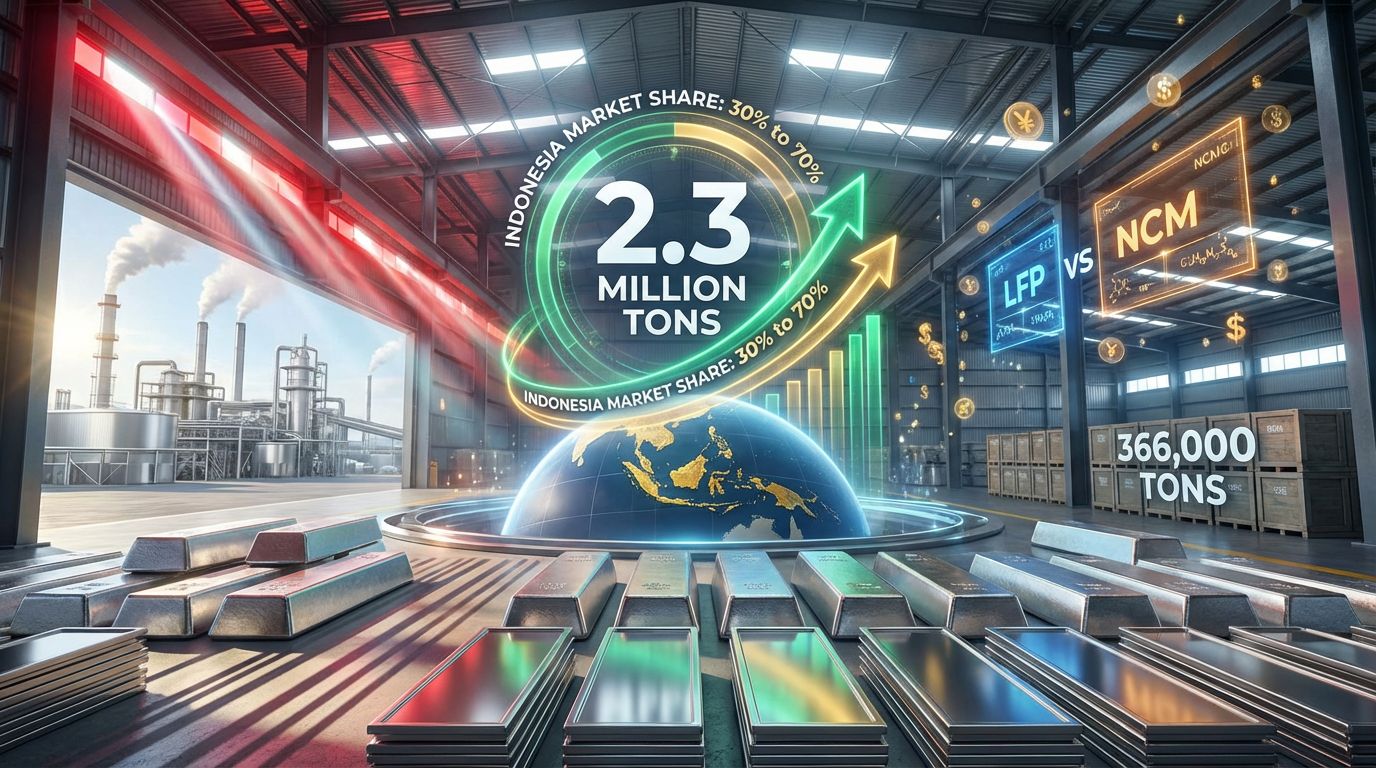
Indonesia's rapid ramp-up—mined nickel output jumped from 780,000 tons in 2020 to 2.3 million tons by 2024 whilst global market share grew from 30% to **70%**—has generated visible overcapacity and volatility. Chinese refiners, responsible for much of this development, continue to add new HPAL capacity despite emerging demand headwinds.
As of 2025, industry forecasts indicate another million tons of HPAL refinery throughput under development. Unless significant brakes are applied, oversupply could persist well into the next decade.
Pipeline Capacity Through 2030
The expansion trajectory remains aggressive despite market signals:
- A projected 1 million tons of new capacity is in development through 2030
- Independent models (e.g., Macquarie Bank) forecast a market glut for at least five more years
- Inventory stockpiles may become even more dominant in market pricing and sentiment
This expansion underscores how quickly boom cycles can turn—particularly when driven by single-customer concentration and technology uncertainty. The situation requires careful analysis of trade war impact analysis to understand broader geopolitical implications.
How Western Market Preferences Create New Opportunity Vectors
Environmental Standards as Market Differentiators
For Indonesia's nickel sector, environmental standards are an emerging risk and opportunity. Western EV manufacturers are far more sensitive to the carbon footprint and social compliance standards of battery materials. While nickel chemistries like NCM (nickel-cobalt-manganese) remain essential in premium segments, Indonesia's heavy reliance on coal-fired power for processing creates a reputational and regulatory handicap.
The renewable energy in mining sector presents potential solutions to these challenges. Key dynamics include:
- European and American buyers increasingly require full traceability and lifecycle emissions audits
- China's new restrictions on exporting LFP technology may send some stress relief to the nickel market
- Environmental factors will determine sourcing preferences in Western markets
Supply Chain Diversification Imperatives
Western automakers are urgently seeking to diversify away from Chinese-dominated supply chains, targeting ethical and environmentally-clean nickel production. This shift opens doors for investment in responsible Indonesian projects or alternative jurisdictions.
In addition:
- The premium segment continues to use nickel-rich batteries, providing potential base demand
- These shifting supply chain strategies add complexity to the global battery metals landscape
- Sustainable production methods are becoming market differentiators
What This Means for Resource Nationalism Globally
The Indonesian Model's Replication Potential
Other resource-rich nations are examining Indonesia's approach as they look to capture more value within their borders. However, the mixed results provide both inspiration and caution.
| Country | Critical Mineral | Export Ban Status | Processing Investment |
|---|---|---|---|
| Indonesia | Nickel | Implemented 2020 | $65B+ Chinese |
| DRC | Cobalt | Under consideration | Limited |
| Chile | Lithium | Partial restrictions | Growing |
| Australia | Iron ore | None | Domestic focus |
Key observations from this analysis:
- The Indonesian experiment is fuelling policy debates from Africa to Latin America
- These approaches require careful balancing to avoid stifling foreign investment
- Success depends on timing, market conditions, and buyer diversification
Strategic Vulnerabilities in Single-Customer Dependencies
Despite the succeed-now-pay-later appeal, Indonesia's dependency on China poses strategic vulnerabilities. Most notably, China built Indonesia's nickel boom but also created concentration risks.
Critical vulnerabilities include:
- Chinese entities control nearly three-quarters of Indonesian nickel refining throughput
- The market operates as an oligopsony—a few buyers dictating price
- When demand shifts, the entire ecosystem is exposed to heightened risk
Where Indonesia's Nickel Future Intersects Global Energy Transition
Scenario Planning for Demand Recovery
Nickel remains a vital material for many energy transition pathways. Furthermore, multiple demand vectors could support market recovery:
- Battery chemistry preferences can swing cyclically with material cost and technology
- Stationary energy storage may offer new demand vectors beyond vehicles
- Stainless steel, consuming over two-thirds of global nickel, provides a comparatively stable end-market
Nevertheless, Indonesia is gambling that battery demand will eventually catch up to production and absorb inventory overhangs. This scenario requires both technological and policy certainty.
Risk Mitigation Strategies
To mitigate risk and remain relevant, Indonesia must pursue several strategic adaptations:
- Diversify its buyer base beyond China and pivot toward Western and third-country markets
- Invest in higher-value processing, emphasising ESG-compliant materials
- Embrace stricter environmental compliance, anticipating tightening import standards
Conclusion: Strategic Lessons from Indonesia's Resource Gamble
Indonesia's nickel transformation, powered by resource nationalism and amplified by Chinese capital, illustrates both the potential and pitfalls of such strategies in fast-evolving technology landscapes. The sector's dramatic overcapacity, single-market exposure risks, and external disruptions from battery technology innovation show that initial success may shift quickly into vulnerability.
China built Indonesia's nickel boom through strategic investment and policy coordination, but this same dependency now creates systemic risks. The dramatic shift towards LFP battery chemistry in China threatens the fundamental premise of Indonesia's nickel-centric industrial strategy.
Key lessons emerge for policymakers and industry stakeholders:
- Long-term resource strategies must adapt to unpredictable changes in technology and demand
- Balancing downstream ambition with market diversification and ESG compliance is central to sustainable success
- The Indonesian playbook serves as both inspiration and cautionary tale for resource-rich nations globally
Stakeholders across the battery supply chain should heed these dynamics as the global race for critical minerals, technological supremacy, and energy transition security continues to intensify. The Indonesian nickel boom represents a critical case study in resource nationalism's potential and pitfalls.
Moreover, understanding China's evolving battery strategies provides crucial context for future market developments. As battery technology continues to evolve, the lessons from Indonesia's experience will inform resource strategies worldwide.
Disclaimer: This article synthesises statistical data, market developments, and projections based on reputable industry sources available as of December 2025. All scenario analyses and speculative points are for informational purposes only; circumstances may evolve as new technology, policy, and market information become available.
Looking to Capitalise on Critical Mineral Market Shifts?
Discovery Alert's proprietary Discovery IQ model delivers real-time alerts on significant ASX mineral discoveries, instantly empowering subscribers to identify actionable opportunities ahead of the broader market. Understand why major mineral discoveries can lead to substantial returns by exploring Discovery Alert's dedicated discoveries page, showcasing historic examples of exceptional outcomes, and begin your 30-day free trial today to position yourself ahead of the market.