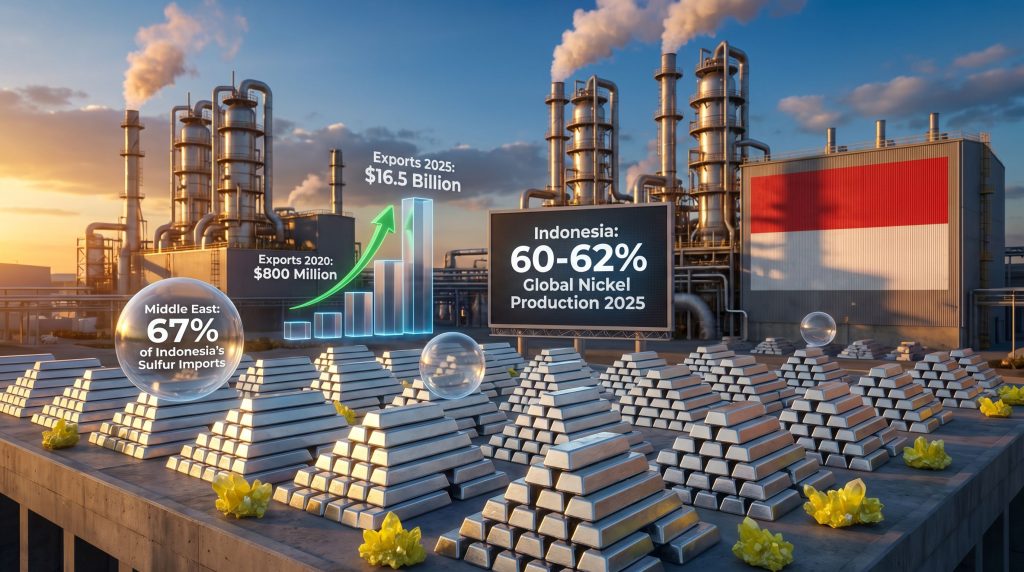
The global commodity landscape continues evolving through unprecedented consolidation patterns, where strategic resource control intersects with technological innovation and geopolitical complexity. Indonesia supply growth and Middle East conflict impact on nickel prices represents a critical intersection of resource policy and geopolitical risk that shapes contemporary market dynamics. Traditional market frameworks struggle to capture the dynamics emerging from supply chain concentration, policy-driven industrial transformation, and cross-regional dependency structures that span multiple continents and political systems.
Strategic Architecture Behind Indonesia's Nickel Revolution
Indonesia's emergence as the world's dominant nickel processor represents more than simple resource exploitation. The country's hilirisasi policy has fundamentally restructured global supply chains by transforming raw material flows into integrated industrial systems. Furthermore, this transformation demonstrates how resource-rich nations can leverage policy tools to capture maximum value from domestic endowments while reshaping international commodity markets, reflecting broader mining industry evolution patterns.
The scale of this transformation becomes evident through revenue metrics that reflect successful industrial policy implementation. Indonesia's nickel export revenues surged from $800 million in 2020 to $16.5 billion by early 2025, representing a twenty-fold increase that exceeds even the country's coal export earnings. This dramatic growth stems from processing laterite ores domestically rather than exporting raw materials, capturing value-added manufacturing margins previously accruing to overseas processors.
Chinese investment and technology transfer enabled this rapid industrial development, with Chinese firms controlling approximately 75% of Indonesia's nickel smelting capacity. This partnership demonstrates how strategic industrial cooperation can compress typical development timelines, allowing Indonesia to achieve world-scale processing capacity within five years rather than the decade typically required for indigenous technology development.
Production Capacity and Strategic Quota Management
Indonesia's processing infrastructure reached 2.2 million metric tons of refined nickel capacity by 2024, with expansion targets of 2.4 million tons for 2025. This capacity growth occurs alongside sophisticated supply management through the RKAB (Work Plan and Budget) quota system, which demonstrates Indonesia's willingness to constrain raw ore availability to support price stability.
The quota framework creates deliberate bottlenecks in global supply chains by reducing ore mining from 379 million wet metric tons in 2025 to 260-270 million tons in 2026. This 31% reduction in domestic ore availability forces global processors to compete for limited Indonesian feedstock while supporting domestic processing facilities through improved input costs and reduced competition from raw ore exports.
Market surplus projections of approximately 324,000 tons in 2026 reflect the balance between constrained ore mining and continued processing capacity expansion. Refined nickel production growth is forecast at 9.8% in 2026, following 9% growth in 2025, demonstrating how policy-managed supply can maintain expansion while supporting price floors through strategic constraint mechanisms.
When big ASX news breaks, our subscribers know first
Middle East Conflict Vulnerabilities in Nickel Supply Chains
The February 28, 2026 escalation of US-Iran tensions exposed critical dependencies in Indonesia's nickel processing infrastructure that traditional commodity analysis typically overlooks. These dependencies extend beyond direct shipping routes to encompass chemical input supplies essential for advanced processing technologies, highlighting the interconnected nature of modern critical minerals strategy considerations.
Sulfur Supply Chain Dependencies
Indonesia's dependency on Middle East sulfur supplies creates direct vulnerability for High-Pressure Acid Leach (HPAL) facilities, which process laterite ore into battery-grade nickel products. With approximately 67% of Indonesia's sulfur imports sourced from the Middle East, regional conflicts directly impact production costs and capacity utilisation across the country's most technologically advanced processing facilities.
Following the conflict escalation, sulfur prices surged 25% within one month, creating immediate cost-push inflation for all HPAL producers globally. This price volatility demonstrates how geopolitical events in seemingly unrelated regions cascade through commodity supply chains via intermediate chemical inputs rather than direct material flows.
The conflict period lasting from February 28 to the April 7 ceasefire created sustained cost pressure that forced producers to either absorb margin compression or pass through higher costs to downstream customers. This five-week disruption period illustrates how relatively brief geopolitical events can create lasting supply chain adjustments and pricing impacts.
Energy Cost Amplification Effects
Beyond sulfur dependencies, elevated energy costs from Middle East conflicts disproportionately impact energy-intensive nickel processing operations. HPAL facilities require substantial electrical power for pressure leaching operations, while nickel pig iron producers depend on thermal energy for smelting processes, creating broad exposure to energy price volatility.
Higher-cost producers outside Indonesia face particular vulnerability to sustained energy price increases, as their processing economics become uncompetitive relative to Indonesian facilities with more favourable energy sourcing arrangements. This selective pressure accelerates market consolidation toward Indonesian capacity while reducing global processing diversity, contributing to broader industry consolidation trends.
Complex Pricing Dynamics Through 2026
The intersection of Indonesian supply management and Middle East conflict impacts creates multilayered pricing environments where traditional supply-demand fundamentals interact with geopolitical risk premiums and policy uncertainty. Consequently, Indonesia supply growth and Middle East conflict impact on nickel prices requires nuanced analysis of these interconnected factors.
Price Forecast Revisions and Trading Patterns
BMI revised its 2026 nickel price forecast upward to $16,600/ton from $15,800/ton previously, reflecting structural supports from Indonesian quota reductions and sulfur supply disruption risks. Indonesian supply cuts are creating strong tailwinds for nickel prices, with market participants recognising these upward revisions acknowledge that multiple price floor mechanisms limit downside risk while introducing new volatility sources.
Year-to-date trading performance shows nickel prices remaining 2.5% higher through April 10, 2026, closing at $17,241/ton despite a 4.8% decline from pre-conflict levels. This pattern reflects initial strength from improved supply-demand fundamentals followed by macroeconomic sentiment deterioration as conflict impacts broadened beyond direct supply chains.
The 2025 average price of $15,161/ton provides baseline context for evaluating current trading levels and the effectiveness of supply-side supports in maintaining elevated pricing despite demand growth moderation. Current levels represent approximately 14% premiums to recent historical averages, suggesting successful policy intervention in commodity pricing dynamics.
| Pricing Factor | Impact Mechanism | Magnitude |
|---|---|---|
| Indonesian quota reductions | Supply constraint | 31% ore mining reduction |
| Sulfur supply disruptions | Cost-push inflation | 25% price surge |
| Energy cost increases | Margin compression | Variable by facility |
| Market surplus expansion | Price ceiling pressure | 324,000 ton surplus |
Supply-Side Price Floor Establishment
Multiple reinforcing mechanisms create asymmetric pricing dynamics where downside risks remain limited while upside potential exists for supply disruption scenarios. The combination of quota constraints, input cost inflation, and energy price pressure establishes a structural price floor below which marginal producers cannot operate profitably.
This price floor mechanism operates differently from traditional commodity cycles, where demand weakness typically drives prices below production costs for extended periods. Instead, policy-managed supply constraints prevent oversupply conditions that would typically depress prices, while input cost inflation raises the minimum viable price level for continued operations.
Battery Chemistry Evolution and Demand Implications
The ongoing transformation in battery technologies presents complex demand dynamics that extend beyond simple electrification growth metrics, requiring analysis of chemistry mix shifts and their implications for nickel intensity per unit of energy storage capacity. However, the broader energy transition impact continues evolving alongside these technological changes.
Chemistry Mix Shift Patterns
Lithium-iron-phosphate (LFP) battery chemistry gained market share to 75% in China (from 62% in 2022) and 50% globally (from 38% in 2022), while high-nickel chemistries declined to 25% in China (from 34% in 2022) and 46% globally (from 54% in 2022). This shift toward non-nickel chemistries occurs despite continued growth in total battery production, creating headwinds for nickel demand growth even as electrification accelerates.
Global nickel demand growth is expected to moderate from 5.8% in 2025 to approximately 3% in 2026, reflecting slower incremental expansion across key end-use sectors combined with reduced nickel intensity per unit of battery capacity. This deceleration occurs despite continued policy support for electrification and renewable energy deployment globally.
The preference for LFP batteries in cost-sensitive applications and plug-in hybrid vehicles over full battery electric vehicles creates more complex demand profiles where total vehicle electrification may not translate directly into proportional nickel demand growth. Understanding application-specific chemistry preferences becomes critical for forecasting long-term consumption patterns.
Alternative Application Growth Potential
While automotive applications show mixed nickel demand patterns, emerging applications in grid-scale energy storage and specialised industrial uses may partially offset automotive demand moderation. These applications often prioritise different performance characteristics, with some favouring energy density (supporting nickel-rich chemistries) while others emphasise cost and safety (favouring LFP alternatives).
The key distinction lies in applications requiring maximum energy density per unit weight or volume, such as aerospace, marine, or long-duration grid storage, where nickel-rich chemistries maintain competitive advantages despite higher costs. These specialised segments may support demand growth even as mass-market applications shift toward alternative chemistries.
In addition, advances in battery recycling breakthrough technologies may influence long-term demand patterns by reducing primary nickel requirements through enhanced secondary material recovery.
Regional Supply Chain Diversification Dynamics
Beyond Indonesia's dominance, regional supply chain development and alternative processing technologies influence long-term market structure through competitive pressure and technology transfer mechanisms. Recent analysis of Middle East tensions affecting nickel markets highlights the importance of supply chain diversification strategies.
Philippines Integration as Feedstock Source
Indonesia's growing imports from the Philippines rose from negligible levels in 2021 to 15,800 tons in 2025, demonstrating flexibility within regional supply chains and Indonesia's ability to supplement domestic ore with external feedstock when quota constraints limit local mining. This pattern suggests Indonesian processing capacity can accommodate feedstock diversification while maintaining dominant market position.
This import growth creates regional interdependence where Indonesian processing capacity serves broader Southeast Asian laterite resources, potentially extending Indonesia's influence beyond domestic resource boundaries. The arrangement benefits both countries while maintaining Indonesia's central role in regional nickel processing.
Technology Transfer and Industrial Development
The concentration of Chinese technology and investment in Indonesian nickel processing creates strategic dependencies alongside efficiency gains. Future market evolution depends partly on whether this technological advantage spreads to other regions through knowledge transfer or remains concentrated within the Indonesia-China partnership through proprietary technology controls.
Alternative processing capacity development outside Indonesia could reduce market concentration risks but potentially at higher costs reflecting less optimal resource endowments and technology access. This trade-off between supply security and economic efficiency influences long-term investment decisions across the global nickel industry.
Investment Scenario Framework for Market Participants
The convergence of supply concentration, geopolitical risks, and evolving demand patterns creates distinct investment scenarios requiring different strategic approaches based on market participant type and risk tolerance. Furthermore, understanding Indonesia supply growth and Middle East conflict impact on nickel prices becomes essential for strategic positioning.
Scenario 1: Sustained Indonesian Dominance
In this scenario, Indonesia successfully manages production quotas while maintaining cost competitiveness despite input price volatility from external sources. Market participants should expect continued price volatility linked to Indonesian policy decisions, gradual margin recovery as supply-demand balance improves, and persistent geopolitical risk premiums in pricing structures.
Key indicators supporting this scenario include:
- Successful management of quota systems without major supply disruptions
- Continued Chinese investment and technology transfer
- Effective alternative sourcing for critical inputs like sulfur
- Stable domestic political environment supporting industrial policy
Scenario 2: Supply Chain Diversification
Alternative processing capacity development outside Indonesia could reduce market concentration risks but potentially at higher costs reflecting suboptimal resource access and technology constraints. This scenario implies more stable pricing with reduced policy-driven volatility, higher average costs across the industry, and improved supply security for strategic applications.
Development pathways include:
- Major mining companies investing in processing capacity outside Indonesia
- Technology transfer to alternative locations through licensing or joint ventures
- Government support for domestic processing in resource-rich countries
- Strategic stockpiling by major consuming nations
Scenario 3: Demand Structure Transformation
Accelerated battery chemistry shifts or breakthrough technologies could fundamentally alter nickel demand patterns, requiring flexible production strategies adaptable to changing specifications, increased investment in research and development for new applications, and comprehensive risk management approaches accounting for demand uncertainty.
Critical factors include:
- Breakthrough battery technologies with different chemistry requirements
- Rapid adoption of alternative energy storage systems
- Significant changes in electric vehicle market penetration rates
- Development of nickel recycling technologies reducing primary demand
The next major ASX story will hit our subscribers first
Strategic Positioning for Long-Term Market Evolution
The nickel market's projected evolution through 2032, when prices are forecast to reach $22,000/ton as markets tip into deficit, requires strategic positioning accounting for both current dynamics and structural transformation patterns across supply chains and end-use applications. Consequently, Indonesia supply growth and Middle East conflict impact on nickel prices will continue shaping market fundamentals throughout this period.
Stakeholder-Specific Strategic Considerations
For Mining and Processing Companies:
- Diversify input supply chains to reduce geopolitical exposure, particularly for critical chemicals and energy sources
- Invest in flexible processing technologies adaptable to changing battery chemistry requirements and alternative feedstock sources
- Develop strategic partnerships across different geographic regions to reduce dependency on single-country policies
- Implement comprehensive risk management frameworks covering both upstream supply and downstream demand uncertainties
For Battery Manufacturers and EV Producers:
- Maintain dual-sourcing strategies for both nickel-containing and alternative battery chemistries to hedge against supply disruptions and cost volatility
- Invest in recycling capabilities to reduce primary material dependencies and create circular supply chain economics
- Monitor geopolitical developments affecting key supply regions through dedicated supply chain intelligence functions
- Develop technology roadmaps accommodating multiple chemistry pathways rather than single-technology dependencies
For Investment Management and Financial Markets:
- Consider full value chain exposure from mining through processing when evaluating commodity investments rather than focusing solely on upstream mining assets
- Factor geopolitical risk premiums into long-term price forecasts and portfolio construction given demonstrated supply chain vulnerabilities
- Evaluate exposure to both supply concentration and demand evolution risks through scenario-based stress testing
- Assess correlation patterns between nickel markets and broader macroeconomic factors including energy prices and currency movements
The interplay between Indonesia's supply dominance and Middle East conflict impacts creates a unique period in nickel market evolution, where traditional commodity fundamentals intersect with industrial policy and geopolitical strategy. Success in this environment requires understanding not just supply and demand metrics, but the broader strategic context shaping global commodity markets.
Long-term market evolution will likely reflect the resolution of tensions between supply concentration and diversification pressures, with outcomes depending on policy decisions in Indonesia, technology transfer patterns, and demand structure changes across end-use applications. Market participants who develop comprehensive frameworks for analysing these interconnected dynamics will be better positioned to navigate the complex commodity landscape emerging through the remainder of the decade.
Disclaimer: This analysis is based on publicly available information and market research. All forecasts, price projections, and scenario analyses are subject to significant uncertainty and should not be construed as investment advice. Market participants should conduct independent research and consult qualified professionals before making investment decisions. Commodity markets involve substantial risks including price volatility, geopolitical events, and regulatory changes that can significantly impact investment outcomes.
Want to capitalise on the next major nickel discovery?
Discovery Alert delivers instant notifications on significant ASX mineral discoveries through its proprietary Discovery IQ model, transforming complex geological data into actionable investment insights for both short-term traders and long-term investors. Whilst global nickel markets face supply concentration risks and geopolitical volatility, Australian exploration companies continue making breakthrough discoveries that can generate substantial returns—explore historic examples of exceptional discovery outcomes and begin your 14-day free trial today to position yourself ahead of market movements.