Strategic diversification forces are reshaping global supply chain architectures as geopolitical tensions intensify between major powers. The rare earth element sector exemplifies these broader trends, with traditional dependencies facing systematic challenges from emerging producers seeking greater autonomy. Understanding these dynamics requires examining both the geological foundations and technological capabilities that determine market positioning in critical minerals supply chains.
Indonesia's potential emergence as a significant player in global rare earth markets represents more than simple resource extraction. The archipelago nation possesses unique advantages through its existing mineral processing infrastructure and strategic geographic positioning, yet faces substantial technological and capital challenges in developing independent rare earth separation capabilities.
Indonesia's Rare Earth Revolution: From Resource Potential to Strategic Reality
The foundation of Indonesia's rare earth ambitions rests on substantial monazite deposits found as byproducts of tin mining operations across Sulawesi and Kalimantan provinces. These monazite-bearing sands contain approximately 50-65% rare earth oxide content by weight, potentially positioning Indonesia among the world's top ten rare earth resource holders.
Current tin mining operations extract roughly 50,000 to 70,000 tons of tin annually, generating an estimated 5,000 to 8,000 tons of monazite byproducts. This monazite contains significant concentrations of cerium, lanthanum, and neodymium, essential elements for permanent magnet production and renewable energy applications.
Monazite Mining Breakthrough: Indonesia's Hidden REE Goldmine
Geological surveys indicate that Indonesian monazite deposits exhibit favourable rare earth distribution patterns compared to traditional hard-rock mining operations. Unlike many global rare earth projects that require extensive overburden removal and complex metallurgical processing, Indonesia's tin-mining infrastructure already handles similar mineral separation processes.
The monazite recovery rate from existing tin operations currently ranges between 15-25%, suggesting substantial room for efficiency improvements through targeted investment in gravity separation and magnetic separation technologies. Enhanced recovery systems could potentially double or triple monazite output without proportional increases in environmental impact or capital expenditure.
| Mining Region | Annual Tin Output | Estimated Monazite Byproduct | REO Content (%) |
|---|---|---|---|
| Bangka-Belitung | 25,000-30,000 tons | 2,500-3,000 tons | 55-60% |
| Central Kalimantan | 15,000-20,000 tons | 1,500-2,000 tons | 50-58% |
| South Sumatra | 8,000-12,000 tons | 800-1,200 tons | 52-62% |
Processing Infrastructure Development: Building Independent Capabilities
Indonesia's rare earth processing ambitions face significant technological hurdles, particularly in rare earth separation and purification stages. Current domestic capabilities centre on primary concentration and basic chemical processing, while advanced separation technologies remain largely concentrated in Chinese, Japanese, and select Western facilities.
The technological gap encompasses several critical areas:
• Solvent extraction systems for individual rare earth element separation
• Ion exchange technologies for high-purity rare earth production
• Crystallisation and precipitation processes for commercial-grade oxides
• Quality control and analytical capabilities for international market standards
Bridging these gaps requires substantial investment in both physical infrastructure and human capital development. Conservative estimates suggest Indonesia would need between $2.5 billion and $4.0 billion in capital investment to establish complete rare earth separation capabilities capable of processing 10,000-15,000 tons of rare earth oxides annually.
Furthermore, timeline projections for achieving processing independence span 7-10 years, assuming consistent technology transfer partnerships and sustained government support. This timeline reflects the complexity of rare earth metallurgy and the need for extensive pilot testing and optimisation phases.
Understanding Market Dynamics Beyond Export Controls
Global rare earth supply chain stability increasingly depends on diversification away from single-source dependencies. Historical patterns demonstrate that export restrictions and trade policy changes can trigger significant market disruptions, creating opportunities for alternative suppliers to establish market positions.
China's historical approach to rare earth export management has evolved from quota-based systems to licensing frameworks that provide greater administrative flexibility while maintaining strategic control. These mechanisms allow for rapid policy adjustments in response to changing geopolitical conditions or domestic industrial requirements.
The development of a comprehensive critical minerals strategy becomes essential for nations seeking to reduce supply chain vulnerabilities. In addition, industry innovation trends continue to reshape how countries approach critical minerals development.
Market Opportunity Windows: How Export Controls Create Indonesian Advantages
Trade flow redirection patterns consistently favour geographically proximate suppliers when primary sources face restrictions. Indonesia's location within the ASEAN trade framework provides preferential access to rapidly growing Southeast Asian manufacturing centres, particularly in Vietnam, Thailand, and Malaysia.
Port infrastructure development opportunities in Indonesian mining regions could facilitate direct rare earth exports to regional consumers, bypassing traditional Chinese intermediary channels. The development of dedicated rare earth handling facilities at Tanjung Priok and Balikpapan ports represents strategic infrastructure investments that could support long-term market positioning.
Digital tracking and compliance systems offer potential competitive advantages for Indonesian rare earth producers seeking to meet increasingly stringent international due diligence requirements. Blockchain-based provenance tracking and automated quality certification systems could differentiate Indonesian products in markets prioritising supply chain transparency.
Processing capacity utilisation rates in Chinese facilities currently operate near maximum levels, creating potential supply constraints during periods of high demand. Indonesian processing capacity, once developed, could capture market share during peak demand periods when Chinese suppliers face capacity limitations.
Can Indonesia Break Free from the $135 Billion Trade Dependency Trap?
Indonesia's economic relationship with China extends far beyond simple bilateral trade statistics. The $135 billion trade volume reached in 2024 represents deep integration across multiple industrial sectors, with particularly strong connections in mineral processing, manufacturing, and infrastructure development.
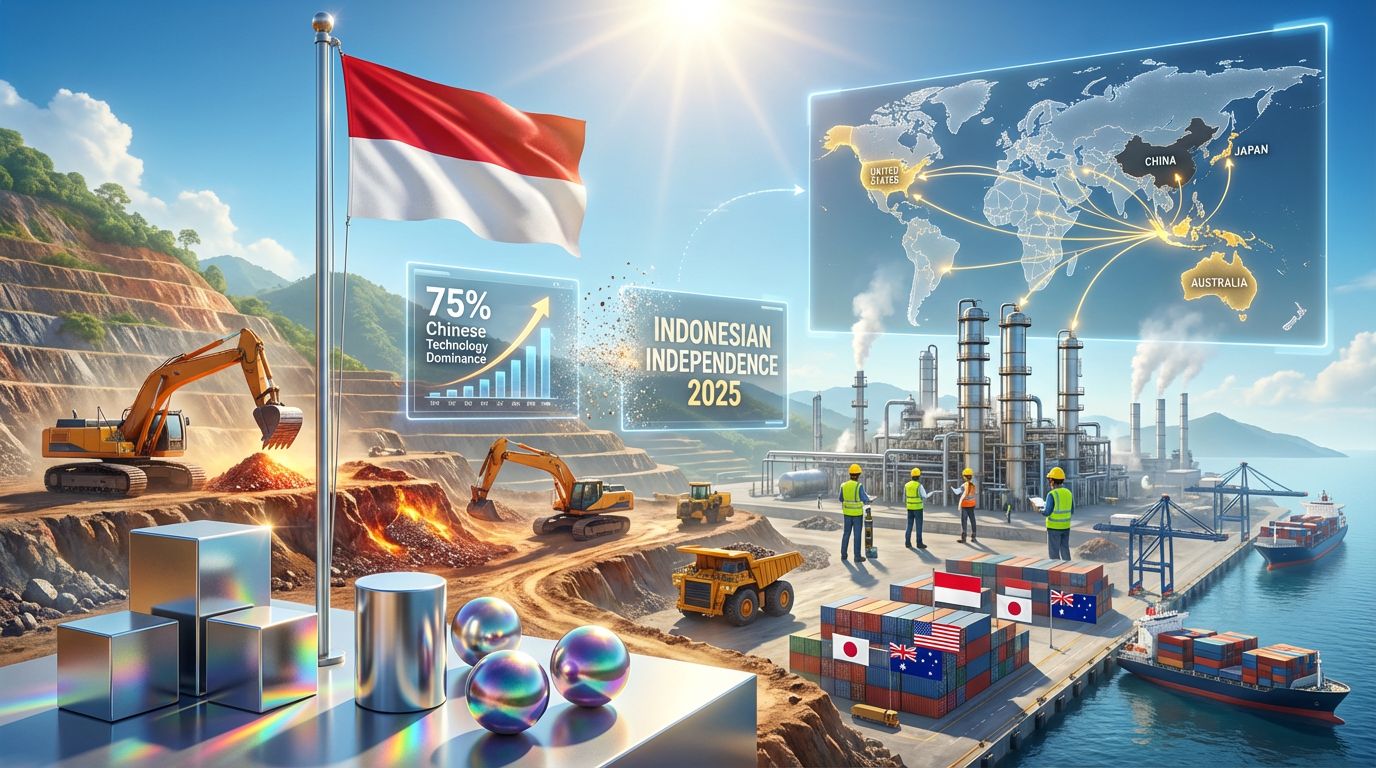
According to the Lowy Institute's analysis, Chinese technological dominance reaches approximately 75% of Indonesia's electric vehicle and battery industrialisation capabilities. This technological dependency creates structural challenges for rapid diversification, as alternative technology suppliers often require extensive adaptation periods and higher initial costs.
Beyond Bilateral Trade Statistics: Understanding Structural Dependencies
Indonesia's rare earth import patterns reveal important insights about current technological dependencies. While official trade statistics show relatively modest direct rare earth compound imports, these figures likely underrepresent the true extent of rare earth element consumption through processed products and intermediate materials.
The complexity of Indonesia and China's rare earth supply chain means that Indonesian manufacturers often receive rare earth elements embedded in Chinese-produced alloys, magnets, and electronic components rather than as standalone rare earth compounds. This embedded consumption creates hidden dependencies that don't appear in conventional trade statistics.
Technology transfer bottlenecks extend beyond equipment purchases to encompass crucial knowledge transfer elements:
• Process optimisation expertise developed through decades of operational experience
• Quality control methodologies specific to rare earth separation chemistry
• Equipment maintenance and troubleshooting capabilities for specialised systems
• Supply chain management for rare earth processing chemicals and consumables
Breaking these dependencies requires systematic development of domestic technical capabilities rather than simple equipment procurement. The learning curve for rare earth processing typically spans multiple years, even with experienced technical assistance.
Diversification Strategies: Australian, Japanese, and US Alternative Partnerships
Alternative technology partnerships offer potential pathways for reducing Chinese technological dependencies, though each option presents distinct advantages and limitations. Australian rare earth companies bring geological expertise and mining experience, while Japanese firms offer advanced separation technologies and quality control systems.
Investment commitments from non-Chinese partners have increased significantly since 2022, with several notable developments:
• Australian mining companies exploring joint venture opportunities for Indonesian rare earth projects
• Japanese trading houses investigating technology transfer arrangements for processing facilities
• US government agencies providing technical assistance through development finance programmes
• European investors seeking exposure to non-Chinese rare earth supply chains
However, the trade war impact continues to influence partnership decisions and strategic planning across the sector.
Comparative analysis of technology transfer terms reveals important differences between Chinese and Western partnership models. Chinese partnerships often emphasise rapid deployment and integrated supply chain connections, while Western partnerships typically focus on technology transfer and capacity building approaches.
Regional supply chain integration opportunities with QUAD nations (Australia, India, Japan, United States) could provide market access and technical support for Indonesian rare earth development. These partnerships might offer more favourable long-term strategic positioning despite potentially higher initial costs and longer development timelines.
How Do Environmental Standards Shape Indonesia's Rare Earth Competitiveness?
Environmental considerations increasingly influence rare earth supply chain decisions as consuming industries face pressure to meet sustainability targets. Indonesian rare earth operations must navigate complex environmental regulatory frameworks while competing against established suppliers with varying environmental standards.
Rare earth processing generates significant environmental challenges, including radioactive waste management, acid mine drainage, and heavy metal contamination risks. These environmental impacts require sophisticated management systems and substantial ongoing operational costs.
Sustainable Mining Protocols vs. Coal-Dependent Infrastructure Challenges
Indonesia's current energy infrastructure relies heavily on coal-fired power generation, potentially creating carbon footprint disadvantages for energy-intensive rare earth processing operations. However, the country's substantial hydroelectric potential and growing renewable energy capacity could provide competitive advantages for environmentally conscious buyers.
Environmental compliance requirements for international rare earth buyers continue to tighten, with major automotive and electronics manufacturers implementing detailed supplier sustainability audits. These requirements cover multiple dimensions:
• Carbon footprint measurement and reduction commitments
• Water usage efficiency and wastewater treatment standards
• Waste management protocols for radioactive and hazardous materials
• Community impact assessments and stakeholder engagement processes
• Biodiversity protection measures in mining and processing areas
In addition, the mining decarbonisation benefits continue to drive investment decisions across the sector.
Green mining technology adoption in Indonesian operations could provide market differentiation opportunities, particularly for suppliers targeting European and North American markets with stringent environmental procurement requirements. Investment in clean processing technologies represents both an environmental necessity and a potential competitive advantage.
Carbon footprint comparison between Indonesian and Chinese rare earth processing depends heavily on energy source composition and processing efficiency. Indonesia's potential advantages in renewable energy access could offset some technological efficiency gaps, particularly for buyers prioritising carbon footprint reduction.
ESG Investment Criteria: Meeting International Sustainability Benchmarks
Environmental, Social, and Governance (ESG) investment criteria increasingly influence rare earth project financing and market access. Indonesian rare earth developers must demonstrate compliance with international ESG frameworks to access capital markets and secure long-term customer contracts.
Due diligence requirements for Western rare earth purchasers typically include comprehensive ESG assessments covering operational practices, community relations, and governance structures. These assessments often determine market access and pricing premiums for compliant suppliers.
"Companies demonstrating superior ESG performance in critical minerals sectors often command price premiums of 5-15% compared to conventional suppliers, reflecting buyer willingness to pay for supply chain security and sustainability assurance."
Community impact management in Indonesian mining regions requires careful attention to local stakeholder concerns and traditional land use patterns. Successful community engagement programmes often become competitive advantages by reducing operational risks and enhancing social licence to operate.
Recycling technology integration and circular economy opportunities represent emerging areas where Indonesian rare earth operations could establish market leadership. As rare earth recycling technologies mature, processing facilities with integrated recycling capabilities may capture additional revenue streams from end-of-life products.
What Are the Investment Implications for Rare Earth Market Participants?
Investment opportunities in Indonesian rare earth development present complex risk-return profiles that require careful analysis of multiple factors including geological potential, technological requirements, regulatory frameworks, and market positioning strategies.
Indonesian rare earth projects typically require longer development timelines compared to conventional mining investments due to processing complexity and infrastructure requirements. Investors must evaluate both resource development risks and market access challenges when assessing investment opportunities.
Indonesian REE Project Pipeline: Risk-Adjusted Return Analysis
Current Indonesian rare earth project development spans various stages from early-stage exploration to advanced feasibility studies. Project economics depend heavily on achieving efficient monazite recovery from tin mining operations and developing cost-effective processing capabilities.
Capital requirements for midstream processing facility development represent the largest component of Indonesian rare earth investment needs. Processing facilities typically require 60-70% of total project capital, with additional infrastructure and working capital needs comprising the remainder.
Geopolitical risk assessment for Indonesian rare earth investments must consider multiple dimensions:
• Regulatory stability in mining and processing permit frameworks
• Political continuity across election cycles and policy changes
• Currency stability for dollar-denominated revenue streams
• Infrastructure development risks for power and transportation systems
• Trade policy changes affecting export competitiveness
Risk mitigation strategies often include political risk insurance, currency hedging arrangements, and diversified customer bases across multiple geographic markets.
Supply Chain Diversification Premium: Quantifying Strategic Value
Market participants increasingly recognise strategic value in supply chain diversification, particularly for critical materials with concentrated supplier bases. This recognition translates into pricing premiums for alternative suppliers that can demonstrate reliable production capabilities.
Price differentials for non-Chinese rare earth sources vary significantly by specific rare earth elements and market conditions. Historical data suggests premiums of 10-30% for confirmed alternative suppliers during periods of supply uncertainty, though these premiums narrow during stable market conditions.
Long-term contract structures emerging in the Indonesian market often include volume commitments and price stability mechanisms that provide revenue certainty for project development. These contracts typically span 5-10 year terms with built-in escalation clauses and force majeure protections.
Strategic stockpiling implications for consuming nations create additional demand sources for Indonesian rare earth production. Government stockpiling programmes in the United States, Japan, and European Union represent potential customers willing to pay security premiums for diversified supply sources.
Strategic Scenarios: Three Pathways for Indonesia-China REE Relations
Future development of Indonesia's rare earth sector could follow multiple pathways depending on technological progress, investment patterns, and geopolitical developments. Understanding these scenarios helps stakeholders prepare for different potential outcomes.
Each scenario presents distinct implications for investors, policymakers, and supply chain participants seeking to position themselves advantageously in evolving rare earth markets.
Scenario 1: Continued Interdependence with Gradual Capacity Building
This pathway assumes Indonesia maintains close technological cooperation with Chinese partners while gradually building domestic processing capabilities through joint ventures and technology transfer arrangements. Development proceeds methodically with Chinese technical assistance and market access.
Probability Assessment: 60-65% likelihood based on current partnership patterns and technological dependencies.
Timeline for achieving processing independence extends to 12-15 years under this scenario, with Indonesian facilities initially handling lower-value processing stages while China retains control over advanced separation technologies.
Investment requirements reach approximately $3-4 billion spread over the development period, with Chinese partners providing significant portions of both capital and technology. Market positioning emphasises cost competitiveness rather than strategic differentiation.
Scenario 2: Accelerated Decoupling Through Western Technology Partnerships
This scenario envisions rapid diversification toward Western technology partners driven by geopolitical tensions or policy changes encouraging supply chain independence. Indonesian rare earth development accelerates through substantial Western investment and technology transfer.
Catalysts that could trigger rapid supply chain reconfiguration include trade disputes, security concerns, or major policy initiatives supporting alternative suppliers. Government incentives and international development finance could accelerate investment timelines.
Infrastructure development acceleration mechanisms might include dedicated infrastructure zones, expedited permitting processes, and coordinated public-private investment programmes. Development timelines compress to 5-7 years with significantly higher initial capital requirements.
Competitive response strategies from Chinese rare earth companies could include increased market access restrictions, pricing competition, or alternative partnership offers to maintain market position.
Scenario 3: Regional Hub Development with Multi-Partner Integration
This pathway positions Indonesia as a Southeast Asian rare earth processing centre serving regional markets through partnerships with multiple international technology providers. Processing capabilities serve both domestic and regional customer bases.
Indonesia as Southeast Asian rare earth processing centre could leverage ASEAN trade preferences and geographic proximity to growing regional markets. Processing facilities might handle materials from multiple regional sources, creating economies of scale.
Cross-border supply chain optimisation opportunities include integrated logistics networks, shared technology platforms, and coordinated regional stockpiling arrangements. Regional integration could reduce individual country dependencies on external suppliers.
Regional security and economic integration benefits extend beyond rare earth supply chains to encompass broader strategic cooperation in critical materials and technology development.
Frequently Asked Questions About Indonesia's Rare Earth Strategy
How Quickly Can Indonesia Reduce Rare Earth Import Dependencies?
Indonesia's timeline for reducing rare earth import dependencies depends heavily on investment levels and technology transfer success. Conservative estimates suggest meaningful reduction within 7-10 years, assuming consistent policy support and successful technology partnerships.
The development process requires sequential phases: resource development, processing facility construction, technology optimisation, and market development. Each phase presents distinct challenges and risk factors that could extend or accelerate timelines.
What Role Will Indonesian Rare Earths Play in Global EV Battery Supply Chains?
Indonesian rare earth production could provide critical materials for permanent magnet motors used in electric vehicles, particularly neodymium and dysprosium. Geographic proximity to growing Asian EV manufacturing centres provides potential logistical advantages.
Integration with existing Indonesian nickel and battery materials production could create comprehensive regional supply chains for EV manufacturers. This integration might include recycling capabilities for end-of-life EV components containing rare earth elements.
Which International Partners Offer the Most Strategic Value for Indonesian REE Development?
Different international partners provide distinct advantages for Indonesian rare earth development. Australian partners offer geological expertise and mining experience, Japanese partners provide advanced processing technologies, and US partners offer market access and development finance.
The optimal partnership strategy likely involves multiple partners contributing different capabilities rather than exclusive relationships with single countries or companies. Diversified partnerships provide risk mitigation and access to broader technological and market resources.
Investment Outlook: Positioning for Indonesia's Rare Earth Emergence
Indonesia's rare earth sector presents compelling long-term investment opportunities despite near-term development challenges. Success requires careful attention to project selection criteria, partnership strategies, and market positioning approaches.
Investment timing considerations must account for lengthy development cycles and evolving market conditions. Early-stage investors may benefit from lower entry costs but face higher development risks, while later-stage investors encounter higher entry costs with reduced technical risks.
Key Performance Indicators for Indonesian REE Market Development
Monitoring Indonesian rare earth market progress requires tracking multiple performance indicators across technical, commercial, and strategic dimensions:
Technical Indicators:
• Monazite recovery rates from tin mining operations
• Processing facility construction progress and commissioning timelines
• Technology transfer milestones and capability development
• Quality certification achievements for international markets
Commercial Indicators:
• Production capacity additions and utilisation rates
• Customer contract announcements and pricing developments
• Market share evolution in regional and global markets
• Investment commitments from international partners
Strategic Indicators:
• Policy developments supporting domestic processing capabilities
• Infrastructure development progress in mining regions
• Regional integration agreements and trade facilitation measures
• Geopolitical developments affecting supply chain strategies
Risk Management Considerations for Rare Earth Investors
Rare earth investment risks span multiple categories requiring sophisticated risk management approaches. Geological risks include resource quality variations and processing complexity challenges that could affect project economics.
Regulatory stability assessment in the Indonesian mining sector requires ongoing monitoring of policy developments, permitting processes, and environmental compliance requirements. Changes in regulatory frameworks could significantly impact project timelines and economics.
Currency and commodity price hedging strategies become particularly important for projects with long development timelines and dollar-denominated revenue streams. Indonesian rupiah volatility and rare earth price fluctuations create complex hedging requirements.
According to IEA analysis, geopolitical risk mitigation approaches must address potential trade disputes, technology transfer restrictions, and supply chain disruptions. Diversified partnership strategies and flexible operational arrangements can provide protection against geopolitical uncertainties.
Investment Disclaimer: Rare earth investments involve substantial risks including commodity price volatility, regulatory changes, technological challenges, and geopolitical uncertainties. This analysis is for informational purposes only and should not be construed as investment advice. Prospective investors should conduct thorough due diligence and consult qualified professionals before making investment decisions.
The emergence of Indonesia and China's rare earth supply chain represents a significant shift in global critical materials markets. Success in capturing these opportunities requires sophisticated understanding of technical challenges, market dynamics, and strategic positioning considerations. As Indonesia and China's rare earth supply chain relationships evolve, market participants must remain adaptable to changing conditions while maintaining focus on long-term value creation strategies.
Are You Ready to Capitalise on Indonesia's Rare Earth Revolution?
Discovery Alert's proprietary Discovery IQ model delivers real-time notifications on significant ASX mineral discoveries, including critical minerals and rare earth opportunities that could benefit from Indonesia's emerging market dynamics. With Indonesia's rare earth sector poised for transformation and supply chain diversification creating new investment opportunities, discover how historic mineral discoveries have generated exceptional returns for early investors.