Understanding Industrial Battery Energy Storage Systems in Mining
The rapid deployment of industrial-scale energy storage systems across remote mining regions represents a fundamental shift in how extractive industries approach power infrastructure. As mining industry evolution accelerates in isolated mining locations, Fortescue battery storage Pilbara installations demonstrate how battery storage technologies have evolved from experimental installations to mission-critical components of modern mining operations. These systems must operate reliably in extreme environments while supporting continuous industrial processes that demand unwavering power stability.
Industrial battery storage in mining environments differs substantially from conventional commercial applications. Remote mining operations face unique challenges that require specialised engineering solutions designed for harsh operational conditions and extended deployment periods.
Grid Isolation Requirements in Remote Mining
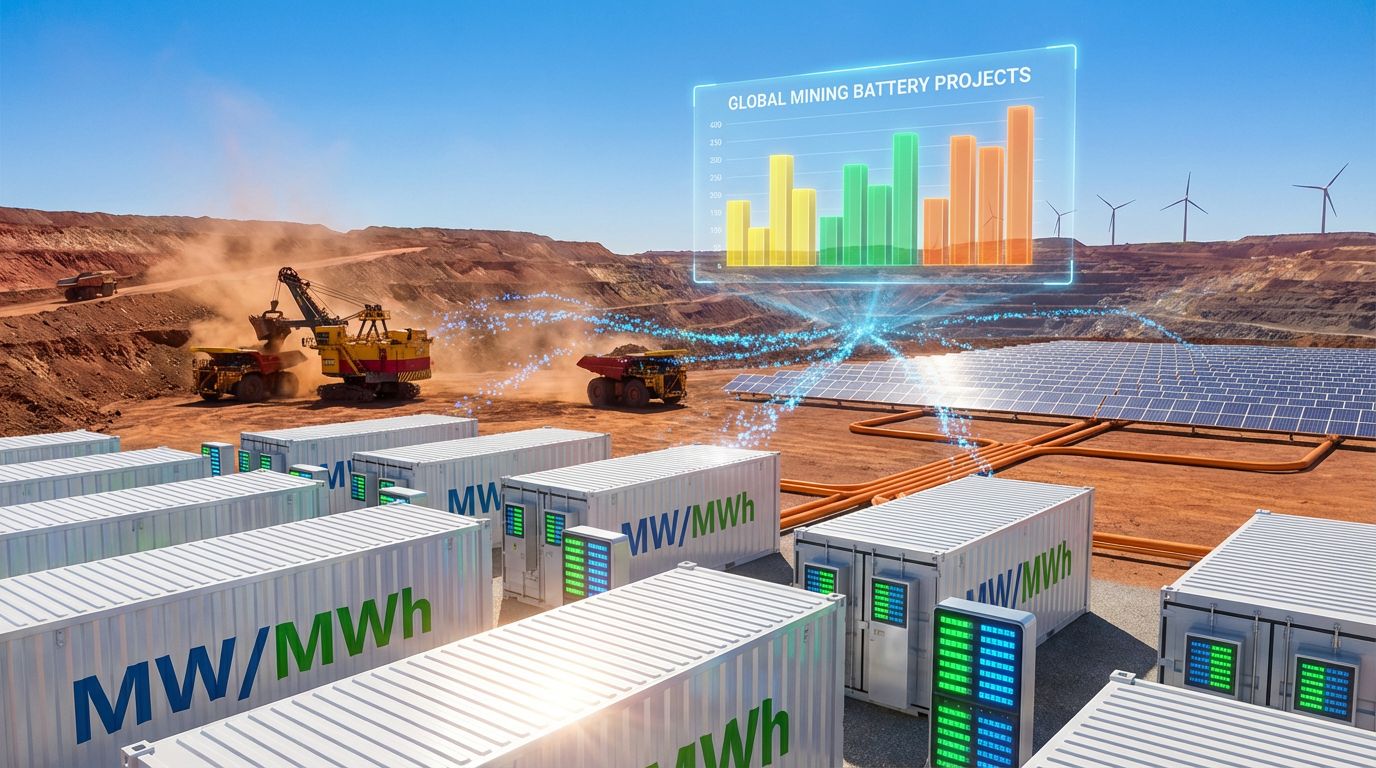
Fortescue's North Star Junction installation demonstrates the scale required for effective mining battery deployment. The system features 250 megawatt-hours (MWh) of total capacity with 50 megawatts (MW) of sustained power delivery over five-hour duration periods. This configuration comprises 48 modular energy storage containers utilising BYD blade battery technology with liquid cooling systems specifically engineered for Pilbara operating conditions.
The installation represents the first operational component of Fortescue's planned 4-5 gigawatt-hour (GWh) rollout across its iron ore operations, supporting the company's Real Zero by 2030 decarbonisation commitment. This sequential deployment approach allows validation of system performance before full-scale implementation.
Technical Specifications for Extreme Climate Operation
BYD's blade battery architecture integrates lithium-iron-phosphate cells directly into the container structure, improving volumetric efficiency and thermal management capability. The liquid cooling system maintains optimal electrochemical performance across the Pilbara's significant temperature variations, where daily swings can exceed 20-30°C between day and night periods.
| System Component | Specification | Mining Application Benefit |
|---|---|---|
| Total Capacity | 250 MWh | Multi-hour energy storage for continuous operations |
| Power Output | 50 MW | Sustained industrial load support |
| Duration | 5 hours | Bridge between renewable generation cycles |
| Containers | 48 units | Modular maintenance and redundancy |
The modular container design enables distributed deployment across mining infrastructure while facilitating maintenance procedures in remote locations. Furthermore, each container operates as an independent unit, providing system redundancy essential for continuous mining operations.
Why Are Mining Companies Investing Heavily in Battery Storage Infrastructure?
Mining operators are deploying battery storage as a strategic response to operational, economic, and environmental pressures. Fortescue's investment trajectory indicates recognition that large-scale storage represents a primary technological solution for maintaining production volumes while eliminating fossil fuel dependencies.
Economic Drivers Behind Storage Adoption
Corporate decarbonisation commitments drive substantial capital allocation toward energy storage infrastructure. In addition, energy transition strategies like Fortescue's Real Zero by 2030 target require fundamental transformation of power generation across Pilbara operations, with battery storage enabling renewable energy integration at industrial scale.
The North Star Junction system stores renewable energy during daylight hours for dispatch during evening and nighttime periods when solar generation ceases. This day-night cycle management requires systems capable of:
- Capturing variable solar generation and buffering for later dispatch
- Providing stable, dispatchable power on demand to mining operations
- Integrating with existing electrical infrastructure without operational disruption
- Maintaining power quality standards for sensitive mining equipment
Strategic Partnership Development
Industry collaboration between mining operators and battery manufacturers reflects recognition that mining applications present unique requirements beyond standard commercial specifications. The Fortescue-BYD partnership demonstrates active development of mining-specific solutions rather than deployment of off-the-shelf systems.
According to BYD's General Manager of Energy Storage and New Battery Applications, Yin Xueqin, the North Star Junction installation represents a significant milestone for delivering large-scale storage needed to power green Pilbara operations. This partnership approach enables iterative system optimisation based on real-world mining deployment experience.
Operational Continuity Value
Sequential implementation strategies allow mining companies to validate performance data before scaling deployment. Fortescue's approach includes the North Star Junction system now operational, with the next installation planned for Eliwana in early 2026. This staging enables:
- Performance validation before full-scale deployment
- Operational procedure refinement and staff training
- Design optimisation based on empirical data
- Risk mitigation through proven technology demonstration
What Are the Technical Challenges of Implementing Battery Storage in Mining?
Environmental durability requirements in mining applications exceed those of typical commercial installations. The Pilbara region experiences extreme temperature conditions with summer maximums exceeding 40°C and substantial daily temperature variations requiring active thermal management systems.
Temperature Management Complexity
Lithium-ion battery performance depends critically on maintaining optimal operating temperatures, typically within 15-35°C ranges. The BYD blade battery system's liquid cooling capability provides active heat rejection to counteract ambient temperature extremes while preventing thermal degradation of battery cells.
Daily thermal cycles in remote mining regions create additional stress on battery systems beyond steady-state high temperature exposure. The North Star Junction installation's cooling system addresses both peak temperature management and thermal cycling to maintain consistent energy delivery capacity throughout system lifecycle.
Contamination Protection in Mining Environments
Mining operations generate substantial environmental challenges for sensitive electronic systems:
- Dust ingress: Iron ore processing creates fine particulate matter requiring sealed enclosures
- Corrosive atmospheres: Mineral dust and potential chemical exposure demand specialised protection
- Vibration resistance: Proximity to blasting operations and heavy machinery requires robust mounting systems
- Moisture protection: Despite arid environments, operational moisture from cooling systems requires management
Remote Maintenance Accessibility
Modular container architecture addresses service complexity in remote locations. The 48-container configuration potentially enables individual unit replacement or maintenance without complete system shutdown, maintaining production continuity during service operations.
This distributed approach provides operational redundancy where loss of individual containers does not eliminate total system capability, essential for mining operations that cannot tolerate extended power interruptions.
How Do Different Battery Technologies Compare for Mining Applications?
Lithium-ion technology dominance in mining applications reflects superior performance characteristics compared to alternative storage technologies. The exclusive selection of lithium-ion systems for major mining deployments indicates industry consensus regarding optimal technology platforms.
Lithium-Ion Performance Advantages
BYD's blade battery design offers specific advantages for mining deployment:
- Energy density: Compact installations suitable for space-constrained mining sites
- Cycle life: 10,000+ charge/discharge cycles supporting daily operational patterns
- Response time: Millisecond-level grid stabilisation for equipment protection
- Scalability: Modular expansion capability matching growing mining operations
Lithium-iron-phosphate chemistry provides enhanced safety characteristics compared to other lithium-ion variants, with improved thermal stability essential for extreme climate operation. However, the blade architecture integrates cells directly into structural components, optimising volumetric efficiency.
Technology Selection Factors
| Technology Feature | Mining Requirement | Solution Approach |
|---|---|---|
| Thermal stability | 40°C+ operation | Liquid cooling systems |
| Cycle durability | Daily charge/discharge | LFP chemistry selection |
| Power delivery | Sustained industrial loads | 50 MW continuous rating |
| Environmental protection | Dust/vibration resistance | Sealed container design |
Alternative technologies including flow batteries and compressed air systems remain under evaluation for specific mining applications, particularly for extended duration storage requirements exceeding current lithium-ion capabilities.
What Role Does Battery Storage Play in Mining Decarbonisation Strategies?
Renewable energy integration represents the primary driver for mining battery storage deployment. Storage systems enable higher renewable penetration rates by addressing intermittency challenges inherent in solar and wind generation.
Solar-Plus-Storage Integration
Fortescue battery storage Pilbara installations demonstrate utility-scale integration of renewable generation with storage systems. The North Star Junction installation captures solar energy during peak generation periods for dispatch during nighttime mining operations, enabling 24/7 renewable power supply.
This integration requires sophisticated energy management systems capable of:
- Forecasting renewable generation based on weather patterns
- Optimising storage dispatch to match mining load profiles
- Maintaining grid stability during renewable generation fluctuations
- Coordinating multiple generation and storage assets across mining sites
Carbon Reduction Impact
Emissions reductions from battery-enabled renewable integration depend on displaced fossil fuel generation. Mining operations traditionally rely on diesel generators for remote power supply, with battery storage enabling elimination of these high-emission sources.
Corporate sustainability reporting increasingly requires quantification of Scope 1 and Scope 2 emission reductions from renewable energy projects, with battery storage playing essential roles in achieving net-zero commitments.
Lifecycle assessments must account for battery manufacturing emissions against operational carbon reductions to accurately measure environmental impact. Current lithium-ion systems typically achieve positive carbon balance within 2-3 years of operation in mining applications.
How Do Mining Battery Projects Compare Globally?
Australia's Pilbara region has emerged as a global leader in mining battery storage deployment, with Fortescue's installation representing the first operational utility-scale system in the region. This deployment establishes performance benchmarks for subsequent projects worldwide.
Regional Deployment Patterns
Global mining battery installations reflect regional energy market characteristics and regulatory frameworks:
- Australia: Focus on renewable integration and grid reliability in remote regions
- North America: Emphasis on peak demand management and renewable energy mandates
- South America: Integration with abundant solar and wind resources in mining regions
- Africa: Addressing grid instability and diesel dependency in remote mining operations
Scale comparison across regions shows increasing installation sizes as technology costs decline and operational experience accumulates. Consequently, Fortescue's planned 4-5 GWh total deployment represents one of the largest committed mining storage programmes globally.
Technology Standardisation Trends
Modular system designs enable standardised deployment approaches across different mining operations and geographic regions. The container-based architecture demonstrated at North Star Junction facilitates replication at other Fortescue sites and adoption by other mining operators.
Partnership models between mining companies and battery manufacturers are becoming standardised approaches for large-scale deployments, enabling technology optimisation for mining-specific requirements while sharing development costs and risks.
What Are the Economic Considerations for Mining Battery Investments?
Capital investment analysis for mining battery systems must account for multiple value streams beyond simple energy cost reduction. These systems provide operational continuity, equipment protection, and environmental compliance benefits that extend beyond traditional financial metrics.
Investment Justification Framework
Payback calculations for mining battery installations consider:
- Diesel fuel displacement: Elimination of backup generator operation and fuel transportation costs
- Grid stability value: Reduced equipment damage from power quality issues
- Production continuity: Avoided revenue losses from power-related mining shutdowns
- Carbon compliance: Meeting corporate sustainability commitments and potential carbon pricing
Financing structures for large-scale mining battery projects increasingly utilise power purchase agreements and energy-as-a-service models, reducing upfront capital requirements while transferring performance risk to specialised service providers.
Operational Cost Optimisation
Maintenance requirements for modern lithium-ion systems remain minimal compared to traditional power generation equipment, with typical service intervals measured in months rather than weeks. Remote monitoring capabilities enable predictive maintenance scheduling to minimise operational disruption.
Energy management optimisation through advanced control systems maximises economic returns by optimising charge/discharge cycles based on renewable generation forecasts, mining load requirements, and energy market pricing where applicable.
How Will Battery Storage Technology Evolve for Mining Applications?
Next-generation battery technologies under development specifically target mining application requirements including extended duration storage, enhanced safety features, and reduced maintenance requirements.
Emerging Technology Developments
Solid-state battery technologies promise improved safety characteristics and energy density compared to current liquid electrolyte systems, potentially enabling more compact installations with enhanced performance in extreme environments. Meanwhile, battery-grade lithium supply considerations continue to influence technology selection for large-scale deployments.
AI-powered optimisation systems are being developed to integrate weather forecasting, mining production scheduling, and energy market data to optimise battery storage operation across multiple time horizons and operational objectives. Furthermore, advances in battery recycling breakthrough technologies support sustainable lifecycle management for industrial-scale installations.
Integrated renewable-storage packages represent an emerging deployment model where battery systems are co-designed with solar or wind generation to optimise overall system performance rather than treating storage as separate infrastructure.
Future Deployment Scenarios
Gigawatt-scale installations may become standard for major mining operations as technology costs continue declining and operational experience validates performance benefits. Multi-GWh systems could support entire mining districts with shared storage infrastructure.
Mobile battery systems under development could serve temporary mining operations or provide backup power during maintenance periods, enhancing operational flexibility for mining companies. In addition, mining electrification trends support broader adoption of battery technologies across mining value chains.
What Are the Regulatory and Safety Considerations?
Safety standards for large-scale lithium-ion installations in mining environments continue evolving as deployment experience accumulates. Fire suppression systems, thermal management protocols, and emergency response procedures require mining-specific adaptations.
Safety Protocol Development
Thermal runaway prevention remains a primary safety focus for mining battery installations. Advanced monitoring systems detect early warning signs of cell degradation while fire suppression systems provide rapid response capability for thermal events.
Worker training programmes must address unique hazards associated with high-voltage DC systems in industrial environments, including electrical safety, chemical exposure risks, and emergency shutdown procedures.
Regulatory Framework Evolution
Grid connection standards for mining battery systems are being developed to address technical requirements for isolated mining networks versus grid-connected commercial installations. These standards must account for black start capability and grid-forming operation requirements.
Environmental permitting processes increasingly incorporate battery storage systems as standard mining infrastructure components, streamlining approval procedures for integrated renewable energy projects.
International standards harmonisation facilitates technology transfer and operational best practices sharing across global mining operations, accelerating deployment and reducing regulatory complexity.
Strategic Implementation Success Factors
Integrated planning approaches coordinate battery storage deployment with broader mining decarbonisation strategies, ensuring optimal technology selection and operational integration. Success depends on aligning storage capabilities with specific mining load profiles and renewable generation resources.
Technology selection criteria must prioritise proven performance in extreme environments while maintaining scalability for future expansion. The sequential deployment approach demonstrated by Fortescue battery storage Pilbara projects provides risk mitigation while enabling technology validation and operational optimisation.
Performance monitoring frameworks establish metrics for ongoing system optimisation including round-trip efficiency, availability rates, and capacity retention over time. These metrics inform maintenance scheduling and technology upgrade decisions while validating investment returns.
The transformation of mining energy infrastructure through large-scale battery storage deployment represents a fundamental shift toward sustainable operations without compromising production reliability. As technology costs continue declining and performance capabilities expand, battery storage will become increasingly central to mining operations worldwide, enabling the industry to achieve ambitious decarbonisation targets while maintaining competitive operational performance.
Implementation success requires careful coordination of technology selection, operational integration, and performance optimisation to realise the full potential of battery storage in mining applications. Early deployments like Fortescue battery storage Pilbara installations provide valuable operational data and demonstrate the viability of this technology transformation for the global mining industry.
Ready to Invest in the Next Major Mining Innovation?
Discovery Alert's proprietary Discovery IQ model delivers real-time alerts on significant mining technology and infrastructure discoveries, instantly empowering subscribers to identify actionable opportunities ahead of the broader market. Begin your 30-day free trial today and secure your market-leading advantage in the evolving mining sector.