
Industrial transformation across the Middle East accelerates as renewable energy abundance converges with strategic manufacturing positioning. The Arabian Peninsula's emergence as a sustainable metals production hub reflects broader industry transformation trends in global supply chain architecture, where carbon intensity increasingly determines competitive advantage. This evolution extends beyond traditional hydrocarbon-based economic models toward integrated renewable energy and advanced manufacturing ecosystems.
Oman's Special Economic Zone at Duqm exemplifies this transformation through its ambitious green aluminium expansion in Duqm, representing a calculated response to evolving market dynamics that favour low-carbon production methods. The convergence of abundant solar resources, strategic geographic positioning, and supportive regulatory frameworks creates conditions for next-generation industrial development that could reshape regional manufacturing capabilities through 2030.
Geographic Advantages Driving Strategic Industrial Positioning
Duqm's location on Oman's eastern coast provides unique advantages for integrated manufacturing operations requiring both raw material imports and finished product exports. The deep-water port infrastructure supports large-scale industrial logistics, while proximity to established petrochemical processing capabilities facilitates technology transfer and operational expertise sharing across related industrial sectors.
The Public Authority for Special Economic Zones and Free Zones has announced three major aluminium ventures currently in early-stage development, with all projects centred on utilising green hydrogen and other low-emission energy sources expected to be available from around 2030. This timeline reflects careful coordination between renewable energy infrastructure development and manufacturing capacity deployment.
Key Infrastructure Advantages:
• Direct shipping access to Asian and European markets through established maritime routes
• Integration with existing industrial utilities and transportation networks
• Proximity to renewable energy development corridors across the Arabian Peninsula
• Access to skilled workforce from regional petrochemical and metals industries
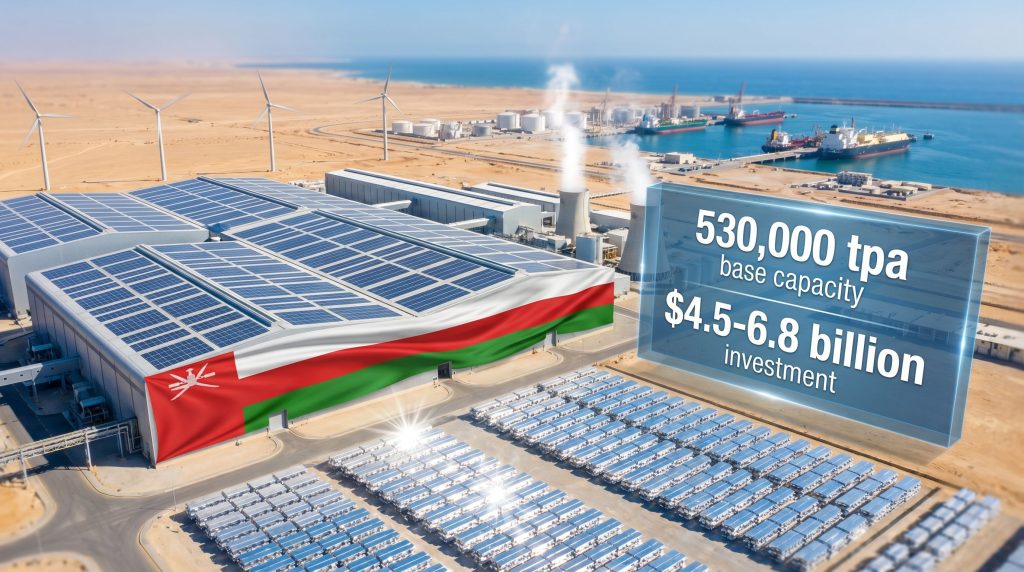
The most prominent project involves an aluminium smelter with 530,000 tonnes annual production capacity, backed by CMOC Group Limited. This initiative, estimated at OMR 2.4 billion, will incorporate low-carbon technologies and include downstream capabilities targeting production of an additional 620,000 tonnes per annum of aluminium billets and pre-cast slabs.
Policy Framework Supporting Sustainable Manufacturing
Oman's regulatory environment provides structured support for sustainable industrial development through Special Economic Zone incentives that reduce operational costs while maintaining environmental performance standards. The framework aligns with Oman's broader economic diversification strategy, moving beyond conventional resource extraction toward value-added manufacturing capabilities.
Furthermore, the development strategy emphasises creating synergies between energy production and industrial activity, contributing to operational cost reduction while attracting global investors focused on sustainability metrics. This approach reflects recognition that future competitive advantage in metals manufacturing will depend increasingly on carbon intensity performance.
Regulatory Support Mechanisms:
• Streamlined permitting processes for renewable energy integration projects
• Tax incentives for sustainable technology deployment and carbon reduction initiatives
• Investment protection mechanisms supporting long-term industrial project development
• Coordination between OPAZ and renewable energy development authorities
When big ASX news breaks, our subscribers know first
Technological Pathways for Low-Carbon Aluminium Production
Green hydrogen deployment represents the primary technological pathway enabling Duqm's aluminium transformation. Solar-powered electrolysis facilities will generate industrial-grade hydrogen for smelting operations, while integrated storage systems ensure continuous production capability despite renewable energy intermittency challenges.
However, the technological framework combines multiple low-carbon approaches that demonstrate the potential decarbonisation benefits available to modern industrial operations:
• Primary hydrogen production through solar-powered electrolysis systems
• Backup generation using wind-hydrogen hybrid production during peak demand periods
• Storage infrastructure including underground hydrogen storage for continuous operations
• Distribution networks connecting energy production facilities to manufacturing sites
Advanced Smelting Technology Integration
Inert anode technology deployment could reduce direct carbon emissions by up to 85% compared to conventional Hall-Héroult smelting processes. This technology eliminates carbon anode consumption while producing oxygen as a byproduct instead of carbon dioxide, fundamentally changing the chemistry of aluminium production.
In addition, two additional initiatives are being explored in collaboration with regional partners: the Geely Green Aluminium Project and the Pearl Green Iron and Aluminium Project. These projects align with SEZAD's broader vision of becoming a hub for sustainable metals manufacturing, supported by Oman's growing investments in renewable energy and hydrogen infrastructure.
Technology Implementation Components:
• Heat recovery systems capturing waste energy for secondary processing applications
• Smart grid integration optimising power consumption during renewable energy peak production
• Carbon capture and utilisation systems for managing remaining process emissions
• Digital twin optimisation enabling real-time monitoring and predictive maintenance
The technological approach reflects careful consideration of both current commercial readiness and future scalability requirements. Implementation timelines allow for technology validation and optimisation before full-scale deployment, reducing technical and financial risks associated with emerging industrial processes.
Investment Scale and Financial Architecture
The financial structure supporting Duqm's green aluminium expansion combines public development authority resources with international private capital, creating risk-sharing mechanisms that support large-scale industrial transformation. The CMOC Group project's OMR 2.4 billion investment provides a baseline for evaluating broader sectoral investment requirements.
| Investment Component | Estimated Range (USD) | Development Timeline | Capacity Impact |
|---|---|---|---|
| Primary smelting facilities | $4.5-6.8 billion | 2026-2030 | 530,000 tpa base capacity |
| Downstream processing | $2.1-3.2 billion | 2028-2031 | 620,000 tpa value-added products |
| Renewable energy systems | $1.8-2.5 billion | 2025-2029 | 2.5-3.2 GW clean power |
| Supporting infrastructure | $800M-1.2 billion | 2025-2027 | Utilities and transportation |
Financing Structure and Capital Sources
The financial architecture combines multiple capital sources to support the scale and complexity of integrated renewable energy and manufacturing development. Public-private partnerships leverage OPAZ development funds while attracting international investors focused on sustainable industrial projects.
Consequently, the phased development approach spreads capital requirements over multiple years while allowing revenue generation from early-phase operations to support later-stage expansion. This structure reduces financing risk while maintaining flexibility for technology optimisation and market adaptation.
Primary Financing Mechanisms:
• Government development funds providing equity participation and infrastructure investment
• Green bonds targeting ESG-focused institutional investors seeking long-term sustainability exposure
• Export credit facilities from development banks supporting technology transfer and equipment procurement
• Sovereign wealth funds from Gulf Cooperation Council members diversifying into sustainable manufacturing
Market Dynamics and Competitive Positioning
Global supply chain integration represents a critical factor in Duqm's competitive positioning within international aluminium markets. Direct shipping access to major consumption centres in Asia and Europe provides logistical advantages, while low-carbon production credentials support premium pricing in markets increasingly focused on carbon footprint reduction.
For instance, the emphasis on green metal production methodologies addresses growing demand from automotive manufacturers and construction companies requiring verified sustainability credentials throughout their supply chains.
Supply Chain Integration Points:
• Upstream linkages through bauxite sourcing from Guinea, Australia, and regional suppliers
• Technology partnerships via joint ventures with European and Asian smelting specialists
• Market access through direct shipping routes to automotive and aerospace sectors
• Regional coordination with complementary positioning alongside UAE and Saudi Arabian aluminium hubs
Demand Scenario Analysis Through 2035
Market development scenarios reflect varying rates of decarbonisation adoption across major aluminium-consuming industries. Automotive electrification drives demand for low-carbon aluminium in battery housings and vehicle structures, while construction and aerospace sectors increasingly require verified sustainability credentials.
Conservative Growth Scenario: 15-20% annual increase in regional green aluminium demand driven by established automotive manufacturing requirements and construction sector adoption of sustainability standards.
Moderate Growth Scenario: 25-30% annual expansion supported by accelerated automotive electrification and aerospace industry carbon reduction commitments creating premium markets for verified low-carbon aluminium.
Aggressive Growth Scenario: 40-45% annual growth reflecting rapid implementation of carbon border adjustment mechanisms and mandatory sustainability reporting driving broad-based demand transformation.
Risk factors include raw material price volatility affecting project economics and renewable energy scaling challenges that could impact production cost competitiveness against conventional aluminium sources.
Operational Models for Industrial Efficiency
Integrated production complex design emphasises vertical integration from alumina processing through finished product manufacturing, creating operational synergies while reducing transportation costs and supply chain complexity. Circular economy principles guide waste heat utilisation and material recycling systems that improve overall resource efficiency.
Production Complex Architecture:
• Modular expansion capability supporting phased capacity increases based on market demand evolution
• Digital twin optimisation enabling real-time monitoring and predictive maintenance across integrated systems
• Waste heat recovery capturing thermal energy from smelting operations for secondary processing
• Material recycling loops processing production waste and end-of-life aluminium products
Workforce Development and Technology Transfer
Human capital development focuses on creating specialised expertise in emerging green metals technologies while building local capacity for long-term operational sustainability. Training programmes combine theoretical education with hands-on experience in advanced manufacturing processes.
The workforce strategy recognises that successful deployment of advanced manufacturing technologies requires sustained investment in human capital development, creating career pathways that support both individual advancement and industrial sector growth.
Skills Development Framework:
• Technical training partnerships with international institutes specialising in renewable energy and metals processing
• Local content requirements establishing graduated targets for Omani workforce participation
• Innovation centres supporting research and development for process optimisation
• Knowledge transfer mechanisms through joint ventures facilitating technology localisation
Risk Management and Operational Continuity
Market risk management emphasises long-term contractual relationships with major industrial consumers requiring verified low-carbon aluminium supplies. Automotive manufacturers, construction companies, and aerospace firms increasingly demand sustainability credentials supported by transparent production documentation.
Market Risk Mitigation Strategies:
• Long-term offtake agreements with automotive and construction companies requiring verified sustainability credentials
• Price hedging mechanisms protecting against aluminium market volatility while maintaining premium pricing for low-carbon products
• Diversified customer base across geographic regions and end-use sectors reducing concentration risk
• Product differentiation through premium certification programmes and blockchain-verified carbon tracking
Operational Risk Controls
Operational continuity depends on managing complex interdependencies between renewable energy systems, hydrogen production, and smelting operations. Backup systems and supply chain diversification reduce vulnerability to single points of failure that could disrupt integrated production processes.
Furthermore, the risk management approach balances operational efficiency with resilience, recognising that integrated industrial systems require redundancy and flexibility to maintain competitive performance over multi-decade investment horizons.
Operational Resilience Framework:
• Renewable energy backup systems ensuring continuous power supply during maintenance or weather-related disruptions
• Supply chain diversification reducing dependence on single raw material sources or transportation routes
• Environmental monitoring preventing regulatory compliance issues and maintaining community relations
• Cybersecurity frameworks protecting industrial control systems from digital threats
The next major ASX story will hit our subscribers first
Regional Influence and Competitive Response
Duqm's success in green aluminium production will likely accelerate competitive responses across the Middle East as other nations recognise the strategic importance of sustainable metals manufacturing. The UAE, Saudi Arabia, and Qatar each possess unique advantages that could support similar initiatives tailored to their specific resource endowments and market positioning.
However, these developments also reflect broader geopolitical market dynamics that favour regions with optimal combinations of renewable energy resources and manufacturing capabilities.
Potential Regional Developments:
• UAE acceleration through enhanced focus on green aluminium in Abu Dhabi's industrial zones leveraging existing infrastructure
• Saudi expansion integrating sustainable metals with NEOM and other Vision 2030 manufacturing initiatives
• Qatar positioning utilising natural gas advantages for transitional low-carbon production bridging to renewable energy
• Kuwait exploration evaluating entry into sustainable manufacturing as part of economic diversification strategies
Technology and Investment Spillover Effects
Successful deployment of green hydrogen and advanced smelting technologies in Duqm creates knowledge spillovers that benefit broader regional industrial development. Equipment suppliers, engineering firms, and specialised service providers establish regional capabilities that reduce costs and implementation timelines for subsequent projects.
The broader impact extends beyond aluminium manufacturing to influence regional approaches to industrial decarbonisation and renewable energy integration across multiple sectors.
Regional Development Catalysts:
• Process innovation diffusion across petrochemical and metals industries sharing similar technical challenges
• Supply chain cluster development creating regional equipment manufacturing and specialised services
• Human capital mobility spreading expertise throughout Gulf industrial sectors
• Investment pattern replication in renewable energy-powered manufacturing across different industries
Global Market Structure Implications
Duqm's emergence as a green aluminium producer reflects broader shifts in global manufacturing economics where carbon intensity increasingly determines competitive advantage. Countries with abundant renewable energy resources gain structural advantages in energy-intensive industries previously dominated by low-cost conventional energy sources.
Geopolitical Positioning Factors:
• China dependency reduction creating alternative supply sources for Western markets seeking supply chain diversification
• Trade route optimisation offering shorter shipping distances to European and African consumers
• Strategic resource control enhancing Middle Eastern influence in critical materials supply chains
• Alliance formation enabling coordination with other sustainable production regions
Industry Structure Evolution
The transition toward renewable energy-powered aluminium production creates new competitive dynamics that favour regions with optimal combinations of renewable energy resources, industrial infrastructure, and market access. Traditional cost advantages based on low-cost fossil fuels become less relevant as carbon pricing and sustainability requirements reshape industry economics.
Consequently, Australia's position in green metals leadership provides valuable insights for understanding how different regions can leverage their unique advantages in this evolving competitive landscape.
Competitive Transformation Drivers:
• Production cost advantages from abundant renewable energy resources supporting long-term competitive positioning
• Quality differentiation through verified low-carbon production processes commanding premium pricing
• Market share redistribution favouring sustainable production locations over conventional low-cost producers
• Innovation acceleration driving development of next-generation aluminium production technologies
The convergence of renewable energy abundance with strategic manufacturing positioning creates unprecedented opportunities for regions that successfully integrate sustainable technology with industrial-scale production capabilities.
Strategic Positioning for Post-Carbon Manufacturing
Duqm's green aluminium initiative represents more than regional industrial development; it signals fundamental changes in global manufacturing economics where renewable energy abundance creates new sources of competitive advantage. The integration of sustainable technology with large-scale production capabilities demonstrates viable pathways for industrial decarbonisation across multiple sectors.
The development timeline extending through 2030 provides opportunities for technology optimisation and market development while establishing Oman as a leader in sustainable metals manufacturing. Success depends on maintaining cost competitiveness while delivering genuine environmental benefits that justify premium pricing in increasingly sustainability-focused markets.
Furthermore, Oman's goals extend beyond aluminium, targeting annual steel production of around 30 million tonnes by 2050 through projects including Jindal Steel Duqm and Meranti Green Steel initiatives. This broader sustainable metals strategy positions Duqm SEZ as a comprehensive low-carbon production centre capable of serving diverse industrial applications.
The transformation reflects recognition that future industrial competitive advantage will increasingly depend on carbon intensity performance, renewable energy integration, and verified sustainability credentials rather than traditional cost factors alone. This shift creates opportunities for regions with optimal resource combinations while challenging established production centres to adapt their operational models.
Disclaimer: This analysis contains forward-looking statements and projections based on current market conditions and announced development plans. Actual outcomes may differ significantly due to market volatility, technological challenges, regulatory changes, and other factors beyond current visibility. Investment decisions should consider comprehensive due diligence and professional financial advice.
Looking to Capitalise on Green Metals Transformation?
Discovery Alert's proprietary Discovery IQ model delivers instant notifications on significant ASX mineral discoveries, empowering subscribers to identify actionable opportunities in the evolving metals sector before broader markets respond. Begin your 14-day free trial today and position yourself ahead of the sustainable mining transformation that's reshaping global investment landscapes.
