July 24, 2026
The Invisible Mine: Why Industrial Wastewater Holds the Key to Europe's Critical Minerals Future
For decades, the dominant mental model of mineral supply has been geological: ore bodies buried beneath mountains, extracted through capital-intensive mining operations that take a decade or more to reach commercial production. Yet one of the most consequential shifts underway in European industrial policy involves a fundamentally different model, one where critical metals are recovered not from rock, but from liquid waste streams flowing out of factories every single day. This reframing, from geology to industrial metabolism, is reshaping how policymakers, investors, and technology companies think about domestic supply security.
The case of Circular Materials, and its Supercritical Water Precipitation technology, illustrates precisely why this paradigm shift is accelerating. The Italian deep-tech company has demonstrated that industrial wastewater is not merely an environmental liability to be managed, but a recoverable resource stream containing commercially significant concentrations of nickel, copper, ruthenium, titanium, and other platinum group metals. The broader implications of Circular Materials wastewater metal recovery funding extend far beyond one company's financing round.
When big ASX news breaks, our subscribers know first
Understanding the Scale of Europe's Critical Materials Exposure
Europe's vulnerability in critical raw materials is structural rather than cyclical. Unlike agricultural commodities or energy, where market disruptions can be absorbed through storage or demand-side adjustments, critical minerals underpin manufacturing processes that have no short-term substitution pathway. Battery cathodes require nickel and cobalt. Advanced catalysts depend on platinum group metals. Aerospace components are built around titanium alloys.
The European Commission's own assessments confirm that the continent remains heavily import-dependent across the majority of its identified critical raw materials, with processing capacity in particular concentrated in a small number of non-European jurisdictions. This concentration amplifies geopolitical risk significantly. Furthermore, Europe's critical minerals supply chain faces mounting pressure as clean energy demand accelerates across the continent.
What makes industrial wastewater a strategically compelling alternative is its ubiquity. Electroplating facilities, battery recycling operations, specialty chemical plants, and surface treatment companies collectively generate enormous volumes of metal-bearing liquid waste across Europe's existing industrial base. Unlike greenfield mining projects, these waste streams are already being produced, already regulated, and already located within the EU's industrial heartland.
The core strategic insight is that Europe already possesses a distributed secondary mine in the form of its industrial waste infrastructure. The challenge has been converting that latent resource into recoverable supply.
How Supercritical Water Precipitation Actually Works
To understand why Circular Materials' SWaP technology represents a genuine technical advance rather than incremental improvement, it helps to understand the physics of supercritical water and why conventional treatment falls short.
Water reaches its critical point at approximately 374 degrees Celsius and 220 bar of pressure. Beyond these thresholds, it no longer exists as a distinct liquid or gas phase but enters a supercritical state with dramatically altered solvent properties. In this condition, water's ability to dissolve organic compounds decreases sharply while its oxidative reactivity increases. For metal-bearing wastewater, this creates conditions in which dissolved metals precipitate out of solution with exceptional selectivity and completeness.
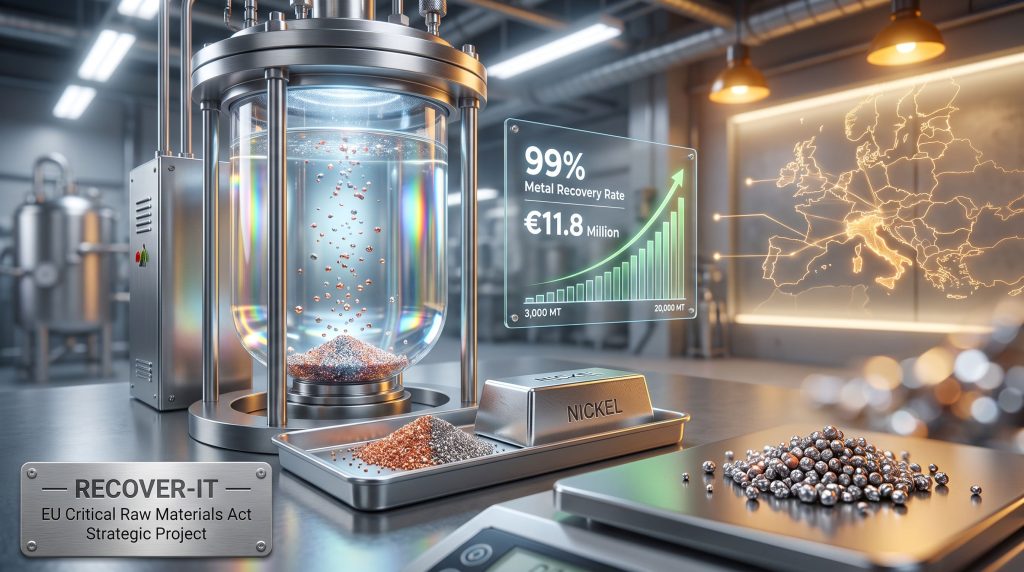
The practical performance outcome is a recovery rate exceeding 99% of dissolved metal content, a figure that conventional chemical precipitation and ion-exchange methods cannot reliably approach, particularly for complex multi-metal waste streams.
The critical differentiator is what SWaP produces versus what legacy systems produce:
- Conventional chemical precipitation converts dissolved metals into hazardous metal hydroxide sludge requiring classified transportation and controlled landfill disposal, a cost centre with no offsetting revenue
- Ion-exchange systems can selectively capture certain metals but generate contaminated resin waste and struggle with complex mixed-metal streams
- SWaP produces directly saleable secondary raw materials in powder form, having achieved End-of-Waste regulatory status at the Padua facility
This distinction between producing a waste byproduct and producing a saleable product is not merely commercial. It is, however, the mechanism through which SWaP converts an industrial liability into an asset. The battery recycling process faces similar challenges in converting complex multi-metal streams into commercially viable outputs.
Metals Recovered Through the SWaP Process
| Metal Category | Specific Metals | Primary Industrial Applications |
|---|---|---|
| Base Metals | Nickel, Copper | Battery cathodes, stainless steel, electroplating |
| Refractory Metals | Titanium | Aerospace, medical implants, advanced alloys |
| Platinum Group Metals | Ruthenium, others | Catalysis, electronics, corrosion-resistant coatings |
The €11.8 Million Financing: What the Capital Structure Reveals
The Circular Materials wastewater metal recovery funding round closed in mid-2026 at €11.8 million (approximately $13.5 million USD) through a SAFE instrument structure. While the absolute quantum is modest relative to late-stage industrial projects, the composition of the investor syndicate is arguably more significant than the headline figure.
Investor Breakdown and Strategic Significance
| Investor | Type | Strategic Role |
|---|---|---|
| European Innovation Council Fund | EU Commission venture arm | Policy-aligned deep-tech commercialisation capital |
| EIT RawMaterials | 300+ partner EU consortium | Critical minerals ecosystem integration and validation |
| CDP Venture Capital | Italian national development finance | Domestic industrial scaling support |
| 360 Capital | Private venture capital | Commercial growth acceleration |
| Corbites | Private investor | Sector-specific strategic capital |
| Lumar S.r.l. | Private investor | Regional industrial network access |
The co-investment of the European Innovation Council Fund alongside EIT RawMaterials is particularly notable from a market signalling perspective. These two institutions represent the primary institutional capital channels for critical materials innovation within the EU's formal policy architecture. Their simultaneous participation in a single financing round signals an institutional conviction that secondary metal recovery from liquid industrial waste is no longer speculative but a recognised component of EU supply chain strategy.
EIT RawMaterials' consortium structure, encompassing more than 300 industrial, academic, and governmental partners, provides Circular Materials with something that no private venture investor alone could deliver: a pre-existing network of potential industrial customers, academic collaborators, and regulatory counterparts spanning the entire European critical minerals ecosystem.
This financing also followed an earlier €2.5 million EIC Accelerator grant under the STOP WASTIN ME project, which focused on energy efficiency improvements and expanding the range of industrial wastewater compositions that SWaP can process. The sequencing, from grant funding to institutional SAFE round, represents a deliberate de-risking pathway that is increasingly common in European deep-tech commercialisation. Circular Materials was selected as a strategic project by the European Commission under the CRMA, further reinforcing this institutional momentum.
Investor Insight: The SAFE structure used in this round allows investors to convert their holdings into equity at a future valuation event without requiring an immediate company valuation, a mechanism well-suited to pre-revenue or early-revenue deep-tech companies where traditional equity pricing is premature.
Industrial Milestones: What the Padua Facility Has Proven
Laboratory-scale demonstrations of novel extraction chemistries are common. Industrial-scale validations under real operating conditions are far rarer, and far more commercially meaningful. The Padua facility's June 2025 production milestones therefore carry weight that extends beyond their modest absolute volumes.
In that month, the facility documented:
- 1 kilogram of ruthenium recovered from industrial wastewater at commercial processing scale
- 1 metric ton of nickel recovered from wastewater supplied by Argos Surface Technologies, a European industrial surface-treatment services company
Neither of these outputs was produced under controlled laboratory conditions. Both were achieved at an operating industrial facility processing real-world waste streams with the compositional complexity and variability that laboratory experiments typically exclude. This distinction matters significantly for investor and customer confidence.
Ruthenium: An Underappreciated Recovery Target
Ruthenium warrants specific attention because it sits in a segment of the platinum group metals market that is both commercially valuable and poorly understood outside specialist circles. It is primarily produced as a byproduct of platinum and palladium refining from South African ore bodies, meaning its supply is structurally inelastic and geographically concentrated.
Its applications in catalysis, data storage hard disk coatings, and electrochemical systems make it a genuinely strategic material with limited substitution options. The recovery of even kilogram-scale quantities from industrial wastewater is commercially meaningful given ruthenium's market pricing. Consequently, the critical minerals demand for platinum group metals continues to intensify as clean energy applications scale across Europe.
The Argos Surface Technologies Partnership Model
The commercial relationship with Argos Surface Technologies establishes a replicable template for industrial wastewater partnerships. Argos, as a surface-treatment services provider, generates nickel-bearing wastewater as an unavoidable byproduct of its core electroplating and finishing operations. Under conventional treatment, this represents a compliance cost with no revenue offset.
The partnership model inverts this dynamic: Argos supplies its nickel-enriched wastewater to Circular Materials' Padua facility, enabling metal recovery while addressing its own waste treatment obligations. This circular supply arrangement transforms wastewater from a regulatory burden into a functional input for domestic critical minerals supply.
Andrea Siano, President of Argos Surface Technologies, has described the partnership as demonstrating how industrial operators can generate new value by contributing waste streams to circular supply chains, framing their nickel-bearing wastewater as a strategic resource for the energy transition rather than a disposal problem.
End-of-Waste Status: The Regulatory Enabler That Changes Everything
One of the least-discussed but most commercially critical achievements of the Padua facility is its attainment of End-of-Waste status under the EU Waste Framework Directive. This regulatory classification is easy to overlook, yet without it, the entire commercial model collapses.
Under EU waste law, materials that remain classified as waste face a cascade of restrictions:
- Mandatory waste tracking and consignment documentation throughout the supply chain
- Restrictions on cross-border transport that complicate European-scale distribution
- Limited buyer eligibility, as many industrial purchasers cannot or will not accept materials classified as waste
- Ongoing compliance obligations that add cost and complexity to every transaction
End-of-Waste status under Article 6 of the Waste Framework Directive removes these constraints by certifying that recovered materials have met specified quality criteria and are suitable for use as secondary raw materials. For Circular Materials, this means recovered nickel powder can be sold directly to battery materials producers or stainless steel manufacturers under standard commercial contracts, without the legal encumbrances of waste regulation.
The practical implication is that End-of-Waste designation is not a regulatory footnote. It is the mechanism that converts technical recovery capability into commercial sales, and it requires both technological performance and regulatory engagement to achieve. However, five barriers to metal recovery from industrial wastewater still remain relevant across the broader industry, making this regulatory milestone all the more significant.
The next major ASX story will hit our subscribers first
The CRMA Strategic Project Designation: Policy Context and Commercial Significance
The European Commission's designation of Circular Materials' RECOVER-IT initiative as a Strategic Project under the EU Critical Raw Materials Act in March 2025 preceded the 2026 financing round by over a year. Understanding the significance of this designation requires understanding what the CRMA is structurally attempting to accomplish.
The CRMA, enacted to diversify European critical minerals supply chains, sets specific domestic capacity benchmarks including a target that at least 40% of annual EU consumption of strategic materials should be processed within European borders by 2030. Secondary recovery from industrial waste streams is explicitly recognised within this framework as a qualifying supply pathway alongside primary mining and processing.
Strategic Project status provides access to streamlined permitting processes and priority consideration for public financing instruments. Critically, it also provides a form of institutional validation that carries commercial weight with private investors who may otherwise find the regulatory landscape for novel industrial processes difficult to assess.
The sequencing, CRMA designation in March 2025 followed by a multi-institutional financing round in 2026, suggests that policy recognition contributed meaningfully to investor confidence in the RECOVER-IT initiative's regulatory trajectory. Furthermore, the broader development of a critical raw materials facility across Europe reflects this accelerating policy commitment to domestic supply security.
Scaling to Ferrara: What a Sixfold Capacity Increase Means
The primary deployment of the €11.8 million financing is the development of a second operational hub in Ferrara, Italy, alongside continued operation of the Padua facility.
Capacity Expansion Targets
| Metric | Current (Padua) | Target (Ferrara + Padua Combined) |
|---|---|---|
| Annual Wastewater Treatment Capacity | 3,000 metric tons | 20,000 metric tons |
| Capacity Increase Factor | Baseline | 6.7x current capacity |
| Primary Recovery Metals | Nickel, Ruthenium | Nickel, Copper, Titanium, PGMs |
A 20,000 metric ton annual treatment capacity positions Circular Materials as a structurally meaningful contributor to European secondary supply rather than a proof-of-concept operation. At this scale, the facility can enter supply agreements with battery manufacturers, specialty chemicals producers, and advanced materials companies requiring consistent certified secondary metal inputs, buyer categories with very different procurement requirements than early-stage technology customers.
The Ferrara hub also signals a geographic expansion strategy within northern Italy, a region with dense industrial infrastructure in electroplating, chemical manufacturing, and advanced materials production, all sectors generating the metal-bearing wastewater streams that SWaP is engineered to process.
Global Comparisons: How the EU Approach Fits the Broader Recovery Landscape
The momentum behind wastewater metal recovery extends beyond Europe. Comparing institutional investment frameworks across jurisdictions illuminates both the convergences and the structural differences in approach.
Global Funding Landscape for Wastewater Metal Recovery
| Jurisdiction | Program/Initiative | Approximate Funding | Primary Focus |
|---|---|---|---|
| European Union | EIC Fund + EIT RawMaterials (Circular Materials) | €11.8 million | Industrial wastewater, nickel, copper, PGMs |
| United States | ARPA-E RECOVER Program | ~$36 million | Ammonia and critical metals from wastewater |
| European Union | EIC Accelerator (STOP WASTIN ME, Circular Materials) | €2.5 million | Energy efficiency in metal recovery processes |
The US ARPA-E RECOVER program directs significant attention toward ammonia recovery alongside critical metals, reflecting the agricultural nitrogen cycle as an additional policy priority. The European framework, anchored by the CRMA, concentrates on metals critical for clean energy and advanced manufacturing, with nickel, copper, and platinum group metals as the primary targets.
Both approaches share a foundational recognition: conventional mine development timelines of 10 to 15 years from discovery to production are structurally incompatible with the urgency of clean energy transition material demand. In addition, the relationship between critical minerals and energy security is becoming an increasingly central concern for policymakers across both jurisdictions.
The Commercial Case for Industrial Operators
For electroplating, battery recycling, and specialty chemical companies, the SWaP partnership model offers a genuinely novel economic proposition. The simplified commercial logic runs through five stages:
- Industrial operator generates metal-bearing wastewater as an unavoidable byproduct of core manufacturing processes
- Wastewater is supplied to a SWaP-equipped recovery facility under a commercial treatment agreement
- Dissolved metals are precipitated and refined to secondary raw material specification with greater than 99% recovery efficiency
- Recovered metals re-enter supply chains as certified secondary inputs, reducing demand for primary mined material
- Industrial operator receives cost reduction on waste treatment obligations, potential revenue sharing on recovered metal value, or both
Industries particularly well positioned to benefit from this model include:
- Electroplating and surface treatment, where process baths and rinse waters carry high dissolved metal concentrations of nickel, chromium, copper, and zinc
- Battery recycling, generating complex multi-metal leachate streams containing nickel, cobalt, copper, manganese, and lithium
- Specialty chemical and pharmaceutical manufacturing, where catalyst recovery from platinum group metal-bearing process streams represents significant latent value
- Specialty alloy production, where titanium and other refractory metal-bearing waste streams arise from machining, surface treatment, and quality rejection processes
For nickel-intensive industries in particular, the arithmetic of recoverable metal value relative to conventional waste disposal costs can be compelling. Industrial nickel concentrations in electroplating rinse waters can reach several hundred milligrams per litre, and across high-volume operations, the cumulative tonnage of dissolved nickel discharged annually can represent material economic value that is currently being paid to waste treatment contractors rather than captured as recoverable product.
Frequently Asked Questions: Circular Materials Wastewater Metal Recovery Funding
What is Circular Materials and what does its technology do?
Circular Materials is an Italian technology company that has developed Supercritical Water Precipitation (SWaP), a proprietary process for recovering critical and strategic metals from industrial liquid waste streams. It addresses both the environmental problem of hazardous wastewater disposal and Europe's structural dependency on imported critical raw materials.
How much has Circular Materials raised and from which investors?
The company closed an €11.8 million (~$13.5 million) SAFE financing round in 2026, with participation from the European Innovation Council Fund, EIT RawMaterials, CDP Venture Capital, 360 Capital, Corbites, and Lumar S.r.l. This followed an earlier €2.5 million EIC Accelerator grant under the STOP WASTIN ME project.
What metals can SWaP technology recover?
The SWaP process has demonstrated industrial-scale recovery of nickel and ruthenium at the Padua facility, with the expanded Ferrara hub expected to process wastewater streams containing copper, titanium, and additional platinum group metals. Documented recovery efficiency exceeds 99% of dissolved metal content.
Why does End-of-Waste status matter?
Without End-of-Waste classification under the EU Waste Framework Directive, recovered materials remain legally classified as waste and face severe market access restrictions. The Padua facility's End-of-Waste status allows recovered metals to be sold commercially as certified secondary raw materials, which is the foundational requirement for a viable commercial model.
What is the RECOVER-IT Strategic Project designation?
Circular Materials' RECOVER-IT initiative received Strategic Project status under the EU Critical Raw Materials Act in March 2025. This designation, awarded to initiatives contributing materially to European domestic critical minerals supply through recycling or secondary recovery, provides access to streamlined permitting and priority consideration for public financing instruments.
How large will operations become after the Ferrara expansion?
The combined Padua and Ferrara facilities are targeted to reach 20,000 metric tons of annual wastewater treatment capacity, representing a more than sixfold increase from the current 3,000 metric ton capacity at Padua. This expanded throughput is expected to return meaningful volumes of nickel, copper, titanium, and platinum group metals to European supply chains.
What This Convergence Signals for Critical Minerals Investment
The Circular Materials case study is significant not only for what it demonstrates about one company's technology, but for what it reveals about the maturation of secondary recovery as an investment category within Europe's critical minerals policy framework.
Three structural factors are converging simultaneously:
- Regulatory enablement through End-of-Waste status and CRMA Strategic Project designation removes the legal barriers that historically prevented recovered materials from accessing commercial markets
- Institutional capital validation through co-investment by the EIC Fund and EIT RawMaterials signals that Europe's primary deep-tech financing infrastructure now recognises wastewater metal recovery as a viable investment category
- Industrial-scale proof points at the Padua facility demonstrate that the performance thresholds claimed for SWaP are achievable under real operating conditions rather than laboratory simulations
Strategic Implication: As European critical minerals policy matures and the CRMA's 2030 domestic supply benchmarks approach, secondary recovery technologies that combine regulatory compliance, institutional backing, and demonstrated industrial-scale performance will increasingly attract both public and private capital. The Circular Materials wastewater metal recovery funding round may prove to be an early marker of a much larger capital reallocation toward Europe's distributed industrial mine.
Readers seeking further coverage of critical minerals technology innovation, secondary recovery developments, and European supply chain policy can find ongoing analysis at Metal Tech News, which tracks developments across mining technology, tech metals, and critical minerals supply chains.
Disclaimer: This article contains forward-looking statements and projections relating to technology performance, capacity targets, and market conditions. These involve inherent uncertainties and should not be construed as investment advice. Readers should conduct independent due diligence before making any investment decisions related to companies or technologies discussed in this article.
Want to Track the Next Critical Minerals Opportunity Before the Broader Market?
Discovery Alert's proprietary Discovery IQ model delivers real-time alerts on significant ASX mineral discoveries — including critical metals driving Europe's supply chain transformation — instantly converting complex data into actionable investment insights for traders and long-term investors alike. Explore historic discoveries and the returns they generated, then begin a 14-day free trial to position yourself ahead of the market.