August 24, 2026
Understanding Industrial Metals as Strategic Investment Assets
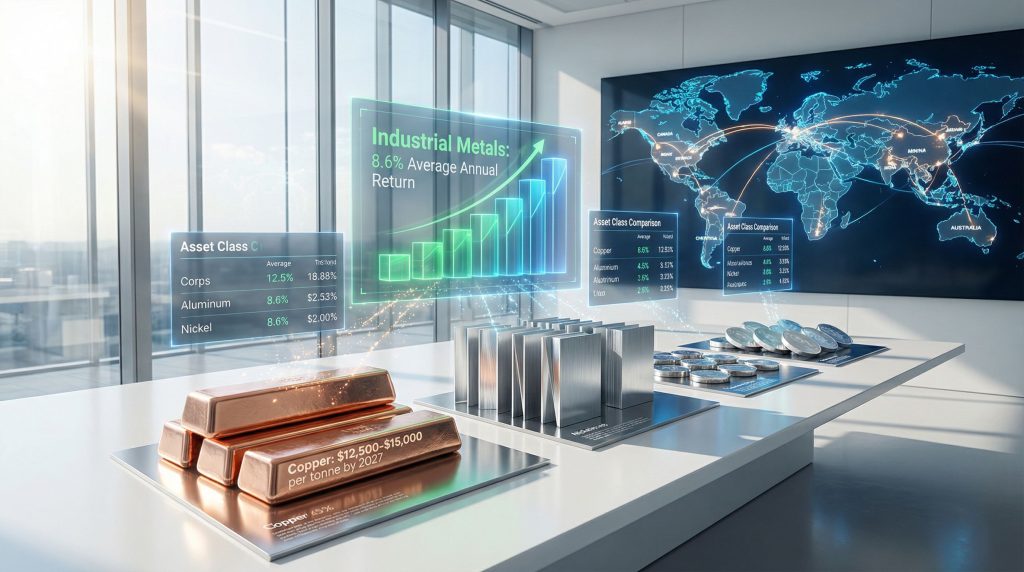
Investment portfolios seeking exposure to structural economic transformation increasingly turn toward industrial metals as both diversification tools and inflation hedges. Unlike precious metals, which derive value from monetary characteristics, base metals such as copper, aluminum, nickel, zinc, and tin generate returns through fundamental industrial demand patterns driven by global infrastructure development and technological advancement.
The strategic case for investing in industrial metals centers on their role as economic building blocks. As analyst Adam Sharp notes, these materials represent "a bet on people in the world getting less poor. Not rich, just not in poverty. A house or apartment, bikes, maybe even a car. It all adds up with billions of people" (Sharp, Daily Reckoning, January 7, 2026).
This thesis reflects the reality that industrialization requires massive material inputs, creating persistent demand regardless of short-term market volatility hedging. China's transformation exemplifies this dynamic: the country expanded from virtually no registered vehicles in 1995 to more than 350 million by 2026, according to CEIC data. This single metric illustrates the material intensity of middle-class formation across emerging economies.
Performance Characteristics of Industrial Metals:
- Inflation correlation: Strong historical relationship with consumer price increases
- Portfolio diversification: Low to moderate correlation with equity markets (0.3-0.5)
- Volatility profile: Higher than traditional fixed income but often lower than individual mining equities
- Cycle sensitivity: Performance tied to global manufacturing and construction activity
When big ASX news breaks, our subscribers know first
Monetary Policy and Macro-Economic Transmission Mechanisms
Central bank policies create cascading effects throughout commodity markets via multiple transmission channels that sophisticated investors must understand when investing in industrial metals. The relationship between monetary accommodation and commodity prices operates through currency devaluation, real interest rate compression, and liquidity flow redirection.
Dollar weakness amplification occurs when Federal Reserve rate cuts reduce the opportunity cost of holding dollar-denominated commodities for international buyers. As Sharp explains: "If the Fed keeps cutting rates and QE continues or accelerates, the dollar should fall. This is basically money printing, and bullish for commodities" (Sharp, Daily Reckoning, January 7, 2026).
Furthermore, the tariff market impact creates additional complexity for commodity investors to navigate.
China's Dominant Market Position:
China accounts for approximately 50% of global industrial metal demand, making Chinese economic policy and growth trajectories critical variables for commodity investors (Sharp, Daily Reckoning, January 7, 2026). This concentration creates both opportunity and risk, as Chinese infrastructure spending, manufacturing output, and domestic consumption patterns directly influence global pricing.
The vehicle registration data illustrates China's consumption trajectory: from essentially zero cars in 1995 to over 350 million registered vehicles by 2026. This automotive fleet represents embedded demand for copper (electrical systems), aluminum (body panels and engines), and specialized alloys (electronic components). Understanding China demand prospects remains crucial for investors.
Geopolitical Risk Premium Integration
Modern industrial metals markets increasingly incorporate geopolitical premiums due to supply chain fragmentation and strategic resource classification. Recent examples include China's implementation of silver export controls in early 2026, demonstrating how policy decisions can rapidly create artificial scarcity.
Supply disruption mechanisms include:
- Export restrictions: Governments limiting critical mineral exports for strategic reasons
- Sanctions impact: Exclusion of major producers from Western markets
- Trade war escalation: Tariffs and import controls affecting material flows
- Strategic stockpiling: Government accumulation of critical materials for security purposes
Sharp notes that "Trade wars are a complete wild card. China just put export controls on silver, which nobody would have expected a year ago. Anything could happen in this geopolitical environment" (Sharp, Daily Reckoning, January 7, 2026).
Structural Demand Drivers Shaping the Next Decade
The electrification mega-trend represents the most significant structural driver for industrial metals demand over the next decade. Electric vehicle adoption, renewable energy infrastructure, and digital economy expansion create unprecedented material requirements that traditional supply chains struggle to meet.
Electric Vehicle Copper Intensity
Electric vehicles require substantially more copper than internal combustion engine vehicles due to motor windings, battery systems, and charging infrastructure. Industry estimates suggest EVs contain 75-100 kilograms of copper per vehicle, compared to approximately 25 kilograms in conventional automobiles.
Key electrification applications:
- Motor windings: High-conductivity copper essential for electric motor efficiency
- Battery systems: Copper foil for lithium-ion battery current collectors
- Charging infrastructure: Substantial copper content in charging stations and grid connections
- Power electronics: Advanced semiconductors requiring high-purity copper substrates
Data Center Infrastructure Expansion
The artificial intelligence revolution creates exponentially growing demand for computing infrastructure, with AI data centers requiring approximately 3x more copper per square foot than traditional facilities due to increased power density and cooling requirements.
Infrastructure requirements include:
- Power distribution: Massive copper bus bars and cabling for high-current applications
- Cooling systems: Copper tubing for liquid cooling in high-performance computing
- Grounding systems: Extensive copper grounding for electrical safety and performance
- Backup power: UPS systems and generators requiring substantial copper content
Renewable Energy Metal Intensity
Solar and wind infrastructure deployment requires significant industrial metals inputs, particularly aluminum for structural components and copper for electrical systems. Solar installations typically require 4-5 kilograms of copper per installed kilowatt, while wind turbines can contain 3-8 tons of copper depending on size and generator design.
Critical Insight: The convergence of electrification, digitalization, and renewable energy creates overlapping demand patterns that traditional forecasting models underestimate, particularly in copper and aluminum markets.
Investment Vehicle Analysis and Selection
Investing in industrial metals requires careful consideration of available vehicles, each offering distinct risk-return profiles and implementation complexities. Investors can access exposure through exchange-traded products, futures markets, or mining equities.
Exchange-Traded Product Comparison
Major Industrial Metals ETFs:
| Fund | Focus | Structure | Key Characteristics |
|---|---|---|---|
| PDBC | Broad commodities | Optimized futures | Diversified exposure across multiple commodities |
| CPER | Pure copper | Futures-based | Direct copper price exposure with roll yield considerations |
| JJN | Nickel exposure | Futures contracts | Battery metals thematic positioning |
Note: Expense ratios and specific holdings require verification against current fund documentation as fees and structures may change.
Understanding industrial metals investing strategies can help investors select appropriate vehicles.
Mining Equity Strategic Positioning
Mining equities provide leveraged exposure to commodity prices while introducing operational, geological, and management risks. The Vale S.A. (NYSE: VALE) case study illustrates both opportunities and complexities in major mining company investment.
Vale's Investment Profile:
- Performance: Up approximately 38% from June 2025 publication to January 2026
- Valuation metrics: Trading at 10x current earnings and 7x 2026 estimates
- Dividend yield: Approximately 5% with growth potential tied to commodity prices
- Production diversification: Primary iron ore producer with significant nickel, copper, cobalt, and precious metals output
Risk factors include:
- Debt burden: Substantial leverage requiring commodity price support for service
- Environmental liabilities: $30 billion court-ordered payment over 20 years for Fundao dam disaster cleanup
- Geopolitical exposure: Brazilian operations subject to local political and regulatory changes
- Commodity price sensitivity: High operational leverage amplifying both gains and losses
As Sharp notes: "Vale is a relatively high-risk, high-reward vehicle to bet on industrial metals (mostly iron with a side of nickel and copper)" (Sharp, Daily Reckoning, January 7, 2026).
Futures Market Mechanics
Direct futures market participation offers the most precise commodity exposure but requires sophisticated understanding of contract structures, margin requirements, and roll yield dynamics.
Critical considerations:
- Contango vs. backwardation: Market structure significantly impacts returns through roll yield
- Margin requirements: Leverage amplifies both gains and losses, requiring careful position sizing
- Contract specifications: Different delivery locations and quality specifications affect pricing
- Storage costs: Physical delivery considerations for investors holding to maturity
Market Timing and Cycle Analysis
Successful investing in industrial metals requires understanding commodity cycles and identifying optimal entry and exit points through fundamental and technical analysis frameworks.
Technical Market Structure Indicators
Backwardation vs. Contango Analysis:
Markets in backwardation (near-term prices exceeding future prices) historically generate superior returns due to positive roll yield. Conversely, contango markets often produce negative roll yields that erode returns over time.
Key timing indicators:
- Inventory levels: Low stockpiles typically correlate with price strength
- Capacity utilization: High production rates indicate strong demand
- Forward curve structure: Pricing relationships across contract months
- Open interest patterns: Institutional positioning and commitment of traders data
Fundamental Supply-Demand Modeling
Leading Economic Indicators:
- Global Manufacturing PMI: Forward-looking demand indicator for base metals
- Chinese credit impulse: Drives infrastructure and construction activity
- Mine supply pipeline: 3-7 year development lead times create predictable constraints
- Substitution dynamics: Price relationships triggering material switching
Sharp emphasises patience in commodity investing: "Industrial metal miners are out of favour, cheap, and starting to show life. In my experience, that's a very good combination. But sometimes this method does take patience" (Sharp, Daily Reckoning, January 7, 2026).
Risk Management and Portfolio Construction
Effective investing in industrial metals requires comprehensive risk management frameworks addressing volatility, concentration, liquidity, and correlation risks.
Multi-Layer Risk Mitigation
Risk Management Strategies:
| Risk Type | Primary Concern | Mitigation Approach |
|---|---|---|
| Price volatility | Commodity price swings | Position sizing and diversification |
| Currency exposure | USD strength/weakness | Currency hedging instruments |
| Liquidity risk | Market access during stress | Staggered position implementation |
| Concentration risk | Single commodity exposure | Cross-metal diversification |
Portfolio Allocation Frameworks
Allocation Models by Risk Tolerance:
- Conservative approach: 5-10% allocation within alternatives portfolio
- Moderate strategy: 15-20% allocation with tactical overlay capabilities
- Aggressive positioning: 25%+ allocation during favourable cycle timing
Implementation considerations:
- Dollar-cost averaging: Systematic accumulation to reduce timing risk
- Rebalancing discipline: Regular portfolio adjustment to maintain target weights
- Correlation monitoring: Tracking relationship changes with traditional assets
- Stress testing: Portfolio behaviour analysis under adverse scenarios
The next major ASX story will hit our subscribers first
Specific Metal Investment Cases
Copper: The Electrification Essential
Copper's unique combination of electrical conductivity, thermal properties, and corrosion resistance makes it irreplaceable in electrification applications. Current market dynamics suggest structural supply deficits emerging as demand growth outpaces mine production capacity.
Investment drivers:
- Supply constraints: Limited new mine development due to declining ore grades and permitting delays
- Demand acceleration: EV adoption and renewable energy deployment
- Grid modernisation: Transmission infrastructure requiring substantial copper content
- Data centre expansion: Computing infrastructure driving incremental demand
Understanding US copper production outlook provides insights into domestic supply dynamics.
Nickel: Battery Metal Premium
Nickel's critical role in lithium-ion battery cathodes creates direct exposure to electric vehicle growth trajectories. Current pricing around $18,000 per ton reflects both supply disruptions and growing battery demand (Sharp, Daily Reckoning, January 7, 2026).
Market dynamics:
- Russian supply disruption: Sanctions limiting access to Norilsk Nickel production
- Battery chemistry evolution: High-nickel cathodes improving energy density
- Stainless steel demand: Traditional industrial applications providing demand floor
- Mine supply concentration: Limited number of major producing regions
Aluminum: Lightweighting Revolution
Aluminum's strength-to-weight ratio drives adoption in transportation, packaging, and construction applications. Vehicle lightweighting mandates and renewable energy infrastructure create structural demand growth.
Strategic applications:
- Automotive lightweighting: Fuel efficiency regulations driving aluminum adoption
- Solar infrastructure: Mounting systems and structural components
- Grid infrastructure: Alternative to copper in power transmission applications
- Packaging evolution: Sustainable alternative to plastic packaging
ESG Considerations and Green Metal Premiums
Environmental, social, and governance factors increasingly influence investing in industrial metals through green certification programmes, carbon border adjustments, and supply chain transparency requirements.
Sustainable Production Premiums
Green Metal Pricing Differentials:
Low-carbon aluminum commands 10-15% premiums over conventional production, while responsibly sourced copper and nickel attract 5-20% premiums depending on certification standards and end-user requirements.
Certification requirements include:
- Carbon footprint verification: Renewable energy sourcing and emissions tracking
- Social responsibility: Community impact assessment and worker safety standards
- Supply chain transparency: Traceability from mine to end user
- Environmental restoration: Mine closure planning and ecosystem rehabilitation
Regulatory Framework Evolution
Policy drivers affecting metal markets:
- EU Carbon Border Adjustment: Import tariffs on high-carbon metals beginning implementation
- US Inflation Reduction Act: Domestic content requirements for clean energy projects
- China dual control policies: Production capacity constraints for energy-intensive industries
- Critical minerals designation: Strategic material classification affecting trade flows
However, these trends reflect broader industry evolution trends that investors must monitor.
Long-Term Scenario Analysis
Bull Case: Accelerated Transition (35% probability)
Aggressive climate policies drive faster electrification while geopolitical tensions maintain supply disruptions. Technology breakthroughs increase metal intensity requirements beyond current projections.
Price implications:
- Copper: Potential $20,000+ per tonne by 2030
- Aluminum: $3,500+ per tonne sustainable levels
- Nickel: $35,000+ per tonne with battery demand acceleration
Base Case: Steady Transition (45% probability)
Moderate policy support enables gradual supply chain diversification while technology improvements offset some demand growth. Commodity cycles continue with elevated volatility.
Expected outcomes:
- Industrial metals returns: 6-8% annually over cycle
- Volatility persistence: Continued price swings around structural trends
- Supply adjustment: New production capacity gradually addressing deficits
Bear Case: Demand Destruction (20% probability)
Economic recession reduces industrial demand while technology substitution accelerates. New supply sources come online rapidly, creating temporary oversupply.
Risk mitigation strategies:
- Focus on low-cost producers: Companies with competitive advantages during downturns
- Maintain liquidity: Capacity for opportunistic positioning during market stress
- Downside protection: Options strategies limiting maximum losses
Implementation Strategy for Industrial Metals Investment
Successful investing in industrial metals requires combining strategic long-term positioning with tactical flexibility, recognising that commodity cycles create both significant opportunities and substantial risks.
Sharp emphasises the patience required: "If we get a major stock market crash and recession, that would temporarily dampen demand for industrial metals. But soon, governments and central banks would be printing money to stimulate lagging economies, supplying stimulus, and building infrastructure" (Sharp, Daily Reckoning, January 7, 2026).
Implementation framework:
- Diversified exposure: Combine ETFs, mining equities, and potentially futures for comprehensive access
- Systematic accumulation: Dollar-cost averaging to reduce timing risk in volatile markets
- Cycle awareness: Understanding commodity cycles for tactical positioning adjustments
- Risk management: Position sizing and correlation monitoring for portfolio protection
Furthermore, investors should consider various metal investment options when constructing their portfolios.
The optimal approach maintains awareness of macro-economic forces, geopolitical developments, and technological changes whilst focusing on liquid, cost-efficient vehicles that provide the desired commodity exposure without excessive complexity or operational risk.
Industrial metals represent a compelling opportunity for portfolios seeking diversification, inflation protection, and exposure to structural transformation trends. The convergence of electrification, digitalisation, and emerging market development creates a multi-decade demand backdrop that patient investors can capture through disciplined implementation and appropriate risk management.
Looking for the Next Major Mineral Discovery?
Discovery Alert instantly alerts investors to significant ASX mineral discoveries using its proprietary Discovery IQ model, turning complex mineral data into actionable insights. Understand why historic discoveries can generate substantial returns by visiting Discovery Alert's dedicated discoveries page, showcasing historic examples of exceptional outcomes, then begin your 30-day free trial today to position yourself ahead of the market.