
August 4, 2026
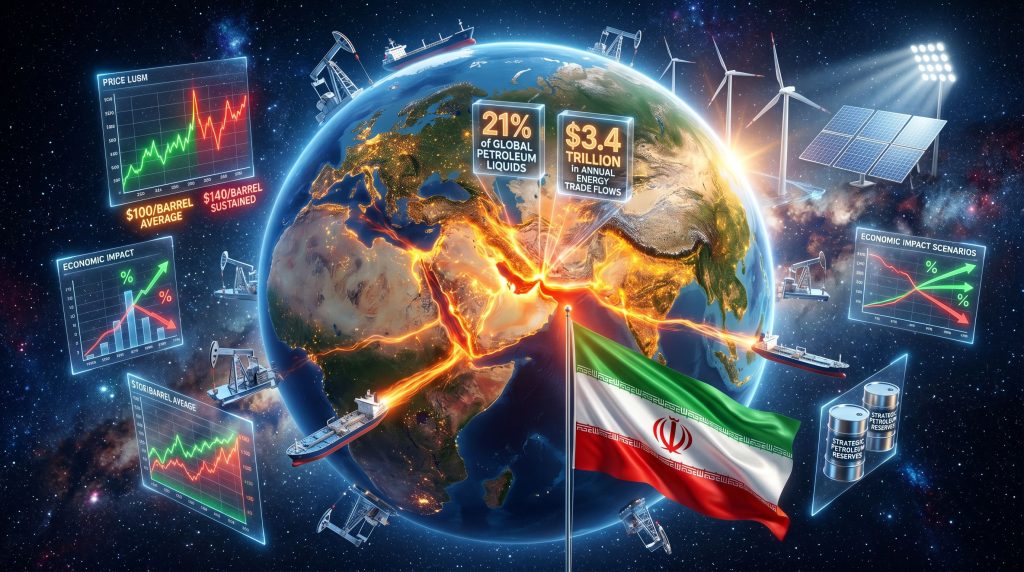
The escalating Iran war affects global oil prices through unprecedented supply disruption mechanisms that extend far beyond immediate conflict zones. Furthermore, the interconnected nature of global energy infrastructure creates cascading risks across multiple economic sectors, triggering systematic vulnerabilities that reshape fundamental market assumptions about pricing and stability.
Understanding the Geopolitical Risk Premium in Energy Markets
The World's Critical Energy Chokepoint
The narrow waterway connecting the Persian Gulf to international markets represents one of the most strategically significant transport corridors in the global energy system. Recent disruptions have exposed the fragility of this critical infrastructure, with Iranian attacks targeting major facilities including the Manifa oilfield and the East-West Pipeline, reducing production capacity by at least 600,000 barrels per day.
Current market indicators reflect sustained pricing pressure, with WTI Crude trading at $89.57 and Brent Crude at $98.42 as of April 2026. The International Energy Agency has declared that the Strait of Hormuz has lost its status as a reliable energy route, indicating fundamental shifts in market confidence regarding traditional supply pathways.
Economic vulnerability analysis reveals that approximately $3.4 trillion in annual energy trade flows depend on stable passage through this strategic chokepoint. Historical precedent analysis from previous Middle East conflicts demonstrates how supply disruption fears can drive price premiums that persist long after actual physical shortages are resolved.
Market Psychology and Fear-Based Trading Patterns
Behavioural economics research indicates that commodity markets during geopolitical crises exhibit heightened sensitivity to sentiment-driven positioning rather than fundamental supply metrics. The world's biggest physical oil trader has warned of months of price volatility ahead, suggesting that market participants anticipate sustained uncertainty rather than rapid stabilisation.
Recent oil price movements demonstrate acute sensitivity to diplomatic announcements and military escalations. Oil prices have experienced significant swings tied to ceasefire discussions and geopolitical statements, with markets showing 10% declines following diplomatic progress announcements and subsequent reversals during military escalations.
Algorithmic trading systems amplify these volatility signals through automated response mechanisms that react to news flow and technical indicators. Risk premium calculations in current market conditions reflect heightened uncertainty premiums that exceed historical norms for similar supply disruption scenarios.
Force majeure declarations by Kuwait following U.S. seizure of Iranian vessels illustrate how supply chain disruption psychology affects entities not directly impacted by physical constraints, demonstrating the psychological contagion effects inherent in energy market dynamics.
When big ASX news breaks, our subscribers know first
Economic Transmission Mechanisms for Oil Price Shocks
Direct Energy Cost Inflation Pathways
The International Monetary Fund's April 2026 World Economic Outlook quantifies specific inflation acceleration scenarios based on sustained oil price levels. At $100 per barrel average oil prices, global inflation acceleration reaches 1.5 to 2.0 percentage points, while sustained prices at $140 per barrel drive inflation increases of 3.5 to 4.2 percentage points.
European energy markets demonstrate acute vulnerability to Middle East supply disruptions, with gas prices surging over 70% during recent conflicts. However, the European Union's energy import dependency remains critical, with nearly 60% of energy needs met through net imports and approximately 70% of gas consumption sourced internationally.
Transportation sector impacts manifest through logistics cost escalation and freight rate increases. Moreover, industrial input cost pressures particularly affect petrochemical-dependent industries, with manufacturing sectors experiencing operational disruptions and production slowdowns as energy-intensive processes become economically constrained.
Regional variation in energy import dependency creates differential economic exposure across major economies. China faces particular pressure on raw material costs and logistics for manufacturing operations, with higher energy costs difficult to pass through to consumers, potentially narrowing trade surpluses and weakening export competitiveness.
Secondary Economic Spillover Effects
The IMF's recession risk probability scenarios demonstrate how energy price shocks translate into broader economic vulnerability:
| Oil Price Scenario | GDP Growth Impact | Inflation Impact | Recession Probability |
|---|---|---|---|
| $100/barrel Average | -0.3 to -0.5 percentage points | +1.5-2.0 percentage points | 15-25% |
| $140/barrel Sustained | -1.2 to -1.8 percentage points | +3.5-4.2 percentage points | 65-75% |
Global GDP expansion projections demonstrate the economic transmission mechanisms of sustained energy price pressures. Base case scenarios project 3.1% growth with short-lived conflicts and oil price normalisation around $82 per barrel. Extended tensions with $100 per barrel averages reduce growth to 2.5%, while deepening hostilities with infrastructure damage could limit global expansion to just 2.0%, placing the world economy on recession's edge.
Currency market destabilisation affects energy-importing nations through current account deterioration and exchange rate pressure. Central bank policy responses face complex trade-offs between fighting inflation and supporting economic growth, with traditional monetary policy tools potentially inadequate for supply-driven price increases.
Supply chain cost amplification extends beyond direct energy inputs through logistics and freight rate increases. Container shipping costs and air cargo premiums create secondary inflation pressures that compound primary energy cost impacts across multiple economic sectors.
Regional Economic Response Patterns to Oil Price Shocks
Advanced Economy Vulnerabilities and Resilience Factors
United States Economic Resilience
The IMF projects U.S. economic growth at 2.3% in 2026, with artificial intelligence investment providing substantial buffer against external energy shocks. Massive AI infrastructure investment by major technology companies drives approximately 40% of projected GDP growth, with data center construction experiencing unprecedented expansion.
AI data center power demand projections show more than thirtyfold growth by 2035, creating domestic energy demand that supports grid modernisation and alternative energy development. This technological transformation provides structural economic resilience against traditional energy supply disruption patterns.
Big Tech firms including Google, Meta, Microsoft, and Amazon invest hundreds of billions annually in AI infrastructure, creating capital flows that offset energy cost pressures through productivity gains and technological advancement. Semiconductor manufacturing expansion further strengthens domestic industrial capacity.
European Union Vulnerability Patterns
Eurozone growth forecasts reflect significant vulnerability to energy price volatility, with IMF projections cut by 0.2 percentage points to 1.1% primarily due to energy import dependency. Despite 20% reduction in gas consumption between 2021 and 2024, the EU still imports approximately 70% of gas requirements.
Industrial sector exposure to gas price increases weighs heavily on manufacturing competitiveness, with energy-intensive industries facing margin compression and operational constraints. Consequently, European EV sales have reportedly increased 51% as consumers respond to gasoline price increases, indicating behavioural adaptation to energy cost pressures.
Energy security strategies focus on supply diversification and accelerated renewable energy deployment, though transition timelines remain constrained by grid infrastructure and storage capacity limitations. Strategic reserve coordination through International Energy Agency protocols provides limited buffer capacity for sustained disruptions.
Japan's Strategic Energy Response
Japan faces particular vulnerability due to high energy import dependency and limited domestic production capacity. Strategic petroleum reserve management and alternative supply route development represent primary policy responses to Middle East supply disruption risks.
Recent headlines indicate Japan's deployment of $10 billion to help Southeast Asia cope with oil shock impacts, suggesting regional energy security cooperation as a strategic response to supply volatility. Industrial adaptation focuses on energy efficiency improvements and alternative fuel development.
Emerging Market Divergence Patterns
India's Economic Outperformance
India demonstrates remarkable resilience with growth forecasts upgraded to 6.5% from 6.4%, reflecting strong domestic consumption and reduced trade friction with the United States. Recent tariff negotiations between President Trump and Prime Minister Modi resulted in significant duty reductions from up to 50% down to 18% on key Indian exports.
Key beneficiaries of lower tariffs include gems, jewellery, textiles, pharmaceuticals, and electronics, with some items achieving zero-duty access. Furthermore, strong carryover momentum from 7.4% growth in 2025 provides economic buffer against external shocks through robust domestic demand.
Production Linked Incentive schemes support manufacturing sector expansion, while services including finance and information technology continue driving GDP growth and export resilience. Government capital expenditure remains high in infrastructure development, with private investment showing revival signs.
Rural demand recovery and steady urban spending sustain domestic consumption as the primary growth engine. Retail automobile sales and festive demand patterns indicate consumer confidence despite global energy market volatility.
Oil-Exporting Nation Challenges
Saudi Arabia faces significant economic pressure with growth forecasts sharply reduced to 3.1% from January 2026 projections of 4.5%. The broader Middle East and North Africa region saw forecasts cut by 2.8 percentage points to 1.1%, primarily reflecting oil export disruptions through traditional shipping routes.
Iranian attacks on major facilities have created widespread instability across the Kingdom's energy sector, with production capacity reductions and operational disruptions affecting revenue projections. The Iran conflict is projected to cost GCC nations up to $200 billion in economic growth during 2026, with potential GDP contractions for some regional economies.
Energy infrastructure vulnerability creates fiscal pressure for oil-dependent economies, with government spending constrained by revenue volatility and security expenditure requirements. Economic diversification efforts face acceleration under crisis conditions.
China's Economic Adjustment
China's growth forecast reflects significant pressure from energy cost increases, with projections slashed to 4.4% in 2026 and 4.0% in 2027. Sustained high oil prices and increased Strait of Hormuz shipping costs drive up raw material and logistics expenses for manufacturing operations.
Petrochemical and manufacturing industries experience higher operating costs, operational disruptions, and production slowdowns. Chinese firms find energy cost pass-through to consumers challenging, potentially narrowing trade surpluses and weakening export competitiveness in global markets. This scenario echoes the broader US‑China trade war impact on economic relationships.
Strategic petroleum reserves, government fiscal control, and accelerated renewable energy development provide partial buffers against oil shock impacts. Recent policy responses include revival of coal-to-gas megaprojects as alternative energy supply diversification accelerates under crisis conditions.
Financial Market Contagion Mechanisms
Sovereign debt stress manifests in energy-importing developing economies through current account deterioration and fiscal pressure from energy subsidy costs. Credit ratings face downward pressure as external financing requirements increase alongside energy import costs.
Corporate earnings compression affects energy-intensive sectors across multiple industries, with margin pressure and operational cost increases driving equity market sector rotation toward defensive positioning. Industrial companies face particular vulnerability to sustained energy price increases.
Equity market volatility reflects uncertainty regarding duration and magnitude of energy price increases, with traditional valuation models struggling to incorporate geopolitical risk premiums and supply disruption scenarios. Currency market pressure affects emerging economies with significant energy import requirements.
Banking sector exposure includes credit risk from energy-intensive borrowers and indirect exposure through economic slowdown effects. Financial institution stress testing scenarios incorporate extended energy price volatility and recession probability assessments.
Policy Tools for Oil Price Shock Mitigation
Strategic Petroleum Reserve Coordination
International Energy Agency emergency response protocols provide framework for coordinated strategic reserve releases among major consuming nations. National reserve release effectiveness depends on timing, magnitude, and market communication strategies during crisis periods.
Coordination challenges between major consuming nations include differing reserve capacity levels, economic exposure patterns, and political considerations regarding release timing. Market impact of reserve releases varies based on supply disruption magnitude and duration expectations.
Reserve capacity constraints limit sustained intervention capability, with global strategic reserves providing temporary market stabilisation rather than long-term supply replacement. Refill strategies during price normalisation periods require careful market timing to avoid price distortion.
Monetary and Fiscal Policy Response Framework
Central bank communication strategies during supply-driven inflation face credibility challenges when traditional demand management tools prove insufficient for addressing supply constraints. Interest rate policy effectiveness diminishes when inflation drivers originate from external supply shocks.
Targeted fiscal support for vulnerable households and industries requires careful design to avoid demand stimulus that exacerbates inflation pressures. Energy subsidy programmes provide short-term relief while potentially delaying necessary consumption adjustments to higher energy costs.
Trade policy adjustments include temporary tariff modifications on energy imports and related products to reduce domestic price pressures. Regional trade agreement provisions may facilitate alternative supply arrangements during crisis periods.
Government energy procurement strategies focus on supply diversification and long-term contract arrangements that provide price stability during volatile market conditions. Public sector energy efficiency investments reduce government exposure to price volatility.
Alternative Energy Acceleration as Economic Defence
Crisis-driven renewable energy investment surge patterns demonstrate how energy security concerns accelerate transition timelines beyond normal market-driven adoption rates. Government policy support includes expedited permitting and enhanced financial incentives during crisis periods.
Grid stability and backup power infrastructure requirements become critical during transition periods when traditional energy supply reliability faces disruption. Energy storage deployment accelerates to manage renewable energy intermittency and provide grid resilience.
Private sector energy transition investment increases as companies seek to reduce exposure to volatile fossil fuel markets through alternative energy adoption and energy efficiency improvements. Corporate power purchase agreements with renewable generators expand during crisis periods.
Industrial process modification focuses on energy efficiency improvements and fuel switching capabilities that provide operational flexibility during supply disruption periods. Manufacturing sector investment priorities shift toward energy-independent production capabilities, particularly as electric vehicles transformation accelerates globally.
Market Structure Changes in Energy Price Discovery
Physical versus Financial Market Dynamics
Spot market premium expansion during supply uncertainty reflects the fundamental difference between financial contracts and physical delivery requirements. Regional crude benchmark price differentials widen as transportation constraints and supply source reliability affect local market conditions.
Futures curve patterns shift between contango and backwardation based on supply disruption duration expectations and storage capacity constraints. Long-term contract pricing incorporates higher risk premiums for supply reliability and transportation security.
Basis risk between regional benchmarks increases during crisis periods as transportation costs and route availability create price differentials that exceed normal geographical arbitrage patterns. Local market conditions become increasingly disconnected from global benchmark pricing.
Trading Infrastructure and Liquidity Considerations
Electronic trading platform stress testing reveals vulnerability during extreme volatility periods when traditional market making mechanisms face capacity constraints. Bid-ask spread expansion during crisis periods reflects reduced liquidity provision and increased transaction costs.
Market maker withdrawal during extreme volatility reduces price discovery efficiency and increases transaction costs for market participants. Regulatory circuit breaker mechanisms in commodity markets provide limited effectiveness compared to equity market protections.
High-frequency trading algorithm performance degrades during sustained volatility periods when traditional technical indicators become less reliable predictors of short-term price movements. Traditional trading relationships between correlated markets break down during crisis conditions.
Long-Term Structural Shifts from Energy Crises
Supply Chain Reshoring and Regionalisation Trends
Energy-intensive manufacturing relocation patterns accelerate as companies seek to reduce exposure to volatile energy costs and supply chain disruptions. Regional energy security alliance formation creates new trading patterns and strategic partnerships.
Investment flow redirection toward energy independence projects increases during crisis periods as both public and private sector priorities shift toward supply security. Infrastructure development focuses on redundancy and alternative supply pathway creation.
Just-in-time manufacturing models face fundamental revision as supply chain resilience becomes prioritised over cost optimisation. Strategic inventory management incorporates higher buffer stock levels for energy-intensive inputs and critical materials.
Accelerated Energy Transition Investment
Crisis-driven renewable energy financing surge demonstrates how geopolitical risks accelerate capital allocation toward energy security investments. Grid modernisation and storage infrastructure development receive enhanced policy support during crisis periods.
Electric vehicle adoption acceleration under high fuel prices creates structural demand changes that persist beyond immediate crisis periods. Charging infrastructure investment increases as transportation electrification becomes economically compelling for consumers.
Industrial process electrification gains economic viability as traditional fuel cost volatility creates business case for alternative energy adoption. Corporate energy strategy prioritises supply security alongside cost considerations.
Geopolitical Realignment and Energy Diplomacy
Alternative energy partnership development creates new international cooperation frameworks beyond traditional oil and gas relationships. Strategic alliance formation around energy security includes technology sharing and infrastructure development agreements.
International energy governance institution evolution reflects changing power dynamics as traditional producer-consumer relationships face disruption. Multilateral energy security frameworks expand beyond emergency response to include long-term supply diversification.
Trade agreement energy provisions include supply security clauses and alternative fuel cooperation frameworks. Regional energy integration projects gain political support as energy independence becomes strategic priority.
The next major ASX story will hit our subscribers first
Economic Recovery Scenarios and Timeline Analysis
Short-Term Stabilisation Pathways
Diplomatic resolution impact on price normalisation depends on infrastructure damage assessment and supply capacity restoration timelines. Market sentiment recovery indicators include futures curve normalisation and volatility index stabilisation.
Alternative supply route development and capacity utilisation provide interim solutions while traditional pathways face uncertainty. Shipping route diversification includes pipeline capacity expansion and alternative transportation mode development.
Leading economic indicators suggest recovery timelines vary significantly based on conflict duration and infrastructure damage severity. Business confidence restoration requires demonstrated supply chain reliability over extended periods.
Medium-Term Structural Adjustment Requirements
Industrial sector adaptation to higher energy cost baseline involves production process modification and efficiency improvements. Energy-intensive industries face fundamental restructuring toward alternative fuel adoption and process optimisation.
Consumer behaviour modification includes transportation choice adjustments and residential energy efficiency investments. Demand destruction thresholds vary by economic sector and geographic region based on substitution availability.
Investment reallocation toward energy efficiency and alternatives creates structural economic changes that persist beyond immediate crisis resolution. Capital allocation priorities permanently shift toward supply security and cost stability considerations.
Economic Vulnerability Assessment Framework:
- Import dependency ratios above 60% indicate high vulnerability to supply disruptions
- Current account deficit expansion beyond 3% of GDP signals economic stress from energy costs
- Inflation expectations anchoring breakdown above 5% annual rates threatens monetary policy credibility
- Corporate margin compression in energy-intensive sectors exceeding 15% indicates structural adjustment pressure
Building Economic Resilience Against Energy Shocks
Strategic Framework for Policymakers and Investors
Diversification strategies for energy supply and economic structure require long-term planning that extends beyond immediate crisis response. Early warning system development for geopolitical risk assessment incorporates economic indicators alongside political and military intelligence.
Investment framework for energy security and economic stability balances cost considerations with supply reliability requirements. Portfolio diversification across energy sources, supply routes, and storage capacity creates resilience against single-point failures.
Economic modelling for energy shock scenarios requires stress testing across multiple timeframes and severity levels. Policy response capabilities include fiscal, monetary, and regulatory tools coordinated across multiple government agencies and international partners.
Infrastructure resilience investment prioritises redundancy and alternative capacity development rather than efficiency optimisation alone. Strategic planning incorporates worst-case scenario preparation alongside probabilistic risk assessment.
The ongoing Iran war affects global oil prices through complex transmission mechanisms that extend far beyond immediate supply disruptions. Economic vulnerability varies significantly across regions based on energy dependency, industrial structure, and policy response capacity. Recovery timelines depend on diplomatic resolution speed, infrastructure restoration requirements, and structural adjustment capabilities across multiple economic sectors.
Furthermore, market analysts note similarities between current conditions and previous oil price crash 2025 scenarios, while OPEC market influence continues to shape global pricing dynamics. Additionally, insights from the economic impact of the 2026 Iran war highlight the broader implications, whilst expert analysis of oil price spikes and money flows provides crucial context for understanding these market mechanisms.
Disclaimer: This analysis contains forward-looking statements and economic projections based on current market conditions and publicly available information. Energy market volatility, geopolitical developments, and economic conditions may differ materially from scenarios presented. Readers should conduct independent research and consult qualified financial advisors before making investment decisions based on this analysis.
Ready to Capitalise on Energy Market Volatility?
Discovery Alert's proprietary Discovery IQ model delivers real-time alerts on significant ASX mineral discoveries, including energy and resource companies positioned to benefit from market volatility and supply chain disruptions. Navigate complex commodity markets with confidence by accessing Discovery Alert's discoveries page to understand how major mineral discoveries can generate substantial returns during periods of global uncertainty. Begin your 14-day free trial today to position yourself ahead of market movements and secure actionable insights powered by advanced AI technology.