
August 7, 2026
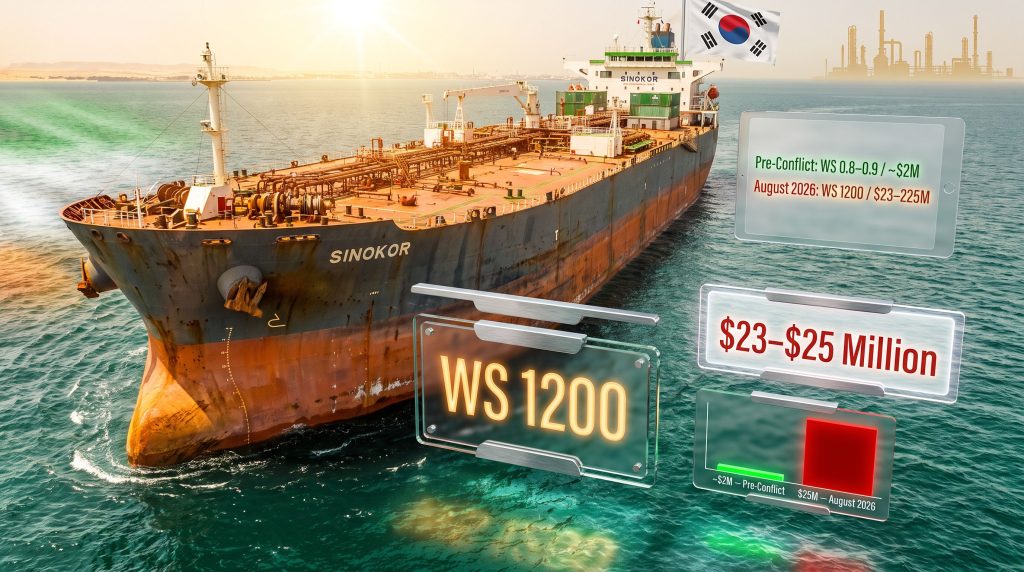
When Freight Costs Rise 1,200%: The Economics of Shipping Through a War Zone
The global tanker market operates on a fundamental tension between risk and reward. Under normal conditions, shipowners compete aggressively for cargo contracts, driving freight rates toward their lowest economically viable levels. But when a waterway carrying roughly 20% of the world's seaborne oil supply becomes a contested zone, that equilibrium collapses almost overnight. What emerges in its place is a market defined not by competition among shipowners, but by the scarcity of operators willing to accept the voyage at any price.
That is precisely the environment in which Reliance Industries record freight for Iraqi crude tanker became the defining commercial story of August 2026. The company paid between $23 million and $25 million for a single supertanker voyage at a Worldscale rate of 1200. Understanding why the company paid that figure, and why it almost certainly still made money on the transaction, requires unpacking several layers of tanker market mechanics, geopolitical risk pricing, and crude oil discount economics.
When big ASX news breaks, our subscribers know first
Decoding Worldscale: The Freight Benchmark Behind the Headlines
Worldscale is a standardised rate index used across the global tanker industry to price voyage charters. The system assigns a flat rate, expressed as WS 100, to any given route based on a standardised vessel size, port costs, fuel assumptions, and voyage distance. Charterers and shipowners then negotiate a percentage of that flat rate, expressed as WS 80, WS 150, or in extreme cases, WS 1200.
How Does This Compare to Normal Conditions?
Under normal Gulf conditions prior to the Iran conflict that began at the end of February 2026, the same voyage from Iraq's Basrah Oil Terminal through the Strait of Hormuz to an Indian refinery was being executed at rates of approximately WS 0.8 to 0.9, translating to a total charter cost of roughly $2 million for a 2-million-barrel cargo.
The August 2026 Reliance charter at WS 1200 represents a rate 12 times the benchmark, producing a total freight bill of $23 million to $25 million. To put that in historical context, understanding crude oil market dynamics makes these figures even more striking:
| Market Condition | Worldscale Rate | Approximate Voyage Cost |
|---|---|---|
| Pre-conflict normal operations | WS 0.8–0.9 | ~$2 million |
| Moderate supply disruption | WS 200–400 | ~$4–8 million |
| Heightened conflict risk | WS 600–800 | ~$12–16 million |
| Extreme conflict disruption (Aug 2026) | WS 1200 | ~$23–25 million |
| Implied VLCC daily rate equivalent | >$411,000/day | Near-zero available tonnage |
This level of freight rate escalation is almost without precedent on a single cargo basis. For context, even during the peak Houthi disruption period in the Red Sea in 2024, Worldscale rates on affected routes did not approach the extremes now being recorded at the Strait of Hormuz.
What Is Actually Happening Inside the Strait of Hormuz?
The Strait of Hormuz is the world's most critical oil chokepoint. Before the conflict with Iran escalated, between 125 and 140 vessels transited the waterway each day, carrying crude oil, LNG, refined products, and general cargo. As of August 2026, according to Reuters, daily vessel transits have fallen significantly below that historical average.
What Is Driving Shipowners Away?
The drivers of this pullback are not difficult to identify. Attacks on commercial vessels navigating the waterway have increased materially since the conflict began, and war-risk insurance premiums have responded accordingly. These premiums, which sit on top of base hull and cargo insurance, have become a substantial cost component in their own right, sometimes exceeding the underlying voyage freight cost during peak disruption events.
Shipowners face a multi-layered risk calculus when evaluating whether to send a vessel through the Strait:
- Physical vessel damage risk from missile, drone, or naval interdiction incidents
- Crew safety obligations under international maritime law and flag state requirements
- War-risk insurance cost escalation, which in some cases has risen to several percentage points of vessel value per voyage
- Potential cargo loss liability, particularly for operators carrying cargo on owner's risk terms
- Reputational and contractual consequences of vessel detention or seizure by state actors
The cumulative weight of these factors explains why the vast majority of tanker operators have simply withdrawn from the route, creating the vessel scarcity that drives rates to WS 1200 levels. Furthermore, this oil market disruption has ripple effects far beyond the Strait itself.
Why Reliance's Numbers Still Work at $25 Million Freight
The single most important piece of context surrounding the Reliance Industries record freight payment is that the company is almost certainly still profitable on the underlying cargo. This is not speculation; it is the product of a straightforward economic calculation grounded in Iraq's current crude pricing strategy.
Iraq's state oil marketer, the State Oil Marketing Organisation (SOMO), is currently offering Basrah crude at discounts of approximately $25 to $30 per barrel below Dubai benchmark prices, according to a document reviewed by Reuters. On a 2-million-barrel cargo, that discount structure produces a gross pricing advantage of between $50 million and $60 million compared to purchasing equivalent crude at market rates from an unaffected origin.
The freight arithmetic therefore looks like this:
On a 2-million-barrel cargo loaded at a $25–$30 per barrel discount to Dubai benchmarks, the total crude cost saving ranges from $50 million to $60 million. After deducting the record $23–$25 million freight bill, Reliance's net economic advantage on the cargo is estimated at between $25 million and $35 million, before refining margin considerations.
This is the core logic that justifies paying WS 1200. The freight cost, while historically extreme, is not irrational when viewed against the scale of the upstream crude discount. SOMO's pricing strategy is itself a deliberate response to the crisis: by deepening discounts, Iraq is essentially subsidising the elevated freight and insurance costs that buyers must absorb to lift cargoes from the Basrah terminal.
How Indian Refiners Evaluate Discounted Crude Economics
The decision to charter a vessel at record rates does not happen impulsively. For a refinery operation of Reliance's scale, the evaluation process involves several sequential steps:
- Assess the crude discount depth relative to the Dubai benchmark and comparable alternative supply origins
- Calculate total cargo discount value by multiplying the per-barrel discount across the full 2-million-barrel parcel
- Model total freight cost including base charter hire, war-risk insurance, and port dues at Basrah
- Evaluate refinery compatibility to confirm that Basrah Heavy or Medium crude suits the Jamnagar facility's crude diet and hydrocracking configuration
- Stress-test voyage risk scenarios including potential delays, vessel damage insurance recovery timelines, and force majeure triggers
- Compare against alternative supply options including Russian ESPO blend, West African grades, and WTI and Brent futures priced cargoes
- Execute if net economics are clearly favourable after all cost layers and risk haircuts are applied
Reliance's Jamnagar refinery complex, with a combined processing capacity of approximately 1.4 million barrels per day, operates at a scale that provides inherent advantages in absorbing freight cost volatility that would be uneconomic for smaller refiners.
Sinokor and the Premium of Being Willing
The South Korean shipowner Sinokor occupies an unusual competitive position in this market. While most major tanker operators have suspended Strait of Hormuz transits, Sinokor has continued sending vessels through the waterway, effectively capturing the war-risk premium that other owners have declined to accept.
This dynamic illustrates a broader principle in disrupted shipping markets: the operators willing to accept elevated risk gain pricing power that would be impossible to extract under normal competitive conditions. At WS 1200, Sinokor's VLCC daily rate of more than $411,000 per day means revenue on a single voyage approximates what a vessel might earn across ten to twelve equivalent voyages under pre-conflict market conditions.
Whether this risk tolerance reflects a calculated commercial strategy, a different insurance arrangement, different flagging considerations, or simply a higher organisational appetite for geopolitical risk exposure is not publicly known. What is clear is that Sinokor's willingness to enter the Strait positions it as an indispensable intermediary in Gulf crude flows for as long as the conflict continues.
The Broader Asian Refiner Response
Reliance is not alone in its interest in Basrah Terminal cargoes. Multiple Indian and Chinese refining operators have actively sought vessels to enter the Strait and lift crude during the same period, attracted by the same SOMO discount structure. However, according to shipping sources, no additional vessels had been successfully fixed at the time of reporting, with shipowner reluctance proving to be the binding constraint.
This creates an asymmetric market structure:
- Crude demand from Asian refiners for discounted Iraqi barrels remains high
- Vessel supply willing to enter the Strait is critically limited to a handful of operators
- The discount-to-freight arbitrage window is therefore accessible only to refiners that can identify and secure one of those rare willing shipowners before competitors do
- Scale advantage is decisive: larger operators with existing shipowner relationships and financial resources to absorb elevated freight are far better positioned than mid-size refiners
This supply-demand mismatch at the vessel level, rather than at the crude level, is the defining feature of the current market dislocation. In addition, monitoring global crude market trends reveals just how structurally significant this dislocation has become.
The next major ASX story will hit our subscribers first
Three Scenarios for How This Resolves
The freight rate environment in the Persian Gulf will not remain at WS 1200 indefinitely. How it normalises depends heavily on the trajectory of the underlying conflict:
- Scenario A: Partial closure continues. Freight rates remain elevated at WS 800–1200; SOMO discounts hold at $25–$30 per barrel; only the largest, most sophisticated Asian refiners can profitably access Basrah cargoes; smaller operators are effectively priced out of the market
- Scenario B: Full Strait closure for 30 or more days. Global crude benchmarks rise sharply as approximately 20% of seaborne oil supply is disrupted; alternative routes via Saudi Arabia's East-West pipeline and limited Red Sea throughput become critically important; Indian refiners without diversified supply portfolios face acute margin compression
- Scenario C: Conflict de-escalation. Vessel supply normalises rapidly as shipowners re-enter the waterway; freight rates fall toward WS 80–100 within weeks; SOMO discounts narrow as competition for Iraqi barrels intensifies and the risk premium on Gulf crude disappears
Investors and refining sector analysts should note that scenario projections involve significant uncertainty. Freight rate forecasts are inherently speculative and depend on geopolitical developments that are not predictable with precision.
India's Structural Exposure to Gulf Freight Volatility
The Reliance Industries record freight for Iraqi crude tanker is not merely a one-off corporate transaction. It reflects a systemic vulnerability in India's crude import architecture. India sources a significant proportion of its crude oil from Middle Eastern producers, with Iraqi, Saudi, and UAE grades collectively accounting for a substantial share of the roughly 4.5 to 5 million barrels per day the country consumed as of 2024.
The geographic concentration of this dependency means that any disruption to Strait of Hormuz transit capacity cascades directly into refinery input costs across the Indian economy. While larger operators like Reliance possess the financial depth and market relationships to navigate these disruptions, smaller state-owned refiners operating on thinner margins face a more challenging calculus.
The diversification of crude supply toward Russian ESPO blend (accessed via the eastern route), West African grades, and US WTI Midland cargoes provides a partial hedge against this geographic risk. Consequently, commodity volatility hedging has become an increasingly critical strategic consideration for refinery operators across the subcontinent.
However, no alternative fully replicates the economics of discounted Gulf crude under normal operating conditions. What the Reliance Industries record freight for Iraqi crude ultimately demonstrates is that the arbitrage between crude discount depth and freight cost elevation can remain commercially viable even at extreme rate levels, but only for operators with the scale, sophistication, and shipowner relationships to execute in markets where most participants have simply stepped back.
FAQ: Reliance Industries, Iraqi Crude, and Record Freight Rates
What Does Worldscale 1200 Actually Mean in Dollar Terms?
Worldscale 1200 means the charterer is paying 12 times the standardised benchmark freight rate for a given route. On the Iraq-to-India voyage carrying 2 million barrels of crude, this translated to a total charter cost of approximately $23 million to $25 million, compared to around $2 million under pre-conflict conditions at WS 0.8–0.9.
Why Is Reliance Paying Record Freight If It Is Still Profitable?
Iraq's SOMO is offering Basrah crude at discounts of $25–$30 per barrel below Dubai benchmarks. Across a 2-million-barrel cargo, that discount produces a gross saving of $50–$60 million, which comfortably absorbs the $23–$25 million freight bill and still delivers a net economic advantage of $25–$35 million on the cargo.
Why Are Most Tanker Operators Unwilling to Enter the Strait of Hormuz?
Attacks on commercial vessels have increased since the Iran conflict began in late February 2026. War-risk insurance premiums have risen sharply, and vessel operators face real physical risks to vessels and crew. Most tanker operators have concluded that the financial and safety risks outweigh the commercial rewards, except at rates like WS 1200.
How Much Oil Does the Reliance-Chartered Supertanker Carry?
The vessel was booked to load approximately 2 million barrels of Iraqi crude at the Basrah Oil Terminal.
Who Supplied the Tanker and Why Are They Willing to Take the Risk?
South Korean shipowner Sinokor supplied the vessel. Sinokor is one of a small number of tanker operators continuing to transit the Strait of Hormuz during the conflict period. The precise basis for their continued operations has not been publicly disclosed.
What Happens to Freight Rates If the Conflict Ends?
Historical precedent from previous Gulf disruptions suggests freight rates can normalise rapidly once vessel supply returns to a waterway. A resolution of the Iran conflict could see rates fall back toward WS 80–100 within weeks as shipowners re-enter the market and competition for voyages resumes.
Want to Know Which ASX Mineral Discoveries Could Deliver Returns Like These Market Dislocations?
When geopolitical shocks reshape entire commodity markets overnight, early identification of high-impact opportunities becomes critical — Discovery Alert's proprietary Discovery IQ model scans ASX announcements in real time, instantly alerting subscribers to significant mineral discoveries before the broader market reacts, much as the economics described above reward those who act decisively ahead of the crowd. Explore historic discovery returns on Discovery Alert's discoveries page and begin your 14-day free trial to position yourself at the front of the market.