August 2, 2026
The global supply chain landscape for critical minerals stands at an inflection point, where traditional cost optimisation strategies yield to strategic security imperatives. This fundamental shift reflects deeper structural tensions between economic efficiency and geopolitical resilience, particularly evident in rare earth element markets where concentration risk has reached unprecedented levels. The emergence of price floor mechanisms, long-term procurement commitments, and coordinated industrial policies signals a new paradigm in resource allocation that prioritises supply security over marginal cost advantages. Furthermore, the Japan and Australia rare earth supply agreement exemplifies this strategic transformation, demonstrating how allied nations can address shared vulnerabilities through innovative partnership structures.
Strategic Architecture of Japan-Australia Rare Earth Partnerships
The foundation of Japan-Australia rare earth cooperation rests on a sophisticated institutional framework designed to bridge commercial interests with strategic imperatives. Japan Organisation for Metals and Energy Security (JOGMEC) and Sojitz Corporation established Japan Australia Rare Earths (JARE) in 2011, creating a dedicated vehicle for securing non-Chinese rare earth supplies. This 15-year operational history demonstrates the maturity and strategic depth of bilateral resource cooperation.
Geopolitical Risk Landscape
China's dominant position in rare earth production creates systemic vulnerabilities across global supply chains, particularly for nations dependent on high-technology manufacturing. The concentration of rare earth processing capabilities within a single jurisdiction generates strategic dependencies that extend far beyond raw material extraction. Supply disruption scenarios, whether driven by trade policy changes, geopolitical tensions, or operational constraints, can cascade through entire industrial ecosystems.
Australia's emergence as a reliable alternative supplier reflects both geological endowments and strategic alignment with allied nations seeking supply diversification. The country's regulatory stability, established mining infrastructure, and geopolitical positioning create favourable conditions for long-term resource partnerships. However, energy security considerations remain paramount as nations balance domestic needs with export commitments.
Institutional Coordination Mechanisms
The partnership structure enables risk sharing between public and private sector entities, with JOGMEC providing institutional backing and risk management capabilities while Sojitz handles commercial operations. This hybrid model allows Japan to pursue strategic supply security objectives whilst maintaining market-competitive pricing and operational efficiency.
Corporate-level agreements between Japanese trading houses and Australian miners operate within broader government-to-government frameworks that establish regulatory certainty and dispute resolution mechanisms. In addition, these multilayered arrangements provide durability against political changes and commercial disputes that might otherwise disrupt supply relationships.
Integration with Trilateral Frameworks
The Japan-Australia partnership aligns with broader US-Japan-Australia critical minerals cooperation, creating overlapping security guarantees and coordinated procurement strategies. During the 2026 Critical Minerals Ministerial in Washington D.C., allied nations articulated a vision for integrated supply chains that maintain consistent pricing within preferential trade zones whilst building immunity to external disruptions.
This coordination extends beyond bilateral relationships to encompass systematic approaches to critical minerals security across democratic allies, reflecting shared vulnerability to supply concentration and common strategic interests in technology sector competitiveness. Consequently, the framework supports broader allied critical minerals strategy development across multiple jurisdictions.
When big ASX news breaks, our subscribers know first
Price Floor Mechanisms and Market Structure Transformation
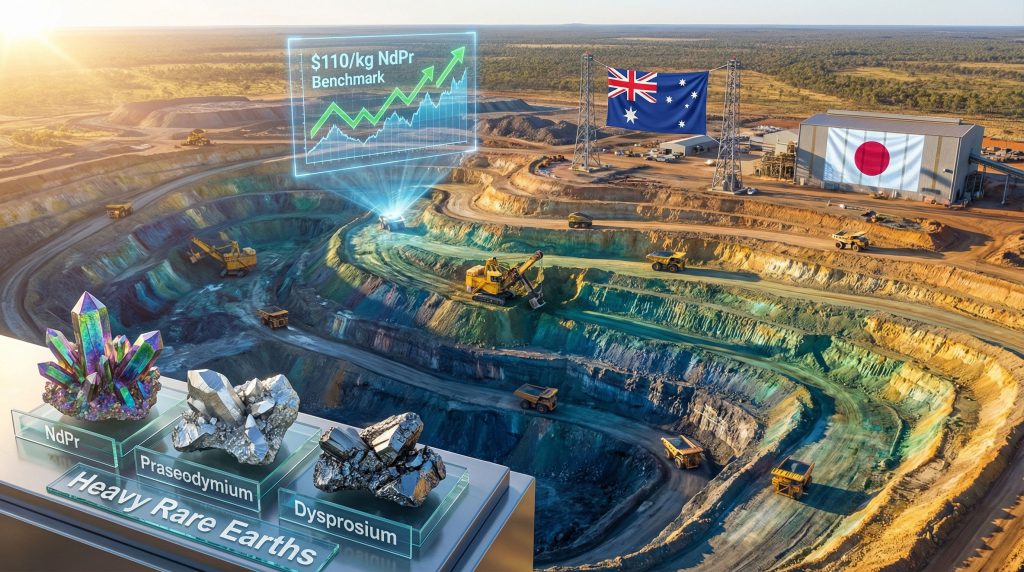
The establishment of a $110 per kilogram neodymium-praseodymium (NdPr) price floor represents a fundamental departure from traditional commodity market structures. This mechanism creates predictable revenue streams for suppliers whilst providing cost certainty for strategic buyers, effectively socialising supply chain risks across allied nations.
Three-Tier Pricing Architecture
The pricing structure operates across distinct bands that serve different strategic objectives:
| Price Range | Mechanism | Strategic Purpose |
|---|---|---|
| Below $110/kg | Guaranteed minimum payment | Protects supplier margins during downturns |
| $110-150/kg | Market-based pricing | Maintains competitive allocation signals |
| Above $150/kg | 30% revenue sharing to buyer | Prevents excessive buyer costs during spikes |
This three-tier system provides downside protection for mining companies whilst creating upside sharing mechanisms that prevent strategic buyers from being locked into disadvantageous contracts during price surges. The annual $10 million cap on revenue sharing limits buyer windfall whilst maintaining supplier incentives for production expansion.
International Precedent and Coordination
The $110/kg floor mirrors agreements between the U.S. Department of War and MP Materials' Mountain Pass facility, demonstrating coordinated pricing policy across allied supply chains. This harmonisation creates consistent investment signals for rare earth mining projects whilst preventing competitive bidding that might inflate strategic material costs.
Such pricing coordination represents a departure from pure market mechanisms toward strategic industrial policy, where national security considerations override traditional cost optimisation. For instance, the consensus pricing approach reduces volatility that has historically deterred long-term mining investment and processing facility development.
Revenue Sharing Impact Analysis
The revenue sharing mechanism above $150/kg creates asymmetric risk distribution that favours strategic buyers during extreme market conditions. Historical rare earth price volatility, including dramatic spikes during supply disruptions, demonstrates the significance of cost protection mechanisms for downstream manufacturers.
JARE's commitment to acquire 5,000 metric tons annually through 2038 provides volume certainty that enables mining companies to justify production capacity investments. This guaranteed offtake reduces project financing risk and supports expansion of non-Chinese supply sources, directly addressing rising minerals demand across allied nations.
Heavy Rare Earth Procurement and Industrial Applications
Japan's commitment to purchase at least 50% of Lynas's heavy rare earth production reflects the strategic criticality of dysprosium and terbium for advanced manufacturing applications. These elements enhance heat resistance and durability of high-performance permanent magnets essential for automotive, renewable energy, and defence technologies.
Performance-Critical Applications
Heavy rare earths enable technological capabilities that cannot be achieved through alternative materials:
• Electric vehicle motors: Heat-resistant magnets operating at sustained high temperatures
• Wind turbine generators: Long-duration performance in variable environmental conditions
• Industrial robotics: Precision servo motors requiring consistent magnetic field strength
• Defence systems: Advanced radar and guidance technologies demanding reliability
• Aerospace applications: Components operating in extreme temperature and stress environments
Supply Scarcity Premium
Heavy rare earths command significant price premiums over light rare earths due to geological scarcity and processing complexity. Dysprosium and terbium concentrations in ore deposits are typically much lower than neodymium and praseodymium, creating natural supply constraints that amplify price volatility.
The technical challenges of separating heavy rare earths from ore concentrates require specialised processing facilities with advanced chemical separation capabilities. Furthermore, limited global processing capacity outside China creates additional supply bottlenecks that justify strategic procurement arrangements and the development of a strategic minerals reserve.
Industrial Strategy Integration
Japan's heavy rare earth procurement supports domestic manufacturing competitiveness across multiple technology sectors. The country's automotive industry, including Toyota, Honda, and Nissan, requires guaranteed rare earth supplies for electric and hybrid vehicle production scaling. Similarly, Japan's renewable energy infrastructure development depends on reliable access to materials for wind turbine manufacturing.
The agreement enables Japanese manufacturers to offer supply chain security to international customers, supporting export competitiveness in technology-intensive sectors. Consequently, this supply security becomes particularly important as global electrification trends drive rare earth demand growth across transportation and energy infrastructure.
Allied Critical Minerals Strategy Coordination
The Japan-Australia partnership operates within a comprehensive allied framework for critical minerals security that extends beyond bilateral trade relationships. This coordination reflects shared recognition that supply chain vulnerabilities require systematic responses across democratic allies.
Multilateral Policy Integration
The 2026 Critical Minerals Ministerial established principles for building stable pricing and investment conditions across allied mineral supply chains. The vision articulated by U.S. leadership emphasises creating preferential trade zones with consistent pricing that remains immune to external disruptions.
This multilateral approach coordinates individual bilateral agreements into broader strategic frameworks that provide overlapping security guarantees. However, each partnership strengthens the overall network whilst reducing dependence on single supply relationships.
Technology Transfer and Capacity Building
Beyond raw material procurement, the partnership facilitates technology sharing in processing and refining capabilities. Japanese expertise in precision manufacturing and quality control combines with Australian mineral processing innovation to develop advanced separation technologies.
Joint research and development initiatives focus on improving rare earth recycling technologies and developing more efficient separation processes. In addition, these technological advances reduce waste streams whilst increasing recovery rates from existing mining operations.
Investment Coordination Mechanisms
Japanese capital deployment in Australian mining projects operates within coordinated investment frameworks that align with broader allied strategy objectives. These mechanisms prevent competitive bidding between allied nations whilst ensuring adequate investment flows to support supply capacity expansion.
Coordinated approaches to third-country market development enable allied nations to collectively support rare earth projects in other democratic countries. Furthermore, this expands the overall non-Chinese supply base through systematic investment policies and comprehensive investment strategies guide implementation.
Long-Term Market Structure Evolution
The transformation of rare earth markets through strategic partnerships and pricing mechanisms represents a fundamental shift toward supply security prioritisation that will likely accelerate through 2030. Market evolution scenarios depend on the success of capacity expansion, technology development, and geopolitical stability.
Supply Diversification Trajectory
Current non-Chinese rare earth supply represents approximately 24% of global production, concentrated primarily in Australia, the United States, and emerging African projects. Successful implementation of allied procurement strategies could increase this share to 35-40% by 2030, significantly reducing concentration risk.
The timeline for supply diversification depends on mining project development cycles, processing facility construction, and regulatory approvals across multiple jurisdictions. However, environmental permitting and community engagement processes add complexity to expansion timelines but remain essential for sustainable development.
Price Volatility and Investment Impact
Price floor mechanisms are expected to reduce rare earth market volatility by 25-30% compared to historical patterns, creating more predictable investment conditions for capacity expansion. This stability encourages long-term capital commitments that have been deterred by extreme price swings in previous market cycles.
Guaranteed offtake arrangements reduce project financing risk, enabling mining companies to secure development capital at lower cost. Consequently, this improved access to capital accelerates project timelines and supports broader supply capacity expansion across allied nations.
Technology Development Acceleration
Supply security initiatives drive innovation in separation technologies, recycling processes, and alternative material development. Japanese and Australian research institutions collaborate on advancing rare earth processing efficiency whilst reducing environmental impact.
Recycling technology development offers potential for significant supply augmentation, particularly for heavy rare earths where primary production remains constrained. For instance, advanced recycling facilities can recover rare earths from end-of-life products, creating circular economy benefits whilst reducing primary mining requirements.
Investment Implications and Strategic Opportunities
The evolution toward strategic partnerships and supply security creates distinct investment themes that extend beyond traditional mining sector dynamics. These opportunities reflect the premium valuation accorded to secure supply sources and the strategic importance of rare earth processing capabilities.
Direct Investment Opportunities
Australian rare earth mining companies with established Japanese partnerships command premium valuations due to guaranteed offtake arrangements and stable pricing mechanisms. These companies benefit from reduced execution risk and predictable cash flows that support expansion capital allocation.
Processing and separation technology companies gain strategic importance as allies seek to develop domestic capabilities outside Chinese-controlled supply chains. Furthermore, advanced separation technologies, quality control systems, and recycling capabilities become increasingly valuable as supply security priorities intensify.
Infrastructure Development Requirements
The scaling of non-Chinese rare earth supply requires substantial infrastructure investment in port facilities, processing plants, and logistics networks. These infrastructure needs create opportunities for engineering, construction, and specialised equipment companies serving the rare earth sector.
Strategic storage and distribution facilities become increasingly important as nations build buffer stocks and emergency reserves. However, the development of these facilities requires specialised design and construction capabilities that understand rare earth handling and storage requirements.
What Are the Key Risk Considerations?
Operational risks include mining project development delays, environmental approval challenges, and technical difficulties in achieving commercial-scale production. Currency fluctuations affect long-term contract economics, particularly for multi-decade agreements spanning different economic cycles.
Strategic risks encompass potential Chinese market responses through price competition or supply restrictions, changes in government policies affecting trade relationships, and alternative technology development that might reduce rare earth demand intensity in key applications. In addition, competition from established Chinese suppliers remains significant, particularly during periods when Chinese producers offer competitive pricing to maintain market share.
The next major ASX story will hit our subscribers first
Market Psychology and Investment Behaviour
The shift toward strategic partnerships reflects fundamental changes in investor psychology regarding critical materials, where supply security considerations increasingly override pure cost optimisation in investment decision-making. This evolution creates new valuation frameworks that incorporate geopolitical risk premiums and strategic option values.
Security Premium Valuation
Companies with verified supply security arrangements command market premiums that reflect the strategic value of guaranteed access to critical materials. These premiums vary based on supply contract duration, pricing mechanisms, and the strategic importance of covered materials.
Institutional investors increasingly evaluate mining investments through strategic security lenses rather than traditional commodity market frameworks. Consequently, this evaluation approach considers geopolitical stability, regulatory certainty, and alignment with allied strategic objectives as key value drivers.
Long-Term Investment Horizon Adjustment
Strategic partnerships encourage longer investment time horizons as guaranteed offtake arrangements provide cash flow visibility extending beyond typical commodity market cycles. This extended visibility supports patient capital deployment in complex mining and processing projects.
The predictability of revenue streams under price floor mechanisms enables more aggressive capacity expansion investments that would be difficult to justify under pure spot market exposure. Furthermore, this investment pattern accelerates supply capacity development across allied nations whilst reducing dependence on single-source suppliers.
According to recent analysis by Bloomberg, "Japan's deepening ties with Lynas reflect a broader global shift toward securing critical mineral supplies as the world seeks alternatives to Chinese dominance in the sector". This strategic realignment demonstrates how the Japan and Australia rare earth supply agreement serves as a blueprint for future allied cooperation.
The Japan and Australia rare earth supply agreement establishes a comprehensive framework for strategic resource cooperation that transcends traditional commodity trading relationships. Through innovative pricing mechanisms, guaranteed procurement commitments, and coordinated investment strategies, this partnership creates a template for critical minerals security that addresses both immediate supply needs and long-term strategic objectives.
Success in transforming global rare earth supply chains will depend on sustained execution capabilities, continued political commitment across electoral cycles, and the ability to compete effectively with established suppliers whilst building genuinely diversified alternatives. However, the framework established through this partnership demonstrates how allied nations can cooperatively address supply chain vulnerabilities whilst maintaining market competitiveness and supporting sustainable development objectives.
Investment decisions should be based on comprehensive due diligence and professional financial advice. This analysis is for informational purposes and does not constitute investment recommendations.
Want to capitalise on critical minerals investment opportunities?
Discovery Alert's proprietary Discovery IQ model delivers real-time alerts on significant ASX mineral discoveries, including rare earth and critical minerals finds that could benefit from emerging strategic partnerships and supply agreements. Start your 14-day free trial today and position yourself ahead of the market as allied nations prioritise supply security over traditional cost optimisation.