June 12, 2026
India's Mineral Federalism Problem: Why the Jharkhand Coal Royalty Dispute Is About Far More Than Money
Every federal system built on natural resource extraction eventually confronts the same fundamental question: who absorbs the costs of mining, and who captures the value? In India, that question has never been fully resolved. The legal and fiscal architecture governing coal royalties was designed in an era when centralised oversight of mineral wealth was considered non-negotiable. Decades later, the states bearing the ecological burden, the displacement costs, and the infrastructural strain of extraction are pushing back with increasing force.
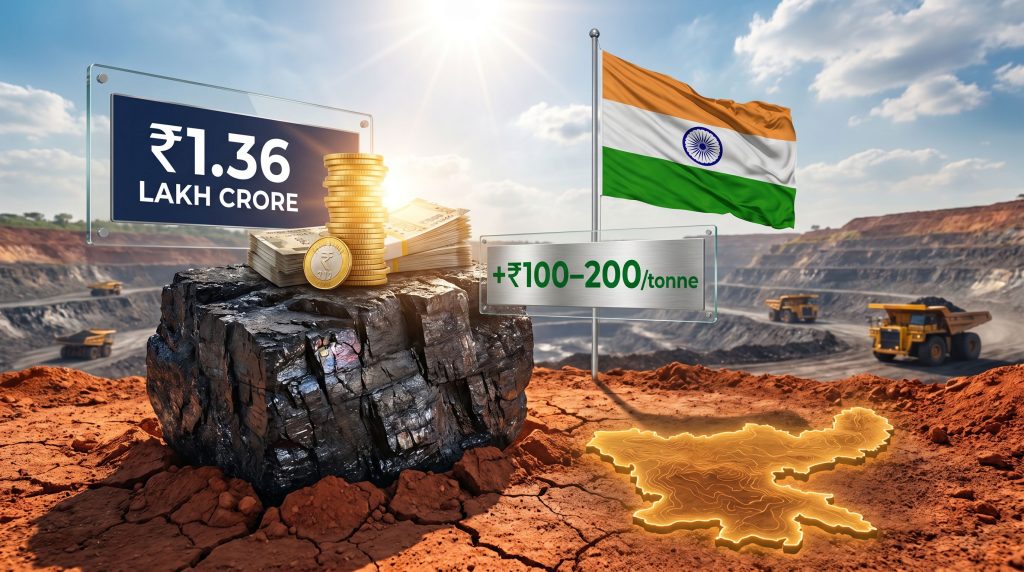
Jharkhand sits at the sharpest edge of this tension. The state accounts for a disproportionate share of India's domestic coal output, yet its government argues that the royalty payments it has received over decades represent a systematic undervaluation of the resource wealth extracted from its territory. The figure now being formally pursued is ₹1.36 lakh crore in Jharkhand coal royalty dues, a number so large it reframes the entire conversation around Indian mineral governance.
When big ASX news breaks, our subscribers know first
Understanding the Mechanics of Coal Royalties in India
Before examining the dispute itself, it is worth understanding exactly how coal royalties function within India's fiscal architecture. Royalties are statutory payments made by mining entities to the state government in whose jurisdiction extraction occurs. The legal foundation is the Mines and Minerals (Development and Regulation) Act, 1957, commonly referred to as the MMDR Act. Understanding mining permitting basics helps contextualise how these statutory obligations interact with broader extraction frameworks.
The critical structural detail is this: royalty rates are set by the Union government, but collected by state governments. This separation between rate-setting authority and collection responsibility creates an inherent governance gap. States have limited ability to independently revise rates in response to commodity price movements, yet they absorb all the social and environmental externalities of extraction.
Jharkhand has moved to partially address this asymmetry by shifting toward a market-linked valuation model for certain coal sales, replacing legacy fixed-rate assessments that were tied to administratively notified prices rather than actual transaction values. The practical effect is significant.
| Calculation Method | Basis | Estimated Collection Impact |
|---|---|---|
| Fixed-rate (legacy model) | Notified price per coal grade | Lower yield when market prices are elevated |
| Market-linked valuation | Actual transaction or market price | Approximately +₹100-200 per tonne increase |
| Washed coal royalty | Post-beneficiation processing value | Historically underpaid per state's claims |
This recalculation is not merely technical. Applied across the volume of coal extracted from Jharkhand annually, a ₹100-200 per tonne adjustment compounds into enormous revenue differentials over multi-year periods, which partially explains how the accumulated dues claim has reached its current scale.
The Four Categories Behind the ₹1.36 Lakh Crore Figure
The total Jharkhand coal royalty dues figure is not a single undisputed liability. It is a composite of distinct claim categories, each with its own legal history and administrative complexity.
- Standard royalty arrears arising from alleged underpayment by Coal India Limited and its subsidiary operating entities within the state.
- Washed coal royalty dues on coal that has undergone beneficiation, where Jharkhand argues royalty should be assessed on post-processing value rather than run-of-mine value.
- Common Cause judgment obligations linked to the Supreme Court's landmark ruling establishing retrospective royalty entitlements for mining states.
- Land acquisition compensation linkages where mining-related displacement costs have been bundled into the broader dues framework.
It is worth noting that Jharkhand's own assembly records have cited figures as high as ₹1.48 lakh crore in certain responses, suggesting the state's internal audit of outstanding dues continues to be refined as calculations evolve.
The Union government's formal position, stated in Parliament, is that no mining royalty dues are owed to Jharkhand. This creates a legally adversarial situation with no administrative resolution pathway. The dispute must consequently be resolved through judicial proceedings or legislative reform, not through bureaucratic reconciliation.
The Common Cause Judgment: An Underappreciated Legal Lever
The Common Cause case is less widely understood outside legal and policy circles than its significance warrants. The Supreme Court's ruling in this matter established a legal precedent allowing states to pursue retrospective royalty entitlements from historical mining operations. For Jharkhand, this judgment provides a judicial foundation for claims that extend back decades, substantially expanding the theoretical scope of the total dues figure.
Critically, implementation of the Common Cause judgment has remained contested and incomplete across multiple states, not just Jharkhand. The gap between legal entitlement and actual recovery remains wide, which is precisely why Jharkhand has escalated from political advocacy to formal legal proceedings.
From Forum Demands to Formal Legal Mechanisms
For much of its history, Jharkhand's coal royalty grievances were aired through intergovernmental forums without binding outcomes. The NITI Aayog governing council became a recurring venue for these demands, but resolutions passed at that level carry persuasive rather than enforceable weight.
The structural shift came in early 2025, when the Jharkhand government established a dedicated committee specifically mandated to:
- Precisely quantify outstanding dues owed by each central public sector undertaking operating in the state.
- Develop an entity-specific recovery framework targeting Coal India subsidiaries individually rather than Coal India as a consolidated entity.
- Appoint a nodal officer with authority to initiate formal legal recovery proceedings.
This disaggregation of the claim by subsidiary entity is strategically significant. Pursuing Coal India as a consolidated entity is procedurally different from pursuing Eastern Coalfields Limited, Central Coalfields Limited, or Bharat Coking Coal Limited as individual respondents. Disaggregation furthermore creates multiple simultaneous legal pressure points and potentially limits the Centre's ability to present a unified defence.
What Was Placed on the Table at the 11th NITI Aayog Meeting
At the 11th NITI Aayog Governing Council meeting, Jharkhand's Chief Minister placed the ₹1.36 lakh crore coal royalty dues claim alongside a separate demand for ₹6,000 crore in expedited Jal Jeevan Mission funding. While technically separate policy demands, the simultaneous presentation signals a deliberate fiscal strategy, framing the state's development financing gap as a systemic consequence of central underpayment across multiple channels.
Additional demands raised at the same forum included revision of District Mineral Foundation Trust norms, simplification of land acquisition procedures, accelerated approvals for education and infrastructure-linked central schemes, and expansion of medical college capacity. Recent mining permit reforms at international levels offer a useful comparative lens for understanding how regulatory change can reshape royalty outcomes.
The District Mineral Foundation Trust: Reform Lever or Contested Instrument?
The DMFT was established under the MMDR Amendment Act of 2015 to channel a defined portion of mining revenues directly into communities affected by extraction. In principle, it was designed to ensure that local populations experience tangible benefits from the mineral wealth extracted from their territory.
In practice, Jharkhand's demand for DMFT norm revisions reflects a broader dissatisfaction with the framework's implementation. The state argues that current allocation and audit mechanisms do not adequately compensate mining-affected communities or fund the long-term ecological restoration that intensive coal extraction demands.
This is a less publicly debated dimension of the royalty dispute but arguably an equally consequential one. DMFT funds represent a parallel fiscal stream distinct from royalties, and the adequacy of both streams is being simultaneously contested by the state.
Development Costs of the Fiscal Standoff
The Jharkhand government argues that unresolved coal royalty dues have directly constrained its capacity to fund social and physical infrastructure. The development gaps are measurable.
| Sector | Current Situation | State Initiative Underway |
|---|---|---|
| Anganwadi infrastructure | Approximately 15,000 of 38,000 centres lack buildings | 5,000 new buildings under construction using state resources |
| Employment | Over 1 lakh youth linked to jobs annually | 6.76 lakh trained under the Sarathi scheme |
| Rural healthcare | 1,276 rural medicine outlets operational | AI-based digital health profiles under development |
| Education | CM Schools of Excellence producing IIT and medical qualifiers | Target of 5,000 such institutions |
| Agriculture | Over 10 lakh nutrition gardens across 1.5 lakh acres | Jharkhand mangoes entering export markets globally |
The pattern visible in this data is instructive: the state is deploying its own limited resources to fill gaps that were structurally intended to be addressed through central transfers and royalty settlements. The opportunity cost of the ongoing dispute is not abstract, it is expressed in every anganwadi centre without a building and every rural clinic without adequate supply chains.
The next major ASX story will hit our subscribers first
Jharkhand's Strategic Pivot Beyond Extraction
One of the more consequential dimensions of the Chief Minister's NITI Aayog address was its forward-looking economic framing. The argument was not simply that Jharkhand deserves compensation for past extraction. It was that unresolved dues have constrained the state's ability to transition from a raw mineral extraction economy toward a diversified industrial base.
Priority investment sectors identified by the state include:
- Critical mineral-based manufacturing, leveraging Jharkhand's geological endowments for downstream processing rather than raw ore export.
- Green energy and EV supply chain components, positioning the state within India's energy transition industrial geography.
- Textiles and electronics manufacturing, labour-intensive sectors suited to the state's demographic profile and wage structure.
- Agro-food processing and logistics, building on existing agricultural strengths including emerging export markets.
The integration of AI in mineral exploration and sustainable mining practice frameworks is particularly notable from an industry standpoint. Adoption of AI-driven subsurface analysis tools can materially improve resource identification accuracy, reduce exploratory drilling costs, and limit surface disturbance — outcomes that attract ESG-conscious industrial investors while also improving the economics of smaller and more complex deposits.
The state has also signalled investment in an AI-driven CM data intelligence platform and integrated command centres for governance transparency and digital fraud prevention, positioning technology adoption as a governance reform tool rather than a purely administrative function.
Mineral Federalism and the Broader National Stakes
Jharkhand's dispute does not exist in isolation. Odisha, Chhattisgarh, and other coal and mineral-bearing states operate under the same royalty rate-setting architecture and have raised analogous concerns through different political and legal channels. However, the Jharkhand coal royalty dues case has attracted particular legal and legislative attention given the scale of the claim.
The concentration of India's coal reserves in a small number of states, combined with central authority over royalty rate structures, creates a structural revenue asymmetry that has persisted across multiple government cycles. In this context, critical minerals and energy security considerations further underscore why equitable royalty distribution matters for long-term national industrial strategy.
The Common Cause judgment provided a legal mechanism for states to contest this asymmetry retrospectively, but the gap between legal entitlement and practical enforcement remains the defining challenge. Furthermore, the Jharkhand minerals department continues to develop administrative frameworks for pursuing these outstanding claims through state-level mechanisms.
Whether Jharkhand's shift to formal legal proceedings accelerates a broader legislative reform of mineral royalty frameworks, or whether it remains a state-specific contested claim, will depend substantially on judicial timelines and on whether other mineral-rich states choose to coordinate their legal strategies. A broader examination of critical minerals strategy in comparable resource-rich jurisdictions offers instructive parallels for how such disputes can ultimately reshape governance frameworks.
What is clear is that the ₹1.36 lakh crore figure attached to Jharkhand coal royalty dues is not primarily a number. It is a demand for a fundamental rebalancing of how India values, distributes, and governs the mineral wealth that underpins its industrial economy.
This article contains forward-looking assessments, policy analysis, and fiscal projections based on publicly available information. Readers should treat royalty dues figures, development impact estimates, and legal outcome projections as indicative rather than confirmed. The fiscal and legal situation remains contested and subject to change.
Want to Track the Next Major Mineral Discovery Before the Broader Market Does?
Discovery Alert's proprietary Discovery IQ model delivers real-time alerts on significant ASX mineral discoveries, transforming complex mineral data into actionable insights for both short-term traders and long-term investors — explore historic examples of exceptional discovery returns to understand the opportunity, then begin your 14-day free trial at Discovery Alert to position yourself ahead of the market.