
August 14, 2026
The Fiat Money Experiment: Five Decades of Purchasing Power Erosion and the Case for Structural Reform
Every monetary system eventually confronts the same fundamental tension: the temptation to expand the money supply for short-term political objectives versus the discipline required to preserve long-term purchasing power. Since 1971, that tension has been resolved consistently in favour of expansion. The result is a half-century of accumulated currency debasement, a Federal Reserve whose footprint now dominates every corner of financial decision-making, and a growing chorus of economists, investors, and policymakers questioning whether the Judy Shelton gold standard and Fed reform agenda represents a structurally credible alternative.
Few voices in that chorus are more informed or more historically grounded than Judy Shelton, an economist whose work sits at the intersection of monetary theory, constitutional principle, and hard-won institutional knowledge.
When big ASX news breaks, our subscribers know first
Understanding the Scale of Dollar Depreciation Since 2021
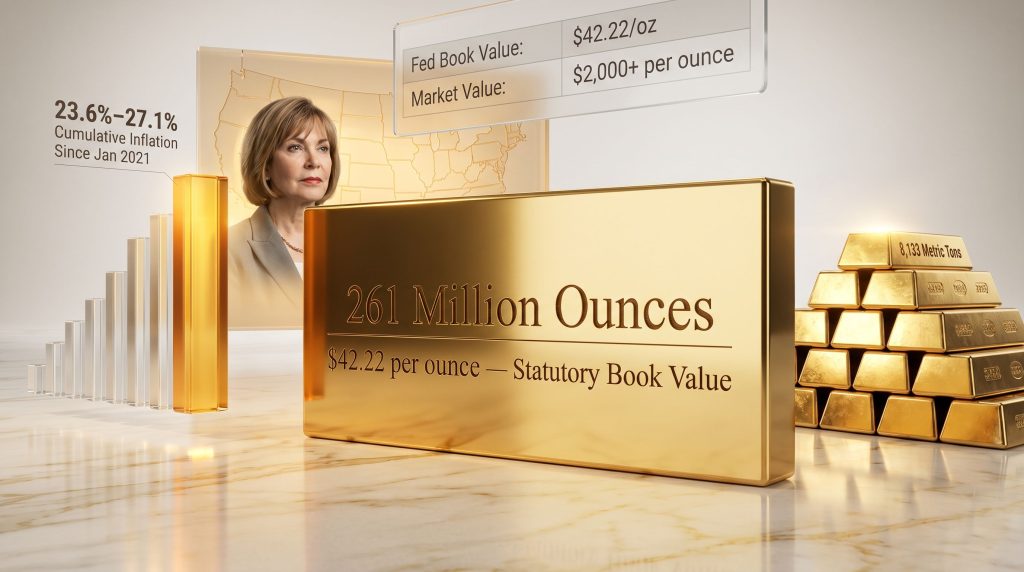
The post-pandemic inflation surge provided a jarring demonstration of what unconstrained monetary expansion looks like in practice. Since January 2021, cumulative price inflation in the United States has risen between 23.6% and 27.1%, depending on which measurement methodology is applied. The variance reflects the difference between official CPI-U data published by the U.S. Bureau of Labor Statistics and alternative frameworks that use pre-revision calculation methods.
Even under the Federal Reserve's official framework, the numbers reveal a structural erosion of purchasing power. The Fed's stated long-run inflation objective is 2% annually, as confirmed in its Statement on Longer-Run Goals and Monetary Policy Strategy. Applied over a five-year horizon using compound mathematics, that target translates into approximately a 9.6% reduction in purchasing power during the period. In practice, outcomes have been significantly worse.
The dollar's depreciation is not a recent phenomenon isolated to pandemic-era policy failures. It represents the cumulative trajectory of a monetary system untethered from any external anchor since August 1971, when President Nixon closed the gold window and severed the final link between the dollar and a fixed quantity of gold. The end of the gold standard meant the original Bretton Woods convertibility rate of $35 per troy ounce, which had held since the conference at Bretton Woods, New Hampshire, in July 1944, was never officially restored.
What is particularly striking about the current environment is that gold's price appreciation is occurring simultaneously across every major currency. Gold denominated in euros, British pounds, Japanese yen, and Chinese yuan has all reached multi-year or record highs in recent periods. This broad-based revaluation is not a reflection of dollar weakness alone. It is a real-time market signal of declining confidence in fiat monetary systems as a category.
Who Is Judy Shelton? Her Intellectual Journey to Sound Money
Shelton's monetary philosophy was not inherited from a textbook. It was constructed through direct engagement with the most consequential monetary policy architects of the twentieth century, and through original research into the internal workings of a centrally controlled monetary system that ultimately destroyed itself.
Her academic foundation was built on a detailed study of the Soviet Union's monetary architecture. By examining how a command economy manages money divorced from market signals, she reached a conclusion that was far from conventional wisdom at the time: central control of monetary systems is structurally self-defeating. The Soviet ruble, stripped of genuine purchasing power and credibility by state management, became precisely the kind of monetary instrument citizens trusted least. Her book, The Coming Soviet Crash: Gorbachev's Desperate Pursuit of Credit in Western Financial Markets, published before the USSR's collapse, predicted the economic trajectory that would eventually materialise.
The book attracted the attention of former President Richard Nixon. In their subsequent correspondence, Nixon admitted frankly that he understood very little about monetary policy, despite having personally authorised the most consequential monetary policy decision of the twentieth century. His private acknowledgement that he lacked the sophistication to evaluate proposals on monetary reform is a remarkable admission from the man who oversaw these pivotal changes.
Shelton also developed an extended professional relationship with Paul Volcker, the Federal Reserve chair who raised the federal funds rate to 20% in June 1981 to break the inflationary spiral that followed the abandonment of gold convertibility. In a recorded three-hour conversation with Shelton, Volcker provided a candid retrospective assessment of the 1971 decision. His position was that the closure of the gold window was intended as a temporary revaluation mechanism, not a permanent structural break. Volcker indicated he believed the convertibility rate would be reset to perhaps $38 or $40 per ounce before being reinstated, and that Treasury officials broadly shared this expectation. That reinstatement never occurred.
Correspondence with Alan Greenspan added another dimension to Shelton's thinking. When critics dismissed her gold standard advocacy during her Federal Reserve nomination process, Greenspan's private response framed the counterargument with characteristic precision: if gold has no monetary value, why do the United States government and every other major sovereign power hold such large quantities of it? Furthermore, this question speaks directly to the broader debate about gold in the monetary system and its enduring relevance.
The Constitutional Dimension: Inflation as Property Expropriation
Shelton's case for sound money extends beyond macroeconomic efficiency arguments. She grounds it in a constitutional and moral framework rooted in property rights.
James Madison argued that a deliberately depreciating currency constitutes government expropriation of private property. Under this framing, earned income is property, and inflation functions as an involuntary transfer of that property from wage earners and savers to debtors and governments. The Federal Reserve's 2% annual inflation target does not merely represent an abstract macroeconomic goal. It institutionalises an annual wealth transfer mechanism that operates invisibly but continuously.
This framing redefines the monetary policy debate from a technical question about interest rates and output gaps into a question about justice, governance, and constitutional boundaries. The populations most exposed to inflation's effects are those least positioned to hedge against it: fixed-income earners, hourly wage workers, and small savers without access to financial assets that appreciate in inflationary environments.
The regressive distributional consequence of accommodative monetary policy is not incidental. Federal Reserve asset purchase programmes and sustained low-rate policies systematically inflate financial asset prices, concentrating gains among those who already hold significant wealth. Shelton's critique of the Fed is therefore not merely technical. It is a challenge to what she characterises as institutionalised monetary favouritism.
The Exchange Rate Blind Spot in Trade Policy Debates
One of the less frequently examined dimensions of Shelton's monetary reform agenda involves the interaction between exchange rate volatility and trade policy. The comparison is worth examining in detail:
| Policy Tool | Typical Adjustment Timeline | Magnitude of Impact |
|---|---|---|
| Tariff negotiation | Months to years | 1-2% relative price shift |
| Exchange rate movement | Minutes to hours | Can erase years of trade gains |
| Gold-linked currency | Structural anchor | Eliminates exchange rate volatility |
Volcker's observation, which Shelton has relayed consistently, was that two years of tariff negotiation can be completely neutralised within ten minutes of foreign exchange trading. The implication is that trade competitiveness debates that focus exclusively on tariff structures while ignoring the monetary foundations of exchange rates are addressing the symptom rather than the cause.
Gold and silver served as a common international unit of account for centuries precisely because they eliminated the exchange rate problem. The Bretton Woods system replicated this function through dollar-gold convertibility, delivering a period of relative price stability and economic growth from 1944 to 1971. The current floating rate environment, by contrast, creates a structurally unstable foundation for long-term cross-border investment and trade planning.
How Shelton Proposes to Re-link the Dollar to Gold
Shelton's reform agenda is deliberately incremental. She does not advocate for an immediate, full return to a pre-Federal Reserve gold standard. Her preferred pathway uses market mechanisms to create a gold anchor progressively, allowing fiscal and institutional discipline to emerge organically.
The Gold-Convertible Treasury Bond
The centrepiece of her proposal is a long-term U.S. Treasury bond with a dual redemption clause. The mechanics would function as follows:
- The U.S. Treasury issues long-dated bonds (50-year maturity) with an embedded gold convertibility option.
- Bondholders retain the option, but not the obligation, to redeem at maturity in either a pre-established quantity of physical gold or the equivalent face value in U.S. dollars.
- Market pricing of these instruments would generate a real-time shadow gold price signal for the dollar.
- As fiscal pressure builds through the tangible-asset linkage of U.S. debt, congressional incentives to limit deficit spending increase structurally.
The conceptual lineage of this instrument draws on thinking articulated by Alan Greenspan in 1981 regarding gold-linked debt instruments. According to Shelton's detailed proposal, July 4, 2026, has been identified as a symbolically resonant launch date for the initial issuance.
The U.S. Gold Reserve Position: An Underutilised Asset
The United States holds the world's largest sovereign gold reserve. The gap between its statutory book value and current market reality represents one of the most striking anomalies in the entire monetary policy debate:
| Metric | Current Status |
|---|---|
| U.S. gold holdings | 261 million troy ounces (8,133 metric tons) |
| Statutory book value | $42.22 per ounce (unchanged since 1973) |
| Market value (approximate, 2026) | Significantly above $2,000 per ounce |
| Implied market value of reserves | Well above $500 billion |
The statutory book value of $42.22 per ounce has not been updated by Congress since 1973, creating a multi-hundred-billion dollar discrepancy between the Treasury's stated gold asset value and its real-world market worth. This undervaluation has significant implications for any gold-convertible bond programme, as the U.S. reserve position would provide the credibility anchor for such instruments.
The United States holds 8,133 metric tons of gold, the largest sovereign reserve in the world, yet carries it on government books at a statutory price last updated over fifty years ago. The gap between that figure and current market reality represents a largely unacknowledged national asset of extraordinary scale.
The Solidus: A Hard-Asset Digital Currency
Shelton has extended her gold remonetisation framework into the digital finance space with a proposal for a stablecoin instrument she calls the Solidus. The name draws on the Byzantine solidus, a gold coin that functioned as a stable international currency for more than 700 years across a vast geographic range.
The proposed instrument would be backed exclusively by gold-convertible Treasury bonds, combining the infrastructure of modern digital payments with hard-asset monetary discipline. Contemporary stablecoins operate on a 1:1 collateral backing model; Shelton's Solidus would extend this architecture to sovereign debt instruments with embedded gold optionality. The concept offers a potential bridge between decentralised finance trends and the credibility requirements of a serious monetary reform programme.
The next major ASX story will hit our subscribers first
The Federal Reserve's Accountability Deficit
Shelton's critique of Jerome Powell's Federal Reserve is grounded in a straightforward observation: accepting verbal responsibility without facing institutional consequences is structurally meaningless as an accountability mechanism. Powell repeatedly characterised price stability as the Federal Reserve's core responsibility throughout the post-pandemic period. The outcome was the largest sustained inflation surge in four decades, with cumulative price increases between 23.6% and 27.1% since January 2021, yet no resignation, no formal accountability process, and no institutional reform.
Beyond the specific handling of post-pandemic inflation, Shelton identifies a deeper structural problem with the Federal Reserve's current role in the economy. The Fed currently pays approximately 4.4% interest on bank reserves, a rate that functions as a policy-set floor distorting capital allocation decisions across the entire financial system. Every investment decision, every portfolio construction exercise, and every corporate financing plan now begins with an assessment of anticipated Federal Reserve movements measured in increments of 25 basis points.
This dependency is not a natural market outcome. It is an institutional addiction created by decades of Fed expansion into functions far beyond its original mandate. Shelton has argued that eliminating interest on excess reserves through congressional legislation, aligned with proposals such as those put forward by Senator Rand Paul, would represent a meaningful first step toward reducing the Fed's distorting footprint.
Why Her Nomination Was Blocked: The Political Economy of Sound Money
President Trump nominated Shelton to the Federal Reserve Board of Governors in 2019. The nomination was ultimately blocked in the Senate, with opposition coalescing around her advocacy for gold-linked monetary instruments and her perceived proximity to the administration.
The institutional logic of that opposition reveals something important about the political economy of central banking. A Federal Reserve oriented toward gold convertibility or purchasing power stability necessarily constrains the political capacity for deficit-financed spending. Both major political parties have relied on monetary accommodation to fund expenditure commitments that could not be financed through taxation alone. The welfare and warfare state model that emerged after 1971 depends structurally on the flexibility to debase the currency.
Shelton's concept of Fed independence is worth examining here. She has characterised the construct as ambiguous in ways that insulate unelected officials from democratic accountability while systematically benefiting holders of financial assets over wage earners. The constitutional argument is that congressional oversight represents the appropriate democratic check on monetary policy outcomes, not an institutional independence framework that protects officials regardless of performance.
Is a Peaceful Monetary Reset Achievable?
Every major monetary system transition in recorded history has been preceded or accompanied by geopolitical rupture: wars, revolutions, or systemic economic collapse. The fall of the Roman solidus, the Weimar hyperinflation, the breakdown of Bretton Woods in 1971, all occurred within contexts of extreme external pressure.
Shelton's thesis is that a disciplined, policy-driven transition represents the only viable non-violent pathway. The precondition is public understanding that inflation is a policy choice, not an economic inevitability. When populations recognise that currency depreciation is not an act of nature but a deliberate institutional decision, the political conditions for demanding genuine monetary reform become possible.
Several developments suggest that transition pressures may already be building:
- Central bank gold demand has reached multi-decade highs globally, with China, Russia, India, and numerous smaller economies accelerating purchases.
- Sovereign nations have made formal requests for gold repatriation plans from the New York Federal Reserve's vaults, reflecting declining confidence in custodial arrangements backed by fiat commitments.
- Gold price appreciation expressed across every major currency simultaneously suggests the market is pricing systemic fiat weakness, not merely dollar-specific risk.
- Growing interest in decentralised finance and hard-asset-backed digital instruments reflects a generational shift in trust away from government-issued monetary systems.
In addition, central bank gold reserves data confirm that institutional accumulation patterns have reached levels not seen since the post-war era, reinforcing the signals emerging from private markets.
A hypothetical phased transition toward a gold-linked monetary framework might unfold across three broad stages:
Phase 1 – Market Signal (Years 1-5): Gold-convertible Treasury bonds are issued. Bond market pricing begins generating a shadow gold price for the dollar. Congressional awareness of fiscal constraint implications increases.
Phase 2 – Institutional Adjustment (Years 5-15): Interest on reserves is eliminated through legislation. Fed discretionary scope narrows. Inflation targeting is progressively replaced with a purchasing power stability mandate. Congressional oversight mechanisms are strengthened.
Phase 3 – Structural Anchor (Years 15-50): Gold-backed digital instruments achieve mainstream adoption. Dollar credibility is restored through demonstrated purchasing power consistency. International monetary coordination around a neutral reserve asset becomes politically viable.
It is important to note that this scenario is speculative and represents one possible trajectory rather than a forecast. Monetary system transitions involve complex political, economic, and institutional dynamics that are inherently difficult to predict. Investors should not make financial decisions based on any specific monetary reform timeline.
The Moral Case for Honest Money
At its core, the Judy Shelton gold standard and Federal Reserve reform agenda is not merely technical. It is a case grounded in property rights, intergenerational equity, and democratic accountability. Consequently, understanding its philosophical foundations is as important as evaluating its policy mechanics.
Deficit spending, in her framing, is not simply a fiscal management challenge. It is a moral failure because it finances present consumption by placing claims on goods that have not yet been produced by future generations. The currency debasement that enables deficit spending functions as a regressive tax whose burden falls most heavily on those least equipped to avoid it.
The demand for sound money, in this reading, is not nostalgia for a simpler economic past. It is a structural response to five decades of a monetary system that has transferred wealth from producers to financial intermediaries, from wage earners to asset holders, and from future generations to present political objectives. As Cato Institute analysis has explored, the classical gold standard offers meaningful lessons for how modern monetary policy might be reformed.
Honest money, as Shelton defines it, requires a unit of account that holds its value across planning horizons, fiscal discipline enforced through tangible-asset-linked debt, and democratic accountability for monetary policy outcomes. These are not radical demands. They are the foundational requirements of a monetary system that serves the people who use it rather than the institutions that manage it.
Whether the political conditions for such reform will emerge through deliberate policy leadership or through the pressure of market forces remains the defining monetary question of the current era. The signals accumulating in global gold markets, in sovereign reserve strategies, and in the growing distrust of fiat institutions suggest the answer may not be long in coming. Furthermore, detailed analysis from monetary economists continues to examine both the practical and structural dimensions of precisely this transition.
This article is for informational and educational purposes only and does not constitute financial advice. Opinions expressed regarding monetary policy reform, gold markets, and economic forecasts involve inherent uncertainty and should not be relied upon as the basis for investment decisions.
Want to Stay Ahead of the Next Major Mineral Discovery?
While the debate around monetary reform and hard-asset value intensifies, Discovery Alert's proprietary Discovery IQ model delivers real-time alerts on significant ASX mineral discoveries — instantly translating complex geological data into actionable investment insights for both traders and long-term investors. Explore how historic discoveries have generated extraordinary returns on Discovery Alert's dedicated discoveries page, and begin your 14-day free trial today to position yourself ahead of the broader market.