Kalamazoo Resources Ltd
- ASX Code: KZR
- Market Cap: $49,474,643
Kalamazoo Resources Defines New Exploration Target at Peake, Revealing a District-Scale Gold Growth Story Beyond Mt Olympus
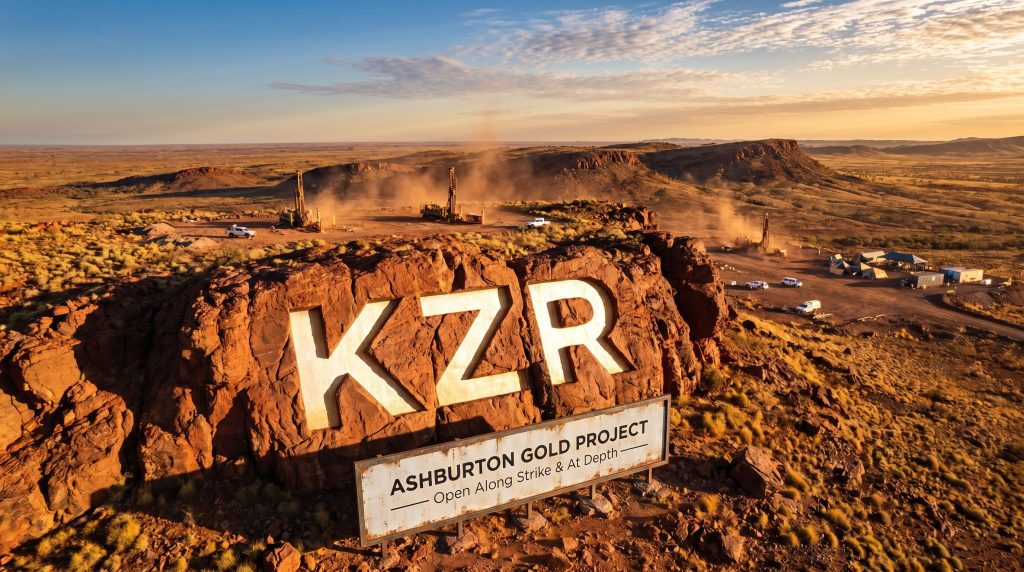
Kalamazoo Resources Limited (ASX: KZR) has announced the definition of a new Underground Exploration Target at its Peake Deposit within the Ashburton Gold Project in Western Australia. Simultaneously, the company has unveiled a district-scale pipeline of five mineralised trends spanning more than 12km of prospective strike. The Kalamazoo Resources Peake exploration target at Ashburton Gold Project signals a meaningful step-change in the growth narrative, extending well beyond the flagship Mt Olympus deposit.
At the core of this announcement is a newly outlined exploration target of 1.7–2.6Mt at 3.4–5.0g/t Au for 240–380koz Au (mid-point 310koz Au). When combined with the existing 210koz Au Mineral Resource at 3.4g/t Au, this points to a combined potential of approximately 450,000–590,000oz Au at Peake alone — none of which is currently incorporated in the Pre-Feasibility Study (PFS) or the earlier Scoping Study.
"We are excited to share the next growth stage after Mt Olympus. Peake is a high-grade vein system that has been outlined over 1.8km in strike extent across the previously mined Peake open pit… The newly defined Peake Underground Exploration Target provides further potential to this prospective deposit." — Ben Ackerman, Executive Director, Kalamazoo Resources
"Ashburton's full Mineral Endowment potential is ours to be realised. We are rapidly advancing work programs to build a pipeline of growth and life extension projects, which will release full value for Kalamazoo." — Andrew McDougall, CEO, Kalamazoo Resources
When big ASX news breaks, our subscribers know first
The Peake Deposit: High-Grade, Under-Drilled, and Open in Every Direction
The Peake Deposit sits approximately 2km west of the Mt Olympus deposit within the broader Ashburton Gold Project tenement package. Gold mineralisation was first identified in 1988, and the deposit went on to produce approximately 18,000oz Au from 0.08Mt at ~7g/t Au from a 500m-long shallow open pit between 1998 and 2004 — a remarkably high-grade historical operation.
Subsequent drilling by Kalamazoo and its predecessors — including Northern Star Resources, Newcrest Mining, and Sipa Resources — has delineated a substantially larger Mineral Resource beneath and around those old workings.
Current Peake Mineral Resource
| Classification | Tonnes (000's) | Grade (g/t Au) | Ounces (000's) |
|---|---|---|---|
| Indicated | 349 | 5.3 | 60 |
| Inferred | 1,571 | 3.0 | 150 |
| Total | 1,920 | 3.4 | 210 |
What makes the current resource especially compelling is what it does not yet capture. Mineralisation has been defined over just ~1.8km of strike and drilled to a maximum depth of only ~200m, leaving significant portions of the system wide open — both along strike and at depth.
The broader Shinkansen Trend, along which Peake sits, extends to approximately 4.5km, meaning roughly 2.8km of known strike extent remains untested by drilling. Furthermore, the highest-grade mineralisation is concentrated within a 900m x 200m north-dipping zone, which remains entirely open below 100m along much of its strike. This is, in short, a deposit that has barely been touched at depth.
The New Exploration Target: Quantifying the Upside Below
The newly defined Kalamazoo Resources Peake exploration target at Ashburton Gold Project has been prepared in accordance with the JORC Code (2012), providing a formal framework for the scale of opportunity that lies beneath and beyond the current resource envelope.
Peake Underground Exploration Target
| Parameter | Range | Mid-Point |
|---|---|---|
| Tonnes | 1.7–2.6Mt | ~2.15Mt |
| Grade | 3.4–5.0g/t Au | ~4.2g/t Au |
| Contained Gold | 240–380koz Au | 310koz Au |
The target incorporates two components: infill drilling within the top 200m of the system where existing drill spacing is too wide to fully define the resource, and extensions to 200–400m depth below prior drilling across the known high-grade vein system strike extent.
Combined Peake Potential
| Component | Ounces |
|---|---|
| Current Mineral Resource | 210koz Au |
| New Underground Exploration Target (mid-point) | 310koz Au |
| Combined Potential | ~450,000–590,000oz Au |
It is important to note the standard JORC caveat: the Exploration Target is conceptual in nature, insufficient exploration drilling has been completed to define this as a Mineral Resource, and it is uncertain whether further drilling will result in a Mineral Resource estimate.
To begin converting this target into something more tangible, Kalamazoo has planned an initial 3,000m RC and diamond drilling programme commencing next quarter, designed to test the Exploration Target volume at 100m x 200m centres.
Understanding Exploration Targets: What They Mean for Investors
For investors less familiar with the technical language of mineral exploration, the distinction between an Exploration Target and a Mineral Resource is an important one to understand.
A Mineral Resource is a formal estimate of mineralised material that has sufficient geological evidence and sampling data to support confidence in its continuity and grade. It is classified under the JORC Code into categories — Inferred, Indicated, and Measured — based on confidence level.
An Exploration Target, by contrast, is a conceptual range of tonnes and grade used to communicate the scale of potential that a project area may hold, based on known geological information but without sufficient drilling density to meet the criteria for a Mineral Resource.
Why does this matter for investors?
Exploration Targets are significant because they frame the opportunity ahead. A well-defined Exploration Target in a geologically well-understood system — as is the case at Peake — signals the potential for resource growth through targeted drilling.
If upcoming drill programmes return results consistent with the target parameters, the pathway from Exploration Target to Mineral Resource can be relatively straightforward. For Kalamazoo, the Kalamazoo Resources Peake exploration target at Ashburton Gold Project provides a size and grade framework directly comparable to the existing resource, suggesting continuity of the system rather than speculative upside.
Key terms glossary:
- Mineral Resource: A concentration of mineralised material with reasonable prospects for eventual economic extraction, estimated in accordance with the JORC Code.
- Exploration Target: A prospective range of tonnes and grade based on geological data, not yet meeting the evidentiary standard for a Mineral Resource estimate.
- g/t Au: Grams of gold per tonne of rock — the standard measure of gold grade.
- Gram-metres: A combined measure of grade and width used to compare drill intercept significance.
- Strike: The horizontal direction or extent of a mineral deposit as measured along its length.
- JORC Code: The Australasian Code for Reporting of Exploration Results, Mineral Resources and Ore Reserves.
Five Mineralised Trends: An Emerging District-Scale Gold Camp
Perhaps equally significant for long-term investors is the broader regional context this announcement reveals. Kalamazoo has completed an initial regional targeting review of the area extending approximately 5km west of Mt Olympus, drawing on historical surface geochemical surveys and shallow drilling data.
The outcome is the identification of five distinct parallel mineralised trends collectively spanning more than 12km of prospective strike.
Regional Mineralised Trends
| Trend Name | Location Relative to Shinkansen | Notes |
|---|---|---|
| Shinkansen | Central | Hosts Peake Deposit; ~4.5km strike, ~2.8km untested |
| MagLev | North of Shinkansen | Identified from surface geochemistry |
| ICE | South of Shinkansen | Identified from surface geochemistry |
| TGV | South of Shinkansen | Identified from surface geochemistry |
| Eurostar | South of Shinkansen | Identified from surface geochemistry |
The four additional trends remain largely untested by drilling, representing a pipeline of early-stage but geologically motivated exploration opportunities. For context, the Ashburton Gold Project sits within the Nanjilgardy Fault Zone along the southern margin of the Pilbara Craton — one of Australia's most prospective gold regions.
The project tenements cover 238km² for the core Ashburton package, with the recently acquired Xanadu Gold Project adding a further 142.4km² of contiguous tenure along strike to the southeast. The identification of multiple parallel gold-bearing trends within a compact, well-controlled tenure package is a hallmark of district-scale gold systems.
Mt Olympus Resource Conversion Drilling: Accelerating Ahead of PFS
While the Peake announcement captures the imagination in terms of future growth, the near-term value driver for Kalamazoo remains the Mt Olympus PFS. Drilling activity there is well advanced and tracking to plan, with four rigs currently active on site.
Mt Olympus Drilling Programme Summary
| Parameter | Detail |
|---|---|
| Total Programme | 14,000m (diamond and RC combined) |
| Completed / In Progress | |
| Active Drill Rigs | Four rigs currently on site |
| Drill Holes Completed/In Progress | 44 holes |
| Drill Spacing | ~20m x 20m infill pattern |
| Objective | Upgrade Inferred to Indicated; support Ore Reserve estimation and PFS inputs |
Selected significant results from the Mt Olympus growth drilling programme reported to date include:
- KADD0003: 8.8m at 11.0g/t Au from 20.5m, including 2.9m at 21.0g/t Au from 22.3m
- KADD0004: 43.8m at 3.4g/t Au from 93m, including 21.0m at 4.6g/t Au from 93m
- KADD0006: 30.9m at 1.5g/t Au from 214.5m, including 9.2m at 2.4g/t Au from 234.3m
Five of the eight growth drill holes reported to date have returned encouraging intersections, including two results exceeding 45 gram-metres. An updated Mineral Resource Estimate for Mt Olympus is expected to be published later in 2026, serving as a key input into the ongoing PFS and representing an important near-term catalyst.
The PFS Foundation: What the Scoping Study Already Established
The Mt Olympus Scoping Study established a strong economic baseline, providing a reference point for what PFS optimisation is working from. However, it is worth noting that the Scoping Study does not include the Mt Olympus underground resources and exploration targets (~350,000–500,000oz at 2.0–3.8g/t Au identified below the open pit), nor does it include any ounces from Peake.
Scoping Study Key Parameters (Mt Olympus)
| Metric | Base Case ($4,500/oz) | Upside Case ($6,000/oz) |
|---|---|---|
| Total Recoverable Gold | ~524,000oz | ~524,000oz |
| Life of Mine | 73 months | 73 months |
| AISC | ~$2,183/oz | ~$2,183/oz |
| Pre-Tax Free Cashflow | ~$747m | ~$1,396b |
| NPV (8%) | ~$423m | ~$842m |
| IRR | ~47% | ~74% |
| Pre-Production Capex | ~$208m | ~$208m |
| Capex Payback | ~23 months | ~23 months |
| Processing Method | 1.5Mtpa flotation | 1.5Mtpa flotation |
| Processing Recovery | ~86% | ~86% |
The newly defined Peake combined potential of 450,000–590,000oz sits entirely outside these numbers, reinforcing management's view that the PFS and Scoping Study represent a floor — not a ceiling — for the project's value.
Why Investors Should Be Watching Kalamazoo Closely
Kalamazoo's announcement does several things simultaneously, each of which matters to the investment case. Furthermore, the breadth of activity across multiple fronts demonstrates operational discipline rarely seen at this stage of project development.
- Formal Growth Framework: A JORC-compliant Exploration Target that quantifies potential ounces beyond the current resource, providing a credible growth pathway.
- Under-Drilled System: Peake is materially under-drilled relative to its geological endowment, with the high-grade vein system tested to only 200m depth along a system open to at least 400m.
- District-Scale Potential: Five identified trends provide a long runway of exploration upside, elevating Ashburton from a single-deposit story to a multi-trend gold camp narrative.
- Operational Momentum: Four drill rigs active at Mt Olympus, 50% of the 14,000m programme complete, and an updated Mineral Resource Estimate expected later this year.
- Additional Upside: The Kalamazoo Resources Peake exploration target at Ashburton Gold Project combined potential of 450,000–590,000oz sits entirely outside the current PFS and Scoping Study, meaning any successful conversion represents direct upside to project economics.
In addition, the Ashburton Gold Project already hosts a total Mineral Resource of 1.44Moz Au across its deposits — Mt Olympus at 1,073koz, Peake at 210koz, Waugh at 32koz, Zeus at 121koz, and Romulus at 27koz — with the exploration pipeline now pointing to meaningful resource growth across multiple fronts.
The next major ASX story will hit our subscribers first
Investment Summary
Kalamazoo Resources (ASX: KZR) has taken a significant step in transforming the Ashburton Gold Project from a single-deposit development into a district-scale gold camp. With four rigs turning at Mt Olympus, a new drilling programme planned at Peake, and five mineralised trends identified across more than 12km of prospective strike, the company is building a compelling multi-catalyst growth story. The Kalamazoo Resources Peake exploration target at Ashburton Gold Project, combined with the strong economics already established in the Scoping Study, positions Ashburton as one of the more interesting emerging gold projects in Australia's prolific Pilbara Craton.
Ready to Identify the Next Major ASX Gold Discovery Before the Market Does?
Discovery Alert's proprietary Discovery IQ model scans ASX announcements in real time, instantly identifying high-potential mineral discoveries like those unfolding across Australia's most prolific gold regions — visit the Discovery Alert discoveries page to see how historic ASX discoveries have generated exceptional returns, and begin your 14-day free trial to position yourself ahead of the broader market.