
August 9, 2026
North American Pipeline Infrastructure Faces a Defining Inflection Point
The economics of crude oil transport have always been shaped less by geology and more by politics, geography, and the infrastructure choices made decades before. For Canadian oil producers, the pipeline bottleneck problem has persisted as a structural drag on producer returns for over a generation. More than 90% of Canadian crude exports flow southward into the United States, a concentration so extreme that a single policy shift in Washington can ripple directly through Alberta's energy revenues. That structural vulnerability is now at the centre of a major development: when Trump approves Keystone Light, the Canada-U.S. oil pipeline debate moves from ideological battleground to engineering and regulatory reality.
When big ASX news breaks, our subscribers know first
What the Bridger Pipeline Expansion Actually Is
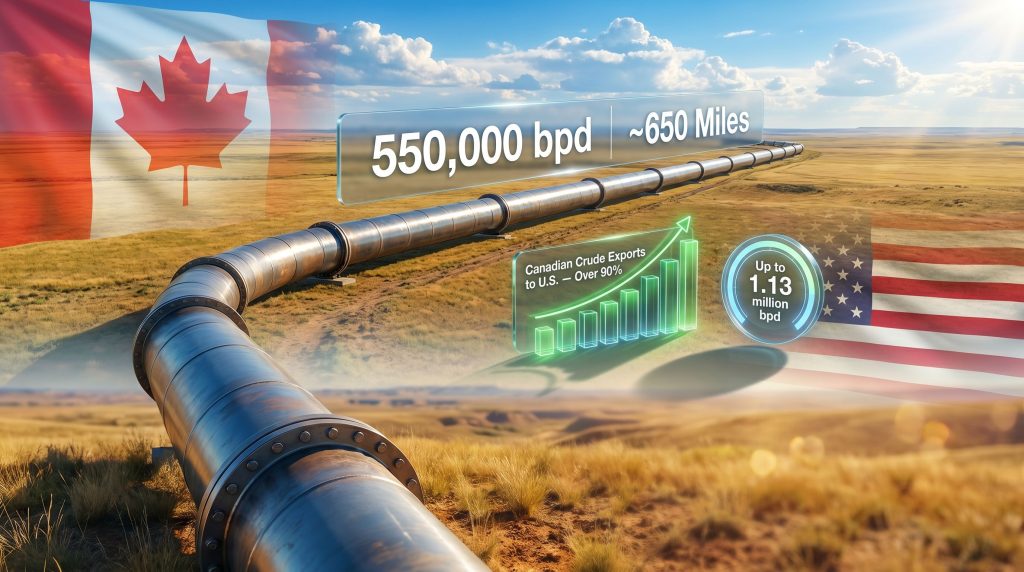
The project formally known as the Bridger Pipeline Expansion is proposed and operated by Bridger Pipeline LLC, a subsidiary of True Companies. The infrastructure would run approximately 650 miles from the U.S.-Canada border in Phillips County, Montana, terminating at Guernsey, Wyoming, with a 36-inch diameter barrel capable of handling significant crude volumes.
Pipeline Specifications at a Glance
| Feature | Detail |
|---|---|
| Pipeline Diameter | 36 inches |
| Total Route Length | ~650 miles (1,050 km) |
| Origin Point | Phillips County, Montana (U.S.-Canada border) |
| Terminus | Guernsey, Wyoming |
| Initial Throughput Capacity | ~550,000 barrels per day (bpd) |
| Maximum Potential Capacity | Up to 1.13 million bpd (light crude batching) |
| Estimated Capital Cost | ~US$2 billion |
| Construction Start Target | 2027 |
| Projected Completion | Late 2028 – Early 2029 |
| Operator/Proponent | Bridger Pipeline LLC (subsidiary of True Companies) |
On May 1, 2026, President Trump signed a presidential permit authorising Bridger Pipeline LLC to proceed with development work on the border-crossing component of this infrastructure. Construction is targeted to begin in 2027, with projected first oil flowing by late 2028 or early 2029, subject to the substantial regulatory process that still lies ahead.
One technical detail that makes this project commercially compelling is the concept of light crude batching. In standard heavy oil pipeline operations, the viscosity of bitumen-heavy crude limits throughput for a given pipe diameter. By interspersing batches of lighter crude through the same line, operators can effectively cycle between product types and achieve higher combined throughput.
According to analysis from Plainview Energy Analytics, this technique would allow the Bridger expansion to exceed the standard heavy oil ceiling of roughly 800,000 bpd for a line of this size, potentially reaching 1.13 million bpd at maximum operational configuration.
Why the Industry Calls It "Keystone Light"
The informal label reflects both the similarities and the deliberate departures from the Keystone XL project that the Biden administration cancelled in January 2021. The Bridger expansion revives portions of that cancelled route concept but has been redesigned to navigate around several of the flashpoints that made Keystone XL so politically and legally vulnerable. As Global News reports, this redesign represents a calculated effort to sidestep the controversies that derailed its predecessor.
Key structural differences include:
- The Bridger route does not cross Native American reservations, a contested dimension of the original Keystone XL design
- Approximately 70% of the 650-mile U.S. route follows existing infrastructure corridors, substantially reducing the environmental footprint and simplifying rights-of-way negotiations
- Around 150 km of pre-built Canadian-side pipeline has been sitting idle since 2021, representing salvageable infrastructure from the Keystone XL cancellation that can be incorporated into the new project
- The estimated capital cost is approximately $2 billion, compared to Keystone XL's estimated $8 billion total cost, reflecting the narrower scope and infrastructure reuse
A Side-by-Side Look: Keystone Light vs. Keystone XL
| Dimension | Keystone XL | Bridger Pipeline Expansion |
|---|---|---|
| Proposed Capacity | ~830,000 bpd | 550,000 bpd initial; up to 1.13 mbpd |
| Route Length | ~1,200 miles (total) | ~650 miles (U.S. segment) |
| Cancellation/Approval | Cancelled January 2021 (Biden) | Approved May 2026 (Trump) |
| Native American Reservation Crossings | Yes (contested) | No (route redesigned) |
| Existing Infrastructure Reuse | Limited | ~70% follows existing corridors |
| Pre-Built Canadian Pipe | N/A | ~150 km idle since 2021 |
| Bakken Shale Integration | No | Yes (potential tie-in) |
| Estimated Cost | ~$8 billion (full project) | ~$2 billion |
What a Presidential Permit Actually Authorises
It is worth understanding exactly what Trump's May 2026 signature achieves and, equally important, what it does not. A presidential permit is the mechanism by which the U.S. federal government authorises the construction, operation, and maintenance of infrastructure that crosses an international border. It is granted through executive authority and, for energy infrastructure, has historically been administered through the U.S. Department of State.
Critical clarification: The presidential permit authorises the border crossing only. Full construction still depends on environmental impact assessments, state-level permits in Montana and Wyoming, and resolution of legal challenges from environmental and Indigenous advocacy groups.
The outstanding approvals still required before shovels can legally break ground include:
- U.S. Army Corps of Engineers permitting for waterway crossings along the route through Montana and Wyoming
- Montana and Wyoming state-level environmental impact reviews, which operate independently of federal processes
- Potential FERC considerations for interstate infrastructure depending on the specific regulatory triggers
- Possible additional presidential permit if the border crossing design is modified at any point during development
This distinction matters enormously for anyone tracking the project's timeline. A presidential permit is a necessary condition for the border-crossing component, but it is nowhere near sufficient for construction to commence.
The Bakken Dimension: More Than Just Canadian Crude
A frequently overlooked aspect of the Bridger expansion is its dual-origin design. While the primary stated purpose involves transporting Canadian crude, company maps and project plans include potential tie-ins for North Dakota's Bakken shale oil field. The pipeline's design provides direct access to a significant portion of Bridger's existing North Dakota gathering network.
Matthew Lewis, founder of Plainview Energy Analytics, has noted that this design optionality positions the project for potential expansion beyond the initial 550,000 bpd capacity and creates the possibility of a new competitive export route for Bakken shale producers.
This matters commercially for several reasons:
- Bakken producers currently rely on a limited number of egress options, which constrains their pricing leverage
- A new competitive pipeline outlet would introduce market discipline into existing transport agreements
- The dual-origin capability strengthens the project's financing case by broadening the shipper base beyond Canadian oil sands producers
- Long-term commercial viability improves substantially when the pipeline is not solely dependent on bilateral Canada-U.S. energy politics
Furthermore, this dual-origin design is one reason industry analysts believe the project has stronger commercial foundations than Keystone XL ever did.
Canada's 90% Problem: Structural Dependence and Its Consequences
The scale of Canada's exposure to U.S. market conditions is difficult to overstate. Over 90% of Canadian crude oil exports flow into the United States, with limited practical alternatives due to decades of infrastructure development oriented southward rather than toward Pacific or Atlantic tidewater access. Understanding crude oil price trends helps contextualise why this concentration carries such significant financial risk for Canadian producers.
| Metric | Data Point |
|---|---|
| Share of Canadian crude exports to the U.S. | More than 90% |
| Canada's role in U.S. oil imports | Primary foreign supplier of heavy crude |
| Potential volume increase via Bridger | Over 12% uplift in Canadian export volumes |
| Estimated GDP contribution of 1.5 mbpd capacity increase | ~$31.4 billion annually (2027-2035) |
This concentration has real pricing consequences. Canadian heavy crude, primarily Western Canadian Select (WCS), consistently trades at a discount to West Texas Intermediate (WTI). Part of that discount reflects crude quality, but a meaningful portion reflects the infrastructure bottleneck premium that buyers extract from sellers who have few alternative outlets.
Every dollar of constrained egress discount that Canadian producers absorb represents a transfer of economic value from Canadian resource owners to U.S. refinery operators. The Bridger expansion, if completed, would increase Canada's crude export volumes to the U.S. by more than 12%, providing incremental pipeline capacity that would reduce transport constraints and could incrementally narrow the WCS-WTI spread over time.
The next major ASX story will hit our subscribers first
Environmental Opposition and the Weight of Bridger's Past
The project faces organised and well-resourced opposition. The Montana Environmental Information Center has raised specific concerns about spill risk to Montana's land and water systems, and has drawn direct attention to the operator's prior environmental record.
In 2015, Bridger Pipeline LLC was responsible for a crude oil spill in which over 30,000 gallons of oil entered the Yellowstone River near Glendive, Montana. The contamination reached Glendive's municipal water supply, forcing a temporary shutdown and creating lasting reputational damage. For opponents of the Bridger expansion, this incident is not historical background material but active evidence against extending the operator's infrastructure footprint across sensitive Montana waterways.
Other groups are engaged on broader grounds:
- WildEarth Guardians and Earthjustice have expressed concerns centred on climate impact and the systemic risk of expanding fossil fuel transport infrastructure
- Greenpeace Canada has argued that Canada's energy sector should be reducing reliance on oil rather than building new capacity to export more of it
It is also worth noting that Greenpeace Canada's opposition exists within the context of significant legal pressure on environmental advocacy groups in the United States. A 2025 jury verdict initially ordered Greenpeace to pay substantial damages for its protest activities related to other pipeline projects, a development with potential chilling effects on the tactics available to environmental opposition movements going forward.
Risk callout: Environmental legal challenges have previously added years to major pipeline approvals in the U.S. The Bridger expansion's construction target of 2027 may prove optimistic if court injunctions are filed during the state-level permitting processes in Montana or Wyoming.
Canada's Parallel Play: The West Coast Diversification Hedge
The Bridger approval does not exist in isolation. Simultaneously, Alberta is pursuing a fundamentally different strategic direction through its proposed Northwest Coast Oil Pipeline, a project for which the provincial government is acting as the formal proponent to accelerate early-stage planning. This initiative is closely connected to Mark Carney's vision of transforming Canada into a genuine energy superpower with diversified export routes.
Established operators including Enbridge (NYSE: ENB, TSX: ENB), South Bow Corp. (NYSE: SOBO, TSX: SOBO), and government-owned Trans Mountain are providing technical guidance. The proposed West Coast pipeline would carry approximately 1 million bpd to tidewater access on Canada's Pacific Coast, where cargoes could be directed to Asian and Middle Eastern markets.
The financing model depends substantially on attracting investment capital from those same regions, creating a commercially integrated case for international buyers to fund the infrastructure that would deliver crude to their refineries. According to expert estimates, a 1.5 million bpd increase in pipeline capacity combined with market diversification could add approximately $31.4 billion annually to Canada's real GDP between 2027 and 2035.
That figure provides the economic rationale for pursuing both the Bridger expansion and the West Coast initiative simultaneously rather than treating them as mutually exclusive. The dual-track strategy plays out across distinct time horizons:
- Near-term: The Bridger expansion increases U.S.-bound export capacity and improves producer netback pricing through reduced transport constraints
- Medium-term: West Coast infrastructure development reduces Canada's exposure to U.S. policy risk and bilateral trade tensions
- Long-term: Tidewater access repositions Canadian crude as a genuinely competitive international commodity rather than a captive supplier to a single market
However, this strategy also exists against a backdrop of proposed tariffs on Canadian energy exports, which further underscore the urgency of diversification. In addition, TC Energy's role in Canada's oil security remains a critical factor in how this infrastructure buildout ultimately unfolds. Broader U.S.-Australia tariff tensions also serve as a reminder that energy trade relationships across the Pacific remain fluid and politically sensitive.
The Regulatory Road Ahead: What Has to Happen Before 2027
The path from presidential permit to operational pipeline requires completing a sequence of processes that have historically proven difficult to compress. The most significant milestones include:
- 2026: Environmental review processes at state and federal levels, alongside shipper commitment negotiations that will underpin project financing
- 2027: Targeted construction commencement, conditional on all regulatory clearances being obtained and no successful legal injunctions being filed
- Late 2028 to early 2029: Projected first oil through the pipeline if the timeline holds
The financing structure of major pipeline projects depends heavily on long-term transportation agreements with shippers who commit to minimum volume guarantees. These agreements are what allow project developers to access capital markets at rates that make multi-billion dollar infrastructure economically viable. If regulatory uncertainty persists, the cost of capital increases, which in turn pressures the project's economics and can delay the shipper commitment process.
Precedent from the Keystone XL legal battles provides a detailed roadmap for opposition groups. A single successfully argued injunction at the state or federal level has the potential to pause construction activities, creating cascading timeline delays that compound financing costs. The compressed 2027 construction target may be the most optimistic assumption embedded in the current project framework. As OilPrice.com has noted, the permit approval is a significant first step, but the regulatory journey ahead remains considerable.
Frequently Asked Questions
What exactly did Trump approve regarding the Keystone Light pipeline?
President Trump signed a presidential permit on May 1, 2026, authorising Bridger Pipeline LLC to proceed with the border-crossing component of its pipeline expansion. The permit allows development work to begin but does not replace state-level environmental reviews, Army Corps of Engineers waterway crossing approvals, or other federal permitting requirements.
When will the Keystone Light pipeline be built?
Construction is targeted to begin in 2027, with completion projected by late 2028 or early 2029. These timelines are conditional on regulatory approvals being obtained on schedule and no successful legal challenges delaying the process.
How much oil will this pipeline carry?
Initial operational capacity is designed at approximately 550,000 bpd. Through light crude batching techniques, capacity could potentially reach up to 1.13 million bpd, though achieving maximum throughput would depend on commercial shipper agreements and operational configurations.
Who owns the pipeline?
The pipeline is proposed and operated by Bridger Pipeline LLC, a subsidiary of True Companies. South Bow Corp. is involved as a partner on the Canadian side of the project.
What are the main environmental concerns?
Key concerns include spill risk to Montana waterways and agricultural land, the operator's prior environmental record including the 2015 Yellowstone River spill of over 30,000 gallons near Glendive, Montana, and the broader climate argument against expanding fossil fuel transport infrastructure.
How does this affect Canadian oil exports?
If completed, the Bridger expansion would increase Canada's crude export volumes to the United States by more than 12%, providing incremental pipeline egress that could improve pricing outcomes for Canadian producers by reducing the transport bottleneck discount embedded in WCS pricing.
This article is intended for informational and educational purposes only and does not constitute financial, investment, or legal advice. Forecasts, timelines, and projections referenced herein are subject to significant regulatory, legal, and commercial uncertainty. Readers should conduct their own due diligence before making any investment or commercial decisions based on the information presented.
Want to Know Which ASX Resource Stocks Are Moving on Major Energy and Commodity Developments?
Discovery Alert's proprietary Discovery IQ model delivers real-time alerts on significant ASX mineral discoveries, transforming complex resource data into actionable investment insights — whether you're tracking energy infrastructure plays or the next major commodity find. Explore how historic discoveries have generated substantial returns on Discovery Alert's dedicated discoveries page, and start your 14-day free trial today to position yourself ahead of the broader market.