Killi Resources Ltd
Killi Resources Acquires Lodestone Iron Ore Project in WA Midwest
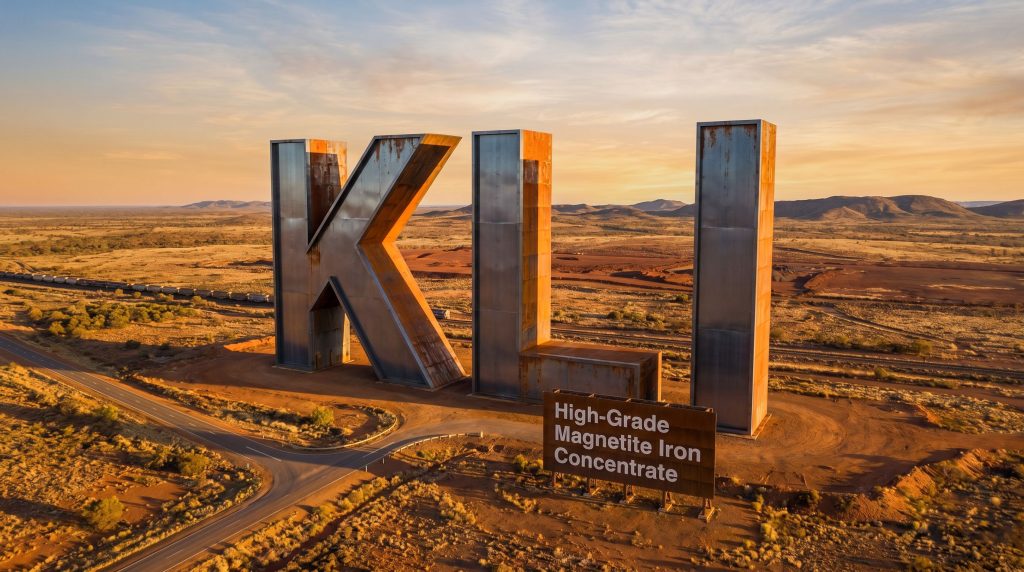
Killi Resources (ASX: KLI) has announced the acquisition of an 80% interest in the Lodestone Iron Ore Project in Western Australia's Mid-West, adding a maiden Inferred Mineral Resource Estimate of 110 million tonnes and a magnetite product profile that the company says can produce 69% Fe concentrate with low impurities. The project sits approximately 200 km from the Port of Geraldton and is close to road, rail and grid power infrastructure.
In addition to the resource acquisition, Killi has secured firm commitments for a $15 million placement, which would leave it with approximately $18.5 million in cash following completion. This transaction is significant because it shifts Killi toward iron ore at a meaningful scale.
Furthermore, the announcement outlined not only an existing resource but also a much larger exploration footprint, with the current estimate covering only around 20% of the known 25 km mineralised trend.
When big ASX news breaks, our subscribers know first
Transaction Terms and Immediate Funding Position
Under the Share Purchase Agreement, Killi will acquire 80% of Yukon Resources Pty Ltd, the holder of the Lodestone Iron Ore Project. The consideration consists of 92,727,273 Killi shares issued at $0.22 per share, implying a value of approximately $20.4 million, plus a 2.5% gross revenue royalty over future production.
How Is the Joint Venture Structured?
The incorporated joint venture terms provide that:
- Killi will hold 80%
- The vendors will retain 20%
- The vendors are free carried until final investment decision
- Killi will manage the joint venture and hold sole discretion over exploration and development activities during the free carry period
The vendors are mining executives Steve Parsons and Hamish Halliday, each holding 45% of Yukon, and Karen McLean, who holds 10%. In connection with the deal, Hamish Halliday has joined the Killi board as a Non-Executive Director, while Parsons and Michael Naylor will act as consultants.
Killi also confirmed firm commitments for a two-tranche placement to raise $15 million before costs at $0.22 per share. Tranche 1 is expected to raise approximately $10.8 million, while Tranche 2 is expected to raise $4.2 million, subject to shareholder approval at an extraordinary general meeting anticipated in July 2026.
For investors, this matters because the company is moving into the project with funding already arranged for drilling, metallurgy, engineering and approvals work. Notably, the placement is not conditional on the acquisition completing, which provides useful capital flexibility either way.
"Lodestone is a company-making acquisition which already has a substantial Mineral Resource with clear scope for rapid resource growth and a pathway to production and cashflow," said Nev Power, Chairman of Killi Resources.
Lodestone Resource Establishes Scale, With Large Strike Growth Still Untested
The maiden resource at Lodestone has been reported in accordance with the 2012 JORC Code and currently sits in the Inferred category for fresh magnetite material. At a 0% DTR Mass Recovery cut-off, the estimate stands at 110Mt at 33% mass recovery, producing a 69% Fe concentrate.
The reported resource outcomes are summarised below.
| DTR Mass Recovery cut-off | Tonnes | Mass Recovery | Concentrate Fe | SiO₂ | Al₂O₃ |
|---|---|---|---|---|---|
| 0% | 110Mt | 33% | 69% | 3.9% | 0.08% |
| 10% | 110Mt | 33% | 69% | 3.9% | 0.08% |
| 20% | 98Mt | 35% | 69% | 3.9% | 0.07% |
| 30% | 77Mt | 38% | 69% | 3.4% | 0.05% |
The current resource is based on a roughly 5 km strike section of the eastern magnetite banded iron formation. However, the broader Lodestone magnetite system extends for approximately 25 km, based on magnetic imagery and surface exposure. That means around 20 km of the known system remains outside the maiden resource area.
What Upside Remains Untested?
This is one of the key investment points in the update. The current estimate gives Killi an existing scale base, while the broader geology provides a defined pathway for further drilling rather than a conceptual search area. The company noted several areas of upside:
- Around 9 km of BIF north of the current resource remains undrilled
- Around 9 km south of the current resource also remains undrilled
- Additional hanging wall and footwall magnetite zones have been identified
- A parallel western BIF unit, approximately 30 m thick, has seen only limited drill testing
The resource is also still relatively early-stage in confidence terms. Most drilling was completed on section spacings of about 400 m, which means infill work could support future classification upgrades if continuity is confirmed.
Why Lodestone's Coarse-Grained Magnetite Matters
A large part of the market interest in this announcement is likely to centre on metallurgy rather than tonnage alone. Killi reported that Lodestone hosts a coarsely crystalline magnetite body, and that test work indicates a high-grade concentrate can be produced at coarse grind sizes of up to 250 microns.
That is important because magnetite projects usually require grinding ore before magnetic separation. In general terms, finer grinding means higher energy use and more complex plant design, while coarser grinding can reduce both operating and capital intensity.
According to the announcement, most magnetite projects in Western Australia require grind sizes in the order of 30 to 50 microns to adequately separate magnetite from waste material. Lodestone differs in that the magnetite appears to be more easily liberated at a larger particle size.
What Does the Test Work Show?
The company reported the following metallurgical results:
- 68% to 70% Fe concentrate can be achieved at grind sizes up to 250 microns
- The current MRE was levelled to a 75-micron grind
- In the southern central zone, concentrate grades have exceeded 70% Fe at coarser grinds
- Bond Work Index bulk sample testing returned 30% to 36% mass recovery and 66.6% to 69.3% Fe concentrate at a 106-micron grind
If confirmed at larger scale, that processing characteristic could have a direct effect on project economics, potentially resulting in lower grinding power demand, simpler processing flowsheets, and lower capital costs than finer-grind magnetite peers.
Understanding Davis Tube Recovery and Why It Is Central to Magnetite Projects
For non-specialist investors, one of the most important technical concepts in the announcement is Davis Tube Recovery (DTR). This is the main laboratory test used to estimate how much magnetite concentrate can be recovered from ore. In simple terms, a rock sample is ground to a chosen size and run through a magnetic separation process in the laboratory.
| Term | Meaning for Investors |
|---|---|
| DTR Mass Recovery | The percentage of feed that becomes concentrate |
| Concentrate Fe | The iron grade of that concentrate |
| Grind size | How fine the ore must be ground before separation |
| Cut-off | The minimum recovery used to define resource material |
Two magnetite projects with similar concentrate grades may have very different economics if one requires much finer grinding than the other. A project producing 69% Fe concentrate at coarse grind sizes may carry a considerably different cost profile from one needing ultra-fine grinding to reach similar product quality.
At Lodestone, the combination of approximately 33% DTR mass recovery and 69% Fe concentrate, together with coarse grind potential, is the key technical feature investors are likely to track in future test work.
Infrastructure and Location Reduce Some Early Development Hurdles
The Lodestone Project is located east of Morawa in Western Australia's Mid-West iron ore district, between the Karara iron ore mine and the inactive Koolanooka mine. Access to the southern end of the project is via Mungada Road, which runs alongside the rail line connecting Karara with Geraldton.
Killi highlighted several location advantages:
- Approximately 200 km by road from the Port of Geraldton
- Immediate proximity to grid power
- Access to sealed roads
- Nearby rail infrastructure leading directly to port
For a bulk commodity such as iron ore, distance to port and access to transport infrastructure can be highly material. An asset already located near existing logistics corridors can consequently have a very different development profile from an isolated greenfields project.
Milestones, Board Changes and the Next Phase of Work
Killi's next steps at Lodestone are expected to focus on three priorities: resource growth, resource confidence upgrades, and metallurgical refinement. Priority activities include infill and extensional drilling, further DTR and density test work, work on the partly oxidised zone, and progression toward future development studies.
The consultant incentive structure is also tied directly to project advancement. Subject to shareholder approval, Parsons and Halliday are to receive a total of 43,000,000 performance rights linked to specific milestones.
| Performance Rights | Milestone |
|---|---|
| 7,666,667 | 20-day VWAP of $0.44+ and completion of 20,000 m of drilling |
| 7,666,667 | MRE of 200Mt at 25%+ mass recovery |
| 7,666,666 | Positive economic study with positive NPV and IRR |
| 20,000,000 | Positive Definitive Feasibility Study with positive NPV and IRR |
For investors, these milestones provide a practical way to track whether the acquisition is translating into measurable project progress. The largest tranche is linked to a Definitive Feasibility Study, placing most of the reward at the more advanced end of the development pathway.
The next major ASX story will hit our subscribers first
What This Means for Killi and Why the Market Will Watch Drilling Closely
The announcement positions Lodestone as Killi's lead asset, though the company still retains exposure to gold and copper exploration. These include the West Tanami Project in WA, where Gold Fields can earn up to 85% by spending $13 million over seven years, plus the Mt Rawdon West and Ravenswood North projects in Queensland.
Nevertheless, market focus is likely to shift toward Lodestone because it combines several features in one transaction: an existing 110Mt Inferred resource, a reported 69% Fe concentrate profile with low impurities, a mineralised trend extending 25 km, test work suggesting coarse-grind processing advantages, and a post-transaction cash position of approximately $18.5 million.
There are still important stages ahead. The resource remains Inferred, more drilling is required to test the broader system, and future economic studies have not yet been completed. However, Killi is entering that phase with funding in place and a materially sized starting resource.
The next 12 months are therefore likely to be judged on drill metres completed, resource growth, updated metallurgy, and whether the current 5 km resource area begins to expand meaningfully into the much larger 25 km system already outlined in the company's reporting.
Want to Track the Next Major ASX Mineral Discovery Before the Market Moves?
Discovery Alert's proprietary Discovery IQ model scans ASX announcements in real time, instantly identifying significant mineral discoveries — from iron ore projects like Lodestone through to gold, copper, and beyond — and delivering actionable alerts directly to subscribers. Explore Discovery Alert's discoveries page to see how historic ASX discoveries have generated substantial returns, and begin your 14-day free trial today to position yourself ahead of the broader market.