
August 5, 2026
The Quiet Transformation Reshaping Global Crude Oil Trade Routes
For decades, the geography of crude oil supply was shaped by proximity, price, and pipeline infrastructure. Refineries sourced feedstock from the nearest available basin, and geopolitical considerations were largely secondary to economics. That calculus has shifted fundamentally. The expansion of Western sanctions regimes into the operational decisions of non-member state refineries represents one of the most consequential structural changes in global energy markets since the post-2014 Russia-Ukraine conflict first began redirecting European energy policy. The story of the Kulevi refinery Libyan crude deal is, at its core, a case study in how that transformation is now reaching facilities that were never designed with sanctions compliance in mind.
When big ASX news breaks, our subscribers know first
Georgia's Only Refinery and the Sanctions Clock Ticking Against It
From Startup to Sanctions Target in Under a Year
The Kulevi refinery entered its first commercial phase in late 2025, making it one of the newest large-scale refining facilities anywhere along the Black Sea coastline. Within months of commissioning, it had already attracted the attention of EU sanctions monitors. The Center for Research on Energy and Clean Air (CREA) documented that the facility received six cargoes of Russian-origin crude between October 2025 and late May 2026, making it a visible node in the network of third-country processing facilities absorbing Russian oil displaced from European markets.
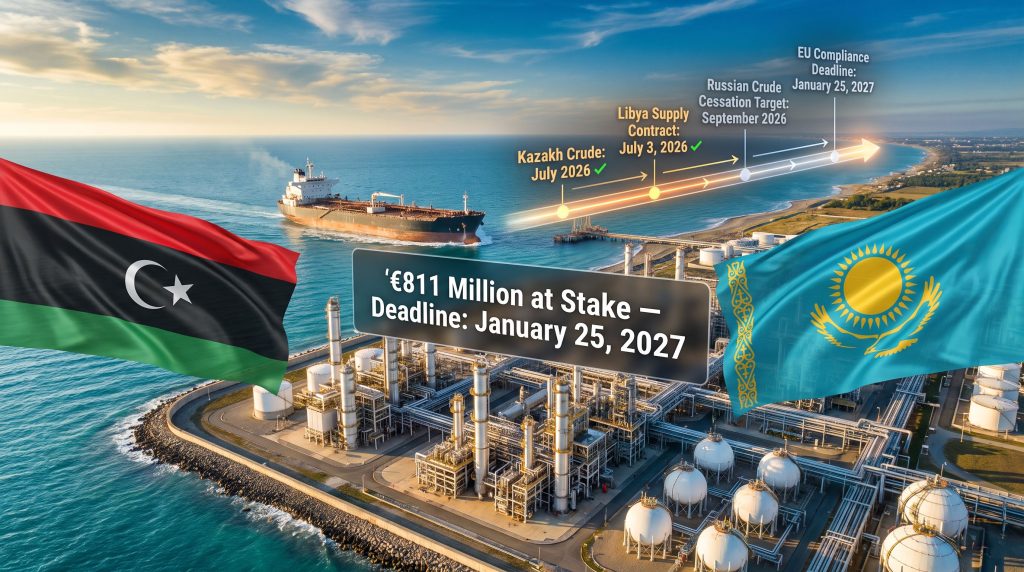
On July 23, 2026, the EU formally incorporated the Kulevi facility into its 21st sanctions package targeting Russian oil revenues. The mechanism chosen was not an immediate asset freeze or operational shutdown. Instead, Brussels applied a compliance window model: Black Sea Petroleum (BSP), the refinery's owner, has until January 25, 2027 to provide verifiable documentation demonstrating that Russian crude has been completely removed from its processing operations.
The commercial stakes attached to this deadline are significant. During the October 2025 to late May 2026 monitoring period, Kulevi exported approximately €811 million (roughly $936 million) worth of refined petroleum products to EU and US markets. That revenue base represents the leverage Brussels is using to enforce compliance without crossing into the legally and diplomatically complex territory of sanctioning a non-member state's sovereign assets directly. Furthermore, the sanctions impact on Russian oil trading has accelerated this enforcement evolution considerably.
"Analytical Note: The compliance window model signals a deliberate enforcement philosophy. Rather than triggering economic shocks through immediate shutdowns, the EU is using future export market access as a conditional incentive, creating a self-enforcing transition mechanism that minimises diplomatic friction while achieving feedstock diversification objectives."
Why 99% Dependency on Russian Crude Was Always a Structural Vulnerability
Official Georgian trade data established a striking picture of feedstock concentration before BSP's diversification programme began: Russian crude accounted for approximately 99% of Georgia's total crude oil imports. For a refinery with aspirations to scale toward 4.5 million metric tons of annual processing capacity and launch new product lines including road bitumen and aviation fuel, this level of single-source dependency created both an operational fragility and a direct pathway into the sanctions perimeter once EU monitoring extended to third-country processing nodes.
The 99% concentration figure is worth examining in context. Georgia is not an EU member state and has no formal obligation to comply with EU energy sanctions. However, the refinery's commercial model was built around EU and US export markets, creating an asymmetric dependency. Brussels did not need jurisdiction over Georgian territory to influence BSP's behaviour; it only needed to signal that continued Russian crude processing would result in the loss of those export revenue streams.
Structural factors that created Kulevi's sanctions exposure:
- Near-total reliance on a single origin-country feedstock with active EU sanctions status
- High-value export flows concentrated in EU and US destination markets
- Black Sea geographic positioning with direct shipping connectivity to Russian export terminals
- Documented cargo receipts during the active CREA monitoring period
- Refinery commissioning timeline that coincided with the EU's accelerating third-country enforcement expansion
The Kulevi Refinery Libyan Crude Deal: Structure, Rationale, and Risk
Contract Terms and the Logic Behind Libya as a Replacement Supplier
BSP formalised the Kulevi refinery Libyan crude deal on July 3, 2026, entering into a supply agreement with an undisclosed Libyan entity. According to reporting from S&P Global, the contract runs through the end of 2027 and includes an option to extend beyond that horizon, signalling that BSP views Libyan crude as a medium-term structural component of its feedstock portfolio rather than a short-term stopgap.
Supply Agreement Parameters at a Glance:
| Parameter | Detail |
|---|---|
| Contract Signing Date | July 3, 2026 |
| Counterparty | Undisclosed Libyan supplier |
| Contract Duration | Through end of 2027 |
| Extension Option | Yes, beyond 2027 |
| First Cargo Window | August 20 to 30, 2026 |
| Financial Terms | Not publicly disclosed |
Libya's crude profile makes it a technically credible alternative to Russian Urals blend for a modern refining configuration. Libyan grades such as Es Sider are classified as light, sweet crude, characterised by low sulphur content and high yields of premium refined products including gasoline, diesel, and jet fuel. By contrast, Russian Urals is a medium-sour blend, meaning a refinery transitioning from Urals to Libyan crude will likely need to adjust catalytic and hydroprocessing unit parameters to optimise the new feedstock. This is a manageable but non-trivial technical adaptation.
From a logistics standpoint, Libya's Mediterranean export infrastructure enables routing through the Strait of Sicily and eastward into the Black Sea via the Bosphorus Strait, a corridor that is commercially established for tanker traffic serving Georgian and Turkish ports. Consequently, transit times from Libyan loading terminals to the Kulevi port are broadly comparable to the routes previously used for Russian crude arriving from Novorossiysk or Tuapse. These oil logistics and geopolitics considerations have become increasingly central to refinery procurement decisions across the region.
"Lesser-Known Market Dynamic: Libya's crude export capacity has shown meaningful recovery since the production disruptions of the early 2020s, with output gradually returning toward the country's pre-conflict baseline of approximately 1.6 million barrels per day. This incremental supply recovery has expanded the pool of available export volumes, making Libya a more viable consistent supplier than it was during the instability peaks of the previous decade. However, Libya's political environment remains fragmented between competing authorities, and production outages linked to domestic disputes have historically occurred with limited warning, reinforcing the case for a dual-source feedstock strategy rather than a simple substitution of Russian crude with Libyan crude."
The Crude Quality Transition: What Switching from Urals to Libyan Grades Actually Means
This is a dimension of the Kulevi refinery Libyan crude deal that receives limited attention in standard reporting but carries genuine operational significance. Refinery configurations are designed and optimised around specific crude slates. Key variables include:
- API gravity: Libyan light grades typically range from 36 to 42 degrees API, compared to Urals at approximately 31 to 32 degrees API. Higher API gravity generally correlates with greater light product yields.
- Sulphur content: Libyan crudes are typically below 0.3% sulphur, qualifying as sweet crude. Urals carries approximately 1.3 to 1.5% sulphur, requiring more intensive hydrodesulphurisation processing to meet finished product specifications.
- Crude compatibility: Mixing Libyan and Kazakh crude in the same refinery introduces blending management considerations, particularly around pour point, wax content, and compatibility with existing pipeline and storage infrastructure.
For a refinery in its first year of commercial operation, managing this transition while simultaneously maintaining throughput, demonstrating regulatory compliance, and preparing for Phase 2 expansion represents a complex operational challenge that the headline narrative of the sanctions story tends to understate.
Kazakhstan as the Second Feedstock Pillar
Why the Dual-Source Model Is More Than Just Hedging
While the Kulevi refinery Libyan crude deal has attracted the most media attention, Kazakh crude was actually the first alternative feedstock BSP successfully processed. The refinery began importing and refining Kazakh-origin crude in July 2026, with continued purchases planned through August and beyond. This sequencing matters: it means BSP entered the Libyan supply negotiation from a position of already having demonstrated operational capability with a non-Russian feedstock.
Comparative Feedstock Source Analysis:
| Attribute | Kazakh Crude (CPC Blend) | Libyan Crude (e.g., Es Sider) |
|---|---|---|
| Routing to Kulevi | Caspian Sea via BTC Pipeline to Black Sea | Mediterranean to Black Sea via Bosphorus |
| API Gravity (approx.) | 44 to 46 degrees | 36 to 42 degrees |
| Sulphur Content | Very low (sweet) | Very low (sweet) |
| Supply Reliability | High, established pipeline infrastructure | Moderate, subject to production variability |
| Sanctions Status | Non-sanctioned | Non-sanctioned |
| Operational Status | Active from July 2026 | First cargo August 2026 |
Kazakhstan's Caspian Pipeline Consortium (CPC) blend is one of the most established crude export streams in the former Soviet space, with a long track record of reliable delivery through the CPC pipeline terminating at Novorossiysk and then onward via tanker to Black Sea ports. For Kulevi, this routing through an established and heavily trafficked tanker corridor provides supply chain predictability that complements the newer Libyan relationship.
The dual-source strategy achieves four distinct objectives:
- Eliminates the single-origin dependency that triggered sanctions scrutiny in the first place
- Provides feedstock continuity if either supply source experiences disruption
- Creates a documented, verifiable audit trail of non-Russian crude processing for EU compliance purposes
- Establishes commercial relationships with multiple supplier regions ahead of the Phase 2 capacity expansion
Compliance Timeline: Can BSP Meet the January 2027 Deadline?
Milestones, Targets, and What Failure Would Cost
BSP has publicly indicated that its internal target for completing the cessation of Russian crude processing is September 2026, which would provide a buffer of approximately four months before the EU's January 25, 2027 hard deadline. The company has also stated it is maintaining active engagement with the European Commission and supplying verifiable documentation of the feedstock transition as it progresses.
Compliance Milestone Tracker:
| Milestone | Target Date | Status |
|---|---|---|
| First Kazakh crude processed | July 2026 | Completed |
| Libyan supply contract signed | July 3, 2026 | Completed |
| First Libyan cargo arrival | August 20 to 30, 2026 | Scheduled |
| Russian crude processing cessation | September 2026 (internal target) | In progress |
| EU compliance documentation deadline | January 25, 2027 | Pending |
| Road bitumen production launch | Q1 2027 | Planned |
| Aviation fuel production launch | Q2 2027 | Planned |
The consequences of failing to meet the compliance threshold extend well beyond immediate sanctions activation. The $800 million Phase 2 expansion, which would take the refinery's annual capacity from 1.2 million to 4.5 million metric tons, would face serious financing headwinds if the facility's export market access were placed in jeopardy. Lender risk assessments for infrastructure projects of this scale typically incorporate regulatory compliance status as a core underwriting criterion.
Additionally, the planned Q1 2027 launch of road bitumen production and Q2 2027 launch of aviation fuel production are product lines that depend on export market access to justify their commercial viability. Both bitumen and aviation fuel have established international trading markets, and loss of EU and US buyer access would significantly compress the addressable market for these new revenue streams.
"Speculative Consideration: If BSP successfully completes its feedstock transition ahead of the January 2027 deadline and demonstrates a clean compliance record to the European Commission, there is a credible pathway for the refinery to petition for removal from the sanctions list before Phase 2 financing is formally structured. A clean compliance outcome could meaningfully reduce the cost of capital for the $800 million expansion programme, as lenders would no longer need to price in sanctions risk as an ongoing operational uncertainty."
Broader Implications: How Third-Country Refineries Are Now Inside the EU Sanctions Perimeter
The Enforcement Evolution That Changes the Rules for Non-EU Processors
The Kulevi case is not a one-off enforcement action. It represents the maturation of a sanctions enforcement model that has been developing since 2022, in which the EU has progressively extended its compliance obligations beyond its formal jurisdictional boundaries by leveraging export market access as a conditional instrument. Indeed, broader geopolitical trade realignment is accelerating this shift across multiple commodity sectors simultaneously.
The key architectural innovation in the 21st sanctions package's treatment of Kulevi is its focus on feedstock origin rather than facility nationality or ownership structure. Under this framework, what matters is not where a refinery is located or who owns it, but rather where the crude it processes originates. This shifts the compliance burden onto the economic behaviour of the facility rather than its legal identity, creating a model that can be applied to any refinery with meaningful export exposure to EU markets regardless of its geographic location.
Emerging enforcement trends reshaping crude trade globally:
- Third-country refining facilities with EU export revenues are increasingly subject to feedstock origin scrutiny
- Independent monitoring organisations are playing a growing evidentiary role in identifying and documenting cargo flows that inform sanctions designations
- Compliance windows are being used as structured transition incentives rather than immediate punitive tools
- Export market leverage is proving more commercially effective than asset-based enforcement for facilities operating outside EU jurisdiction
Libya and Kazakhstan as Beneficiaries of the Russian Crude Displacement
As the EU's enforcement architecture systematically reduces Russian crude processing across the Eurasian refining landscape, both Libya and Kazakhstan are positioned to capture redirected demand. Libya's Mediterranean export position gives it natural access to refineries throughout the Black Sea and Eastern Mediterranean corridor. Kazakhstan's CPC pipeline infrastructure connects Caspian production directly to Black Sea shipping lanes, placing it at the centre of a growing alternative supply network for facilities transitioning away from Russian feedstock.
The Kulevi refinery Libyan crude deal, viewed in this broader context, is a microcosm of a structural reorientation that is reshaping bilateral trade relationships across the Eurasian energy corridor. The refinery processed more than 650,000 metric tons of crude oil in the first half of 2026, a throughput figure that will need to be sustained or grown through non-Russian supply chains as it scales toward its long-term capacity targets.
For energy market observers, the Kulevi situation also illustrates an underappreciated dynamic in the sanctions compliance space: the speed with which a newly commissioned facility can be incorporated into a major enforcement package, and the correspondingly rapid commercial adaptation required to avoid catastrophic market access losses. Moreover, the intersection of trade wars and oil prices is further complicating the commercial calculus for refinery operators navigating this environment. BSP's response, anchoring supply across two geographically distinct non-sanctioned sources within weeks of the sanctions designation, reflects a level of supply chain agility that was not previously a standard expectation for refinery operators in emerging Black Sea markets.
Furthermore, global trade policy shifts are adding an additional layer of complexity for facilities like Kulevi that depend on sustained access to Western export markets. A detailed analysis from Investing.com highlights how BSP's September 2026 internal target aligns with the broader commercial imperative to protect those revenue streams before any enforcement triggers activate.
The next major ASX story will hit our subscribers first
Frequently Asked Questions
What is the Kulevi refinery and who operates it?
The Kulevi refinery is Georgia's only oil refining facility, owned by Black Sea Petroleum and located on the Black Sea coast adjacent to the SOCAR-operated Kulevi oil terminal. Its first operational phase, with annual processing capacity of 1.2 million metric tons, entered service in late 2025.
Why was the Kulevi refinery included in EU sanctions?
The EU included Kulevi in its 21st sanctions package in July 2026 after independent monitoring documented the facility's receipt of six Russian crude cargoes between October 2025 and late May 2026, combined with its significant refined product export revenues flowing to EU and US markets during the same period.
What are the key terms of the Kulevi refinery Libyan crude deal?
BSP signed a Libyan crude supply agreement on July 3, 2026, with an undisclosed Libyan counterparty. The contract covers supply through the end of 2027 with an extension option. The first Libyan cargo is scheduled to arrive between August 20 and 30, 2026. Financial terms were not disclosed publicly.
Is Kulevi also importing crude from Kazakhstan?
Yes. Kazakh crude was the first alternative feedstock processed at Kulevi, with imports and processing beginning in July 2026. Kazakhstan and Libya together form the two primary pillars of BSP's feedstock diversification strategy.
What is the EU sanctions compliance deadline for Kulevi?
The EU has set January 25, 2027 as the deadline by which BSP must demonstrate complete cessation of Russian crude processing. BSP has indicated it aims to achieve this by September 2026, providing a buffer of approximately four months before the regulatory deadline.
What happens to Kulevi's expansion plans if it misses the deadline?
Failure to comply would activate EU sanctions restricting the refinery's export market access, directly threatening the commercial viability of the planned $800 million Phase 2 expansion to 4.5 million metric tons annual capacity, as well as the Q1 2027 road bitumen and Q2 2027 aviation fuel production launches.
Disclaimer: This article contains forward-looking statements, projections, and analytical commentary based on publicly available information. It does not constitute financial or investment advice. Compliance timelines, production targets, and commercial outcomes are subject to change based on operational, regulatory, and geopolitical developments. Readers should conduct independent research before making any decisions based on the information presented here.
Want to Stay Ahead of the Resource Opportunities Emerging From Global Energy Realignment?
As sanctions reshape crude oil trade routes and redirect capital across commodity markets, Discovery Alert's proprietary Discovery IQ model scans ASX announcements in real time, delivering instant alerts on significant mineral discoveries so subscribers can identify actionable opportunities before the broader market reacts — explore historic discovery returns on Discovery Alert's dedicated discoveries page and begin a 14-day free trial to secure a market-leading edge.