May 21, 2026
How Gulf Pipeline Monetization Works — And Why Kuwait's $7 Billion Deal Is a Defining Moment for GCC Infrastructure Finance
Infrastructure investment cycles across the Gulf Cooperation Council have entered a structurally distinct phase. For decades, national oil companies held their pipeline networks as wholly sovereign assets, treating them as operational necessities rather than financial instruments. That calculus has fundamentally shifted. The maturation of global infrastructure capital markets, combined with rising domestic expenditure demands across hydrocarbon-dependent economies, has created powerful incentives for Gulf sovereigns to extract latent value from assets that generate predictable, long-duration cash flows. The Kuwait oil pipeline stake deal financing now taking shape represents one of the most technically sophisticated expressions of this transformation.
When big ASX news breaks, our subscribers know first
The Strategic Logic Behind GCC Midstream Asset Carve-Outs
Understanding why Kuwait Petroleum Corporation is pursuing a partial stake sale in its crude oil pipeline network requires stepping back from the transaction itself and examining the structural economics that make this category of asset so attractive to both sellers and buyers.
Pipeline infrastructure occupies a distinctive position within the energy asset universe. Unlike upstream production assets, where value fluctuates with reservoir performance, commodity prices, and exploration outcomes, pipeline networks generate revenue primarily as a function of throughput volume and contractual tariff arrangements. This places them closer, in credit terms, to regulated utilities than to conventional oil and gas investments.
For investors managing long-duration capital — such as pension funds, sovereign wealth funds, and infrastructure-specialist asset managers — the combination of contracted revenue streams, minimal operational complexity post-acquisition, and sovereign counterparty risk creates a near-ideal risk-adjusted return profile. Furthermore, commodity trading giants have increasingly recognised this dynamic, directing significant capital toward midstream infrastructure as a complement to their broader resource portfolios.
For the selling party, the arithmetic is equally compelling. Rather than carrying a fully depreciated or slowly depreciating infrastructure asset on the balance sheet at book value, a partial divestiture crystallizes market value, unlocks capital for reinvestment, and does so without surrendering operational sovereignty. The national oil company retains full control over how the network is operated, maintained, and expanded.
This is precisely the architecture that Kuwait Petroleum Corporation is deploying. The network transports crude oil and refined products across Kuwait's producing regions and connects them to export terminals on the Arabian Gulf. It is being partially monetized through a structured stake sale estimated at approximately $7 billion in total asset value. KPC retains operational control, while a minority interest is offered to private capital under a long-term lease arrangement.
How the Kuwait Oil Pipeline Stake Deal Financing Is Structured
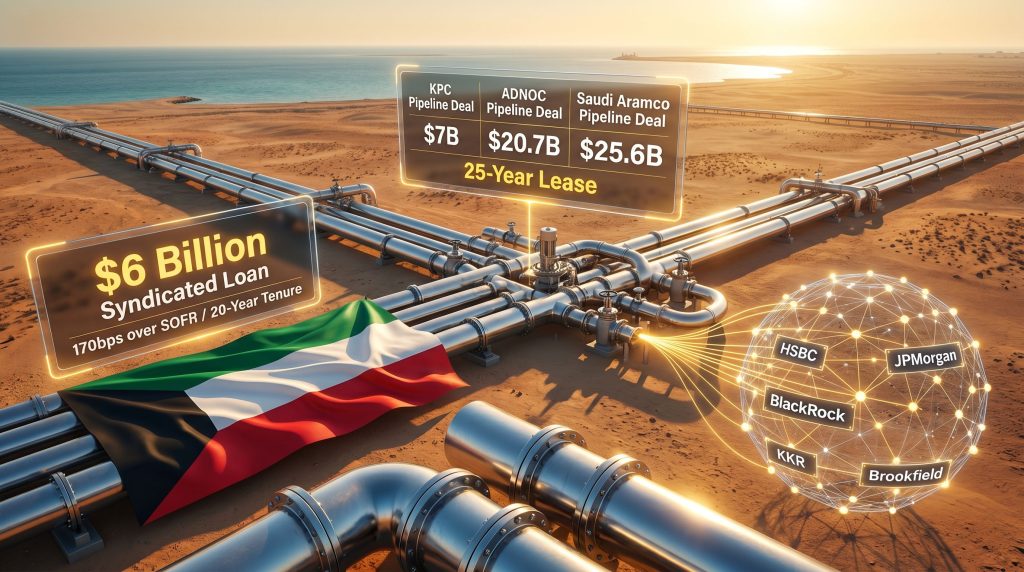
The Kuwait oil pipeline stake deal financing rests on a debt-heavy capital structure that reflects both the long-duration nature of the underlying cash flows and the favourable credit characteristics that come with a state-owned counterparty. According to reporting by Reuters, sourced from individuals familiar with the matter, the financing package totals approximately $6 billion, divided between roughly $1.5 billion in equity and approximately $5.5 billion in debt. This implies a leverage ratio of approximately 79%, which sits within the upper range of investment-grade infrastructure transactions globally but is not unusual for assets where sovereign counterparty risk effectively backstops the revenue stream.
The debt component carries a 20-year tenure, mirroring the long-dated nature of the lease agreement that governs cash flows to investors. Indicative pricing has been set at 170 basis points over SOFR — the Secured Overnight Financing Rate that replaced LIBOR as the benchmark for US dollar-denominated syndicated lending. Market participants familiar with the transaction have characterised this pricing as competitive relative to current regional conditions, a notable assessment given the active conflict environment in which the deal is being executed.
What Is the Lease-and-Re-Lease Model?
The structural mechanism underlying this transaction is the lease-and-re-lease model, a methodology that has become the standard template for GCC pipeline monetisations following its successful application by Saudi Aramco and Abu Dhabi National Oil Company. Under this arrangement, investors acquire a minority ownership stake in the pipeline infrastructure. That infrastructure is then leased back to Kuwait Petroleum Corporation under a long-term agreement, with KPC paying a defined tariff or rental stream to the investor consortium over the lease duration.
The critical investor protection embedded in this structure is the contracted nature of the cash flow. Revenue is governed by the lease agreement, which typically includes minimum volume guarantees, tariff escalation mechanisms, and force majeure provisions. The specific terms of KPC's lease structure have not been publicly disclosed, but precedent GCC transactions provide a reasonable framework for understanding the likely mechanics.
Comparing KPC's Deal to GCC Precedent Transactions
The following table positions the KPC deal within the broader GCC pipeline monetisation wave, alongside comparable transactions by regional peers. Note that figures for ADNOC and Saudi Aramco are indicative, based on publicly reported deal information, and may not reflect final transaction terms.
| Feature | KPC Pipeline Deal | ADNOC Pipeline Deal | Saudi Aramco Pipeline Deal |
|---|---|---|---|
| Total Asset Valuation | ~$7 billion | ~$20.7 billion | ~$25.6 billion |
| Lease Duration | 25 years | 20 years | 20 years |
| Equity Raised | ~$1.5 billion | ~$10.1 billion | ~$12.4 billion |
| Debt Component | ~$5.5 billion | Not publicly disclosed | Not publicly disclosed |
| Operational Control Retained | Yes (KPC) | Yes (ADNOC) | Yes (Saudi Aramco) |
| Leverage Ratio | ~79% | Not disclosed | Not disclosed |
Disclaimer: ADNOC and Saudi Aramco figures are indicative estimates based on publicly reported deal terms and may not represent confirmed final transaction values. This table is provided for comparative context only.
One structural feature that distinguishes the KPC transaction from its predecessors is its notably high debt ratio. The approximately 79% leverage in Kuwait's deal is materially higher than the equity-weighted structures associated with the ADNOC and Saudi Aramco transactions. This difference carries implications for investor return expectations and refinancing risk over the 20-year loan horizon, discussed in greater detail in the risk section below.
Inside the $6 Billion Banking Syndicate
The composition of the lending syndicate reveals important dimensions of how the Kuwait oil pipeline stake deal financing is being assembled and what institutional confidence it has attracted despite the turbulent regional backdrop.
HSBC has taken the lead underwriting role on the debt component, effectively anchoring the syndication process. JPMorgan operates in a dual capacity that is notable even by the standards of large-scale infrastructure transactions: the bank is simultaneously serving as financial adviser to KPC on the sale process and participating as a lender in the financing syndicate. This kind of dual mandate is not uncommon in integrated global banking, but it does create a layered set of institutional incentives that sophisticated investors will factor into their assessment of the process.
National Bank of Kuwait and Kuwait Finance House, the two largest domestic lenders in Kuwait's banking system, are also joining the syndicate. Their participation signals that Kuwaiti domestic institutions have sufficient confidence in the transaction's creditworthiness and regulatory compliance to commit capital alongside global banks.
How Kuwait's Central Bank Enabled Domestic Bank Participation
The involvement of NBK and KFH was not straightforward. The regional conflict that preceded and overlapped with the deal process created financial stress conditions that would ordinarily constrain domestic lenders' capacity to commit to large, long-duration infrastructure financings. Kuwait's central bank responded by implementing a series of regulatory accommodations for local financial institutions:
- Relaxation of the liquidity coverage ratio (LCR) requirements, which govern how much high-quality liquid assets banks must hold against short-term obligations
- Adjustment of net stable funding ratio (NSFR) standards, which determine the stability of a bank's funding profile over a one-year horizon
- Expansion of lending limits, enabling banks to extend larger credit facilities to individual counterparties without breaching prudential concentration thresholds
These adjustments collectively created the headroom for NBK and KFH to participate without triggering regulatory violations. Consequently, Kuwait's central bank demonstrated a willingness to use regulatory flexibility as a mechanism for sustaining strategic capital market activity during periods of acute geopolitical disruption.
Geopolitical Risk Pricing and the Hormuz Variable
No analysis of the Kuwait oil pipeline stake deal financing is complete without examining how investors have priced the geopolitical risks that nearly derailed the transaction before it reached this stage. Indeed, broader US-China trade war impacts have compounded the complexity of pricing risk in cross-border infrastructure deals of this nature throughout the region.
The sale process was originally launched in late February 2026, just before joint U.S.-Israeli military strikes against Iran on February 28 triggered a broader conflict escalation involving Iranian strikes against Israel, U.S. bases, and Gulf states. Kuwait Petroleum Corporation publicly acknowledged that some of its operating units suffered what it described as severe material damage following drone strikes. This prompted prospective investors to request additional time, leading KPC to extend the preliminary bid deadline from April 7 to April 28.
A U.S.-Iran ceasefire announced on April 8 partially stabilised the outlook, enabling the process to resume. However, the structural risk concerns raised by investors did not disappear with the ceasefire announcement. Specifically, investor groups sought contractual protections against volume disruption risks affecting pipeline throughput and Strait of Hormuz transit capacity.
The Strait of Hormuz remains the most consequential single chokepoint in global energy logistics, with approximately 20 to 21% of global petroleum trade transiting the waterway, according to U.S. Energy Information Administration data. Any sustained disruption to Hormuz passage would directly impair the economic foundation of pipeline assets whose investment thesis depends on consistent export throughput.
This is not a theoretical concern for investors underwriting a 20-year financing commitment. Force majeure provisions and volume guarantee mechanisms are standard tools in project finance, but their precise construction in the KPC context will determine how much residual Hormuz risk investors are ultimately required to absorb. Furthermore, energy security trends across the region are reshaping how both sovereign issuers and institutional investors approach long-duration infrastructure exposure in politically sensitive corridors.
A further dimension of geopolitical complexity surrounds the reported interest from Chinese institutional investors, including the China Silk Road Fund and China Merchants Capital. The KPC deal, if it proceeds with Chinese capital participation, would raise strategic sensitivities that Gulf host governments must navigate carefully.
Who Is Competing for the KPC Pipeline Stake?
The reported investor field reflects the full breadth of global infrastructure capital, spanning North American asset managers, specialist infrastructure funds, and Asian strategic investors.
| Investor Category | Reported Interested Parties |
|---|---|
| Global Asset Managers | BlackRock, Brookfield Asset Management |
| Infrastructure-Specialist Funds | EIG Partners, KKR, Macquarie Infrastructure Partners, I Squared Capital |
| Asian Strategic Capital | China Silk Road Fund, China Merchants Capital |
Note: Investor interest is based on reported market intelligence and does not confirm formal bid submission or participation in the final process.
What makes the KPC pipeline an attractive target for all of these players is a combination of factors that are difficult to replicate in OECD infrastructure markets: a sovereign counterparty providing investment-grade credit quality, a 25-year lease duration that matches long-horizon fund mandates, meaningful yield premium relative to compressed infrastructure returns in developed markets, and exposure to a jurisdiction with substantial proven hydrocarbon reserves underpinning long-term throughput demand.
The next major ASX story will hit our subscribers first
Key Risks and Structural Uncertainties
Investors and analysts assessing the Kuwait oil pipeline stake deal financing must weigh a layered set of risks that extend well beyond standard infrastructure transaction considerations. In addition, commodity market volatility throughout the region has introduced further uncertainty into deal pricing assumptions.
Geopolitical and Operational Risk Factors
- The ceasefire announced on April 8 remains fragile, and any resumption of regional conflict could disrupt the final bid and closing timeline
- KPC's acknowledged infrastructure damage at unspecified operating units creates a due diligence gap that prospective buyers must resolve before committing capital
- Strait of Hormuz transit risk represents a systemic vulnerability that contractual guarantees can partially but not entirely mitigate
Structural and Financial Risks
- A leverage ratio of approximately 79% is aggressive by global infrastructure standards and introduces meaningful refinancing risk at the 20-year loan maturity
- SOFR-linked floating rate exposure across a two-decade financing period creates interest rate risk that both lenders and borrowers will need to manage through hedging instruments
- Volume risk under the lease structure remains a concern if KPC's production trajectory or export volumes decline materially
Regulatory and Sovereign Risk
- Kuwait's parliamentary system has historically exercised scrutiny over major state asset transactions, and the deal's ultimate approval pathway involves multiple institutional stakeholders
- The role of Kuwait's Investment Authority and other sovereign oversight bodies introduces procedural timelines that may not align with investor expectations
- Domestic political sentiment around the partial divestiture of critical national infrastructure carries an unpredictability that investors in more straightforward jurisdictions may underestimate
Moreover, geopolitical risk in mining and broader resource infrastructure across the Middle East has reinforced investor caution around long-duration commitments in the current environment.
What This Deal Means for GCC Infrastructure Capital Markets
If successfully priced and closed, a $6 billion infrastructure syndicated loan would represent one of the largest debt capital market transactions in Kuwait's history. The involvement of domestic institutions NBK and KFH alongside global banks demonstrates that Kuwait's local financial sector can anchor transactions of this scale. Furthermore, this serves as a proof point that could expand the universe of bankable infrastructure projects across the country's state-owned enterprise ecosystem.
More broadly, Kuwait's formal entry into the GCC pipeline monetisation template validates the replicability of the model across sovereigns with varying fiscal profiles and capital market depths. Saudi Aramco and ADNOC pioneered this transaction architecture from positions of exceptional financial strength. Kuwait's execution of a structurally similar deal under materially more difficult geopolitical conditions signals that the model is robust enough to function even in environments of acute regional stress.
The GCC midstream capital market is transitioning from a series of isolated landmark transactions into a recognisable and investable asset class. If the KPC deal closes on the terms currently under discussion, it would likely catalyse further pipeline monetisation processes elsewhere in the region, with Qatar, Oman, and potentially Iraq's state energy sector all possessing midstream infrastructure networks that could plausibly follow the same capital recycling logic.
The KPC pipeline stake deal financing represents Kuwait's proof-of-concept moment in the international infrastructure capital markets. Its successful execution under conditions of geopolitical stress would reinforce the GCC's position as a primary destination for long-duration sovereign infrastructure investment and accelerate the next wave of midstream asset monetisations across the region.
Frequently Asked Questions: Kuwait Oil Pipeline Stake Deal Financing
What is the total value of the KPC pipeline stake deal?
Kuwait Petroleum Corporation's crude oil pipeline network has been valued at approximately $7 billion, with a minority stake being offered to private investors through a structured sale and lease-back arrangement.
Which banks are providing financing for the KPC pipeline deal?
The financing syndicate includes HSBC as lead underwriter, JPMorgan in a dual advisory and lending role, National Bank of Kuwait, and Kuwait Finance House, collectively arranging approximately $6 billion in debt financing. For additional context on the syndicate's formation, TipRanks provides further detail on how the $6 billion financing package came together.
What are the loan terms for the KPC pipeline financing?
The syndicated loan carries a 20-year tenure with indicative pricing of 170 basis points over SOFR.
Why was the bid deadline for the KPC pipeline stake extended?
The preliminary bid deadline was extended from April 7 to April 28 to allow prospective investors additional time to assess risks arising from the active regional conflict environment, including concerns about infrastructure damage and Strait of Hormuz transit security.
How does the KPC pipeline deal compare to similar Gulf transactions?
The KPC deal follows a structural template established by Saudi Aramco and ADNOC, using a lease-and-re-lease model to attract private capital into midstream infrastructure while retaining full operational control. The KPC transaction is distinguished by a higher debt-to-total capital ratio relative to its GCC predecessors.
What investors have expressed interest in the KPC pipeline stake?
Reported interested parties include BlackRock, Brookfield Asset Management, EIG Partners, KKR, Macquarie Infrastructure Partners, I Squared Capital, China Silk Road Fund, and China Merchants Capital. This does not confirm formal bid participation.
Disclaimer: This article contains forward-looking assessments, deal comparisons, and financial projections based on publicly reported information and market analysis. Transaction terms, investor participation, and deal timelines remain subject to change. Readers should conduct independent due diligence and not treat this content as investment advice. Figures attributed to ADNOC and Saudi Aramco transactions are indicative and based on publicly available reporting; they may not reflect final or verified deal terms.
For ongoing coverage of Gulf energy infrastructure transactions and GCC capital market developments, Zawya's Energy and Capital Markets sections provide continuous regional deal intelligence at zawya.com.
Want to Identify the Next Major Resource Discovery Before the Market Does?
Discovery Alert's proprietary Discovery IQ model delivers real-time alerts on significant ASX mineral discoveries, instantly transforming complex geological data into actionable investment insights — explore the historic returns major discoveries have generated and begin your 14-day free trial at Discovery Alert to position yourself ahead of the broader market.