The interconnected nature of modern commodity markets reveals itself most clearly during periods of extreme price volatility. When essential industrial inputs experience dramatic cost fluctuations, the ripple effects extend far beyond immediate supply chains, influencing agricultural productivity, food security, and macroeconomic stability across multiple regions. This phenomenon has become particularly evident in 2025, as the kuwait sulphur price increase demonstrates how geopolitical disruptions, capacity constraints, and demand shifts can fundamentally alter global commodity pricing structures.
Industrial sulphur serves as a critical input for fertiliser production, chemical manufacturing, and various processing applications. Unlike many commodities that experience gradual price adjustments based on seasonal demand patterns, sulphur pricing reflects the unique economics of co-product recovery from oil refining and natural gas processing operations. This structural characteristic creates supply inflexibility that amplifies price movements during periods of capacity disruption or unexpected demand growth.
Current Drivers Behind Sulphur Price Acceleration
Supply Constraint Fundamentals
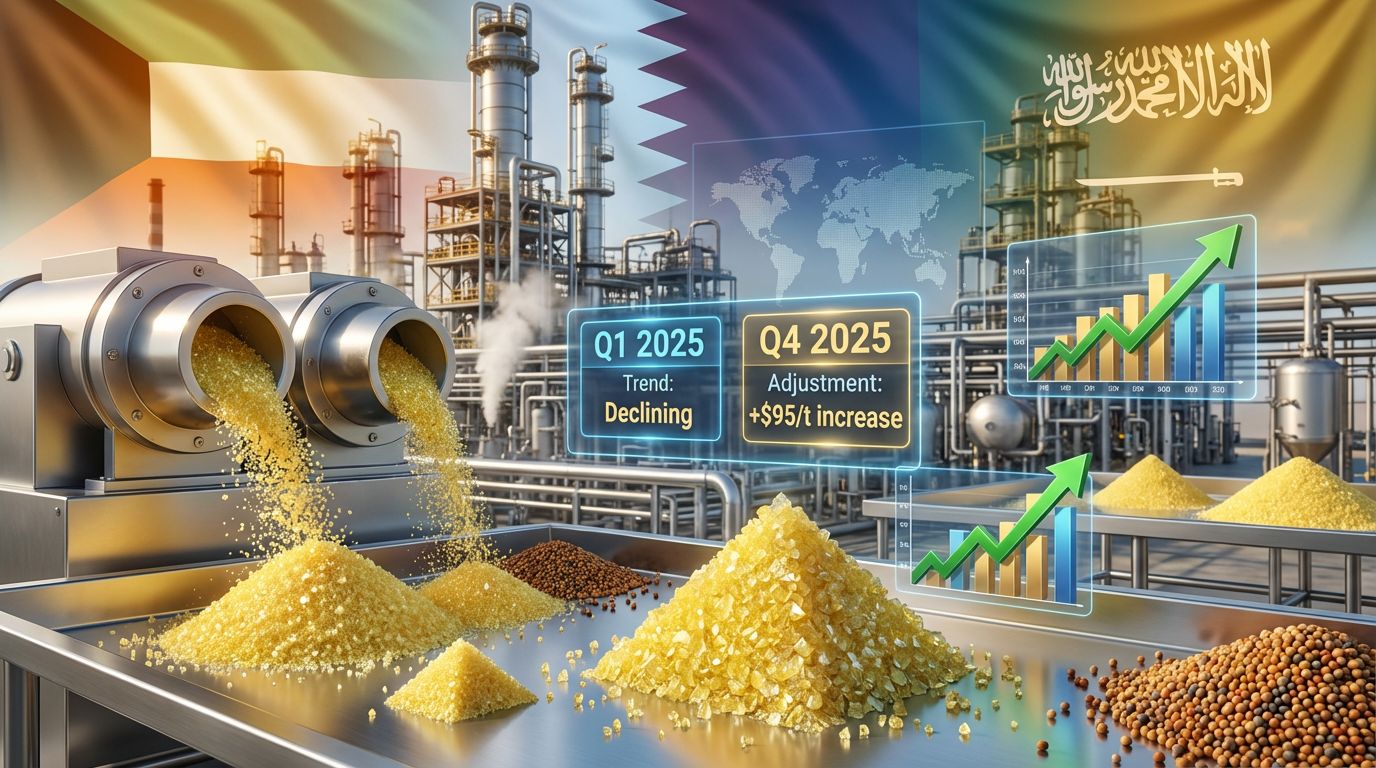
The dramatic price increases observed throughout late 2025 reflect genuine supply-side constraints rather than speculative positioning. Kuwait's state-owned producer KPC announced its December Kuwait Sulphur Price (KSP) at $495 per tonne fob Kuwait, representing a $95 per tonne increase from October 2025 levels. This pricing level exceeds the previous all-time high of $490 per tonne established in June 2022 by $5 per tonne.
QatarEnergy simultaneously announced identical pricing at $495 per tonne fob for December deliveries, matching Kuwait's substantial $95 per tonne monthly increase. The synchronised timing of these announcements, with Qatar announcing on November 30th and Kuwait following on December 2nd, suggests coordinated market positioning among major Middle Eastern producers. Furthermore, this coordination reflects broader commodity trading volatility patterns affecting global markets.
Key Price Indicators:
- Delivered pricing to China: $517-521 per tonne cfr based on current freight assessments
- Freight costs to South China: $22-24 per tonne for 30,000-35,000 tonne shipments
- River port premiums: Additional $2 per tonne for Chinese inland deliveries
Production Disruption Analysis
Two material supply disruptions have emerged as primary drivers of the current price surge. Russian sulphur production capacity has experienced significant offline volumes due to conflict-related damage to oil and gas processing infrastructure. Russia historically represented a major global producer, and the reduction in available supply has created immediate market tightness.
Simultaneously, new competing demand has emerged through capacity additions in Morocco and Indonesia. Morocco has commissioned new fertiliser production facilities requiring sulphur inputs, while Indonesia has brought online new nickel refining capacity that utilises sulphur in processing operations. These additions have occurred precisely when global supply faced constraints, creating an unfavourable supply-demand balance.
Regional Price Transmission Effects
Turkish refiner Tupras demonstrated the market's pricing response through its e-tender awards on November 25th, 2025. The company awarded 13,225 tonnes of sulphur for December loading at $483-488 per tonne FCA, representing a 50%+ increase from October-loading tenders priced at $323-339 per tonne FCA.
Tupras Award Distribution:
- Izmit refinery: 9,000 tonnes at $484-488 per tonne FCA
- Izmir refinery: 4,225 tonnes at $483-488 per tonne FCA
- Total volumes: Significantly fragmented into smaller lots of 25-1,200 tonnes
This lot fragmentation indicates inventory management challenges amid supply uncertainty, as refiners accept higher costs to secure necessary inputs rather than risk production disruptions. Additionally, these pricing patterns mirror broader us-china trade war impact on global supply chain resilience.
Middle Eastern Producer Coordination Patterns
Synchronised Pricing Announcements
The identical price announcements by Kuwait and Qatar within a 48-hour window, with both entities adopting the same $95 per tonne increase and converging at $495 per tonne, demonstrates coordinated price leadership rather than independent market pricing. This coordination reflects several structural factors within Gulf Cooperation Council (GCC) markets.
State-owned producers in the region likely maintain visibility into regional supply conditions, refinery utilisation rates, and buyer demand through both formal industry channels and informal market intelligence sharing. Similar production cost structures across Gulf producers create natural price floors, reducing economic incentives for competitive price undercutting during periods of supply tightness.
Market Information Asymmetries
Large fertiliser manufacturers and industrial importers typically negotiate with multiple GCC suppliers simultaneously, creating implicit pressure for price consistency across regional producers. This buyer concentration enables producers to gauge market acceptance of price increases before implementing changes, reducing individual producer risks associated with pricing leadership.
Regional Production Context:
- Middle East share: Approximately 50-60% of global sulphur production capacity
- GCC member integration: Shared transportation infrastructure and loading facilities
- Maintenance coordination: Regional scheduling to minimise simultaneous supply disruptions
Fertiliser Industry Response to Input Cost Volatility
Demand Elasticity Characteristics
Despite sulphur prices reaching historically elevated levels that industry participants describe as making sulphur "unaffordable for many fertiliser producers, sulphuric acid sellers and chemical companies," demand erosion has not been sufficient to offset rising price trends. This demonstrates the relatively inelastic nature of sulphur demand in core industrial applications.
India's fertiliser import activity provides insight into industry response patterns. Indian Potash Limited (IPL) confirmed purchases of 1.56 million tonnes of urea through its November 20th tender, accepting pricing at $418-420 per tonne cfr despite elevated input costs. The high participation rate and competitive bidding suggest buyers believe current pricing represents acceptable market equilibrium rather than unsustainable speculation.
Procurement Strategy Evolution
Fertiliser manufacturers are implementing sophisticated approaches to manage input cost volatility:
Multi-Source Contracting: Reducing dependency on single suppliers through diversified sourcing agreements
Inventory Optimisation: Balancing carrying costs against supply security considerations
Financial Risk Management: Employing hedging instruments to stabilise input costs over production cycles
However, long-term supply contract appetite has deteriorated significantly. Rashtriya Chemicals & Fertilizers (RCF) received minimal interest for its December 1st tender seeking 2.5 million tonnes annually over three years, with only one trading firm submitting offers. This indicates major producers' reluctance to enter multi-year fixed-price commitments at current market levels.
Agricultural Economics and Food Security Implications
Cost Transmission Mechanisms
Higher sulphur prices create multiple transmission pathways through global agricultural systems. Fertiliser production costs increase proportionally with sulphur input prices, as substitution options remain limited for phosphoric acid manufacturing and other essential agricultural chemical processes. These cost increases ultimately translate to higher fertiliser prices for agricultural producers.
Regional Impact Assessment:
- South Asia: Rice and wheat production facing 15-20% fertiliser cost increases
- Sub-Saharan Africa: Potential reduction in fertiliser application rates due to affordability constraints
- Latin America: Accelerated interest in organic and reduced-input farming systems
Food Price Inflation Dynamics
The relatively inelastic nature of food demand means that agricultural producers typically pass through increased input costs to consumers rather than absorbing margin compression. This creates inflationary pressure on food prices, particularly affecting protein-intensive livestock operations that require grain-based feed inputs.
Currency pressure on emerging market economies compounds these effects, as fertiliser imports are typically denominated in US dollars while agricultural revenues are earned in local currencies. Countries with significant fertiliser import dependencies face trade balance deterioration as the kuwait sulphur price increase flows through to fertiliser costs. Moreover, these dynamics reflect broader us economy and tariffs pressures affecting global trade.
Investment Market Response to Commodity Shifts
Sector Rotation Patterns
Investment flows are responding to sulphur market dynamics through targeted sector allocations. Agricultural technology companies benefit from increased demand for efficiency-enhancing solutions as producers seek to optimise fertiliser utilisation amid higher costs. Alternative fertiliser companies focusing on organic and specialised products gain valuation premiums as cost-conscious farmers explore substitutes.
Traditional chemical producers face margin compression risks as input costs rise faster than product pricing power allows. This creates divergent performance within chemical sector equities, with downstream processors experiencing greater pressure than upstream integrated producers with captive sulphur production capabilities.
Commodity Investment Strategies
Institutional investors are adapting their commodity exposure approaches to capture value from sulphur market volatility:
Direct Sulphur Exposure: Limited futures markets constrain direct investment options, leading to equity proxies through fertiliser producers
Agricultural Land Investments: Real asset exposure providing inflation protection against rising input costs
Supply Chain Integration: Investments in companies with vertical integration reducing input cost exposure
Long-Term Structural Market Changes
Supply Chain Reconfiguration
The 2025 price volatility accelerates structural changes in global sulphur distribution networks. Regional processing hubs are gaining importance as transportation costs and logistics complexity increase. Technology investments in sulphur recovery and processing efficiency become more economically attractive at elevated price levels.
Strategic partnerships between producers and major consumers are emerging as both parties seek to reduce price volatility exposure. Long-term supply agreements with price adjustment mechanisms provide stability for capacity planning while maintaining some market price linkage. In addition, these partnerships reflect evolving mining industry trends toward greater supply chain integration.
Sustainability Integration Impacts
Environmental considerations increasingly influence sulphur market dynamics as carbon footprint optimisation affects production location decisions and transportation mode selections. Circular economy initiatives promoting sulphur recycling from industrial waste streams gain economic viability at higher market prices.
Regulatory compliance costs related to environmental standards affect pricing structures, particularly for producers in regions with stringent emissions requirements. These costs create competitive advantages for producers in regions with less restrictive environmental frameworks. Consequently, decarbonisation benefits in mining operations become increasingly relevant to sulphur market competitiveness.
Risk Management and Market Navigation Strategies
Comprehensive Risk Frameworks
Successful navigation of volatile sulphur markets requires sophisticated risk management approaches incorporating multiple scenario analyses. Companies across the value chain must develop contingency plans for various price trajectory outcomes while maintaining operational flexibility.
Strategic Risk Mitigation:
- Diversified sourcing portfolios reducing concentration risk across suppliers and geographic regions
- Dynamic inventory management optimising carrying costs against supply security requirements
- Contract structure innovation incorporating price volatility clauses and adjustment mechanisms
Operational Adaptation Requirements
Market participants are implementing operational changes to manage the new cost environment:
Technology Investment: Production efficiency improvements become more valuable at higher input costs
Supply Chain Integration: Vertical integration considerations gain importance for large consumers
Financial Planning: Enhanced scenario modelling for capital allocation and investment decisions
Market Participation Strategies:
- Spot market engagement balanced with contract coverage
- Financial hedging program development where instruments are available
- Alternative sourcing evaluation including geographic diversification
Future Market Structure Evolution
The sulphur market transformation observed in 2025 represents broader changes occurring across essential commodity markets. Geopolitical tensions, environmental regulations, and supply chain vulnerability considerations are influencing pricing mechanisms beyond traditional supply-demand fundamentals.
Coordination patterns among Middle Eastern producers, combined with demand-side adaptations from fertiliser manufacturers, indicate that commodity market dynamics are evolving toward more complex, interconnected systems. Traditional price discovery mechanisms are incorporating additional risk premiums for supply security, environmental compliance, and geopolitical stability.
Understanding these evolving relationships becomes crucial for stakeholders across agricultural value chains as they navigate increasingly volatile input cost environments. The kuwait sulphur price increase to $495 per tonne represents more than a simple supply-demand adjustment; it signals fundamental changes in how essential commodities are valued within the global economic system. Furthermore, global market analysis suggests these structural shifts will persist into 2026.
Market participants must develop more sophisticated approaches to commodity exposure management, incorporating geopolitical risk assessment, supply chain diversification, and financial risk management tools. The traditional approach of relying solely on long-term supply contracts at fixed prices appears less viable in an environment characterised by structural supply disruptions and coordinated producer behaviour.
Disclaimer: This analysis is based on publicly available market information and should not be considered as investment advice. Commodity markets are subject to significant volatility and risk. Market participants should conduct their own due diligence and consult with qualified professionals before making investment or procurement decisions.
Want to Capitalise on Commodity Market Volatility?
Discovery Alert's proprietary Discovery IQ model delivers instant alerts on significant ASX mineral discoveries, including sulphur and industrial metals opportunities, helping investors identify actionable trading positions ahead of major market movements. Begin your 30-day free trial at Discovery Alert today and gain the market edge needed to navigate volatile commodity cycles with confidence.