June 6, 2026
When Trade Policy Becomes a Political Weapon: The Week in Latam, Two Elections, New Tariffs, and Billions on the Line
Every few years, a single week arrives in Latin American affairs that compresses months of economic consequence into days. The forces at play are rarely isolated — they accumulate, intersect, and amplify one another in ways that catch investors, policymakers, and supply chain operators flatfooted. The week in latam two elections new tariffs and billions on the line is precisely one of those moments. Simultaneous electoral transitions, an aggressive U.S. tariff escalation, and a hard implementation deadline converging across the region's largest economies have created a risk environment that demands careful navigation from anyone with capital, contracts, or strategic interests across the Americas.
Understanding what is truly at stake requires looking beyond the headlines and examining the structural mechanics of how tariff policy, democratic transitions, and trade architecture interact — particularly when the numbers involved run into the hundreds of billions of dollars.
When big ASX news breaks, our subscribers know first
The $1 Trillion Relationship Under Pressure
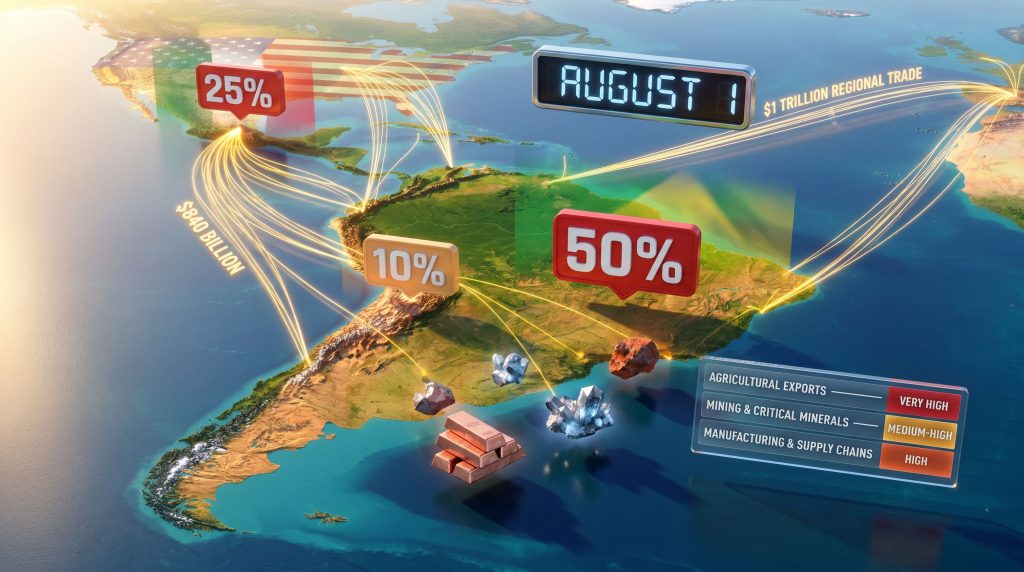
The scale of economic interdependence between the United States and Latin America is frequently underappreciated outside specialist circles. U.S.-Latin America trade surpassed $1 trillion in 2023, a figure that places the relationship among the most significant bilateral trade corridors on the planet. Furthermore, U.S.-Mexico trade alone reached $840 billion in 2024, making Mexico the single largest trading partner of the United States — surpassing both Canada and China in bilateral trade volume.
These are not abstract statistics. They represent integrated manufacturing ecosystems, agricultural supply chains feeding North American consumers, energy flows that move in both directions across the Rio Grande, and financial services networks that underpin investment activity from Monterrey to São Paulo. When tariff measures of the magnitude currently in play are introduced into a system this tightly coupled, the disruption transmits directly into corporate earnings, commodity prices, and currency valuations.
The trade war impacts rippling through global markets provide a useful analytical lens here. The Trump administration's tariff architecture across Latin America currently operates across three distinct tiers:
| Tariff Tier | Rate | Primary Countries Affected |
|---|---|---|
| Baseline Regional Tariff | 10% | Most of Central America, Caribbean, Andean nations |
| North American Trade Partner | 25% | Mexico (and Canada) |
| Punitive Bilateral Tariff | 50% | Brazil |
Each tier carries distinct economic consequences, and each requires a different analytical lens to understand fully.
Brazil's 50% Tariff: When Trade Policy Becomes Geopolitical Leverage
The imposition of a 50% import duty on Brazilian goods represents something qualitatively different from conventional trade friction. Standard tariff disputes arise from market access concerns, dumping allegations, or reciprocity imbalances. Trump's 50% tariff threat on Brazil has explicitly linked a trade measure to a domestic judicial proceeding in a sovereign foreign nation, specifically the prosecution of former Brazilian President Jair Bolsonaro.
This precedent carries implications that extend far beyond the Brazil-U.S. bilateral relationship. If Washington can deploy tariffs as leverage against foreign judicial outcomes, the international trading system's rules-based framework faces a fundamental challenge. Governments across Latin America — and globally — must now factor the possibility of retaliatory tariffs into domestic judicial and political decisions, introducing a form of external pressure that international trade law has traditionally been designed to prevent.
What Does This Mean for Brazilian Exporters?
For Brazilian exporters, the immediate consequences are severe. Agriculture, manufacturing, iron ore, and energy sectors all face dramatically altered access to one of their key export markets at a time when global commodity tariffs remain a source of significant market sensitivity. Brazil is the world's largest exporter of iron ore, soybeans, and beef — product categories now facing a cost barrier steep enough to redirect trade flows rather than merely compress margins.
The Brazilian government's response pathway involves countermeasures that would carry significant consequences for U.S. commercial interests. Among the tools under active consideration is the suspension of bilateral investment frameworks, trade agreements, and intellectual property arrangements. U.S. technology and pharmaceutical companies operating in Brazil would face direct exposure if intellectual property protections are reconsidered as retaliatory instruments.
Disclaimer: The above represents an analysis of publicly reported policy signals and should not be construed as investment advice. The trajectory of diplomatic negotiations remains highly uncertain.
The August 1 Countdown: A Hard Deadline in a Region That Rarely Moves Fast
One of the most consequential and underappreciated elements of the current tariff environment is the specificity of the timeline. The Trump administration has shifted the implementation deadline to August 1, creating a compressed pressure window that forces decision-makers across the region — governments, investors, and multinationals alike — to make contingency choices within weeks rather than months.
Latin American trade negotiations have historically operated on extended timelines. The August 1 deadline is structurally incompatible with this rhythm, which is precisely the point. A hard deadline forces reactive decision-making, creates negotiating leverage for Washington, and generates the kind of economic uncertainty that can destabilise investment environments in ways that outlast the immediate dispute.
For investors and corporate operators, the August 1 deadline creates three actionable scenarios:
-
Negotiated Resolution Before August 1 — Governments reach bilateral agreements with Washington that result in tariff rollbacks or reductions in exchange for political concessions. Market relief follows, FDI flows resume, and commodity prices stabilise. This outcome requires significant diplomatic momentum within a narrow window.
-
Partial Escalation — Tariffs are maintained against Brazil and Mexico while smaller economies receive exemptions or reductions in exchange for diplomatic accommodation. The outcome is a bifurcated regional investment environment where supply chain restructuring accelerates as companies seek tariff-exempt production bases.
-
Full Escalation With Retaliation — All threatened tariff measures are implemented, Brazil and other affected nations activate retaliatory measures, and a broader trade conflict materialises. This scenario carries meaningful downside for FDI flows, currency stability, and potentially IMF engagement in the most vulnerable economies.
Mexico's 25% Tariff: Supply Chain Integration Cuts Both Ways
The 25% tariff applied to Mexican goods operates in a fundamentally different economic context than the Brazil measure. Where the Brazil tariff functions primarily as punitive leverage in a bilateral political dispute, the Mexico tariff strikes at the core of an integrated manufacturing ecosystem that has been deliberately constructed over three decades of North American economic integration under NAFTA and its successor, the USMCA.
The nearshoring trend that gained extraordinary momentum following pandemic-era supply chain disruptions brought hundreds of billions of dollars in manufacturing investment into Mexico specifically to serve U.S. markets. However, a 25% tariff fundamentally undermines that investment thesis, effectively penalising the exact behaviour that American trade policy had previously incentivised. For context on how similar sweeping tariff measures have been applied globally, the pattern of economic disruption is well established.
Three Structural Vulnerabilities
Three structural vulnerabilities deserve particular attention:
-
Automotive sector exposure: North American vehicle production operates on deeply integrated cross-border supply chains where components frequently cross the U.S.-Mexico border multiple times during the manufacturing process. Each crossing under a 25% tariff regime compounds cost escalation in ways that can make entire production models economically unviable.
-
Energy interdependence complexity: Mexico imports substantial volumes of natural gas from the United States while exporting crude oil northward. A blanket tariff applied to Mexican goods creates a peculiar self-defeating dynamic for Washington, as it raises costs in a system where U.S. energy exporters depend on Mexican demand as a significant revenue stream.
-
USMCA framework tension: The very trade agreement that governs U.S.-Mexico-Canada commerce contains dispute resolution mechanisms that may be invoked by Mexico, creating a legal architecture for challenging the tariff measures that could generate multi-year litigation timelines and regulatory uncertainty.
Electoral Transitions as Investment Inflection Points
The week's political dimension compounds the trade risk environment in ways that require separate analytical treatment. Latin American electoral transitions have historically served as significant inflection points for regulatory frameworks governing energy, mining, infrastructure, and foreign investment. Research on electoral cycles in emerging markets consistently demonstrates that political transitions in resource-rich economies generate substantial variance in foreign direct investment flows in the months following a change of government.
The investment-critical questions any electoral transition raises in the current environment include:
-
Will the incoming government pursue bilateral negotiations with Washington or adopt a confrontational posture that deepens trade conflict?
-
How will fiscal policy adapt to reduced export revenues caused by tariff barriers, and what does that mean for infrastructure investment capacity?
-
What happens to energy privatisation, mining investment frameworks, and public-private partnership structures under new political leadership?
-
How will central bank independence and monetary policy credibility be managed during the transition period?
The answers to these questions determine whether electoral transitions serve as catalysts for investment recovery or accelerants of capital flight.
The next major ASX story will hit our subscribers first
The Critical Minerals Paradox: Washington Needs What It Is Pressuring
Perhaps the most strategically incoherent dimension of the current U.S. tariff approach to Latin America involves critical minerals. The growing critical minerals demand driven by the global energy transition makes this tension particularly acute, as the region holds some of the world's most significant reserves of the resources Washington has identified as essential to domestic clean energy manufacturing and national security supply chains.
| Resource | Key Latin American Producers | U.S. Strategic Dependency | Tariff Impact Pathway |
|---|---|---|---|
| Lithium | Chile, Argentina, Bolivia | High — EV battery supply chains | Indirect; raises cost of bilateral cooperation frameworks |
| Copper | Chile, Peru | Very High — electrification infrastructure | Moderate; affects investment climate and project timelines |
| Nickel | Brazil, Colombia | Medium | Direct; Brazilian 50% tariff hits nickel export economics |
| Iron Ore | Brazil | Medium-High | Direct; 50% tariff creates immediate cost pressure across steel inputs |
The lithium triangle spanning Chile, Argentina, and Bolivia contains an estimated 54% of the world's known lithium reserves, according to the U.S. Geological Survey. Moreover, the dynamics of the global lithium market illustrate just how consequential regional investment climates are for supply security. Copper, essential for every dimension of the electrification agenda, is dominated by Chilean and Peruvian production — and a copper supply crunch becomes considerably more likely when tariff measures degrade the investment climate in producing nations.
Battery Energy Storage Systems (BESS) represent a specific pressure point where the contradiction is particularly acute. BESS deployment across both the United States and Latin America depends on lithium-ion chemistry sourced from regional producers. Tariff measures that destabilise mining investment in lithium-producing nations ultimately constrain the supply chains that American clean energy policy depends upon — a self-limiting dynamic that creates long-term strategic costs even as it achieves short-term political leverage.
Sector Exposure Map: Where the Billions Are Concentrated
Understanding the week in latam two elections new tariffs and billions on the line requires moving beyond aggregate trade figures to sector-level exposure analysis. Different industries face materially different risk profiles depending on their trade dependency, investment structures, and regulatory sensitivity to political transitions.
Energy sector: Renewable energy development faces dual pressure from the current environment. Tariff escalation raises the cost of imported solar panels, wind turbine components, and BESS equipment, squeezing project economics at a time when the region's clean energy transition requires accelerating investment. Simultaneously, electoral transitions introduce regulatory uncertainty that extends project timelines and raises the cost of capital.
Mining and critical minerals: Exploration and extraction activity across the Andean corridor and Brazil faces both direct tariff exposure on commodity exports and indirect pressure through currency depreciation in affected economies. Geological mapping and survey activity — early-stage investment that precedes production by years — is particularly sensitive to investment climate deterioration because these expenditures are discretionary.
Infrastructure: Drinking water treatment plants, aqueducts, highway concessions, and passenger transport electrification programmes depend on a stable fiscal environment and predictable foreign investment flows. Trade disruption reduces government revenues and constrains public investment capacity while simultaneously raising the cost of private capital through increased country risk premiums.
Oil and gas: Offshore platforms and upstream exploration activity require long-cycle capital commitments that demand regulatory stability over multi-year horizons. The combination of political transition risk and tariff uncertainty creates the kind of investment climate deterioration that causes majors to defer final investment decisions.
Resilience vs. Vulnerability: Not All Latin American Economies Face Equal Exposure
The current environment creates winners and losers within the regional landscape in ways that experienced investors recognise but that are easily obscured by aggregate regional analysis.
Characteristics of more resilient economies in this environment include diversified export markets with significant Asia-Pacific relationships that reduce U.S. market dependency, strong commodity positions in resources Washington strategically requires, and existing bilateral frameworks that provide partial insulation from blanket tariff measures.
Characteristics of higher-vulnerability economies include high U.S. trade concentration on both import and export sides, fiscal deficits that limit policy response capacity when export revenues decline, simultaneous political transitions that compound regulatory uncertainty, and commodity export profiles with direct tariff impact exposure.
Central American economies with high textile and agricultural export dependency on U.S. markets face disproportionate impact from even the baseline 10% tariff regime. For nations where U.S. market access represents a dominant share of export revenue, a 10% cost barrier is not a marginal inconvenience — it is a structural challenge to fiscal sustainability.
A Decision Framework for Operating Through Uncertainty
The following strategic framework represents analytical perspective and should not be construed as financial advice. All investment decisions should be made in consultation with qualified professional advisors with current knowledge of specific regulatory and market conditions.
For investors and business operators with Latin American exposure, the current environment demands systematic scenario-based repositioning. Four analytical priorities stand out:
-
Tariff exposure mapping: Identify precisely which revenue streams, supply chains, or cost structures are directly affected by each tariff tier. The 10%, 25%, and 50% tiers carry fundamentally different economic implications and require separate mitigation approaches.
-
Political transition risk assessment: Evaluate how electoral outcomes in affected countries could alter the regulatory frameworks governing your specific sector. Historical analysis of Latin American electoral cycles provides useful pattern recognition for likely policy directions under different outcome scenarios.
-
Hedge mechanism identification: Currency hedging, supply chain geographic diversification, alternative market access strategies, and contractual force majeure provisions all represent tools available to operators managing heightened uncertainty.
-
Multilateral institution monitoring: IDB, World Bank, and IMF engagement trajectories in affected countries serve as early indicators of either stabilisation or deteriorating fiscal conditions. Increased multilateral engagement typically precedes formal adjustment programmes that reshape the investment environment in material ways.
The Week That Redefined Regional Risk Calculations
The week in latam two elections new tariffs and billions on the line is not simply another episode in the cyclical rhythm of Latin American political economy. It represents a structural shift in how U.S. trade policy is being deployed toward the region — as geopolitical leverage rather than purely economic instrument — and a compression of political and trade risk into a single temporal window that amplifies the consequence of each individual development.
The $840 billion U.S.-Mexico trade relationship, the 50% tariff on Brazilian goods tied to domestic judicial proceedings, the August 1 implementation deadline, and the simultaneous electoral transitions across the region each carry significant standalone consequence. Their convergence creates a risk environment where the whole is considerably more destabilising than the sum of its parts.
For the investors, operators, and policymakers navigating this landscape, the priority is not to predict the precise outcome of any single negotiation. Rather, it is to build decision frameworks robust enough to preserve value and optionality across the full range of scenarios that remain plausible before August 1 arrives. That analytical discipline, more than any individual prediction, is what separates those who emerge from this period well-positioned from those who do not.
Want to Stay Ahead of the Next Major Mineral Discovery Emerging From Latin America's Critical Minerals Boom?
As trade disruptions reshape investment flows across the Americas and pressure mounts on the region's lithium, copper, and nickel sectors, Discovery Alert's proprietary Discovery IQ model delivers real-time ASX alerts on significant mineral discoveries — instantly translating complex geological data into actionable opportunities. Explore how historic mineral discoveries have generated substantial returns and begin your 14-day free trial today to position yourself ahead of the market.