June 22, 2026
The Underground Infrastructure Bottleneck Driving Zambia's Next Mining Cycle
When a copper-producing nation sets its sights on tripling annual output within a single decade, the conversation quickly moves beyond ore grades and commodity prices. The real constraint becomes infrastructure — specifically, the vertical shafts, ventilation corridors, and underground access systems that make deep-level mining physically possible. Across the Zambian Copperbelt, where surface-accessible ore bodies are becoming progressively depleted, this infrastructure challenge is reshaping which contractors win business and which countries supply them.
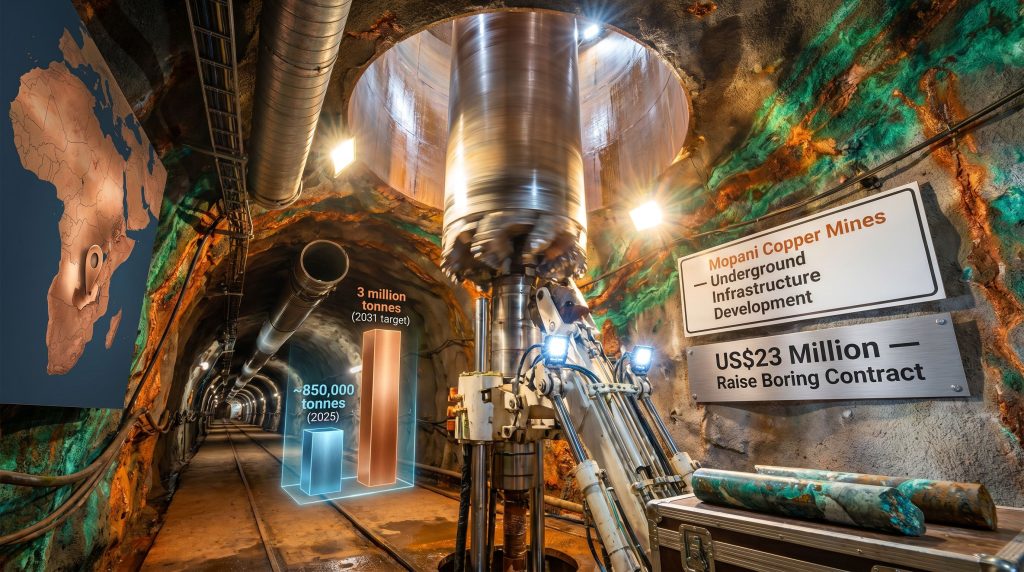
It is within this context that the Laxyo Zambia underground mining contract at Mopani Copper Mines carries significance well beyond its headline figure. The INR 2 billion (approximately US$23 million) raise-boring award is not simply one project among many — it is a signal about the direction of capital, the nature of underground mining demand, and the expanding reach of Indian industrial services companies into African resource markets.
When big ASX news breaks, our subscribers know first
Zambia's Production Gap and the Infrastructure It Requires
The Zambia copper production forecast shows the country produced approximately 800,000 to 850,000 tonnes of copper in 2025, placing it second on the continent behind the Democratic Republic of the Congo, which extracted roughly 3.3 million tonnes over the same period. The Zambian government has publicly committed to surpassing 3 million tonnes per year by 2031 — a target that would require nearly tripling current output within six years.
Achieving that ambition is not primarily a geological challenge. The Zambian Copperbelt holds substantial mineral endowment, but accessing it requires going deeper. Shallow oxide and mixed ore zones that once supported open-pit and shallow underground operations are increasingly exhausted. What remains is predominantly primary sulphide mineralisation at greater depths, and reaching it demands a different class of underground infrastructure.
Zambia's copper ambitions are fundamentally an underground infrastructure story. The contractors who secure early positions in this development cycle stand to capture a disproportionate share of a multi-year project pipeline.
This transition from near-surface to deep underground mining creates structural demand for three specialised capabilities: shaft sinking, raise boring, and ventilation system development. Of these, raise boring has become particularly critical because it offers speed and safety advantages that conventional drill-and-blast shaft construction cannot match at the depths now being targeted. Furthermore, current copper market trends suggest this demand is only set to intensify as global supply constraints tighten.
What Raise Boring Actually Does — and Why It Matters at Depth
Raise boring is a mechanised excavation technique used to create vertical or steeply inclined shafts connecting two levels of an underground mine. Unlike conventional shaft sinking, which progresses downward using explosives and manual mucking operations, raise boring works from below upward. A pilot hole is drilled from one level to another, a large-diameter reaming head is then attached and pulled back upward, cutting the finished shaft diameter in a single pass.
The practical advantages in a deep copper mine environment are significant:
- No explosive charges are required, eliminating blast vibration damage to adjacent ground and infrastructure
- Workers are not positioned at the advancing face during excavation, substantially improving safety profiles
- Cycle times in competent rock formations are typically faster than conventional methods
- Ground disturbance is more controlled, which matters in the fractured geological conditions common across parts of the Copperbelt
- Finished shaft quality is generally more consistent, reducing secondary support requirements
In deep copper mines, raise-bored shafts serve four primary functions: ventilation of working areas at depth (critical because air temperatures and diesel exhaust concentrations increase with depth), ore pass transfer of broken rock between levels, emergency egress for personnel, and infrastructure routing for power cables, compressed air lines, and dewatering pipes. In addition, advances in underground copper mining technology are further enhancing the efficiency and safety of these operations.
What Is Raise Boring in Mining?
Raise boring is a mechanised underground excavation method that creates vertical or inclined shafts between mine levels without using explosives. It is widely used in deep underground copper mining to develop ventilation shafts, ore transfer passes, and emergency escape routes, and is preferred for its safety record and operational efficiency in competent rock conditions.
The geology of the Zambian Copperbelt is characterised by the Katanga Supergroup metasedimentary sequence, which hosts copper mineralisation within dolomitic shales and quartzites. While competent in many zones, the stratigraphy can include faulted intervals and water-bearing formations that add complexity to deep shaft development — precisely the conditions where mechanised raise boring reduces risk compared to conventional blasting.
The Laxyo Zambia Underground Mining Contract: Key Parameters
The Laxyo Zambia underground mining contract awarded at Mopani Copper Mines represents several firsts for the company while building on an established African operational foundation.
| Parameter | Detail |
|---|---|
| Contract Value | INR 2 billion (approximately US$23 million) |
| Contract Type | Raise-boring (underground mining services) |
| Client | Mopani Copper Mines, Zambia |
| Executing Entity | Laxyo Evapeta Zambia Ltd (subsidiary) |
| Share of Order Book | 12.6% |
| First Overseas Raise-Boring Contract | Yes |
Mopani Copper Mines is jointly held by UAE-based International Resources Holding and Zambia's state-linked ZCCM Investments Holdings, making it one of the most strategically significant copper operations in the country. The mine sits within the Copperbelt Province and has historically been one of Zambia's highest-volume underground copper producers, which explains why it is at the front of the queue for shaft infrastructure investment as the industry accelerates its deep-level development programme.
Who Is Laxyo and How Did It Build an African Footprint?
Founded in 2007 under the name Laxyo Energy Limited before rebranding, Laxyo Limited has evolved across four distinct business lines:
- Railway infrastructure services — construction and maintenance of railway civil works in India
- Mining services and raise-boring operations — the segment most directly relevant to the Mopani award
- Dredging and land reclamation — marine and inland waterway projects
- Operations and maintenance — industrial and thermal power facility services
The company's African presence predates the Mopani contract by more than a decade. In 2010, Laxyo acquired a 50% stake in AICM, a South Africa-based operations and maintenance specialist. This was followed by the establishment of subsidiaries in both South Africa and Zambia, through which the company conducted engineering and maintenance assignments for mining and industrial clients across the region.
This history matters for understanding the Mopani contract correctly. The award is not a cold-entry into an unfamiliar market but rather an escalation of an existing presence — a shift from maintenance-oriented work toward specialised underground mining services. That distinction carries real commercial significance because it means Laxyo already holds regulatory standing, understands local labour dynamics, and has established logistics relationships in Zambia before mobilising for a technically demanding underground project.
The IPO Dimension: Strategic Timing
Laxyo has filed a draft red herring prospectus with India's Securities and Exchange Board of India (SEBI) seeking to raise up to INR 1.5 billion (approximately US$17 million) through an initial public offering. Proceeds are earmarked for debt reduction, capital equipment procurement, and working capital.
When a company secures an international contract representing 12.6% of its total order book in a high-growth mining jurisdiction immediately before a public listing, the dual function is clear — operational revenue generation and investor confidence signalling to prospective shareholders evaluating geographic diversification.
For investors assessing the IPO, the Mopani contract substantially strengthens the pre-listing narrative. It demonstrates that Laxyo's raise-boring capabilities have been validated outside the domestic Indian market, which is a meaningful differentiator at the listing stage. Consequently, those exploring copper investment opportunities will find the contract's timing particularly noteworthy.
Zambia's Major Copper Operations: The Competitive Mining Landscape
Understanding where Mopani sits within Zambia's broader mining sector is essential context for evaluating the scale of infrastructure demand that will continue generating contract opportunities.
| Operation | Operator / Owner | Current Status |
|---|---|---|
| Mopani Copper Mines | International Resources Holding / ZCCM-IH | Active; raise-boring contract awarded to Laxyo |
| Kansanshi Mine | First Quantum Minerals | One of Africa's largest copper mines by output |
| Sentinel Mine | First Quantum Minerals | Large-scale open-pit operation, northwestern Zambia |
| Lumwana Mine | Barrick Mining | Major copper producer |
| Konkola Copper Mines | Vedanta Resources | Undergoing 60-day maintenance shutdown as of mid-2025 |
| Chambishi Mine | China Nonferrous Metal Mining Group | Chinese state-linked operator |
The concentration of major international mining groups within a single country's Copperbelt creates a contractor market with unusual depth. As each operation scales up or undergoes infrastructure renewal, it generates tendering activity for shaft development, ventilation, and underground civil works — a pipeline that is set to expand as Zambia pursues its production targets. This mirrors the scale of ambition seen in other major copper project development efforts taking place globally.
Zambia's Export Duty Suspension: Policy Context
Zambia extended the suspension of a 10% export duty on copper concentrates until 30 September, covering 271,742 tonnes of approved duty-free exports. The measure, originally introduced in August 2025, was designed to provide relief to producers dealing with smelter maintenance backlogs and processing constraints across the sector.
The policy reflects a pragmatic tension at the heart of Zambia's mining governance: the government's long-term aspiration is to process more copper domestically before export, increasing in-country value addition. But when smelting infrastructure requires extended maintenance, insisting on beneficiation creates production bottlenecks that undermine revenue generation and investor confidence.
From a contractor perspective, smelter maintenance disruptions carry an indirect but important implication. When processing capacity is constrained, mining operators face mounting stockpiles of unprocessed ore concentrate. To manage this, they have an incentive to ensure that underground mining output — the upstream stage — remains efficient and that future production capacity is secured. This, in turn, accelerates the timeline for underground infrastructure investment, including shaft development and ventilation expansion.
The next major ASX story will hit our subscribers first
How Laxyo Competes Against Established Raise-Boring Specialists
The raise-boring segment in Africa is served by a compact group of highly specialised contractors, each with substantial fleet assets and multi-decade project histories. Laxyo enters a market where the incumbents include:
- Master Drilling Group — a South Africa-headquartered specialist widely regarded as one of the most technically capable raise-boring contractors on the continent, with operations spanning multiple African jurisdictions
- Murray and Roberts Holdings — a diversified South African engineering group with underground mining services capabilities and a long track record across southern and central Africa
- Redpath Mining — a privately held Canadian contractor with significant African underground project experience and established client relationships across the Copperbelt
What separates these incumbents from challengers is not technology alone — it is the combination of equipment fleet depth, experienced raise-boring personnel, and institutional knowledge of the geological and regulatory conditions unique to each jurisdiction.
Laxyo's competitive positioning is that of a cost-competitive challenger with genuine local infrastructure advantages. Its Zambian subsidiary structure reduces the mobilisation overhead that a purely offshore contractor would face. Familiarity with Zambian regulatory requirements and established labour relationships could compress project initiation timelines. However, the company's limited track record in African raise-boring projects beyond India's domestic market remains the most significant risk factor for clients evaluating technical capability against established competitors.
India's Expanding Role in African Mining Services
The Laxyo Zambia underground mining contract reflects a broader and accelerating pattern of Indian corporate engagement with Africa's resource sector. Over the past two decades, Indian companies have accumulated substantial mining and industrial interests across the continent.
| Indian Company | African Mining Activity |
|---|---|
| Vedanta Resources | Controls Konkola Copper Mines in Zambia |
| Jindal Steel and Power | Coal mining and power infrastructure in Mozambique |
| Tata Steel | Mineral interests in South Africa and Côte d'Ivoire |
| NMDC Ltd. (state-owned) | Exploration activity across southern Africa |
| Coal India Ltd. | Examined coal project opportunities in Mozambique |
| Laxyo Limited | Underground mining services at Mopani, Zambia |
A recurring structural pattern emerges from this history: Indian resource investors typically enter African markets first, establishing equity stakes and operational footholds. Engineering, construction, and services firms then follow, leveraging the relationships, local knowledge, and physical infrastructure that the resource investors have already established. Laxyo's trajectory fits this model precisely — its operational entry through AICM in South Africa and its subsequent Zambian subsidiary work preceded the Mopani raise-boring award by more than a decade.
India vs. China in African Mining Services: Contrasting Approaches
| Dimension | Indian Approach | Chinese Approach |
|---|---|---|
| Entry Model | Services and O&M first, then resource ownership | State-backed equity and infrastructure financing |
| Key Commodities | Copper, coal, industrial services | Copper, cobalt, iron ore, infrastructure |
| Zambia Presence | Vedanta (KCM), Laxyo (services) | CNMC (Chambishi), various infrastructure projects |
| Capital Source | Private corporate and IPO market financing | State-owned enterprise balance sheets |
| Local Integration | Subsidiary structures, joint ventures | Large-scale project execution with variable local content |
The contrast in approach carries long-term implications for which model generates more durable local relationships and repeat contract opportunities. Services-first entry, as exemplified by Laxyo, tends to build operational legitimacy incrementally rather than through headline capital deployment.
The Indian Raise-Boring Market and What It Signals Globally
Laxyo's own draft prospectus projects the Indian raise-boring services market to expand at a compound annual growth rate of approximately 27.3% between FY2025 and FY2031, reaching an estimated size of INR 5.75 billion (approximately US$67 million).
This growth rate reflects several converging forces: India's accelerating underground coal development programme, increasing mechanisation of metallic mineral mines as shallow deposits become exhausted, and growing adoption of raise boring over conventional drill-and-blast in infrastructure tunnel projects.
The significance for Zambia is that these same underlying forces apply at a global level. Copper mines everywhere are going deeper as near-surface reserves deplete. Raise boring's safety and efficiency advantages become more pronounced, not less, as operating depths increase. A company developing its technical personnel and equipment fleet to serve India's domestic growth cycle is simultaneously building the capability set needed to compete in African deep-level mining markets.
For Laxyo specifically, the international contract win at Mopani provides the proof-of-concept that domestic Indian market growth projections alone cannot deliver — demonstrated competitiveness in a foreign jurisdiction under internationally benchmarked technical standards. According to reporting on the contract award, this milestone marks a significant step in Laxyo's global expansion strategy.
Frequently Asked Questions: Laxyo Zambia Underground Mining Contract
What Is the Laxyo Zambia Underground Mining Contract?
The Laxyo Zambia underground mining contract is a raise-boring services agreement at Mopani Copper Mines valued at approximately US$23 million (INR 2 billion). The work will be carried out by Laxyo Evapeta Zambia Ltd, the company's Zambian subsidiary, and represents Laxyo's first raise-boring project outside India.
What Is Raise Boring Used for in Copper Mining?
Raise boring excavates vertical or inclined shafts in underground mines without explosives. In copper mining it is primarily used for ventilation infrastructure, ore transfer passes, and emergency access routes — all essential to safe and efficient deep underground operations.
Who Owns Mopani Copper Mines?
Mopani Copper Mines is jointly owned by International Resources Holding, a UAE-based entity, and ZCCM Investments Holdings, which represents Zambia's state mining interests.
Is Laxyo Ltd. Publicly Listed?
As of the time of the contract announcement, Laxyo Ltd. was preparing for an initial public offering, having filed a draft red herring prospectus with SEBI to raise up to INR 1.5 billion (approximately US$17 million).
How Much Copper Does Zambia Produce?
Zambia produced approximately 800,000 to 850,000 tonnes of copper in 2025, ranking as Africa's second-largest producer. The government has targeted annual output exceeding 3 million tonnes by 2031.
What Other Indian Companies Operate in Zambia's Mining Sector?
Vedanta Resources, through Konkola Copper Mines, is the most prominent Indian mining company in Zambia. Laxyo's expansion into raise-boring services at Mopani represents a newer tier of Indian industrial services companies building on the foundations laid by larger resource investors.
Key Takeaways: What the Mopani Contract Signals for the Sector
- Underground infrastructure demand is accelerating across the Zambian Copperbelt as near-surface ore bodies deplete and the 3-million-tonne production target requires deep-level mine development
- Raise boring is a high-growth technical niche with a projected 27.3% CAGR in India's domestic market through FY2031, reflecting global demand dynamics directly applicable to African copper belt expansion
- Indian services firms are following capital into Africa through a well-established pattern where resource investors open the door for engineering and services companies to follow
- Laxyo's African entry predates the Mopani contract by over a decade, meaning this award represents operational escalation rather than market entry risk
- The IPO timing amplifies the contract's strategic value, with a 12.6% order book contribution from an international project strengthening geographic diversification credentials ahead of a public listing
- Zambia's export duty suspension illustrates the government's pragmatic approach to balancing domestic beneficiation ambitions against near-term production continuity requirements
This article contains forward-looking information including production targets, market growth projections, and company development plans. These represent stated objectives and analyst projections, not guaranteed outcomes. Readers should conduct independent research before making investment decisions.
Want to Capitalise on the Next Major Mineral Discovery Before the Broader Market Does?
The Zambian Copperbelt's accelerating infrastructure cycle is just one signal of the broader commodity opportunities emerging across global resource markets — and Discovery Alert's proprietary Discovery IQ model scans the ASX daily to deliver real-time alerts on significant mineral discoveries the moment they are announced, turning complex data across 30-plus commodities into clear, actionable insights. Explore why historic ASX mineral discoveries have generated substantial returns and start your 14-day free trial today to ensure you are positioned ahead of the market.