Livium Ltd
Livium Hits a Key Milestone as Dedicated Envirostream Plant Comes Online and Sell & Parker Volumes Rise
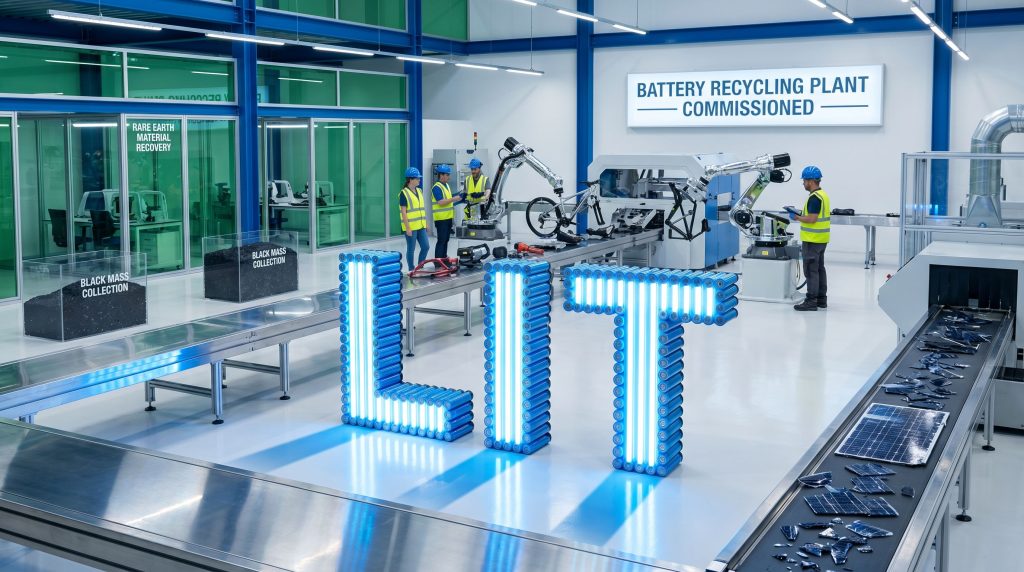
Livium Ltd (ASX: LIT) has reported completion of commissioning for a dedicated battery recycling plant at its Envirostream facility in Campbellfield, Victoria. The Livium battery recycling plant commissioned at Envirostream Campbellfield for Sell & Parker volumes marks a significant operational milestone, confirmed in the ASX announcement dated 8 July 2026. This plant has been funded by Sell & Parker under the April 2026 variation to the existing recycling agreement.
The commissioning coincides with a marked increase in material received. In July 2026, Envirostream is anticipated to receive 55 tonnes of material from Sell & Parker, compared with an historical monthly average of approximately 7 tonnes of materials containing embedded batteries recorded between May 2025 and May 2026.
The Sell & Parker recycling agreement, originally disclosed in April 2025, was reported as having an anticipated contract value in excess of $5.0 million and the potential to be Envirostream's largest recycling contract to date on a revenue basis. According to Livium Ltd, that potential assessment remains unchanged.
When big ASX news breaks, our subscribers know first
From Agreement to Action: What Commissioning Means on the Ground
The ASX announcement confirms that the dedicated processing plant at Envirostream's Campbellfield facility has now completed commissioning. This plant was developed under an April 2026 variation to the Sell & Parker agreement, which introduced a Sell & Parker funded deposit structure.
This structure was designed to:
- Support development of additional, dedicated processing capacity at Campbellfield
- Facilitate an acceleration of volumes under the existing recycling agreement
With commissioning complete, the reported volume profile for July 2026 is as follows:
- 9 tonnes of material received from Sell & Parker in early July
- A further 9 tonnes scheduled for delivery on 9 July 2026
- An additional 37 tonnes anticipated over the remainder of the month
- Total July 2026 forecast: 55 tonnes
For context, Livium Ltd reports that from May 2025 to May 2026, the average monthly receipt of materials containing embedded batteries under the Sell & Parker agreement was approximately 7 tonnes.
The resulting step-change is summarised below:
| Period | Average / Forecast Monthly Volume |
|---|---|
| May 2025 – May 2026 (historical average) | ~7 tonnes |
| July 2026 (anticipated) | 55 tonnes |
| Implied increase | ~7 times |
This shift indicates that the dedicated plant is now positioned to process materially higher monthly volumes than those reported over the prior year, consistent with the objective of the April 2026 variation.
What Are "Materials Containing Embedded Batteries"?
Understanding Embedded Batteries in the Recycling Chain
The Sell & Parker agreement covers "materials containing embedded batteries", a term that can be unclear for those outside the recycling sector. In this context, it refers to items where batteries are built into or fixed within the product rather than easily removable.
Common examples include:
- Power tools and garden equipment with lithium-ion packs inside the casing
- E-bikes and scooters where batteries sit within the frame or body
- Consumer electronics, such as laptops and tablets, where the battery is screwed or glued in place
- Industrial scrap that contains lithium-ion cells or packs still inside equipment
These items cannot be processed as ordinary scrap metal or general waste. If shredded, crushed or melted without proper preparation, the batteries inside can:
- Catch fire or explode, due to short circuits or heat
- Release hazardous substances, including electrolyte and fine metal particles
- Damage equipment at metal recycling plants and waste facilities
Why Specialised Battery Recycling Is Required
Envirostream's role within Livium Ltd is to provide specialised processing for these embedded battery materials. This involves:
- Safely identifying and separating embedded batteries from host products
- Discharging or otherwise making batteries safe for further processing
- Shredding and sorting batteries to recover valuable components, including metal-rich material known as black mass
Handling embedded batteries safely requires:
- Dedicated facilities with fire management systems
- Trained staff familiar with lithium-ion risks
- Processes that comply with relevant environmental and safety regulations
According to the ASX announcement, Envirostream is set up to undertake this specialised work at its Campbellfield facility, and the new Sell & Parker funded plant is intended to increase capacity to do so.
Why This Matters to Investors
The Sell & Parker announcement highlights several points that may be relevant to investors:
- Policy and market trends are leading to rising use of lithium-ion batteries across tools, vehicles and consumer products. As a result, more embedded batteries are entering industrial scrap streams.
- Scrap metal operators such as Sell & Parker, which has over 400 employees and 8 metal recycling facilities across Australia, are increasingly encountering this material and require compliant, specialist recyclers to manage it.
- Envirostream's dedicated capacity improves Livium Ltd's ability to receive, process and invoice larger volumes of these materials from counterparties like Sell & Parker, which could support the realisation of the previously disclosed $5.0 million+ contract value if volume plans are achieved.
CEO Commentary
"Completion and commissioning of the dedicated plant is an important milestone for Envirostream and Sell & Parker, demonstrating our collective desire to safely dispose of materials containing embedded batteries through Envirostream's facilities in Victoria.
The increase in July volumes is an encouraging early result since plant commissioning and is an encouraging indication of the revenue potential originally disclosed to the market under this Agreement."
Simon Linge, Managing Director and CEO, Livium Ltd
Agreement Revenue Potential and Key Terms
Contract Value and Status
The Sell & Parker recycling agreement was first disclosed on 24 April 2025. According to Livium Ltd, the agreement:
- Has an anticipated contract value in excess of $5.0 million
- Was identified as having the potential to be Envirostream's largest recycling contract to date on a revenue basis
In its 8 July 2026 announcement, Livium Ltd states that this assessment "continues to be the case" following plant commissioning.
The April 2026 variation, announced previously, introduced:
- A Sell & Parker funded deposit structure
- Support for development of additional dedicated processing capacity
- A framework to accelerate volumes under the agreement
The latest update furthermore confirms that:
- The dedicated plant has completed commissioning
- Increased volumes in July 2026 have commenced
- The parties are now working through forward volume planning
Agreement Characteristics of Interest to Investors
While detailed commercial terms are not disclosed in the ASX release, the information provided highlights several characteristics that may be relevant for investors monitoring Livium Ltd:
-
Scale and profile of Sell & Parker
- Trading since 1966
- Operates 8 metal recycling facilities across Australia
- Employs more than 400 staff
- Buys and sells all grades of ferrous and non-ferrous metals and reportedly sells direct to end users
-
Counterparty-funded infrastructure
- The dedicated Envirostream plant tied to the agreement is funded by Sell & Parker under the variation
- This indicates an ongoing commercial relationship structured around a specific, shared asset
-
Potential revenue contribution
- The previously announced $5.0 million+ anticipated contract value is material for a recycling-focused business
- Management has indicated that this agreement could be Envirostream's largest revenue contract to date
-
Forward planning focus
- Livium Ltd reports that it is continuing to work with Sell & Parker on forward volume plans
- The stated objective is monthly volume receipts consistent with the revenue potential originally disclosed under the agreement
The extent to which these volumes are achieved will be observable in future operational updates and quarterly reports.
What Comes Next: Forward Volume Planning and Monitoring Indicators
With commissioning complete and an initial volume uplift reported for July 2026, Livium Ltd identifies forward volume planning as the current area of focus.
The announcement suggests the following near-term reference points for investors tracking progress:
-
Monthly receipts for August and September 2026
- Observing whether volumes remain near the 55 tonne level reported for July 2026
- Assessing whether there is further growth, stabilisation, or variability in monthly tonnage
-
Outcomes of the volume plan
- Livium Ltd has indicated that both parties are working to achieve monthly volumes that align with the previously disclosed revenue potential
- Any subsequent ASX disclosure relating to contracted volumes, or commentary within quarterly reports, will provide more clarity
-
Revenue trends in upcoming quarters
- As volumes pass through Envirostream's plant, these should be visible in Livium Ltd's reported recycling revenue, subject to timing of invoicing and payment terms
The key milestones around this agreement can be summarised as follows:
| Milestone | Reported Status |
|---|---|
| Sell & Parker recycling agreement signed | Completed – April 2025 |
| April 2026 variation (deposit structure and capacity) | Completed – April 2026 |
| Dedicated Envirostream plant commissioning | Completed – July 2026 |
| July 2026 volume ramp (55 tonnes anticipated) | In progress – as at 8 July 2026 |
| Forward volume planning | Ongoing |
| Realisation of $5.0 million+ anticipated contract value | Target – subject to volumes over life of agreement |
Investment Context: Livium's Role in Battery and Clean Energy Materials Recycling
Position Within the Clean Energy Supply Chain
According to its ASX release, Livium Ltd is "Australia's leading battery recycler" through its wholly owned subsidiary Envirostream Australia Pty Ltd. The Envirostream business is described as a profitable operation focused on recovering valuable materials from end-of-life batteries.
Beyond battery recycling, Livium Ltd reports that it is expanding into:
- Rare earth element recycling
- Solar panel recycling
- Processing of black mass
These activities are presented by the company as strengthening Australia's clean energy supply chain by enabling recovery and reuse of critical materials.
Why the Sell & Parker Milestone Is Relevant to Livium's Broader Strategy
From an investment perspective, the Sell & Parker development connects to the Livium Ltd strategy in several ways:
- It relates directly to the core, operating battery recycling business (Envirostream), rather than early-stage projects.
- The agreement has an anticipated contract value in excess of $5.0 million, which could represent a meaningful contribution relative to existing operations if volume and pricing assumptions are met.
- The counterparty-funded plant signals a structured commercial arrangement anchored by specific, dedicated infrastructure at Campbellfield.
- The reported uplift from ~7 tonnes to 55 tonnes in one month indicates that capacity constraints that may have previously limited throughput under the agreement have now been addressed from an infrastructure standpoint.
For investors following Livium Ltd, the Sell & Parker agreement can consequently be viewed as:
- An operating contract that may influence short to medium term cash flows
- A validation of Envirostream's capabilities as a specialist partner for large metal recyclers handling embedded batteries
- A potential reference point for similar agreements with other counterparties, subject to future contracting activity
Educational Section: How Battery Recycling and Black Mass Processing Work
To support interpretation of Livium Ltd's activities, it is useful to outline the key stages of lithium-ion battery recycling and the concept of black mass.
Key Steps in Lithium-Ion Battery Recycling
-
Collection and logistics
- End-of-life batteries and products containing embedded batteries are collected from scrap yards, consumers, OEMs (original equipment manufacturers) and other sources.
- Safe transport is required to prevent short circuits, fire or leakage.
-
Sorting and preparation
- Batteries are identified and sorted by type (for example, lithium-ion vs lead-acid).
- Embedded batteries are separated from host products if possible.
- Damaged or swollen batteries are handled with additional precautions.
-
Discharge and dismantling
- Batteries are partially or fully discharged to reduce risk during processing.
- Larger packs (for example from electric vehicles or industrial equipment) may be dismantled into modules and cells.
-
Mechanical processing
- Batteries or cells are shredded or crushed in controlled conditions.
- After shredding, material is separated into streams such as metals, plastics and fine powder.
-
Black mass production
- The fine powder containing high concentrations of metals (including lithium, cobalt, nickel and manganese) is known as black mass.
- Black mass is then sold to or processed in specialist refining facilities that extract and purify the metals for reuse.
What Is Black Mass?
Black mass is the industry term for the metal-rich powder produced when lithium-ion batteries are mechanically processed. It typically contains:
- Lithium
- Cobalt
- Nickel
- Manganese
- Other metal and carbon components
Black mass does not go straight into new batteries. It first passes through hydrometallurgical or pyrometallurgical refining steps, where:
- Metals are leached, separated and purified
- Saleable compounds are produced for use in cathode and other battery materials
Livium Ltd references black mass processing as one of its adjacent focus areas. This suggests that the company is not only involved in collecting and mechanically processing batteries, but is also interested in activities further along the materials recovery chain.
The next major ASX story will hit our subscribers first
Glossary of Key Terms
Black mass
The metal-rich powder produced after shredding and processing lithium-ion batteries. It contains valuable metals such as lithium, cobalt, nickel and manganese, which can be further refined and reused in new battery materials.
Embedded batteries
Batteries that are built into a product or device so they are not easily removed before disposal. Examples include batteries inside power tools, e-bikes and consumer electronics.
Commissioning
The stage where a new plant or piece of equipment is tested to confirm it operates according to design specifications before entering routine commercial operation.
Variation (to an agreement)
A formal amendment to an existing contract that revises certain terms. In this case, the April 2026 variation to the Sell & Parker agreement introduced a deposit-funded structure and support for additional processing capacity at Envirostream's Campbellfield facility.
Envirostream Australia
A wholly owned subsidiary of Livium Ltd that operates battery and embedded battery recycling facilities. Envirostream runs the Campbellfield, Victoria plant discussed in the 8 July 2026 ASX announcement.
Want to Learn More About Livium's Battery Recycling Operations?
Livium Ltd (ASX: LIT) is building a compelling position as Australia's leading battery recycler, with the Envirostream facility now processing significantly higher volumes under its Sell & Parker agreement. With a dedicated, counterparty-funded plant now commissioned and monthly volumes anticipated to reach approximately 7x historical levels, this is a pivotal moment for the company's operational and commercial trajectory. To find out more about Livium Ltd and its projects, head to the Livium Investor Hub.