Lode Resources Ltd
- ASX Code: LDR
- Market Cap: $31,878,988
Lode Resources Strikes High-Grade Antimony Gold at Rock Abbey Discovery
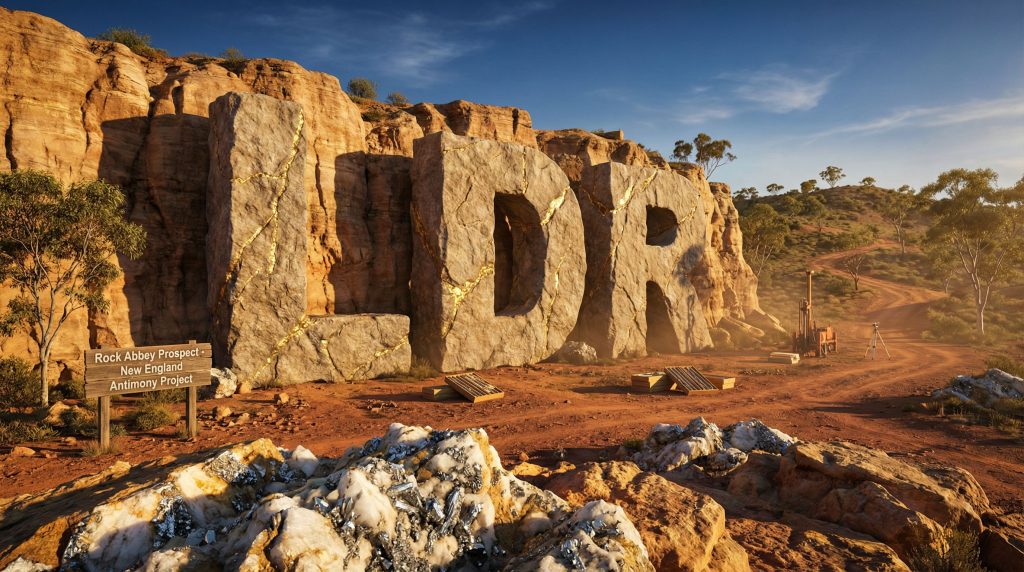
Lode Resources Ltd (ASX: LDR) has announced a significant antimony and gold discovery at its Rock Abbey prospect, with surface sampling returning exceptional antimony grades up to 37.7% Sb over a 750-metre strike length. The discovery, located just 7km southwest of the historical Magwood Antimony Mine, represents a major expansion of the company's New England Antimony Project.
Furthermore, this positions Lode as a key player in Australia's critical minerals sector. The Lode Resources Rock Abbey discovery delivered consistently high antimony grades across multiple samples, with six samples returning grades between 19.5% and 37.7% Sb.
Notably, two samples also contained significant gold values of 0.54 g/t Au and 0.24 g/t Au, suggesting potential for gold-bearing lodes at depth similar to the renowned Hillgrove mine.
When big ASX news breaks, our subscribers know first
Rock Abbey Discovery Delivers Outstanding Results
Surface mapping and sampling at Rock Abbey has revealed extensive high-grade antimony mineralisation hosted in stibnite-quartz breccias, similar to those observed at the neighbouring Magwood prospect. The mineralisation appears to extend over a confirmed 750-metre strike length based on current assays.
In addition, additional sampling has been completed over a 1,700-metre corridor awaiting results. This demonstrates the structural continuity of antimony mineralisation across the broader New England region.
Key Antimony Assay Results
| Sample No. | Antimony (Sb) | Gold (Au) | Location (Easting/Northing) |
|---|---|---|---|
| R569 | 37.7% | 0.04 g/t | 412679E, 6652649N |
| R571 | 31.5% | 0.12 g/t | 412755E, 6652666N |
| R570 | 28.9% | 0.10 g/t | 412751E, 6652656N |
| R573 | 28.3% | 0.54 g/t | 412799E, 6652664N |
| R572 | 23.1% | 0.10 g/t | 412742E, 6652649N |
| R574 | 19.5% | 0.05 g/t | 412811E, 6652670N |
The discovery demonstrates the structural continuity of antimony mineralisation across the broader New England region. Rock Abbey shows geological similarities to both Magwood and the historic Hillgrove antimony-gold mine.
Managing Director Keith Mayes commented: "The discovery of significant antimony and gold mineralisation at Rock Abbey is a testament to the prospectivity of Lode's New England Antimony Project which covers an area of 1,100 square kilometres. Like Magwood, the geology of Rock Abbey draws strong geological analogies with the Hillgrove antimony mine located a short distance to the south."
Understanding Antimony: A Critical Metal for Modern Technology
Antimony (Sb) is classified as a critical mineral by governments worldwide due to its essential role in flame retardants, batteries, semiconductors, and military applications. The silvery-white metalloid occurs naturally as stibnite (Sb₂S₃), the primary ore mineral found at the Lode Resources Rock Abbey discovery.
Properties and Applications
Antimony possesses unique chemical properties that make it irreplaceable in many industrial applications. Its primary use is in flame retardants, where it acts as a catalyst to improve the fire-resistance of plastics, textiles, and building materials.
The metal also plays a crucial role in lead-acid battery production, where it hardens lead plates and improves battery performance. However, supply security concerns create significant investment opportunities.
Why antimony matters to investors:
- Supply security concerns: China controls approximately 60% of global production
- Growing demand: Essential for renewable energy storage and defence technologies
- Limited alternatives: Few substitutes exist for antimony's unique properties
- Strategic value: Listed in NSW Government's Critical Minerals Strategy 2024-2035
Australian Antimony Potential
The New England region historically produced significant antimony, with the nearby Hillgrove mine operating as a major producer. Rock Abbey's geological setting within the same structural framework suggests excellent potential for economic mineralisation.
The region's proven track record of antimony production provides confidence in the geological prospectivity of Lode's exploration targets. This historical context strengthens the investment case for the Lode Resources Rock Abbey discovery.
What Makes the Strategic Drilling Program So Compelling?
Lode is planning an initial 10-15 hole RC drilling program at Rock Abbey, scheduled to commence immediately following completion of drilling at the company's Uralla Gold Project. Unlike Magwood, where historical workings extend to considerable depth, Rock Abbey's shallow historical workings present unique advantages.
The workings are estimated at just 20 metres depth, which will enable several key benefits. These include rapid drilling results from shallow targets and cost-effective exploration with shorter drill holes.
Furthermore, quick resource definition potential exists alongside a faster path to development if mineralisation continues at depth. The drilling strategy will target antimony-bearing lode structures defined by surface mapping and sampling.
Comparison with Magwood Success
Rock Abbey's geological similarities to Magwood are encouraging, particularly given Magwood's recent drilling success. Initial drilling at Magwood returned impressive intercepts including 9.92% Sb over 4.8m in drill hole MAG010.
Moreover, results showed 19.61% Sb over 2.4m within the broader intercept. Like Magwood, Rock Abbey has never been previously drilled or subjected to modern exploration techniques.
This suggests significant discovery potential remains untested. Consequently, this presents a compelling opportunity for Lode to replicate its Magwood success across multiple antimony prospects within its extensive tenement package.
Building Australia's Premier Antimony Portfolio
The Lode Resources Rock Abbey discovery strengthens the company's position as a major antimony explorer in Australia. Lode now controls 1,900 km² of antimony-prospective ground across two key projects.
New England Antimony Project (NSW)
The project features 19 recorded antimony prospects across EL9662 and EL9319. Rock Abbey and Magwood represent priority targets with minimal historical drilling despite high prospectivity.
The geological analogies to the productive Hillgrove system provide additional confidence. The New England project benefits from established infrastructure and proximity to historical mining centres.
The region's proven antimony endowment and favourable geology provide an excellent foundation. This supports systematic exploration across multiple targets.
Montezuma Silver-Antimony Project (Tasmania)
The Tasmanian project features an active drilling program in Tasmania's premier West Coast Mining Province. Advanced metallurgical test work has been completed with existing beneficiation infrastructure in place.
This dual-jurisdiction approach provides Lode with diversified antimony exposure and reduces single-project risk. It maximises discovery potential across proven antimony-producing regions.
Investment Thesis: Critical Minerals at the Right Time
The Lode Resources Rock Abbey discovery comes at an opportune time for antimony investors. Several factors are converging to support the investment thesis.
Market Fundamentals
Global supply security concerns are driving government support whilst the NSW Government's Critical Minerals Strategy provides policy backing. Limited new antimony discoveries globally combine with growing defence and technology sector demand.
Operational Excellence
100% ownership of all antimony projects provides complete control. The systematic exploration approach yields consistent discoveries with an experienced management team having a proven track record.
Strategic location in established mining regions provides infrastructure advantages. The combination creates multiple pathways to value creation.
Near-term Catalysts
Pending assay results from additional 1,700m of sampling provide immediate newsflow. The inaugural drilling program at Rock Abbey represents a major catalyst.
Ongoing drilling at Montezuma project in Tasmania continues, whilst follow-up drilling at Uralla Gold Project maintains momentum. These multiple programs create regular newsflow opportunities.
Financial Position
With drilling programs planned across multiple projects, Lode's financial capacity to execute its exploration strategy will be crucial. This maintains momentum across its diversified portfolio.
The company's systematic approach to exploration has demonstrated consistent success in identifying high-grade mineralisation. This track record provides confidence in future discoveries.
Geological Significance and Development Potential
The Rock Abbey antimony mineralisation occurs within stibnite-quartz breccias, indicating a structural control to mineralisation. This is characteristic of orogenic gold-antimony systems.
This geological setting is similar to other productive antimony mines in the region. It suggests the potential for economic grade continuity at depth.
The presence of gold values of up to 0.54 g/t Au alongside high-grade antimony adds a potential revenue stream. This could enhance project economics significantly.
This antimony-gold association mirrors the successful Hillgrove mine, where both metals contributed to the operation's profitability. Historical workings at Rock Abbey appear limited to shallow depths.
This suggests earlier miners may have only exploited the easily accessible, highest-grade portions of the mineralised system. Modern exploration techniques and drilling capabilities may reveal more extensive mineralisation at depth.
The next major ASX story will hit our subscribers first
Why Should Investors Follow Lode Resources?
The Rock Abbey discovery represents more than just another high-grade antimony intercept. It validates Lode's systematic approach to exploring Australia's most prospective but under-explored antimony regions.
With 19 antimony prospects identified across its New England tenements and active drilling at Montezuma, the company is building a pipeline of critical mineral opportunities. These align with global supply security concerns.
The combination of exceptional grades, extensive strike length, and shallow drilling targets at Rock Abbey provides multiple pathways to value creation. The discovery's proximity to established infrastructure enhances its development potential.
Key tracking points for investors:
- Assay results from additional Rock Abbey sampling over 1,700m strike
- Drilling commencement at Rock Abbey following Uralla completion
- Montezuma drilling results from ongoing Tasmanian program
- Resource definition potential across multiple antimony prospects
- Strategic partnerships or offtake agreements given critical mineral status
Lode Resources has positioned itself as Australia's premier antimony explorer, with the Rock Abbey discovery demonstrating the significant potential within its 1,900 km² of antimony-prospective ground. With multiple drilling programs planned and growing government support for critical minerals, Lode offers investors leveraged exposure to a supply-constrained commodity essential for modern technology and defence applications.
Looking to Capitalise on Critical Mineral Discoveries?
Discovery Alert's proprietary Discovery IQ model provides instant notifications on significant ASX mineral discoveries like Lode's exceptional antimony results at Rock Abbey, empowering subscribers to identify actionable opportunities ahead of the broader market. Begin your 14-day free trial today at Discovery Alert and position yourself to capture the next major breakthrough in Australia's critical minerals sector.