July 22, 2026
When Supply Chains Break, Pricing Power Returns
The history of rare earth markets is defined by long, grinding cycles. Prices compress during periods of Chinese export dominance, then surge violently when supply disruptions, geopolitical friction, or demand shocks expose how fragile ex-China rare earth supply actually is. Investors who understand this cyclical architecture can identify inflection points before they become consensus. The Lynas Rare Earths June quarter earnings results, filed with the ASX on 22 July 2026, represent exactly that kind of inflection, where recovering pricing, expanding capacity, and deepening downstream partnerships converge into a structurally different growth story than the one that defined FY25.
Understanding why this quarter matters requires stepping back from the headline numbers and examining the mechanics beneath them.
When big ASX news breaks, our subscribers know first
The Structural Case for Ex-China Rare Earth Production
Rare earth elements are not rare in a geological sense. They are, however, extraordinarily concentrated in terms of where they are processed and refined. China currently controls the majority of global rare earth separation and processing capacity, giving it substantial leverage over the rare earth supply chains that feed electric vehicle motors, precision-guided munitions, wind turbine generators, and consumer electronics.
This concentration has driven a sustained policy response from manufacturing nations seeking to diversify sourcing. Furthermore, China's export restrictions have accelerated that diversification push. The key commercial beneficiary is a company operating the only large-scale, vertically integrated rare earth mine-to-oxide operation outside of China: Lynas Rare Earths (ASX: LYC), anchored by its Mt Weld orebody in Western Australia.
Mt Weld is widely regarded as one of the highest-grade rare earth deposits on Earth, with ore grades that significantly reduce the volume of material needing to be processed to yield commercial quantities of rare earth oxide. High ore grade is a fundamental competitive advantage in rare earths because processing costs are largely volume-driven; a higher-grade feed means lower cost per kilogram of product output. This geological advantage underpins the economics that make Lynas competitive even during pricing troughs.
Lynas Rare Earths June Quarter Earnings: The Numbers That Define a Record
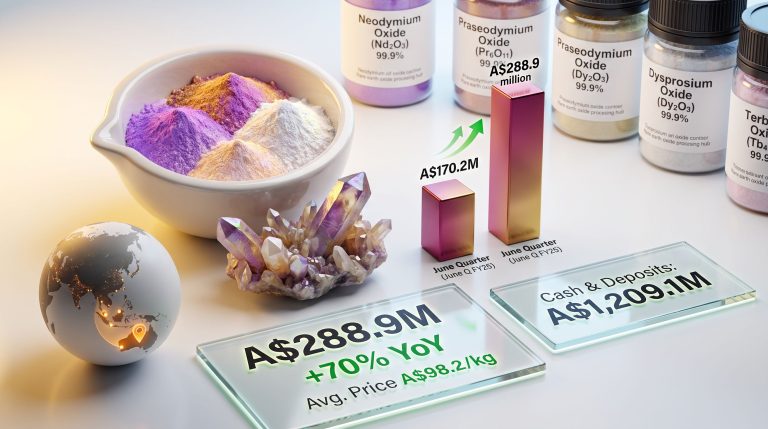
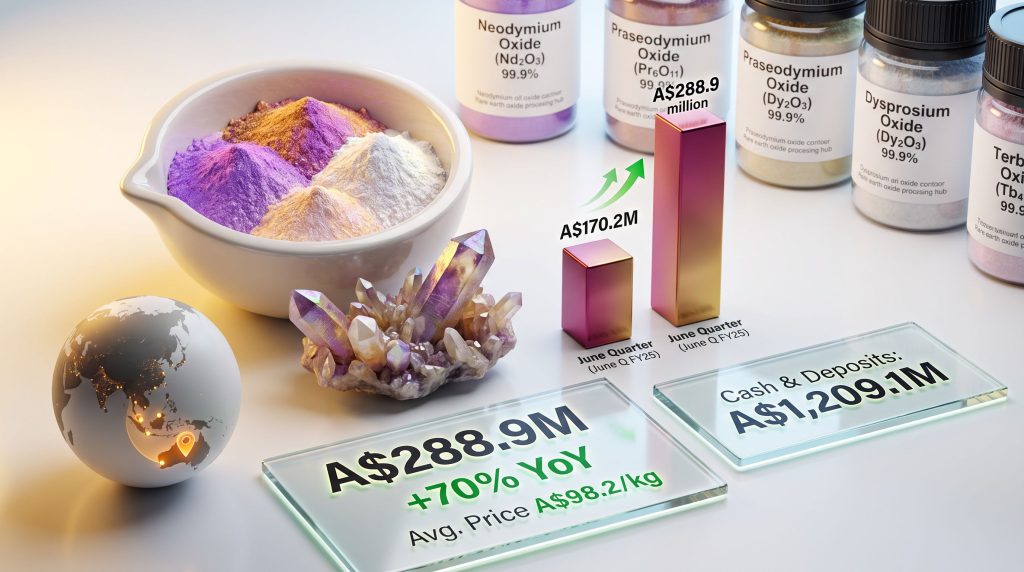
The June 2026 quarter delivered the strongest revenue result for Lynas since the fourth quarter of FY22, a period that marked the previous pricing peak. The headline metrics paint a clear picture of a business operating at a different level than twelve months prior. You can review Lynas' financial reports directly for additional historical context.
| Metric | June Quarter FY26 | June Quarter FY25 | Change |
|---|---|---|---|
| Gross Sales Revenue | A$288.9 million | A$170.2 million | +70% YoY |
| Sales Receipts | A$297.1 million | A$152.7 million | +95% YoY |
| Average Selling Price | A$98.2/kg | A$60.2/kg | +63% YoY |
| Closing Cash & Short-Term Deposits | A$1,209.1 million | A$523.8 million | +131% YoY |
| Total REO Production | 3,481 tonnes | Not disclosed | N/A |
| CAPEX & Development Payments | A$27.8 million | Not disclosed | N/A |
Several aspects of this data deserve deeper analysis beyond the headline growth rates.
The Significance of A$98.2/kg: More Than Just a Price
The average selling price of A$98.2 per kilogram is the most analytically important figure in the entire result. A year earlier, the same metric sat at A$60.2/kg. That 63% uplift does not translate linearly into a 63% earnings increase; it translates into a disproportionately larger improvement at the operating profit level because fixed costs are spread across the same production base.
This is the earnings leverage effect that commodity investors focus on: once a mining company has covered its fixed cost base, incremental price improvements flow almost entirely to the bottom line. For context, Lynas reported a full-year net profit after tax of just A$8.0 million in FY25, down sharply from A$84.5 million in FY24. A single quarter at A$98.2/kg pricing fundamentally alters that earnings trajectory.
The pricing dynamics are being driven by several converging forces:
- NdPr oxide demand from EV motor manufacturing, where neodymium-praseodymium alloys are essential to high-performance permanent magnets used in traction motors
- Defence procurement cycles across NATO and Indo-Pacific nations, which require samarium-cobalt and NdFeB magnets for guidance systems, radar, and propulsion
- Wind turbine expansion, particularly direct-drive turbines that use significantly more rare earth magnetic material per unit of generating capacity
- Constrained ex-China supply, where the number of commercially operating rare earth separation facilities outside China can still be counted on one hand
The Cash Position: A Strategic Asset, Not Just a Safety Net
Closing cash and short-term deposits of A$1,209.1 million represents more than financial security. Crossing the A$1.2 billion threshold signals that Lynas can fund its heavy rare earth expansion program in Malaysia, pursue further downstream partnerships, and absorb any near-term processing disruptions without requiring equity raisings or debt facilities. For a company with a history of capital-intensive growth initiatives, the cash pile fundamentally changes how investors should assess dilution risk.
Operational Milestones: What Changed During the Quarter
Mt Weld Expansion: Throughput Constraints Being Resolved
The A$1.5 billion Lynas 2025 growth initiative, now largely completed, centred on expanding processing capacity at Mt Weld in Western Australia and the associated Kalgoorlie Rare Earths Processing Facility. During the June quarter, the company continued ramping up the expanded Mt Weld plant while actively addressing throughput bottlenecks at Kalgoorlie. These bottlenecks are a normal feature of any processing plant ramp-up and do not indicate structural problems; they reflect the complexity of commissioning high-temperature chemical processing circuits at scale.
Total REO production of 3,481 tonnes during the quarter reflects the expanded nameplate capacity starting to be utilised more fully, though the full volume benefit of the expansion is expected to compound through FY27 as bottlenecks are cleared. The rare earth processing challenges involved in scaling such facilities are well documented across the industry.
Samarium Oxide: A New Revenue Stream With Strategic Depth
One of the most underappreciated developments in the June quarter was the commercial launch of Samarium oxide production. Samarium is a heavy rare earth element that sits outside the more widely discussed NdPr category, yet it carries significant commercial and strategic value.
Samarium-cobalt (SmCo) magnets are used extensively in defence and aerospace applications because they maintain their magnetic properties at high temperatures where standard neodymium magnets begin to degrade. Jet engine sensors, missile guidance systems, and satellite components all rely on SmCo magnets. The number of non-Chinese producers capable of supplying commercial-grade Samarium oxide is extremely limited, which gives Lynas a near-unique market position.
First customer orders for Samarium oxide are anticipated in Q1 FY27, with demand expected to come primarily from defence contractors and precision electronics manufacturers seeking supply chain independence from Chinese sources.
The JS Link Partnership: Vertical Integration Begins
The supply and investment agreement with JS Link represents a structural deepening of Lynas' commercial architecture. Under the arrangement, Lynas will exclusively supply rare earth materials to support the construction and operation of a rare earth magnet factory in Malaysia, with this rare earth offtake agreement running until 2038.
The strategic logic here is compelling. Rare earth oxide producers have historically captured only a fraction of the total value chain; the majority of margin accrues to companies that convert oxides into metals, then alloys, then finished magnets. By locking in a downstream magnet manufacturing partnership, Lynas begins to capture more of that value chain whilst simultaneously guaranteeing offtake volumes for its expanding production base. For investors focused on long-term earnings quality, contracted revenue running to 2038 is qualitatively different from spot-price-dependent sales.
Malaysia Operations: The Heavy Rare Earth Frontier
Why Heavy Rare Earths Command Premium Pricing
The rare earths universe splits broadly into light rare earths (LREEs) such as neodymium, praseodymium, lanthanum, and cerium, and heavy rare earths (HREEs) including dysprosium, terbium, gadolinium, and erbium. HREEs are present in lower concentrations in virtually every known deposit, making them substantially harder and more expensive to produce. However, their functional properties are irreplaceable in high-temperature magnet applications.
Dysprosium and terbium, in particular, are added to NdFeB magnets to improve their resistance to demagnetisation at elevated temperatures, a property critical for EV motors that operate in thermally challenging environments. Because of their scarcity and functional necessity, HREE prices command significant premiums over NdPr.
Lynas' expanded heavy rare earth processing facility in Malaysia is specifically designed to separate and refine these higher-value elements from the heavy rare earth fractions produced at Mt Weld.
Gadolinium Targeted for Early FY28
Gadolinium production at the expanded Malaysia facility is targeted for early FY28. Beyond its magnet applications, gadolinium has specialised uses in medical imaging as a contrast agent for MRI procedures, and in nuclear reactor control rods. Lynas entering commercial Gadolinium production will consequently further diversify its product suite and expose it to demand segments beyond the EV and defence sectors.
The pathway to eventually producing commercial terbium and dysprosium from the Malaysia facility represents the most significant long-term value creation opportunity in Lynas' portfolio, as these elements command the highest per-kilogram prices in the rare earths complex.
Share Price Context and Investor Considerations
Over the twelve months to July 2026, Lynas shares appreciated approximately 58%, substantially outperforming the S&P/ASX 200 Index, which returned approximately 1% over the same period. This re-rating reflects three compounding factors: earnings recovery from the FY25 trough, rapid cash accumulation reinforcing balance sheet confidence, and strategic partnership announcements signalling downstream demand certainty. Market analysts have noted that Lynas delivered its best quarter in four years on the back of rising NdPr prices.
How Lynas Compares Within the ASX Resources Sector
| Attribute | Lynas Rare Earths (LYC) | Diversified Miners (BHP, RIO) |
|---|---|---|
| Rare earth exposure | Pure-play, primary focus | Negligible or indirect |
| Processing capability | Mine-to-oxide vertically integrated | Limited rare earth processing |
| Ex-China positioning | Core competitive advantage | Not a strategic differentiator |
| Cash generation | Strongly improving | Mature, dividend-oriented |
| Growth optionality | HRE expansion, new products | Primarily through M&A |
The scarcity premium attached to vertically integrated, ex-China rare earth producers is real and structural. Lynas occupies a category with effectively no direct ASX-listed peers at comparable scale.
Key risk factors investors should weigh include:
- Rare earth commodity price volatility, which remains the primary earnings driver
- Processing licence renewals in Malaysia, which have historically attracted regulatory scrutiny around radioactive waste management from the processing of thorium-bearing rare earth ores
- Single-asset concentration risk at Mt Weld, where any extended production disruption would directly impair revenue
- The execution timeline for the Malaysia HRE facility, where delays would push back the Gadolinium and eventual dysprosium/terbium revenue streams
The next major ASX story will hit our subscribers first
Catalysts Worth Monitoring Through FY27 and FY28
Near-Term (FY27)
- First commercial Samarium oxide orders, expected Q1 FY27
- Continued throughput improvement at the Kalgoorlie processing facility
- Progress updates on Malaysia HRE facility construction milestones
- Any additional exclusive offtake agreements with downstream magnet manufacturers following the JS Link model
Medium-Term (FY28 and Beyond)
- Gadolinium production commencement at the Malaysia facility (early FY28 target)
- Expansion of the HREE product suite toward terbium and dysprosium
- Scaling of the JS Link magnet factory supply relationship as the facility reaches full production capacity
- Potential new supply agreements with manufacturers in Japan, the United States, or Europe seeking to build resilient rare earth magnet supply chains
Key Takeaways from the Lynas Rare Earths June Quarter Earnings
The June 2026 quarter results offer a multi-dimensional picture of a company emerging from a prolonged earnings trough with stronger pricing, expanded capacity, a fortified balance sheet, and a deepening commercial architecture.
- Record revenue of A$288.9 million confirms the decisive break from FY25 conditions, driven by both volume and price
- Average pricing of A$98.2/kg reflects structural demand growth and supply scarcity, not a temporary speculative spike
- A$1.2 billion in cash eliminates near-term dilution risk and funds the HREE expansion without external capital
- Samarium oxide commercialisation introduces a new revenue stream anchored in defence and precision electronics demand
- The JS Link partnership to 2038 transforms a portion of Lynas' revenue from spot-price exposure to contracted long-term supply
- Gadolinium production in early FY28 begins the transition into the highest-value tier of the rare earths complex
The structural argument for Lynas rests on a simple but powerful reality: the world needs more rare earth supply outside China, Mt Weld is among the best deposits on Earth to provide it, and the company now has the financial resources and downstream partnerships to execute on that opportunity at scale.
Important Disclaimer: This article provides general financial information only and does not constitute personal investment advice. All financial figures are sourced from Lynas Rare Earths' quarterly activities report filed with the ASX on 22 July 2026. Forecasts, timelines, and strategic targets are those of the company and may not be achieved. Past share price performance is not indicative of future returns. Investors should conduct independent due diligence and consider seeking advice from a licensed financial adviser before making any investment decisions.
Want to Capitalise on the Next Major ASX Mineral Discovery Before the Crowd Does?
Discovery Alert's proprietary Discovery IQ model scans ASX announcements in real time, instantly translating complex mineral data into actionable insights for both short-term traders and long-term investors — explore historic discoveries and their exceptional returns to understand the scale of opportunity, then begin your 14-day free trial at Discovery Alert to position yourself ahead of the broader market.