
August 11, 2026
Underground Gold Mining's Quiet Renaissance: What the Macmahon Holdings Snowy River Gold Mine Contract Reveals About a Shifting Sector
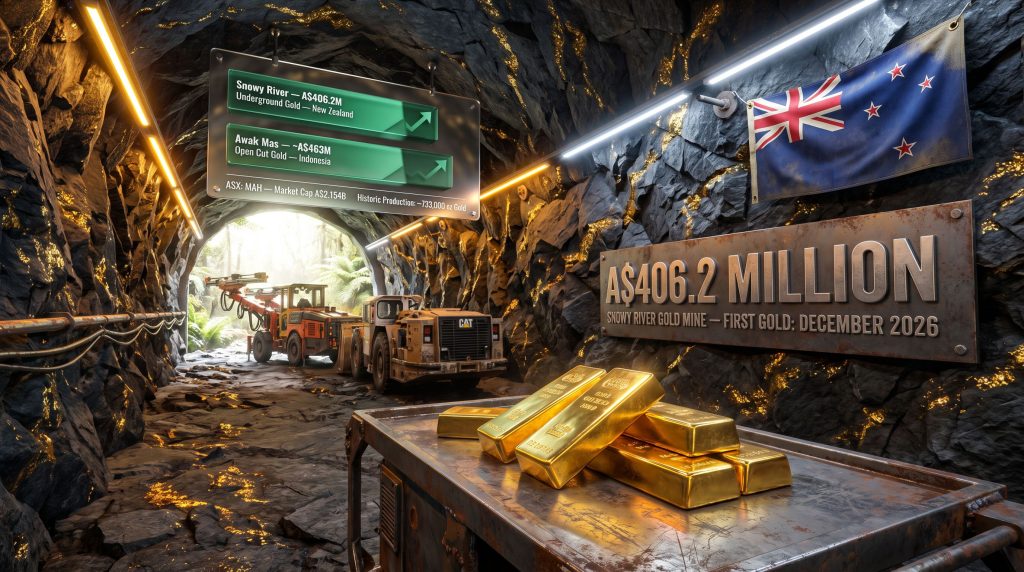
For much of the past two decades, the global mining industry tilted heavily toward bulk-tonnage open-cut operations, favouring scale over grade. That preference is now reversing. As record gold prices sustain historically elevated levels and high-quality underground deposits become increasingly scarce, a structural rotation is underway, one that rewards technical precision over sheer volume. The Macmahon Holdings Snowy River gold mine contract, valued at A$406.2 million, is a crystalline example of this shift materialising in real capital commitments.
When big ASX news breaks, our subscribers know first
Snowy River: Not a Greenfield Story, But a Resurrection
The Snowy River gold mine is not a newly discovered resource chasing an exploration narrative. Its geological credentials were established more than a century ago. The main ore body, known as the Birthday Reef, was first identified in 1905 by a small prospecting group operating in the rugged terrain south of Reefton on New Zealand's South Island. What followed was an uninterrupted 45-year production run that extracted an estimated 733,000 ounces of gold, approximately 21 tonnes, before operations were halted in 1951.
Critically, the closure was not caused by resource depletion. The Blackwater Shaft suffered a structural collapse that rendered continued access uneconomic to repair at the time. The ore body itself remained viable. This distinction matters enormously from an investment and geological standpoint because it means the revival of Snowy River is not a speculative bet on an unproven system. The reef's productivity was demonstrated across nearly half a century of continuous extraction.
The Birthday Reef: Grade, Consistency, and Geological Rarity
Within underground gold mining, reef-style ore bodies are evaluated not just on grade but on lateral and vertical consistency. Many high-grade intercepts globally prove erratic at depth or along strike, creating production uncertainty that inflates operating costs and complicates reserve estimation. The Birthday Reef's reputation for consistency is precisely what differentiates Snowy River from the broader universe of historic underground gold mines.
Narrow-vein, high-grade reef systems of this profile are characterised geologically by:
- Structurally controlled mineralisation hosted within quartz veins
- Gold occurring in free-milling form, typically amenable to conventional processing
- Steep dip angles that require vertical shaft or decline access rather than open-pit geometries
- Limited dilution potential when mined using selective methods, preserving head grade through to the mill
These characteristics explain why the Snowy River project attracted institutional-grade backing and why a contractor of Macmahon's scale was engaged to manage the underground services scope. Selective, high-grade underground mining demands a different operational discipline than bulk open-cut work, and the choice of contractor reflects that reality.
Breaking Down the $406.2M Contract Structure
The Macmahon Holdings Snowy River gold mine contract is executed through Macmahon New Zealand, a wholly-owned subsidiary established to manage jurisdictional and contractual obligations within the New Zealand operating environment. The client counterparty is Tasman Mining, itself a wholly-owned subsidiary of Endura Mining.
| Parameter | Detail |
|---|---|
| Contract Value | A$406.2 million |
| Contract Term | 5 years |
| Commencement | October 2026 |
| First Gold Target | December 2026 |
| Services Scope | Development, production, backfill operations |
| Contracting Entity | Macmahon New Zealand |
| Client Entity | Tasman Mining (Endura Mining subsidiary) |
| Mine Location | South of Reefton, South Island, New Zealand |
The inclusion of backfill operations within the contracted scope is a technical detail worth unpacking. Backfilling in underground mining refers to the practice of returning waste material, cemented or otherwise, into mined-out voids called stopes. This serves two purposes: it maintains the structural integrity of the surrounding rock mass, and it allows mining to proceed safely in adjacent ore zones without triggering subsidence or seismic instability.
The fact that backfill has been scoped into this contract from the outset signals that the underground geometry at Snowy River demands careful void management, a hallmark of high-grade, narrow-vein reef environments where the surrounding rock is not always self-supporting after extraction.
The presence of backfill obligations also increases the technical complexity and cost profile of the contract, which in part explains why the per-year contract value averages roughly A$81 million annually across the five-year term. This figure is consistent with a technically demanding underground operation rather than a simple ore haulage arrangement. Furthermore, similar technically complex contracts, such as the Tanami underground expansion, demonstrate how capital-intensive underground commitments of this scale are becoming increasingly common across the sector.
Macmahon's Strategic Logic: New Zealand Re-Entry and Portfolio Diversification
For Macmahon Holdings (ASX: MAH), the Snowy River award carries meaning beyond its face value. The contract represents the company's re-entry into the New Zealand mining services market, a jurisdiction it had not previously operated in at this scale. With a market capitalisation of approximately A$2.154 billion at the time of the announcement and shares steady at A$1.01, the market's muted reaction reflected absorption of this win as consistent with Macmahon's existing growth trajectory rather than a surprise outperformance.
That composure from the market is itself informative. It suggests that institutional investors already anticipated contract pipeline growth of this magnitude, and that the Snowy River award is viewed as execution on an established strategy rather than a deviation from it.
Comparing Macmahon's Major Active Contracts
| Contract | Location | Value | Mining Type | Margin Profile |
|---|---|---|---|---|
| Snowy River (Endura Mining) | New Zealand | A$406.2M | Underground gold | Higher (technical complexity) |
| Awak Mas (PT Masmindo Dwi Area) | South Sulawesi, Indonesia | ~A$463M | Open-cut gold | Standard |
The contrast between these two major contracts is instructive. Underground mining services consistently command higher technical margins than open-cut equivalents because they require specialised equipment fleets, more intensive safety management systems, and personnel with specific competencies in ground support, ventilation, and stope sequencing. For Macmahon, growing the underground component of its revenue mix is a deliberate margin improvement strategy, not merely geographic expansion.
Why the Subsidiary Structure Matters
The use of Macmahon New Zealand as the contracting vehicle rather than the parent entity is not merely a legal formality. Operating through a local subsidiary allows Macmahon to manage New Zealand-specific employment law, health and safety regulations under the Health and Safety at Work Act 2015 (NZ), and potential currency exposure more efficiently. It also positions the subsidiary as a standalone entity capable of building a New Zealand contract portfolio over time, with Snowy River as the anchor engagement.
Endura Mining and the Ambition Behind Tasman Mining's Development
Endura Mining's decision to develop Snowy River as a flagship asset reflects a broader thesis about where value creation in gold mining currently resides. Led by Executive Chair Jake Klein, Endura is pursuing a strategy centred on assembling a portfolio of gold and copper assets with defined geological quality. The engagement of Macmahon, a contractor operating at the A$2 billion market cap scale, signals that the Snowy River project is being developed with institutional-grade operational standards from the outset.
The company's ambition to position Snowy River as one of New Zealand's largest gold mining operations is underpinned by the ore body's demonstrated historical productivity. New Zealand's gold mining sector has been historically underinvested relative to Australia's, partly due to regulatory complexity, environmental sensitivity, and the smaller domestic capital markets infrastructure available to support large project development.
The involvement of experienced institutional leadership at Endura, combined with a contracted mining services arrangement that transfers operational execution risk to a specialist provider, addresses many of the barriers that have historically constrained New Zealand gold development. In addition, precedents such as the Gruyere underground study illustrate how rigorous pre-development analysis underpins the confidence required to commit this level of capital to underground gold operations.
The October to December 2026 Window: Execution Risk in Focus
The two-month gap between Macmahon's contract commencement in October 2026 and the targeted first gold pour in December 2026 represents the highest concentration of operational execution risk in the project's near-term timeline. During this period, the underground operation must transition from a development-phase configuration to an initial production-ready state, with backfill infrastructure operational and stope sequencing established.
Key risks within this window include:
- Ground conditions: Any unexpected geological variability during final development drives could delay stope readiness
- Equipment mobilisation: Specialised underground fleet logistics across an international border add lead time complexity
- Labour ramp-up: Sourcing and credentialing underground personnel in New Zealand requires compliance with NZ mining certification standards
- Backfill plant commissioning: Cemented backfill systems must be operational before production stopes can be safely opened at scale
For analysts monitoring both Macmahon Holdings and Endura Mining, the December 2026 first gold milestone functions as the primary near-term proof point for project execution. A successful on-schedule pour would validate both the contractor's underground capability and the operator's development management. Any delay carries reputational weight for both parties beyond the immediate financial implications.
The next major ASX story will hit our subscribers first
Structural Forces Driving the Underground Gold Services Market
The Macmahon Holdings Snowy River gold mine contract does not exist in isolation. It reflects a broader structural shift in how mining capital is being allocated globally as the gold price environment sustains support for previously marginal underground projects.
Several converging forces are shaping this dynamic:
- Gold price elevation: Sustained gold prices above US$2,000 per ounce through 2025 and into 2026 have materially improved the economics of high-grade underground projects that require more capital-intensive development
- Grade scarcity premium: As open-cut deposits globally trend toward lower average grades, high-grade underground systems command increasing attention from both operators and investors
- Services margin rotation: Mining services companies are actively seeking to increase their underground exposure because the technical complexity generates higher margins than open-cut equivalents
- New Zealand sector reawakening: New Zealand's gold mining sector, historically underexplored relative to its geological prospectivity, is seeing renewed interest from groups with the institutional capital and technical capacity to develop complex underground systems
Order Book Depth as a Valuation Signal
For ASX-listed mining services companies, secured order book is among the most closely watched valuation metrics by institutional investors. It provides revenue certainty that underwrites capital investment decisions, supports debt servicing capacity, and signals competitive positioning within the contractor landscape.
However, understanding how these projects arrive at contracted status requires careful analysis. Consequently, definitive feasibility studies play a critical role in converting geological potential into bankable project commitments that underpin contracts of this scale. Furthermore, interpreting gold drill results at the earliest exploration stages is what ultimately determines whether assets like Snowy River progress from historical curiosity to active development.
The addition of A$406.2 million to Macmahon's order book reinforces its standing among Australia's largest mining services providers and strengthens the case for sustained earnings visibility across the 2026–2031 period.
Disclaimer: This article is intended for informational purposes only and does not constitute financial advice. All forward-looking statements, project timelines, and financial figures are based on publicly available information as of the date of publication. Readers are encouraged to conduct independent research and consult a licensed financial adviser before making investment decisions. Past performance of mining projects and listed securities is not indicative of future results.
Want to Know When the Next Major Underground Gold Discovery Hits the ASX?
Discovery Alert's proprietary Discovery IQ model scans ASX announcements in real time, instantly identifying high-potential mineral discoveries across gold and 30+ other commodities — turning complex data into actionable investment insights before the broader market reacts. Explore historic discoveries and their remarkable returns, then begin your 14-day free trial at Discovery Alert to position yourself ahead of the next major find.