June 3, 2026
Madagascar's Rare Earth Mining Environmental Impact: A Biodiversity Crossroads
Global demand for critical minerals intersects with unique ecological systems in complex ways that reshape entire landscapes. The increasing urgency of energy transition technologies creates mounting pressure on nations with substantial rare earth deposits to balance extraction economics against environmental preservation. Madagascar rare earth mining environmental impact exemplifies this tension, where exceptional biodiversity meets strategic mineral potential in a developing economy seeking revenue diversification.
The island's rare earth mining prospects emerge within a broader context of supply chain vulnerability and geopolitical realignment. Furthermore, mining industry evolution demonstrates how traditional mining regions face depletion or political instability, prompting new territories to enter consideration for their untapped mineral resources. However, Madagascar's case presents distinctive challenges due to its status as one of Earth's most biodiverse hotspots, containing endemic species found nowhere else on the planet.
When big ASX news breaks, our subscribers know first
Understanding Madagascar's Position in the Global Rare Earth Supply Chain
Madagascar's emergence as a potential rare earth supplier represents a critical inflection point in global resource geopolitics. The island nation sits atop significant deposits of these 17 strategically vital elements, positioning itself as a potential alternative to China's market dominance. According to the U.S. Geological Survey's 2026 Mineral Commodity Summary, China controlled approximately 60-70% of global rare earth production through 2025, with operations concentrated in Jiangxi, Inner Mongolia, and Shandong provinces.
The strategic importance of diversification becomes apparent when examining supply concentration risks. Current market dynamics show that disruptions in Chinese production or export policies directly affect global technology manufacturing, electric vehicle production, and renewable energy infrastructure development. Consequently, green transition insights suggest that Madagascar's deposits offer geographic diversification rather than supply dominance, potentially capturing 3-5% of global supply by 2035.
Strategic Importance of Rare Earth Elements
| Element Group | Primary Applications | Madagascar's Potential Role |
|---|---|---|
| Light REEs (La, Ce, Pr, Nd) | Wind turbines, electric vehicles | Primary target for extraction |
| Heavy REEs (Dy, Tb, Y) | Advanced electronics, defense systems | Secondary extraction potential |
| Critical Pairs (Nd-Dy, Pr-Tb) | Permanent magnets | Key to energy transition |
The U.S. Energy Information Administration projects global rare earth element demand growing at 4-6% annually through 2035, driven primarily by renewable energy infrastructure expansion. Wind turbine permanent magnets requiring neodymium and dysprosium represent the largest demand growth sector, with electric vehicle motors consuming 30-40% of global neodymium production.
Madagascar's Geological Advantage
The island's rare earth deposits occur primarily in ionic clay formations, distinguishing them from hard-rock deposits found in China, Australia, and the United States. These formations contain readily extractable rare earth ions but require extensive processing infrastructure to achieve commercial viability. In addition, ionic adsorption clays typically contain 0.04-0.12% rare earth oxides by weight, compared to hard-rock deposits ranging from 0.01-0.3%.
Technical Processing Differences:
• Ionic Clay Method: Heap leaching with ammonium sulphate solutions to mobilise ions from clay structure
• Lower Energy Requirements: Reduced crushing and grinding compared to hard-rock mining
• Chemical Processing Intensity: Higher chemical input requirements for extraction and purification
• Waste Generation Patterns: Different waste composition but potentially higher volumes per unit of production
The ionic clay extraction model offers both opportunities and challenges. While requiring lower capital intensity than traditional hard-rock mining, these operations generate proportionally higher chemical processing requirements and create different environmental impact patterns.
How Do Current Mining Projects Balance Economic Returns Against Environmental Risks?
Ampasindava Peninsula Development Framework
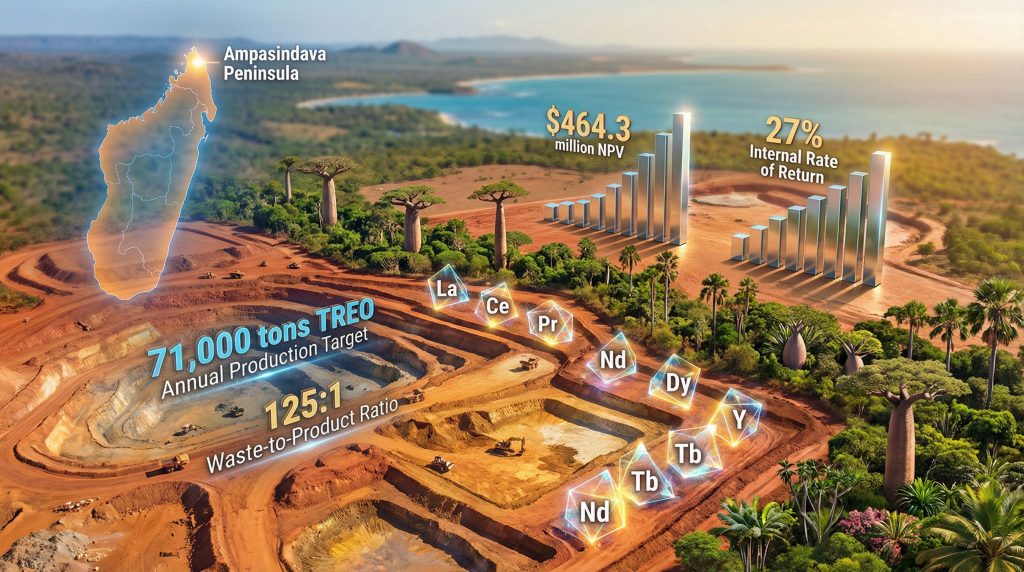
Harena Rare Earths' Ampasindava project represents Madagascar's most advanced rare earth development initiative. The pre-feasibility study released in January 2026 outlines production targets that position the project among significant global rare earth operations.
Project Financial Specifications:
• Annual Production Target: 71,000 tons TREO (Total Rare Earth Oxide)
• Project Lifespan: 20 years operational period
• Initial Capital Investment: $142 million infrastructure development
• After-Tax Net Present Value: $464.3 million
• Internal Rate of Return: 27% (exceeding Madagascar's estimated 8-12% cost of capital)
• Payback Period: 5 years (shorter than typical 7-10 year mining project averages)
• Cumulative After-Tax Cash Flows: $2.6 billion over operational life
The project's 27% internal rate of return significantly exceeds typical mining project returns and Madagascar's country risk-adjusted cost of capital. However, pre-feasibility projections typically incorporate conservative price assumptions and optimistic cost estimates, requiring validation through full feasibility analysis.
Environmental Processing Requirements:
• Waste-to-Product Ratio: 125:1 (125 tons waste per ton of rare earths produced)
• Annual Waste Generation: 8.875 million tons requiring containment or discharge management
• Water Consumption: 400 million tons over project life (20 million tons annually)
• Primary Chemical Inputs: Ammonium sulphate and acid leaching solutions for ion extraction
• Processing Chemical Volume: Estimated 50,000-100,000 tons annually of chemical reagents
Vara Mada Project Comparative Analysis
Energy Fuels Inc.'s Vara Mada project offers a contrasting development model, integrating rare earth production with traditional mineral sands operations. The feasibility study completed in January 2026 demonstrates how rare earth extraction can complement existing mining activities.
| Metric | Ampasindava | Vara Mada |
|---|---|---|
| Primary Target | Rare earth oxides | Monazite (27% of revenue) |
| Annual Production | 71,000 tons TREO | 24,000 tons monazite |
| Project Duration | 20 years | 38 years |
| Development Status | Pre-feasibility | Full feasibility |
| Revenue Model | Pure rare earth focus | Diversified mineral sands |
| Byproducts | Minimal | Ilmenite, zircon, rutile (73% revenue) |
The Vara Mada project's extended 38-year lifespan reflects monazite's characteristics as a byproduct of mineral sands mining rather than a primary extraction target. This structure potentially reduces environmental footprint intensity by spreading operations across multiple commodity streams while creating long-term exposure to market volatility.
Economic Comparison Context:
Lynas Rare Earths' Mount Weld hard-rock operation in Western Australia provides benchmarking data for rare earth project economics. Lynas achieved approximately 18-22% internal rates of return on their initial $235 million development investment, with a 6-7 year payback period. The lower returns compared to Madagascar's projected 27% reflect hard-rock mining's higher processing complexity and waste management costs.
What Environmental Degradation Patterns Emerge from Rare Earth Extraction?
Water System Contamination Pathways
Rare earth extraction creates multiple contamination vectors that persist long after active mining ceases. The chemical processing required to concentrate rare earth elements from low-grade ores introduces contaminants that exceed natural ecosystem buffering capacity.
Immediate Impact Vectors:
• pH Alteration: Ammonium sulphate leaching typically lowers pH by 2-3 units (from neutral pH 7 to acidic pH 4-5)
• Heavy Metal Mobilisation: Process solutions contain cadmium (0.5-2 ppm), lead (1-5 ppm), and zinc (5-20 ppm)
• Chemical Reagent Residues: Persistent ammonium compounds and organic extraction solvents
• Radioactive Material Exposure: Natural thorium (5-10% by weight) and uranium (0.1-0.5% by weight) in monazite deposits
Long-term Hydrological Effects:
Madagascar's northeastern regions receive 2,000-3,500mm annual rainfall, significantly above global median precipitation. This high rainfall accelerates contaminant transport through soil profiles, creating persistent pollution plumes extending beyond immediate extraction sites. The island's hydrological systems lack sufficient buffering capacity to neutralise acidic drainage over project lifespans.
Contamination Persistence Timeline:
• Active Operations: Immediate water quality degradation in extraction zones
• Post-Closure (1-5 years): Continued leaching from waste containment areas
• Long-term (10-50 years): Groundwater plume migration and ecosystem accumulation
• Permanent Legacy: Heavy metal bioaccumulation in endemic species with no migration alternatives
Biodiversity Hotspot Vulnerability Assessment
Madagascar's status as a biodiversity hotspot amplifies the environmental consequences of mining operations. The island's isolation has produced exceptional endemic species concentrations, making ecosystem disruption irreversible through local extinctions.
Ecosystem Disruption Scale:
• Direct Habitat Loss: 300 km² of concessions overlapping protected areas
• Population Displacement: 15,000 residents forced into ecologically sensitive zones
• Agricultural Impact: Loss of rice paddies, vanilla cultivation, and subsistence farming areas
• Marine Ecosystem Stress: Coastal communities reporting 50-60% decline in fish catches
Endemic Species Risk Factors:
Madagascar contains approximately 5% of global plant and animal species despite representing only 0.4% of global land area. The island's fauna includes 101 lemur species (all endemic), 346 reptile species (95% endemic), and over 11,000 endemic plant species. Mining operations create habitat fragmentation that prevents species recovery through migration from adjacent areas.
Biodiversity Impact Mechanisms:
• Habitat Fragmentation: Mining concessions create barriers to species movement
• Water Source Contamination: Endemic aquatic species lack alternative habitats
• Soil Chemistry Alteration: Endemic plant communities adapted to specific soil conditions
• Noise and Light Pollution: Disruption of sensitive endemic fauna behavioural patterns
Research from Madagascar's protected area management indicates that ecosystem recovery from mining disturbance requires 25-50 years minimum, with some functions never fully restored. The island's unique evolutionary history means that local species extinctions represent permanent global biodiversity loss.
Which Regulatory Frameworks Govern Environmental Protection in Madagascar's Mining Sector?
2023 Mining Code Environmental Provisions
Madagascar updated its mining regulations in 2023 to incorporate international environmental standards and address community concerns from previous mining projects. The revised framework establishes comprehensive assessment requirements and enforcement mechanisms.
Mandatory Assessment Requirements:
• Environmental Impact Assessment (EIA): Comprehensive ecosystem analysis before permit approval
• Social Impact Assessment: Community consultation and consent documentation
• Rehabilitation Planning: Detailed post-mining restoration specifications
• Financial Guarantees: Bank-guaranteed deposits for environmental restoration
• Continuous Monitoring Systems: Real-time environmental parameter tracking throughout operations
Community Consultation Protocols:
• Stakeholder Identification: Mapping of affected communities and traditional authorities
• Information Disclosure: Public access to environmental assessment findings
• Consent Documentation: Formal agreement processes with local communities
• Grievance Mechanisms: Complaint resolution procedures during operations
• Benefit-Sharing Agreements: Community compensation and development commitments
Implementation Gaps and Challenges
Despite comprehensive regulatory frameworks, enforcement capacity remains limited by institutional resources and technical expertise. The gap between regulatory intentions and implementation reality creates uncertainties for both investors and communities.
| Regulatory Area | Intended Protection | Current Enforcement Reality |
|---|---|---|
| Waste Management | Secure containment systems | Limited monitoring infrastructure |
| Water Quality | Baseline protection standards | Insufficient testing frequency |
| Community Rights | Meaningful consultation | Inadequate representation mechanisms |
| Restoration Planning | Comprehensive rehabilitation | Unclear long-term funding |
| Environmental Monitoring | Continuous assessment | Intermittent data collection |
Enforcement Mechanisms:
• Progressive Penalty Structure: Escalating fines from $10,000 to $1 million for violations
• Operating Licence Suspension: Authority to halt operations for serious environmental breaches
• Restoration Bonding: Financial guarantees equivalent to 15-20% of project capital costs
• Third-Party Auditing: Independent environmental compliance verification requirements
The regulatory framework incorporates international best practices but faces implementation challenges common to developing economies. Limited technical capacity for environmental monitoring and enforcement creates risks that actual environmental protection may fall short of regulatory intentions.
How Do Local Communities Experience Mining Development Pressures?
Socioeconomic Disruption Patterns
Mining development fundamentally alters traditional livelihood systems across affected regions. Communities experience immediate displacement pressures while facing uncertain long-term economic benefits from mining operations.
Livelihood Transformation Impacts:
• Agricultural Displacement: Traditional farming systems disrupted by land acquisition and water source contamination
• Marine Resource Degradation: Fishing communities report 50-60% reductions in catch volumes due to coastal sedimentation
• Cultural Heritage Threats: Sacred sites and burial grounds threatened by mining concession boundaries
• Economic Dependency Risks: Shift from diversified subsistence economy to mining-dependent wage labour
• Infrastructure Overwhelm: Local roads, healthcare, and education systems stressed by mining workforce influx
Community resistance movements have emerged across multiple mining regions, with residents, traditional leaders, and civil society organisations forming coalitions to challenge project approvals. These movements document environmental damage from previous exploration phases and demand stronger protection mechanisms. Additionally, according to Madagascar's mining governance research, these resistance efforts highlight the complex relationship between large-scale mining development and local community impacts.
Land Tenure Complications:
Madagascar's customary land tenure systems often lack formal legal recognition, creating vulnerabilities when mining concessions overlap traditional territories. Community land rights typically depend on ancestral use patterns and traditional authority recognition rather than formal title registration.
Gender-Differentiated Environmental Impacts
Environmental degradation from mining creates disproportionate impacts on women due to their roles in water collection, subsistence agriculture, and household health management.
Disproportionate Effects on Women:
• Water Collection Burden: Increased distances to clean water sources (from average 500m to 2-5km in affected areas)
• Food Security Responsibility: Women manage 70% of subsistence agriculture affected by land acquisition and soil contamination
• Health Care Access: Limited resources for addressing pollution-related respiratory and skin conditions
• Economic Participation: Reduced opportunities in traditional economic activities like vanilla cultivation and artisanal fishing
• Childcare Complications: Environmental health risks creating additional childcare responsibilities
Research from similar mining contexts indicates that women's economic participation decreases by 15-25% during mining development phases due to disruption of traditional income sources and increased domestic responsibilities from environmental health impacts.
The next major ASX story will hit our subscribers first
What Alternative Development Models Could Minimise Environmental Damage?
Technological Innovation Opportunities
Advanced extraction technologies offer potential pathways to reduce environmental footprints while maintaining economic viability. However, technology adoption requires significant capital investment and technical expertise development. Furthermore, ongoing mining sustainability trends demonstrate how innovation can reshape traditional extraction approaches.
Advanced Extraction Methods:
• In-Situ Leaching: Underground processing reduces surface disruption by 60-70% compared to conventional methods
• Selective Extraction: Targeting specific rare earth elements minimises waste generation and chemical usage
• Closed-Loop Water Systems: Water recycling reduces freshwater consumption by 80-90% and eliminates discharge
• Bioremediation Integration: Natural processes neutralise mining waste using endemic microbial communities
• Precision Mining: GPS and sensor-guided extraction reduces overburden removal and habitat disruption
Processing Efficiency Improvements:
• Concentration Technologies: Advanced separation techniques increase rare earth yields per ton of processed material by 20-30%
• Waste Valorisation: Converting mining byproducts into construction materials or agricultural soil amendments
• Renewable Energy Integration: Solar and wind power for processing operations reduces carbon footprint
• Modular Processing Plants: Scalable facilities that can adjust production to market demand and environmental conditions
Sustainable Mining Framework Development
Comprehensive sustainability frameworks require integration across environmental protection, social equity, economic viability, and governance transparency dimensions. Moreover, successful implementation of mine reclamation innovation demonstrates how restoration technologies can reduce long-term environmental impacts.
| Sustainability Pillar | Implementation Strategy | Measurable Outcomes |
|---|---|---|
| Environmental Protection | Ecosystem-based management | Biodiversity indices maintenance |
| Social Equity | Community ownership models | 30% local employment minimum |
| Economic Viability | Value-added processing | 60% domestic value capture |
| Governance Transparency | Public monitoring systems | Real-time environmental data access |
| Cultural Preservation | Traditional authority integration | Sacred site protection protocols |
Community Partnership Models:
• Revenue Sharing Agreements: 5-15% of project revenues allocated to community development funds
• Local Employment Requirements: Minimum 30% workforce from affected communities with skills training programmes
• Environmental Co-Management: Community involvement in monitoring and restoration activities
• Traditional Knowledge Integration: Incorporating indigenous environmental management practices
• Cultural Impact Mitigation: Protocols for protecting sacred sites and traditional practices
These partnership models require legal frameworks that recognise customary land rights and traditional authority systems while providing mechanisms for meaningful community participation in decision-making processes.
What Role Does Madagascar Play in Global Rare Earth Supply Security?
Geopolitical Supply Chain Implications
Madagascar's rare earth potential addresses critical supply chain vulnerabilities in Western economies while avoiding the scale that would create new dependency relationships. The island's production capacity offers meaningful diversification without market disruption. In this context, understanding decarbonisation mining benefits helps explain the strategic importance of sustainable mineral extraction approaches.
Strategic Diversification Benefits:
• Reduced Chinese Dependency: Alternative source for Western technology and defence industries
• Supply Chain Resilience: Geographic distribution reduces single-point-of-failure risks
• Technology Transfer Opportunities: Knowledge sharing for sustainable extraction methods
• Regional Economic Integration: Southern African mining corridor development
• Political Stability: Democratic governance structure compared to some rare earth producing regions
Market Position Analysis:
Current global rare earth mine production totals approximately 300,000 tons annually, with China producing 210,000-240,000 tons (70-80% market share). Madagascar's projected production of 70,000-95,000 tons (combining major projects) would represent 3-5% of global supply, providing meaningful diversification while remaining a relatively minor player compared to established producers.
Supply Security Considerations:
• Processing Capacity: Madagascar lacks downstream processing capabilities, requiring technology transfer and investment
• Infrastructure Development: Port facilities, transportation networks, and power generation require substantial upgrade
• Technical Expertise: Limited domestic capacity for rare earth metallurgy and quality control
• Environmental Standards: International buyers increasingly require certified sustainable sourcing
• Political Risk: Long-term stability essential for supply chain planning by international buyers
Investment Risk-Return Calculations
Investors must evaluate Madagascar's rare earth projects within complex risk matrices that incorporate environmental liabilities, regulatory changes, community relations, and market volatility. Additionally, concerns about rare earth mining environmental consequences highlight the broader global debate surrounding critical mineral extraction impacts.
Environmental Cost Internalisation:
• Restoration Provisioning: 15-20% of project revenues allocated to environmental remediation reserves
• Insurance Requirements: Comprehensive environmental liability coverage ($50-100 million policies)
• Monitoring Expenses: $2-5 million annually for environmental assessment and reporting
• Community Compensation: $10-20 million over project life for ecosystem service losses and development programmes
• Regulatory Compliance: $3-8 million annually for permitting, auditing, and reporting requirements
Risk-Adjusted Return Analysis:
Standard mining project evaluation incorporates 15-25% risk premiums for environmental and social factors in developing economies. Madagascar's biodiversity sensitivity and community resistance movements suggest risk premiums at the higher end of this range, potentially reducing effective project returns from 27% to 18-22% when fully risk-adjusted.
Investment Structure Considerations:
• Debt Financing Availability: International lenders increasingly require environmental and social compliance certification
• Equity Partner Requirements: Major mining companies seek proven environmental management track records
• Government Partnership: State participation may reduce political risk but add bureaucratic complexity
• Export Credit Agencies: Government-backed financing often includes environmental performance conditions
• Carbon Credit Integration: Potential revenue from verified emissions reductions through sustainable practices
Frequently Asked Questions About Madagascar Rare Earth Mining Environmental Impact
How long do environmental impacts from rare earth mining persist in Madagascar's unique ecosystem?
Environmental contamination from rare earth extraction in Madagascar can persist for decades to centuries, particularly in groundwater systems where heavy metals and radioactive materials accumulate. The island's high rainfall (2,000-3,500mm annually) accelerates contaminant transport but also dilutes concentrations over time. Restoration efforts typically require 10-15 years minimum for basic ecosystem function recovery, with some endemic species populations potentially never recovering due to Madagascar's isolation preventing species recolonisation from adjacent areas.
What makes Madagascar's rare earth deposits environmentally riskier than other global locations?
Madagascar's environmental risks exceed other locations due to three critical factors: exceptional biodiversity with 95% endemic species that cannot migrate to alternative habitats, ionic clay deposits requiring intensive chemical leaching processes, and high rainfall patterns that rapidly transport contaminants through ecosystems. Unlike continental mining operations where species can relocate to similar habitats, Madagascar's island isolation means local extinctions represent permanent global biodiversity loss.
Can rare earth mining be conducted in Madagascar without significant environmental damage?
While advanced technologies can reduce environmental impacts by 60-80% compared to conventional methods, rare earth mining inherently involves large-scale landscape disruption and chemical processing. The 125:1 waste-to-product ratio means every ton of rare earths produces 125 tons of waste requiring management. The question becomes whether economic and strategic benefits justify carefully managed environmental trade-offs rather than achieving zero environmental impact, which current technology cannot deliver.
How do Madagascar's environmental standards compare to other rare earth producing countries?
Madagascar's 2023 Mining Code incorporates international best practices comparable to Australia and Canada's regulatory frameworks, requiring comprehensive environmental impact assessments, community consultation, and financial guarantees for restoration. However, enforcement capacity remains limited compared to developed countries, with insufficient monitoring infrastructure and technical expertise creating implementation gaps. Standards match developed countries on paper but actual environmental protection depends on enforcement capability development.
What are the specific health risks for local communities from rare earth mining in Madagascar?
Health risks include respiratory problems from dust exposure containing radioactive particles, skin and digestive issues from contaminated water sources, and long-term cancer risks from thorium and uranium exposure naturally occurring in rare earth deposits. Children face particular vulnerability due to developmental sensitivity to heavy metal exposure. Community health impacts typically emerge 2-5 years after operations begin and can persist 10-20 years post-closure without proper remediation.
How do Madagascar's projects compare economically to established rare earth operations globally?
Madagascar's projected 27% internal rate of return exceeds established operations like Lynas Rare Earths' Mount Weld (18-22% IRR) due to ionic clay deposits requiring lower energy processing than hard-rock mining. However, these projections come from pre-feasibility studies that typically underestimate costs and overestimate revenues. Environmental compliance costs of 15-20% of revenues may reduce actual returns to 18-22% range, comparable to international peers but carrying higher regulatory and community relations risks.
Weighing Development Aspirations Against Ecological Preservation
Madagascar rare earth mining environmental impact represents a fundamental test of whether developing nations can pursue mineral-led economic growth while preserving irreplaceable biodiversity. The island's unique evolutionary heritage creates environmental stakes unlike those in continental mining regions, where species can migrate to alternative habitats during ecosystem disruption.
The economic projections from current projects suggest substantial revenue potential, with combined operations potentially generating $3-4 billion over operational lifespans. For a nation where mining represents 49% of export revenues, these projects offer significant GDP growth and foreign exchange earnings. However, the 125:1 waste-to-product ratio and chemical processing requirements create environmental liabilities extending decades beyond active mining periods.
Critical Decision Framework Factors:
• Irreversibility Risk: Endemic species extinctions cannot be reversed through conservation efforts alone
• Economic Dependency: Mining revenue concentration creates vulnerability to commodity price cycles
• Environmental Justice: Impacts disproportionately affect rural communities with limited political representation
• Global Responsibility: Madagascar's biodiversity represents global heritage requiring international stewardship
• Technological Potential: Advanced extraction methods could reduce environmental impacts by 60-80%
Success requires innovative approaches that transcend traditional mining models, incorporating advanced technologies, meaningful community ownership, and genuine environmental protection mechanisms. The decisions made in the coming years will determine whether Madagascar becomes a model for sustainable critical mineral development or another example of resource extraction's environmental costs.
International stakeholders bear responsibility for supporting development pathways that recognise Madagascar's unique ecological value while addressing legitimate economic development needs. This may require premium pricing for sustainably sourced rare earths and technology transfer to minimise environmental impacts.
The path forward demands honest acknowledgment of environmental trade-offs while pursuing development models that prioritise long-term ecological health alongside immediate economic benefits. Madagascar rare earth mining environmental impact will ultimately influence how the global community approaches critical mineral extraction in biodiversity hotspots worldwide, making current decisions consequential far beyond the island's shores.
Disclaimer: This analysis incorporates financial projections and environmental impact assessments that involve significant uncertainties. Actual project economics may differ substantially from feasibility study projections due to commodity price volatility, regulatory changes, and unforeseen environmental compliance costs. Environmental impact assessments represent current scientific understanding but ecosystem responses to mining activities may vary from predicted scenarios. Readers should conduct independent due diligence before making investment decisions related to Madagascar rare earth mining projects.
Ready to Track the Next Critical Minerals Discovery?
Madagascar's rare earth mining developments highlight the complex investment landscape in critical minerals, where environmental considerations increasingly influence project viability and returns. Discovery Alert's proprietary Discovery IQ model delivers real-time notifications on significant ASX mineral discoveries, helping investors identify opportunities across all commodity sectors while navigating the evolving sustainability requirements that shape modern mining investments. Begin your 30-day free trial today to gain immediate access to actionable mining investment intelligence.