The Magnetic Foundation of Industrial Competitiveness
Heavy rare earth elements operate as invisible architects of modern industrial power. These specialised materials possess unique atomic structures that enable permanent magnets to function under extreme conditions, making them indispensable for technologies requiring reliability at elevated temperatures and mechanical stress. Unlike light rare earths, which serve broader applications, dysprosium and terbium create the magnetic backbone supporting Europe's transition toward renewable energy and advanced manufacturing.
The critical nature of these elements stems from their ability to enhance coercivity in permanent magnet compositions. Dysprosium prevents magnetic degradation at temperatures exceeding 150°C, whilst terbium strengthens grain boundaries in magnet microstructures. These properties translate directly into operational reliability for wind turbines, electric vehicle motors, and defence systems operating in challenging environments.
European industrial strategy recognises heavy rare earth supply security as fundamental to maintaining technological sovereignty. The continent's complete dependence on external sources creates systemic vulnerability across multiple sectors, from renewable energy infrastructure to defence capabilities. This dependency becomes particularly acute when considering that China's rare earth dominance controls approximately 70% of global rare earth processing capacity, with significant influence over heavy rare earth element refining infrastructure.
Strategic Applications Driving European Demand
Wind energy development represents the largest growth driver for Norra Kärr dysprosium terbium supply requirements. Modern offshore wind turbines require 200-400 kg of rare earths per MW of installed capacity, with dysprosium comprising 2-3% of permanent magnet weight in high-performance generators. The European Union's wind turbine installations reached 27.1 GW in 2023, with projected expansion to 45 GW by 2030, indicating substantial demand growth for temperature-resistant magnetic materials.
Electric vehicle manufacturing creates additional pressure on heavy rare earth supply chains. Permanent magnet traction motors require 0.5-1.5 kg of rare earths per vehicle, with terbium essential for maintaining magnetic properties under the thermal cycling experienced in automotive applications. Furthermore, European manufacturers including Volkswagen, BMW, and Renault have identified HREE supply constraints as potential production bottlenecks for high-efficiency motor designs.
Defence applications present the most stringent quality requirements for heavy rare earth materials. Military-grade permanent magnets used in radar systems, electromagnetic countermeasures, and propulsion systems demand consistent performance under extreme conditions. Current European defence-critical materials strategy relies entirely on imported HREEs, creating strategic vulnerability recognised by European Defence Agency assessments.
The Critical Materials Act Framework
European Commission Regulation (EU) 2024/1589, known as the Critical Raw Materials Act, explicitly designates dysprosium and terbium as critical raw materials requiring domestic production capacity development. The regulation targets minimum 10% domestic supply capacity by 2030 and 25% by 2050 for designated critical materials, providing direct policy validation for domestic HREE projects.
This regulatory framework acknowledges that strategic autonomy requires more than policy declarations. The heavy rare earth global crisis of 2010-2011, when export restrictions resulted in permanent magnet price increases of 300-500%, demonstrated the economic consequences of supply concentration. European industries experienced manufacturing delays and cost escalation that persisted for multiple years, highlighting the systemic risks inherent in single-source dependency.
The legislation establishes preferential procurement mechanisms and potential government support for projects meeting domestic supply objectives. Norra Kärr dysprosium terbium supply capacity aligns directly with these policy frameworks, positioning the project for regulatory support and streamlined permitting processes where environmental compliance standards are met.
Quantifying Norra Kärr's Market Impact
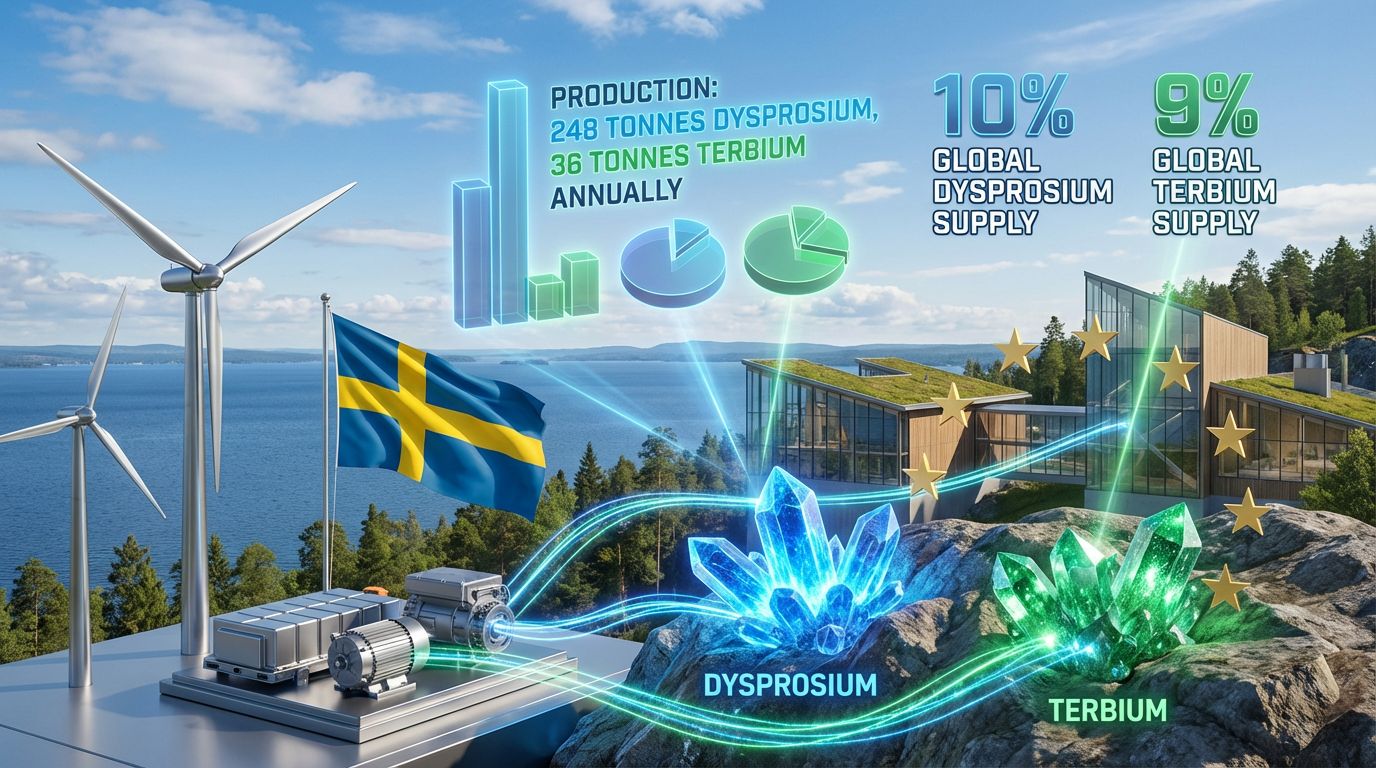
Production capacity analysis reveals the substantial scale of Leading Edge Materials' proposed heavy rare earth operations. In addition, the Norra Kärr dysprosium terbium supply project targets 248 tonnes per annum of dysprosium and 36 tonnes per annum of terbium over a 26-year operational lifespan, representing approximately 9.9% of global dysprosium production and 9% of global terbium production.
These output levels position Norra Kärr as a meaningful supply diversification option rather than a marginal market participant. Current global dysprosium production approximates 2,500 tonnes annually, whilst terbium production reaches approximately 400 tonnes annually. The project's contribution would represent sufficient volume to influence European market dynamics and reduce import dependency significantly.
Resource Quality and Processing Advantages
| Production Metric | Norra Kärr Specification | Global Context |
|---|---|---|
| Dysprosium Output | 248 tpa | 9.9% of global production |
| Terbium Output | 36 tpa | 9% of global production |
| Total TREO | 5,341 tpa | Comparable to major operations |
| HREE Percentage | 52% of TREO | Well above global average (5-15%) |
| Operational Timeline | 26 years | Long-term supply security |
The deposit's 52% heavy rare earth content distinguishes it from typical rare earth resources, which contain 5-15% HREE by weight. This concentration reduces processing waste, improves product economics, and simplifies separation chemistry compared to light rare earth dominant deposits. The high HREE grade translates into operational efficiency advantages and reduced environmental impact per unit of heavy rare earth production.
Magnet rare earth oxide (MREO) production of 1,005 tonnes per annum provides additional strategic value. MREO represents the specific rare earth elements used in permanent magnet manufacturing, including neodymium, praseodymium, dysprosium, and terbium. This output directly addresses European magnet manufacturer requirements without requiring further concentration or beneficiation.
Comparative Analysis with Global Operations
Lynas Rare Earths' Malaysian facility provides the most relevant operational comparison for Norra Kärr dysprosium terbium supply planning. Lynas processes approximately 11,000-12,000 tonnes per annum of total rare earth oxides, making Norra Kärr's 5,341 tpa TREO roughly 48% of Lynas' current processing capacity. This scale represents meaningful production volume without attempting to dominate global markets.
The operational timeline comparison reveals important development considerations:
- Lynas Malaysian expansion: 5-year development cycle (2018 announcement to 2023 production increase)
- Norra Kärr projected timeline: Prefeasibility study completion Q1-Q2 2026, with commercial production targeting 2028-2030
- Mountain Pass (California): 7,000-8,000 tpa TREO but limited HREE processing capability
- Previous European operations: Historically minimal, with no current commercial HREE production
The timeline differential reflects Sweden's comprehensive environmental permitting requirements compared to Malaysia's accelerated development processes. However, the extended development period provides opportunities for market preparation and customer relationship establishment that could benefit long-term commercial success.
Co-Product Value Creation
Nepheline syenite co-production represents significant additional revenue potential. The project generates 100-500 tonnes per hour of this industrial mineral during mining operations, with applications in ceramics, glass manufacturing, and specialty cement production. Market valuations range from $100-500 per tonne depending on processing level and end-use application.
This co-product integration improves overall project economics whilst maximising resource utilisation efficiency. Nepheline syenite demand remains stable across industrial cycles, providing revenue diversification that reduces dependence on volatile rare earth pricing. The combination of HREE production and industrial mineral sales creates a more robust financial foundation for sustained operations.
Environmental Compliance and Regulatory Navigation
Sweden's environmental regulatory framework emphasises precautionary principles and comprehensive impact assessment, particularly for projects near sensitive ecosystems. Lake Vättern's protection represents the central environmental challenge for Norra Kärr dysprosium terbium supply development, requiring project modifications that address water quality concerns whilst maintaining operational viability.
The lake serves as a drinking water source for approximately 2 million people and maintains oligotrophic status, meaning it contains naturally low nutrient concentrations with minimal biological buffering capacity against contamination. This sensitivity necessitates exceptional environmental safeguards that exceed typical mining operation standards.
Project Design Evolution
Leading Edge Materials has implemented substantial project modifications to address environmental concerns:
- 65% reduction in operational footprint compared to original proposals
- Complete elimination of onsite chemical processing to minimise contamination risk
- 30% decrease in water consumption through optimised extraction methods
- Transition to dry-stack tailings systems replacing traditional wet-tailings facilities
- Concentrate shipping protocols moving processing to external facilities with established permits
These modifications demonstrate adaptive project management responding to regulatory requirements and community concerns. The footprint reduction particularly addresses local opposition regarding visual impact and ecosystem disruption, whilst the processing elimination removes the most controversial aspect of rare earth operations.
Dry Tailings Technology Implementation
Dry-stack tailings represent advanced waste management technology reducing environmental risks compared to traditional wet-tailings ponds. The system filters mining waste solids to 15-25% water content, then stacks them in engineered facilities rather than storing them in liquid suspension. This approach provides multiple environmental benefits:
- Reduced seepage risk through lower water content and engineered containment
- Smaller surface footprint due to higher density storage
- Improved dust control through daily cover materials and moisture management
- Enhanced long-term stability with reduced catastrophic failure potential
The technology requires significant capital investment in filtration equipment and engineered storage structures but provides superior environmental protection that aligns with Swedish regulatory expectations and community concerns.
Community Engagement Strategy
The "Project Café" initiative represents structured stakeholder engagement recognising that technical solutions require public acceptance to achieve regulatory approval. In Sweden's participatory regulatory environment, public opposition can extend permitting timelines through formal appeals and consultation periods, making community acceptance strategically equivalent to environmental compliance.
This engagement approach acknowledges that social licence to operate has become a binding constraint parallel to regulatory approval. The strategy focuses on transparent communication about operational impacts, economic benefits, and environmental protection measures, building local support through information sharing rather than promotional messaging.
Swedish mining project permitting typically requires 5-8 years from initial application to final approval, with environmental impact assessment consuming 18-36 months and public consultation extending 6-12 months minimum. Appeals processes can add up to 2 years additional in contested cases, highlighting the importance of early community engagement and environmental design optimisation.
Transforming European Supply Chain Architecture
Norra Kärr dysprosium terbium supply development could fundamentally alter European heavy rare earth market dynamics by introducing domestic production capacity where none currently exists. Europe's 100% import dependency for dysprosium and terbium creates systemic vulnerability that extends beyond pricing concerns to include supply security and industrial competitiveness.
The transformation potential operates across multiple dimensions. Strategic supply diversification reduces European manufacturers' exposure to single-source disruption risks, whilst price stability improvements provide cost predictability for permanent magnet producers and downstream industries. Enhanced negotiating leverage with traditional suppliers becomes possible when alternative sources exist.
European Magnet Manufacturing Renaissance
Secure domestic HREE supply could catalyse expansion of permanent magnet manufacturing capacity within the European Union. Currently, European magnet producers rely on Asian suppliers for both raw materials and finished components, limiting local value chain development and creating logistics vulnerabilities.
Domestic dysprosium and terbium availability enables European magnet manufacturers to develop supply relationships independent of Asian supply chains. This capability becomes increasingly valuable as global competition for critical minerals intensifies and geopolitical tensions affect trade relationships.
Industrial policy alignment supports this transformation. The European critical raw materials facility specifically encourages domestic value chain development through preferential procurement, research funding, and regulatory streamlining. Norra Kärr dysprosium terbium supply positions European magnet manufacturers to benefit from these policy instruments whilst reducing external dependencies.
Defence Industry Strategic Autonomy
European defence manufacturers require the highest performance permanent magnets for radar systems, electronic warfare equipment, and propulsion applications. These systems demand consistent material properties and supply reliability that become compromised when dependent on external sources potentially affected by trade restrictions or political tensions.
Domestic HREE production provides defence contractors with supply security that meets NATO interoperability requirements and national security considerations. The ability to control supply chains for defence-critical materials enhances European strategic autonomy and reduces vulnerability to external pressure in security-sensitive applications.
Defence procurement programmes increasingly emphasise supply chain security alongside technical performance, creating preference for domestic suppliers where feasible. Norra Kärr dysprosium terbium supply could capture significant market share in defence applications where supply security justifies premium pricing compared to commercial markets.
Renewable Energy Infrastructure Impact
European wind energy expansion requires massive quantities of permanent magnet materials for direct-drive turbine generators. Offshore installations particularly demand high-performance magnets capable of operating reliably in harsh marine environments without maintenance access, necessitating dysprosium-enhanced compositions.
Projected European wind capacity growth from 27.1 GW installed in 2023 to 45 GW by 2030 creates substantial demand for temperature-resistant permanent magnets. Each MW of offshore wind capacity requires approximately 200-400 kg of rare earth materials, with dysprosium comprising 2-3% of magnet weight in demanding applications.
Domestic dysprosium supply reduces European wind developers' exposure to material cost volatility and supply disruptions that could affect project economics and completion schedules. The cost predictability enables more accurate project financing and risk assessment, supporting continued renewable energy investment and deployment through critical minerals and energy security.
Economic Viability and Investment Framework
Norra Kärr dysprosium terbium supply project economics reflect the challenging balance between capital requirements, operational costs, and revenue projections in volatile rare earth markets. The project's 26-year operational lifespan provides long-term revenue visibility that supports investment recovery models, whilst multi-product revenue streams reduce dependence on single commodity pricing.
Initial capital estimates incorporate modern mining standards with emphasis on environmental compliance and operational efficiency. The project's environmental modifications increase upfront costs but reduce operational risks and regulatory approval timeline uncertainty. Dry-stack tailings systems and eliminated onsite processing require higher initial investment but provide operational cost savings and environmental risk mitigation.
Revenue Model and Market Positioning
| Revenue Component | Annual Production | Market Context | Strategic Value |
|---|---|---|---|
| Dysprosium | 248 tpa | 9.9% global supply | Premium pricing for European customers |
| Terbium | 36 tpa | 9% global supply | Defence and specialty applications |
| Other HREEs | Included in TREO | Diversified product mix | Market stability |
| Nepheline Syenite | 100-500 tph | $100-500/tonne | Revenue diversification |
Long-term supply agreements provide revenue stability and customer relationship development opportunities. European magnet manufacturers seek supply security that justifies premium pricing compared to spot market transactions. Contract pricing mechanisms can include inflation adjustments and volume commitments that improve project cash flow predictability.
The European supply premium reflects logistics advantages, supply security benefits, and regulatory compliance that creates value for downstream customers. Domestic sourcing eliminates shipping costs, reduces lead times, and provides supply guarantee that overseas suppliers cannot match during geopolitical tensions or trade disruptions.
Capital Market Considerations
European critical minerals projects benefit from evolving government support mechanisms and strategic investor interest. The European Union's Critical Raw Materials Act creates policy frameworks supporting domestic production through preferential procurement, research funding, and potentially direct financial assistance.
Strategic investor participation could include permanent magnet manufacturers, defence contractors, and renewable energy developers seeking supply chain security. These customers provide natural partners for project financing through offtake agreements, advance payments, or equity participation that align commercial interests with supply security objectives.
Mining project financing increasingly incorporates ESG considerations that favour environmentally compliant operations in stable jurisdictions. Norra Kärr's Swedish location, environmental design modifications, and community engagement strategy position it favourably for institutional investor participation compared to projects in higher-risk jurisdictions.
Operational Cost Management
Swedish operating environment provides infrastructure advantages including reliable electrical power, skilled workforce availability, and established mining services sector. These factors reduce operational risks compared to remote or politically unstable locations, though labour costs and environmental compliance requirements are higher than developing country alternatives.
Process optimisation through hydrometallurgical efficiency improvements reduces both operational costs and environmental impact. The 30% water consumption reduction demonstrates technical innovation that provides cost savings whilst addressing environmental concerns. Concentrate shipping to established processing facilities eliminates onsite chemical processing costs and environmental risks.
Co-product revenue optimisation through nepheline syenite processing and marketing provides additional margin that improves overall project economics. Industrial mineral markets offer stable demand and predictable pricing that complements volatile rare earth revenue streams.
Leading Edge Materials' Strategic Portfolio Integration
Leading Edge Materials' multi-asset approach creates operational synergies and risk distribution across critical mineral categories essential to European industrial transformation. The portfolio spanning graphite, heavy rare earths, and battery metals positions the company as a comprehensive supplier for European clean energy and technology manufacturing requirements.
Portfolio diversification reduces dependence on single commodity markets whilst maintaining focus on materials essential to European strategic autonomy. The geographic concentration within the European Union provides regulatory consistency and eliminates political risk associated with cross-border operations in multiple jurisdictions.
Woxna Graphite Mine Synergies
The fully permitted Woxna Graphite Mine provides immediate revenue potential whilst supporting integrated supply chain development for European battery manufacturers. Production capacity of 10,000-15,000 tonnes per annum of graphite concentrate addresses growing demand from lithium-ion battery production and steel industry applications.
Vertical integration opportunities into coated spherical purified graphite create higher-value products for battery anode applications. This processing capability complements leading edge materials advances through providing multiple critical materials to the same customer base, including electric vehicle manufacturers and energy storage system producers.
Operational infrastructure sharing between Swedish facilities reduces administrative costs, provides technical expertise transfer, and creates operational efficiencies that improve margins for both projects. Regulatory experience gained through Woxna permitting provides valuable knowledge applicable to Norra Kärr development and community engagement.
Bihor Sud Nickel-Cobalt Complementarity
Romania's Bihor Sud Nickel-Cobalt Project expands battery metals exposure whilst maintaining European Union operational focus. The project benefits from extensive underground access and confirmed high-grade mineralisation in reopened galleries, providing near-term exploration catalysts and development potential.
Battery supply chain integration becomes possible through combined nickel, cobalt, and graphite supply capability addressing multiple components required for lithium-ion battery production. European battery manufacturers seek domestic suppliers capable of providing multiple critical materials through integrated supply relationships.
Geographic risk distribution across Sweden and Romania provides operational diversification whilst maintaining EU regulatory advantages. Both jurisdictions offer political stability, established mining frameworks, and infrastructure access that supports long-term operational planning and investment recovery.
Strategic Customer Relationships
Integrated product offering enables Leading Edge Materials to develop comprehensive supply relationships with major European industrial customers. Electric vehicle manufacturers, wind turbine producers, and defence contractors require multiple critical materials that the company's portfolio can address through single-source supply arrangements.
Supply chain simplification creates competitive advantages for customers seeking to reduce supplier complexity whilst maintaining supply security. Single-source arrangements for multiple critical materials provide procurement efficiency and relationship management benefits that justify pricing premiums compared to spot market purchases.
European Union alignment with Critical Raw Materials Act objectives positions the company for preferential treatment in government procurement programmes and policy support mechanisms. The portfolio directly addresses EU strategic autonomy objectives across multiple critical mineral categories identified as essential for industrial competitiveness.
Long-Term European Industrial Transformation
Norra Kärr dysprosium terbium supply development represents more than commodity production; it constitutes foundational infrastructure supporting European industrial transformation toward clean energy, electrification, and advanced manufacturing. The project's strategic significance extends beyond its direct economic contribution to encompass technological sovereignty and geopolitical positioning.
European industrial competitiveness increasingly depends on secure access to critical materials that enable advanced technologies. Heavy rare earth supply security becomes essential as industries transition toward permanent magnet applications requiring temperature stability, efficiency optimisation, and performance reliability under demanding conditions.
Innovation Ecosystem Development
Domestic HREE availability could stimulate European research and development in advanced magnetic materials and applications, creating technological advantages in clean energy and defence sectors. University partnerships and industrial research programmes benefit from reliable material supply that enables consistent experimental programmes and prototype development.
Intellectual property development in permanent magnet design, processing technology, and application engineering becomes possible when material supply security supports long-term research investment. European companies could develop proprietary technologies that create competitive advantages in global markets for magnetic materials and systems.
Startup ecosystem support through reliable critical material access enables European entrepreneurs to develop innovative applications without supply chain constraints that limit business model viability. Technology transfer from research institutions to commercial applications accelerates when material availability supports prototype development and market testing.
Geopolitical Strategic Positioning
Critical mineral supply autonomy provides European policymakers with diplomatic leverage and reduces vulnerability to external economic pressure. Trade negotiation positioning improves when domestic alternatives exist for strategically important materials, enabling more assertive policy positions in international relations.
Defence industrial base strengthening through secure HREE supply supports NATO interoperability requirements and alliance burden-sharing objectives. European defence capabilities depend increasingly on advanced electronic systems requiring high-performance permanent magnets that demand supply chain security for operational readiness.
Technology export control capabilities improve when domestic supply chains eliminate dependence on potentially hostile suppliers. European manufacturers can pursue export opportunities in sensitive applications when supply chain security meets government approval requirements for technology transfer restrictions.
Climate Policy Implementation
European climate objectives require massive deployment of wind energy, electric vehicles, and energy storage systems that depend on permanent magnet technologies. Renewable energy targets for 2030 and 2050 necessitate corresponding growth in magnet material supply that current import dependencies cannot reliably support.
Green transition financing increasingly emphasises supply chain sustainability and security as selection criteria for investment programmes. Norra Kärr dysprosium terbium supply aligns with European Green Deal objectives whilst providing supply security that supports climate policy implementation without external dependencies.
Industrial decarbonisation requires electric motor efficiency improvements that depend on advanced permanent magnet materials. European manufacturers pursuing electrification strategies need reliable access to temperature-stable magnetic materials that enable efficient motor designs and operational performance targets. Consequently, mining industry innovation trends support technological advancement in extraction and processing methods.
Strategic Investment Considerations
Norra Kärr dysprosium terbium supply investment evaluation must consider multiple risk factors, development timelines, and market dynamics that affect project viability and return potential. The intersection of technical feasibility, regulatory approval probability, and market demand creates a complex investment framework requiring careful analysis of multiple scenarios.
Swedish regulatory environment provides political stability and established legal frameworks but requires comprehensive environmental compliance and extended permitting timelines. Risk mitigation through early community engagement and environmental design optimisation improves approval probability but increases development costs and timeline uncertainty.
Market Timing Considerations
Heavy rare earth supply constraints are intensifying as Chinese production consolidation continues and global demand growth accelerates. Market entry timing for new production capacity could capture significant pricing advantages if development completion aligns with supply gap expansion during the late 2020s.
European policy support through the Critical Raw Materials Act creates favourable regulatory and potentially financial conditions for domestic production projects. Government backing probability increases for projects demonstrating environmental compliance, community acceptance, and technical viability that align with strategic autonomy objectives.
Customer relationship development during construction phases enables long-term supply agreements that provide revenue security and operational optimisation opportunities. European magnet manufacturers seeking supply diversification represent natural partners for project development financing and offtake commitments.
Technical Risk Assessment
Metallurgical processing for HREE separation and purification represents established technology with multiple reference operations globally. Technical risk primarily relates to environmental compliance requirements rather than fundamental processing challenges, suggesting manageable execution risk for experienced operators.
Resource definition through extensive drilling programmes provides high confidence in ore grade, tonnage, and mineralogy characteristics essential for production planning. Geological risk appears limited based on current resource definition and deposit understanding, supporting production volume and timeline projections.
Infrastructure requirements benefit from Swedish location with established electrical power, transportation networks, and skilled workforce availability. Operational risk remains lower than comparable projects in remote or politically unstable jurisdictions, though labour costs and regulatory compliance create ongoing expense pressures.
Investment decisions should consider current market conditions, regulatory developments, and individual risk tolerance. This analysis is based on publicly available information and does not constitute investment advice.
Ready to Capitalise on the Next Critical Minerals Discovery?
Discovery Alert's proprietary Discovery IQ model delivers instant notifications on significant ASX mineral discoveries, including critical materials like rare earth elements that are driving European strategic autonomy initiatives. Visit Discovery Alert's discoveries page to understand how historic mineral discoveries have generated exceptional returns, then begin your 30-day free trial to position yourself ahead of the market for future opportunities.