Magnum Mining and Exploration Ltd
- ASX Code: MGU
- Market Cap: $20,884,741
- Shares On Issue (SOI): 3,213,037,149
Magnum Mining Completes Palmares Drilling Under Budget as Azimuth Flagship Advances Ahead of Schedule
Magnum Mining and Exploration completes Palmares drilling and advances Azimuth REE project in Brazil, delivering its reverse circulation (RC) drilling programme at the Palmares Rare Earth Element (REE) Project in Bahia State approximately 30% under budget. According to the ASX release dated 29 July 2026, the company has simultaneously accelerated a key milestone at its flagship Azimuth REE Project, pulling forward an Exploration Target by four to six weeks.
The update covers two active REE project areas in Brazil, with assay results from Palmares anticipated within roughly one week of the announcement, and a major resource milestone at Azimuth now targeted for early August 2026.
When big ASX news breaks, our subscribers know first
Palmares RC Drilling Wraps Up With Efficient Execution
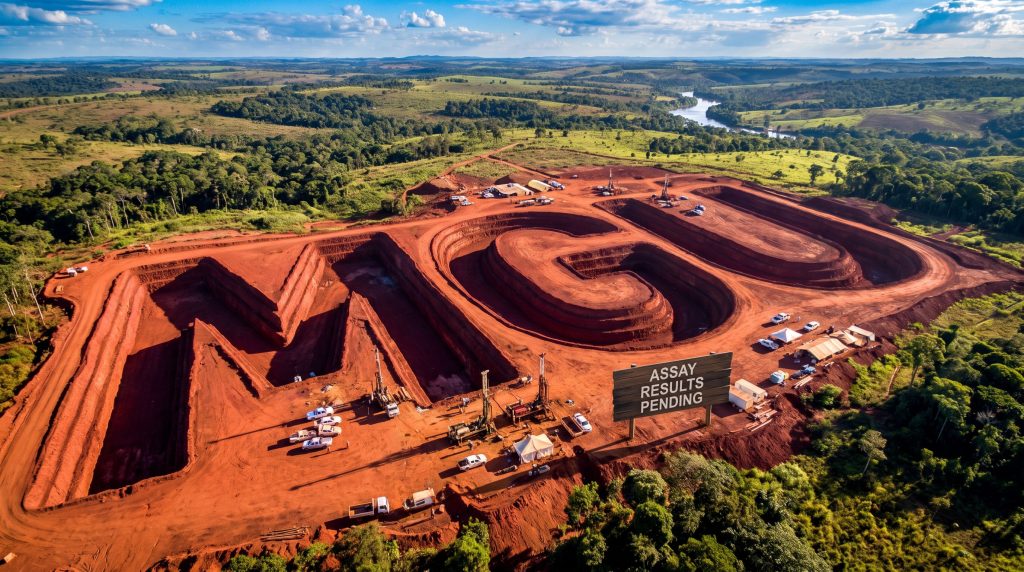
The completed RC programme at the Palmares REE Project comprised 75 drill holes for a total of 1,145 metres, focused predominantly on the Feirinha Prospect. Of the total holes drilled:
- 5 holes were completed in the northern portion of the Palmares project
- 70 holes targeted the Feirinha Prospect specifically
According to the announcement, the programme was revised from an originally planned 143-hole, 2,145-metre scope, with the reduction driven by a deliberate prioritisation of drilling resources toward the Azimuth REE Project. The company has stated that the 75 completed holes were considered sufficient to test the priority areas identified for this phase of exploration. When adjusted for the reduced scope, the programme came in approximately 30% under budget.
"The drilling programme was revised downwards due to the prioritisation of drilling at the Company's Azimuth REE Project… the 75 completed RC holes were considered sufficient to test the priority areas identified for the current phase of exploration."
— Magnum Mining and Exploration, ASX Release, 29 July 2026
All samples have been dispatched to ALS laboratory in Brazil for assaying. Furthermore, Magnum has indicated it anticipates completing quality assurance and quality control (QA/QC) procedures and reporting results within approximately one week of the announcement.
Feirinha Prospect and Its Surface Mineralisation History
The Feirinha Prospect is located within the Jequié Belt, a metamorphosed intrusive belt in Bahia State described in the announcement as an emerging REE province. The geological setting hosts pegmatite swarms — mineralised rock structures that the RC drilling programme was designed to test at depth and laterally.
Previous surface work at Feirinha returned the following results, as previously disclosed to the ASX:
| Sample Type | Best Result | Equivalent |
|---|---|---|
| Trench Samples | 1.69% TREO | 16,884 ppm Total Rare Earth Oxides |
| Rock Samples | 1.31% TREO | 13,082 ppm Total Rare Earth Oxides |
These surface results provided the geological rationale for the RC programme, which was designed to determine whether the REE mineralisation identified at surface continues laterally and at depth. This is a critical question for any future resource estimation pathway. Assay results from the 75-hole programme are expected to provide the first systematic subsurface dataset for the Feirinha Prospect.
Understanding Total Rare Earth Oxides (TREO)
Total Rare Earth Oxides (TREO) is the standard measure used across the REE mining industry to express the combined concentration of all rare earth elements present in a sample. It is typically reported as a percentage or in parts per million (ppm).
TREO grade is one of the primary indicators used to assess the economic potential of an REE deposit. Higher grades generally correspond to lower processing costs and improved project economics, though this depends on a range of additional factors including mineralogy and metallurgical recovery.
The 1.69% TREO trench result at Feirinha represents a notably high surface grade. For context, many ionic adsorption clay (IAC) REE deposits — a common deposit type across Brazil and China — are considered by industry participants to be potentially economic at grades as low as 0.05% to 0.10% TREO. The mineralisation style at Feirinha, which is pegmatite-hosted, is geologically distinct and typically associated with higher grades. However, drilling results will be required to determine whether this grade is consistent at depth.
Azimuth Flagship Project Advances Ahead of Schedule
While the Palmares programme concludes, drilling continues at Magnum's Azimuth REE Project in Goiás State, Brazil. A 10,000-metre auger drilling programme is underway at the Piracanjuba Prospect, with approximately 4,400 metres completed to date, representing nearly half of the planned programme.
Piracanjuba is described in the announcement as an emerging greenfield Ionic Adsorption Clay (IAC) REE discovery, associated with a 116 km² geophysical footprint. The company has indicated that this footprint size is a relevant indicator of the prospect's potential scale.
| Milestone | Previous Target | Revised Target |
|---|---|---|
| Exploration Target | September 2026 | Early August 2026 |
| JORC Mineral Resource Estimate | Not previously specified | November 2026 (subject to exploration results) |
The Exploration Target delivery has been moved forward by approximately four to six weeks, which the company has attributed to the pace at which the drilling programme is advancing. Consequently, Magnum has stated it expects to report assay results in batches as drilling progresses.
What Is an Ionic Adsorption Clay REE Deposit?
Ionic Adsorption Clay (IAC) deposits are a specific type of REE deposit that forms when rare earth elements leach from weathered granite and become loosely attached to clay minerals within the weathering profile. This deposit type is predominantly found in southern China and is increasingly being identified in South America.
A key characteristic of IAC deposits is that the rare earth elements are loosely bound to clay particles, which can allow for extraction using relatively simple leaching processes, typically involving ammonium sulphate or similar reagents. This contrasts with hard-rock REE deposits, which generally require more energy-intensive and costly processing methods.
If exploration confirms a substantial IAC REE deposit across the 116 km² footprint at Piracanjuba, the potential processing simplicity could be a relevant economic consideration relative to hard-rock alternatives. IAC deposits have attracted global interest due to their comparatively lower-cost extraction potential, though any conclusions regarding Piracanjuba's economic potential remain subject to further exploration and, ultimately, resource definition.
Near-Term Catalysts for Investors to Monitor
Several near-term deliverables have been outlined across both projects.
| Catalyst | Project | Expected Timing |
|---|---|---|
| Feirinha Assay Results | Palmares REE Project | ~1 week from 29 July 2026 |
| Exploration Target | Azimuth – Piracanjuba | Early August 2026 |
| Batch Assay Results | Azimuth – Piracanjuba | Rolling / ongoing |
| JORC Mineral Resource Estimate | Azimuth – Piracanjuba | November 2026 |
The Palmares assay results will be the first systematic subsurface dataset from the Feirinha Prospect, testing whether the high-grade surface mineralisation continues at depth. At Azimuth, the accelerated Exploration Target is intended to provide an initial estimate of the potential scale of mineralisation at Piracanjuba, while the targeted JORC Mineral Resource Estimate in November 2026 would represent a more advanced resource classification, subject to ongoing exploration results.
Two Project Types, One Brazilian REE Strategy
Magnum's current operational profile provides exposure to two distinct REE deposit styles across Brazil's exploration landscape.
| Feature | Palmares REE Project | Azimuth REE Project |
|---|---|---|
| Location | Bahia State, Brazil | Goiás State, Brazil |
| Deposit Style | Pegmatite-hosted (hard rock) | Ionic Adsorption Clay (IAC) |
| Ownership | 100% | 100% |
| Current Stage | RC drilling complete, awaiting assays | 10,000m auger programme underway |
| Key Prospect | Feirinha | Piracanjuba |
| Geophysical Footprint | Not specified | 116 km² |
| Best Surface Grade | 1.69% TREO (trench) | Not applicable |
| Near-Term Milestone | Assay results (~1 week) | Exploration Target (early August) |
Both projects are wholly owned by Magnum, meaning shareholders retain full exposure to any value created through exploration outcomes at either site. In addition, the company is running two active exploration programmes concurrently, which provides a spread of near-term news flow across separate deposit types rather than dependence on a single result.
The budget performance at Palmares — with the programme completed approximately 30% under budget once adjusted for its revised scope — is a relevant data point for capital management in the context of junior exploration companies, where cash discipline is closely watched by investors.
The next major ASX story will hit our subscribers first
Summary of the Update for Investors
Magnum Mining and Exploration completes Palmares drilling and advances Azimuth REE project in Brazil as part of a defined pipeline of near-term catalysts across both active sites. Points of relevance for investors include:
- Imminent assay results from 75 RC holes at the Feirinha Prospect, testing high-grade surface mineralisation of up to 1.69% TREO at depth for the first time
- An accelerated Exploration Target at the Azimuth project, now expected in early August 2026 rather than the previously stated September 2026 timeline
- A 116 km² geophysical footprint at Piracanjuba underpinning the IAC discovery potential, subject to further drilling confirmation
- 100% ownership of both the Palmares and Azimuth projects
- Demonstrated capital discipline, with the Palmares programme delivered approximately 30% under budget
- A JORC Mineral Resource Estimate targeted for November 2026 at Azimuth, subject to exploration results
"Magnum Mining and Exploration has outlined a dual-project REE exploration strategy in Brazil, with near-term catalysts including pending assay results from Palmares, an accelerated Exploration Target at Azimuth expected in early August 2026, and a targeted JORC Mineral Resource Estimate by November 2026. With full ownership retained across both projects and a drilling programme completed under budget, investors have a series of defined milestones to track over the coming months."
Want to Know More About Magnum Mining's Brazilian REE Projects?
With imminent assay results from Palmares, an accelerated Exploration Target at Azimuth expected in early August 2026, and a JORC Mineral Resource Estimate targeted for November 2026, Magnum Mining and Exploration has a defined pipeline of near-term catalysts across two wholly owned REE projects in Brazil. Investors looking to stay ahead of upcoming milestones and learn more about the company's dual-project strategy can visit the official Magnum Mining and Exploration website at www.mmel.com.au.