August 8, 2026
When Venture Capital Meets the Earth: How a $310 Million Bet Is Rewriting the Rules of Copper Mining
The mining industry has always moved slowly. Decades of permitting, billions in capital expenditure, and geological uncertainty have historically kept speculative tech investors well away from resource extraction. Yet something fundamental is changing. The convergence of artificial intelligence, geopolitical supply chain anxiety, and the sheer copper intensity of the energy transition has created conditions where venture capital firms now compete alongside sovereign-adjacent institutions to back pre-production minerals companies. The Mariana Minerals funding round and autonomous mining represent one of the clearest expressions of this structural realignment, and understanding its deeper mechanics reveals far more than a single capital raise.
When big ASX news breaks, our subscribers know first
A Software Platform Wearing a Mining Company's Hard Hat
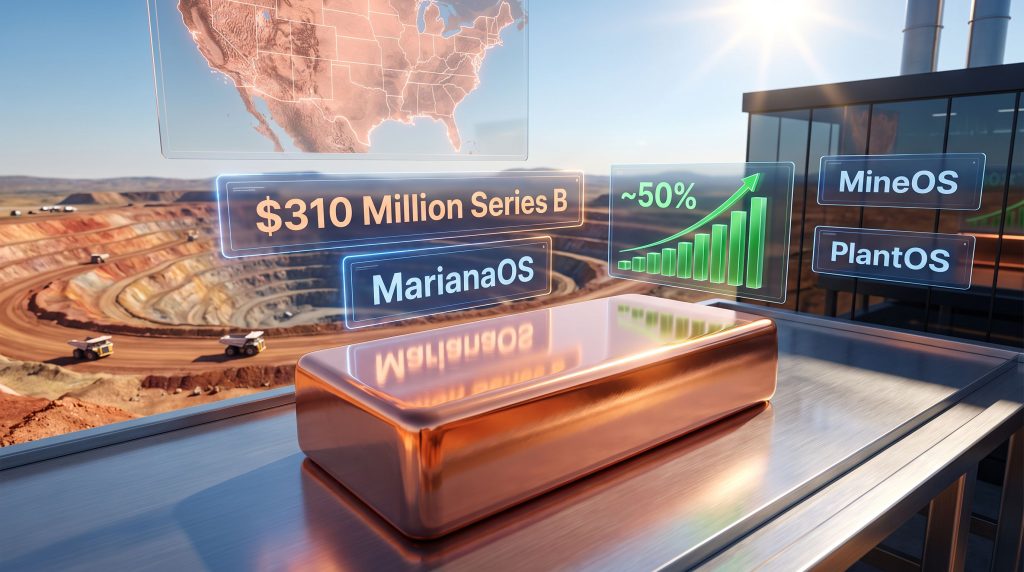
Most mining companies acquire software. Mariana Minerals, led by CEO Turner Caldwell, was built around it. The company's proprietary operating system, MarianaOS, is not a productivity layer sitting atop conventional equipment management. It functions as the core operational nervous system of the entire business, governing decisions from autonomous truck routing to real-time reagent dosing inside processing facilities.
MarianaOS is divided into two interconnected modules:
- MineOS handles autonomous mine development and equipment fleet operations, integrating AI-based path planning, collision avoidance, and dynamic task allocation across haulage and drilling equipment
- PlantOS governs processing and refining facility performance using reinforcement learning architecture that continuously adapts to changing ore characteristics, moisture content, and mineralogical variability
This distinction matters enormously from an investment thesis perspective. Processing plant automation via PlantOS is applicable across both open-pit and underground operations, making it a more universally deployable value driver than fleet automation alone, which works most effectively in shallow, consistent open-pit environments. Furthermore, underground autonomy is advancing rapidly with automated loaders and tele-remote drilling systems, but the processing layer represents the more immediately scalable commercial proposition.
The company also pairs primary copper production from its U.S. mining operations with a scrap copper recycling stream, creating a dual-input supply model that reduces dependence on any single source. This blended approach delivers a lower aggregate carbon intensity than greenfield mining alone and hedges against geological variability by incorporating a secondary supply source with near-term production potential.
Anatomy of a $310 Million Series B: What the Investor Mix Actually Signals
The Mariana Minerals funding round totals approximately $400 million across all capital events, including an $85 million Series A anchored by Andreessen Horowitz and Breakthrough Energy Ventures, followed by the $310 million Series B led by Khosla Ventures.
| Capital Event | Amount | Lead / Notable Investors |
|---|---|---|
| Series A | $85 million | Andreessen Horowitz (a16z), Breakthrough Energy Ventures |
| Series B | $310 million | Khosla Ventures, a16z, BHP Ventures, Mitsubishi Corp, In-Q-Tel |
| Combined Total | ~$400 million | Multi-archetype syndicate |
The composition of the Series B syndicate is analytically rich. It spans four distinct capital categories, each with its own evaluative lens:
- Venture and deep tech capital (Khosla Ventures, a16z, Greycroft, Greenoaks, Pax Ventures) valuing the platform economics of MarianaOS as a scalable technology business
- Energy transition capital (Breakthrough Energy Ventures, Earthshot Ventures) assessing the climate impact of domestic copper supply against imported alternatives
- Strategic industrial capital (BHP Ventures, Mitsubishi Corporation) evaluating the technology's potential to reshape how large-scale mining operations are conducted
- Sovereign-adjacent institutional capital (In-Q-Tel, StepStone Group, Washington Harbour Partners, Halo Fund) applying national security and supply chain resilience criteria
The simultaneous presence of BHP Ventures, the strategic investment arm of the world's largest mining company, and In-Q-Tel, the U.S. intelligence community's venture vehicle, in the same cap table is not coincidental. It suggests that Mariana's autonomous platform is being stress-tested through both a commercial mining viability framework and a national security supply chain framework at the same time.
This kind of multi-archetype investor validation is rare at the Series B stage for a pre-production minerals company and, consequently, reflects how fundamentally the critical minerals landscape has shifted.
Copper's Structural Deficit: The Numbers Behind the Urgency
The macro environment surrounding the Mariana Minerals funding round and autonomous mining investment more broadly is shaped by a copper market under genuine structural strain. According to S&P Global's Dan Yergin, copper prices have surged approximately 50% in recent periods, driven by the intersection of geopolitical realignment, policy-driven electrification spending, and demand growth from clean energy infrastructure (CNBC, August 2026).
The demand mathematics are stark:
- A standard electric vehicle requires roughly 2.5 to 4 times the copper content of an equivalent internal combustion engine vehicle
- Offshore wind turbines consume approximately 9.5 tonnes of copper per megawatt of installed capacity
- Grid modernisation and power transmission infrastructure upgrades compound both of these demand vectors simultaneously
Meanwhile, the U.S. domestic copper supply position is structurally weak. The country imports a significant share of its refined copper from Chile, Peru, and other jurisdictions, some of which carry complex geopolitical profiles that expose downstream manufacturers to supply interruption risk. In addition, current copper market supply pressures are intensifying the urgency for domestic alternatives.
| Supply Source | Time to Production | Carbon Profile | Risk Factors |
|---|---|---|---|
| Greenfield copper mine | 10 to 20 years | High | Permitting, geological uncertainty |
| Brownfield expansion | 3 to 7 years | Medium | Regulatory approvals, infrastructure |
| Scrap copper recycling | Immediate to 12 months | Low | Scrap availability, pricing volatility |
| Mariana's combined model | Staged (mine + recycling) | Blended / lower | Diversified across two input streams |
The U.S. production capacity that exists today has not kept pace with the demand trajectory implied by the Inflation Reduction Act, the CHIPS Act, or the broader grid infrastructure investment cycle. This creates a persistent domestic supply gap that companies like Mariana are explicitly positioning themselves to fill.
The Labour Problem That Autonomy Is Designed to Solve
A dimension of autonomous mining that receives insufficient analytical attention is its role in addressing a structural, not cyclical, labour shortage across the global mining sector. Several compounding forces are converging:
- Workforce demographics in established mining regions are skewing older, with replacement pipelines insufficient to maintain operational continuity
- Remote site work has declining attractiveness among younger generations with viable alternatives in technology and services sectors
- Geographic mismatches between available skilled labour pools and new project locations, particularly in the American Southwest and interior West, create chronic staffing constraints
- Technology sector wage inflation is pulling engineers, data scientists, and systems specialists away from mining company employment pipelines
As Turner Caldwell has articulated publicly, automation is not simply a mechanism for reducing headcount. Its deeper economic value lies in unlocking projects that are fundamentally unviable under conventional labour cost structures. A copper deposit that generates insufficient margin to justify the cost of a fully staffed remote operation becomes commercially attractive when autonomous systems eliminate the accommodation, logistics, and shift-rotation costs associated with that workforce.
The corollary is equally important: autonomy generates a new category of higher-value technical employment. Rather than equipment operators working in hazardous conditions on rotating shifts, the autonomous mining model demands remote systems engineers, reinforcement learning specialists, fleet optimisation analysts, and data infrastructure architects. This represents a genuine job category upgrade, not merely job elimination. Furthermore, AI-driven mining operations are increasingly demonstrating that this transition is already underway across the broader sector.
How Reinforcement Learning Transforms Processing Plant Economics
The PlantOS system represents one of the more technically sophisticated elements of Mariana's autonomous mining proposition and deserves closer examination than it typically receives in coverage of the funding round.
Why Conventional Control Systems Fall Short
Conventional processing facilities rely on proportional-integral-derivative (PID) control loops, which are rule-based automation systems that make adjustments based on the deviation of a measured value from a preset target. These systems work adequately when input conditions are stable. However, the problem is that copper ore bodies are rarely stable in their characteristics. Ore grade, mineralogy, hardness, sulphide content, and moisture can shift meaningfully across a single ore body and certainly across the life of a mine.
Reinforcement learning is particularly powerful in precisely these conditions. Unlike static rule-based systems, an RL-trained control agent learns which actions in a given state produce the best outcomes over time, continuously updating its policy as it accumulates experience from real operating data.
What PlantOS Can Dynamically Adjust
Applied to copper processing, this means PlantOS can dynamically adjust:
- Grind size and mill throughput in response to ore hardness variation
- Flotation reagent dosing and froth depth as sulphide mineralogy shifts
- Leach cycle parameters in oxide ore processing environments
- Energy consumption profiles to balance throughput against operating cost
The result, in principle, is a processing plant that becomes progressively more efficient over its operational life rather than degrading toward suboptimal fixed setpoints. This adaptive capability is the source of the claimed advantage over human-operated facilities in maintaining copper recovery rates and minimising reagent waste.
The next major ASX story will hit our subscribers first
The Platform Investment Thesis: Why This Is Not a Conventional Mining Equity
Understanding the Mariana Minerals funding round requires stepping outside the conventional framework used to value mining companies. Traditional mining equity valuation is anchored in resource estimates, reserve grades, net present value of cash flows at assumed commodity prices, and capital cost comparisons against analogous operations.
Mariana's investors, however, appear to be applying a different model entirely — one closer to industrial software platform valuation.
| Company Category | Primary Value Driver | Valuation Framework |
|---|---|---|
| Major miners (BHP, Rio Tinto) | Scale, existing reserve base | EV/EBITDA, NAV multiples |
| Junior explorers | Discovery upside | Market cap vs. resource ounces |
| Mariana Minerals | MarianaOS platform + copper resource | Platform economics + resource optionality |
| Autonomy OEMs (Caterpillar Command, Komatsu FrontRunner) | Hardware and software for existing operators | Enterprise software multiples |
The investment thesis embedded in the $310 million raise implies that MarianaOS could eventually be licensed to third-party operators, used to attract lower-cost project finance by demonstrating superior operational risk management, or applied across multiple mine sites to generate compounding platform returns. For investors exploring copper investment opportunities in this space, this platform dynamic introduces a fundamentally different risk-return profile than conventional mining equity.
This mirrors the logic applied to companies like Aspentech in process simulation or OSIsoft in industrial data infrastructure: the software generates value that compounds independently of, though synergistically with, the underlying physical asset.
Key Risks That Sophisticated Investors Are Pricing In
No analysis of this magnitude is complete without an honest assessment of execution risk. Several material uncertainties apply:
Technical validation gap: MarianaOS has not yet been demonstrated at commercial scale across a full mine-to-refinery value chain. Deploying reinforcement learning in live industrial environments introduces failure modes absent from simulated training environments, including equipment degradation patterns, edge-case geological events, and cascading system interactions.
Permitting complexity: New copper mines in the United States face some of the world's most demanding regulatory timelines. National Environmental Policy Act processes, state-level environmental review, tribal consultation requirements, and water rights adjudication can collectively extend permitting timelines beyond a decade.
Commodity price sensitivity: Project economics premised on the autonomous cost reduction thesis are ultimately still exposed to copper price cycles. A sustained price decline would compress margins for all producers and could impair the viability of deposits that are only economic under the low-cost autonomous operating model.
Scrap supply constraints: The secondary copper stream depends on scrap availability and pricing dynamics that are themselves volatile. Chinese demand for copper scrap has historically driven international competition for available material, and U.S. collection infrastructure for high-quality industrial scrap remains fragmented. Consequently, Australia's green metals positioning offers an instructive parallel in how jurisdictions can strategically address such supply chain vulnerabilities.
This article is intended for informational purposes only and does not constitute financial or investment advice. Readers should conduct their own due diligence before making any investment decisions. Forecasts, projections, and forward-looking statements involve inherent uncertainty and may not materialise as described.
FAQ: Mariana Minerals Funding Round and Autonomous Mining
What is the Mariana Minerals funding round and how large is it?
The most recent capital raise is a $310 million Series B led by Khosla Ventures, bringing total capital raised across all rounds to approximately $400 million including a prior $85 million Series A.
Who are the key investors in the Series B?
The syndicate includes Khosla Ventures, Andreessen Horowitz, Breakthrough Energy Ventures, BHP Ventures, Mitsubishi Corporation, In-Q-Tel, Greycroft, StepStone Group, Earthshot Ventures, Greenoaks, Pax Ventures, Halo Fund, and Washington Harbour Partners.
What does MarianaOS actually do?
It is a proprietary autonomous operating system comprising two modules: MineOS for mine equipment and development automation, and PlantOS for processing facility optimisation using reinforcement learning algorithms.
Why is copper considered critical to national supply chains right now?
Copper is essential to electric vehicles, renewable energy generation, power transmission infrastructure, and defence applications. Demand growth from electrification is outpacing new mine supply, creating a structural deficit that has contributed to approximately 50% price appreciation in recent periods, according to S&P Global's Dan Yergin (CNBC, August 2026).
What makes autonomous mining economically compelling beyond cost reduction?
The deeper value proposition is project unlocking: autonomous systems can render previously sub-economic copper deposits commercially viable by sufficiently reducing per-tonne operating costs, thereby expanding the addressable universe of developable resources.
Want to Track the Next Major Mineral Discovery Before the Broader Market Does?
Discovery Alert's proprietary Discovery IQ model delivers real-time alerts on significant ASX mineral discoveries — cutting through complex geological and commodity data to surface actionable investment opportunities the moment they are announced. Explore how historic discoveries have generated substantial returns and begin your 14-day free trial today to position yourself ahead of the market.