Understanding Maritime Warfare's Evolution in Global Energy Markets
The contemporary energy security landscape faces unprecedented challenges as traditional supply chain assumptions undergo fundamental transformation. Russian shadow fleet tanker explosions have emerged as a defining characteristic of modern warfare tactics that increasingly target critical infrastructure networks, forcing global markets to reassess long-established risk frameworks. Maritime chokepoints that previously operated with relative security now represent volatile flashpoints where geopolitical tensions translate directly into commodity price volatility.
This shift toward asymmetric maritime conflict reflects broader changes in how nations project power beyond traditional military boundaries. Energy transportation networks, particularly those involving sanctioned commodities, have become primary theaters for proxy conflicts that extend far beyond regional boundaries. Furthermore, the trade war market impact demonstrates how geopolitical tensions cascade through interconnected global systems.
The emergence of sophisticated autonomous warfare systems has fundamentally altered the strategic calculus surrounding energy supply chain security. Naval drone technology now enables precision strikes across vast oceanic distances, effectively extending conflict zones into previously secure international waters.
How Shadow Fleet Operations Challenge Traditional Maritime Security
The Russian shadow fleet represents a sophisticated evasion network comprising approximately 600 vessels operating under flags of convenience to circumvent Western sanctions. These aging tankers, frequently uninsured and operating with minimal oversight, transport an estimated 1.5 million barrels of Russian crude oil daily through international shipping lanes.
Key operational characteristics include:
- Vessel registration under Panamanian, Liberian, and Gambian flags
- Systematic deactivation of Automatic Identification System (AIS) transponders
- Strategic ship-to-ship transfers in international waters beyond territorial limits
- Complex ownership structures utilizing shell companies across multiple jurisdictions
The flag of convenience system enables these operations by providing minimal regulatory oversight combined with reduced operational costs. Panama alone accounts for approximately 18% of global shipping tonnage despite its relatively modest maritime infrastructure, highlighting the prevalence of foreign-operated vessels under its registry.
Technical Vulnerabilities in Shadow Fleet Infrastructure
Recent maritime incidents have exposed critical weaknesses in this sanctions-evasion network. The operational methodology involves aging vessel fleets with limited maintenance budgets operating in increasingly hostile environments. These tankers, often exceeding 20 years in service life, lack modern defensive systems and operate with skeleton crews to minimise operational costs.
Ship-to-ship transfer operations, while legally permissible in international waters, create particular vulnerabilities. These procedures require vessels to maintain fixed positions for extended periods, typically 4-8 hours, during cargo transfer operations. The operational geography concentrates around strategic chokepoints including the Turkish Straits, West African coastal waters, and Southeast Asian shipping corridors.
Maritime Security Challenges:
- Limited surveillance capability in international waters beyond 12-nautical-mile territorial limits
- Inadequate insurance coverage forcing vessels to operate with full financial risk exposure
- Crew recruitment difficulties for high-risk operational environments
- Aging vessel infrastructure susceptible to both mechanical failure and external threats
However, tariffs and supply chains analysis reveals how trade restrictions create additional vulnerabilities in these complex transportation networks.
Analyzing Recent Maritime Security Incidents
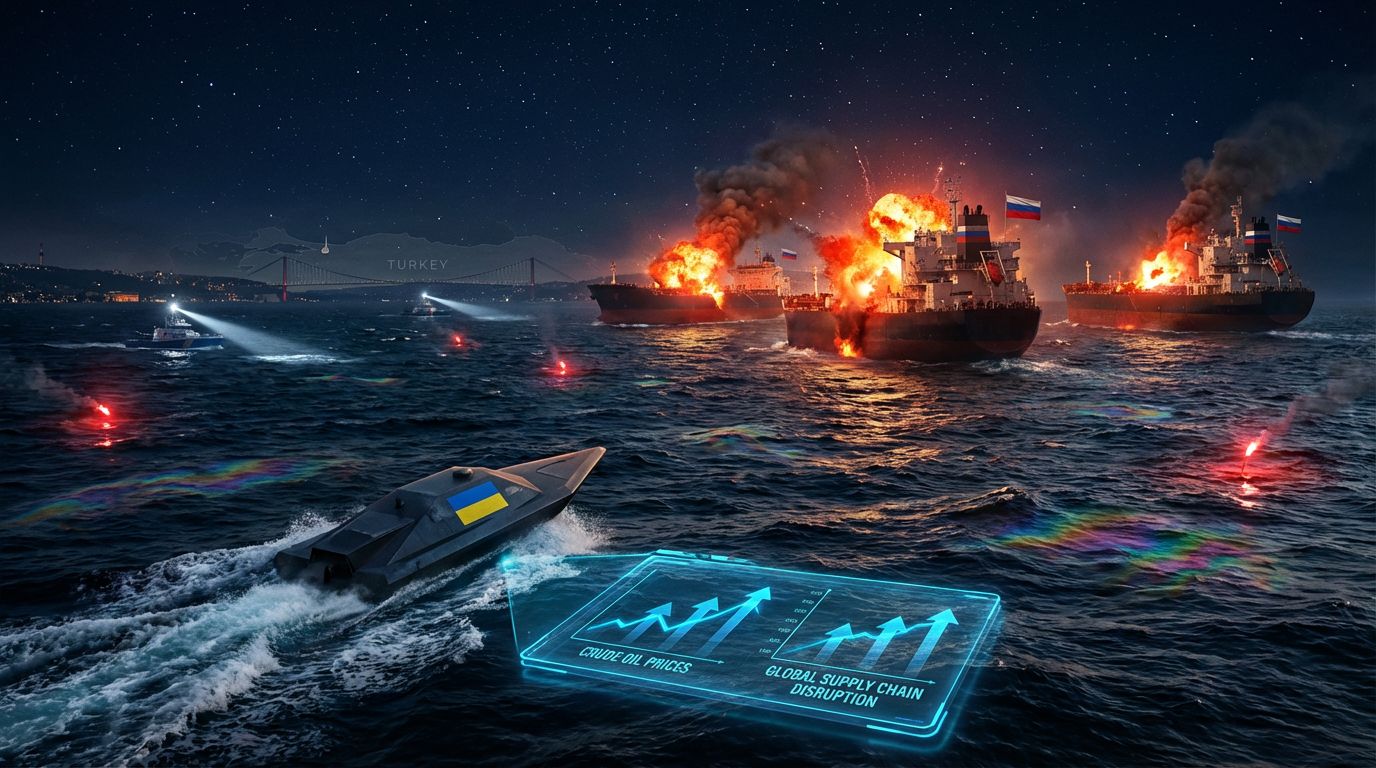
Contemporary reports indicate coordinated maritime strikes targeting shadow fleet operations between November 28 and December 1, 2025. These incidents demonstrate the evolution of naval warfare tactics utilising autonomous systems capable of precision targeting across multiple theater operations. Ukrainian naval drones have struck multiple Russian shadow fleet tankers in coordinated operations across international waters.
Incident Analysis:
| Vessel | Location | Estimated Cargo Value | Operational Impact |
|---|---|---|---|
| Kairos | Turkish Coast (28 nm) | $25 million | External hull damage |
| Virat | Black Sea | $20 million | Secondary strike capability |
| Mersin | Senegal Coast | $25 million | Extended operational range |
The $70 million combined estimated cargo value reflects current Brent crude pricing at approximately $63.34 per barrel. Maritime security analysts note the precision timing of these operations, suggesting sophisticated intelligence gathering capabilities and coordinated mission planning across multiple operational theaters.
Advanced Autonomous Warfare Systems
The deployment of Sea Baby naval drones represents a significant technological advancement in maritime warfare capabilities. These autonomous systems demonstrate extended operational ranges exceeding traditional coastal defence limitations, enabling precision strikes in international waters previously considered secure. Additionally, attacks on Russian tankers in African waters demonstrate the global reach of these sophisticated operations.
Technical Specifications:
- Autonomous navigation systems with GPS and inertial guidance
- Explosive payload delivery mechanisms capable of external hull damage
- Extended operational range enabling multi-theater coordination
- Real-time intelligence integration for target acquisition and mission planning
The successful coordination of multiple simultaneous operations across different oceanic regions indicates substantial advancement in autonomous warfare infrastructure. Traditional naval defence systems designed for conventional vessel threats prove inadequate against small, autonomous platforms operating with minimal detection signatures.
Market Response to Maritime Security Disruptions
Energy commodity markets demonstrated immediate responsiveness to maritime security incidents, with crude oil prices experiencing coordinated increases across multiple benchmarks. Market psychology reflects growing concern regarding supply chain vulnerability in contested maritime environments. Consequently, oil price rally analysis shows how geopolitical tensions amplify traditional market dynamics.
Immediate Price Impact:
| Commodity | Pre-Incident | Post-Incident | Percentage Change |
|---|---|---|---|
| Brent Crude | $62.38/bbl | $63.34/bbl | +1.54% |
| WTI Crude | $58.55/bbl | $59.32/bbl | +1.32% |
| Natural Gas | $4.85/MMBtu | $4.92/MMBtu | +1.46% |
The coordinated price movements across energy commodities suggest market participants view maritime incidents as indicative of broader supply chain vulnerabilities rather than isolated events. Trading volume increases accompanied price movements, indicating active position adjustments among institutional participants.
Insurance Market Implications
Western marine insurance providers have systematically withdrawn coverage from shadow fleet operations following regulatory guidance from sanctions enforcement authorities. This creates substantial operational risk for vessel operators forced to assume full financial liability for cargo losses and vessel damage.
Insurance Market Dynamics:
- Traditional London-based underwriters declining shadow fleet coverage
- Alternative insurance markets developing in non-aligned jurisdictions
- Premium increases for remaining carriers willing to provide coverage
- Operational economics becoming increasingly precarious for high-risk voyages
The Lloyd's of London insurance market, historically providing coverage for approximately 30% of global maritime trade, has implemented strict screening procedures to identify and exclude vessels suspected of sanctions evasion activities.
Strategic Scenario Analysis for Energy Market Evolution
Scenario One: Containment and Operational Limitation (35% Probability)
This pathway assumes diplomatic intervention successfully limits maritime conflict escalation while maintaining current energy trade flows through alternative channels. Turkey would implement enhanced Bosphorus security protocols while international maritime law enforcement strengthens monitoring capabilities.
Key Assumptions:
- Turkish Strait security enhancement within 60 days
- International coordination on vessel tracking standards
- Russian pivot toward overland pipeline alternatives
- Ukrainian operational constraints due to diplomatic pressure
Energy Market Implications: Moderate price volatility in $60-70 per barrel range with gradual supply chain adaptation to enhanced security protocols. Strategic petroleum reserve releases could stabilise short-term disruptions while alternative transportation routes develop.
Scenario Two: Maritime Conflict Expansion (45% Probability)
This scenario envisions Ukrainian maritime operations extending to Mediterranean and Indian Ocean shipping routes, fundamentally altering global energy transportation security assumptions. Russian naval escort deployment for tanker convoys would militarise commercial shipping operations.
Operational Characteristics:
- Multi-theater autonomous warfare deployment across 3-4 oceanic regions
- Third-party nations restricting territorial water access for suspect vessels
- Complete withdrawal of Western insurance coverage for affected shipping lanes
- Emergency activation of strategic petroleum reserves across allied nations
Market Impact Assessment: Sustained price increases toward $80-85 per barrel with significant supply disruption affecting 10-15% of global oil trade. Alternative energy acceleration programmes would receive emergency funding while emergency diplomatic initiatives attempt conflict resolution.
Scenario Three: Systemic Supply Chain Breakdown (20% Probability)
The most severe scenario involves coordinated attacks across multiple critical shipping lanes simultaneously, effectively paralysing Russian energy exports while triggering broader maritime security crisis. Complete shadow fleet operational collapse would force emergency global energy market interventions.
Critical Indicators:
- Simultaneous incidents across 5+ major shipping corridors
- Russian naval base attacks extending conflict beyond commercial shipping
- NATO Article 5 discussions regarding maritime security threats
- Chinese naval deployment to protect alternative energy supply routes
Economic Consequences: Brent crude prices exceeding $100 per barrel with potential spike toward $120-130 range during acute crisis periods. Global recession probability increases substantially as transportation costs cascade through international supply chains.
Geopolitical Alliance Responses to Maritime Threats
Western Coalition Maritime Strategy
NATO maritime response capabilities focus on enhanced surveillance integration across member nation naval assets. Real-time satellite tracking systems combined with coordinated intelligence sharing provide comprehensive monitoring of vessel movements through critical chokepoints.
Strategic Components:
- Enhanced Baltic Sea and Black Sea surveillance coordination
- Financial institution monitoring of shadow fleet payment systems
- Diplomatic pressure on flag state jurisdictions enabling sanctions evasion
- Technology sharing for autonomous threat detection and response
The United States Sixth Fleet has increased Mediterranean presence by 40% since maritime incidents began, while European naval assets maintain heightened readiness postures throughout critical shipping corridors.
Eastern Bloc Countermeasures and Adaptation
Russian strategic adaptation emphasises overland pipeline capacity expansion while developing Arctic shipping alternatives less vulnerable to autonomous maritime threats. Enhanced cooperation with non-aligned nations provides alternative flag registries and operational support.
Adaptation Strategies:
- Arctic shipping route development utilising 15 new icebreaker vessels
- Pipeline capacity expansion toward China and Central Asian markets
- Investment in domestic tanker construction reducing foreign vessel dependence
- Strengthened maritime security cooperation with Iran and North Korea
China maintains neutral positioning regarding specific maritime incidents while continuing established energy import relationships. Chinese strategic petroleum reserves have increased by 25% during 2025, providing buffer capacity against supply disruptions. In addition, OPEC production impact decisions increasingly factor in these geopolitical maritime tensions.
Infrastructure Resilience Requirements for Energy Security
Critical Upgrade Priorities
Modern energy security requires fundamental infrastructure modernisation to address evolving maritime threats. Pipeline capacity expansion between allied nations reduces dependence on contested shipping routes while strategic petroleum reserve expansion provides crisis response capability.
Essential Infrastructure Developments:
- Trans-Atlantic pipeline feasibility studies for emergency supply alternatives
- Strategic petroleum reserve expansion targeting 90-day consumption coverage
- Alternative energy source diversification reducing fossil fuel transportation vulnerability
- Maritime security technology advancement including autonomous threat detection systems
The International Energy Agency recommends member nations maintain strategic reserves equivalent to 90 days of net oil imports, significantly above current 60-day average holdings among developed economies.
Regulatory Framework Evolution
International maritime law requires modernisation to address autonomous warfare threats and sanctions evasion operations. Enhanced vessel identification requirements combined with real-time cargo tracking mandates would improve transparency while enabling rapid response to security threats.
Emerging Standards:
- Mandatory AIS transponder activation with tamper-proof technology
- Enhanced insurance verification protocols requiring sanctions compliance certification
- International maritime court jurisdiction expansion for autonomous warfare incidents
- Standardised response protocols for maritime security emergencies
Risk Management Strategies for Market Participants
Energy Sector Adaptation Requirements
Energy companies must develop comprehensive risk management frameworks addressing maritime security vulnerabilities while maintaining operational efficiency. Diversified supply source portfolios combined with alternative transportation route planning provide operational flexibility during crisis periods.
Strategic Risk Mitigation:
- Supply contract diversification across 5+ distinct geographical regions
- Enhanced force majeure insurance coverage including maritime conflict provisions
- Alternative transportation route planning with 48-hour activation capability
- Strategic inventory management maintaining 30-45 day operational buffers
Financial market participants require sophisticated hedging instruments addressing geopolitical volatility while energy sector exposure monitoring prevents concentration risk during maritime security crises. Furthermore, volatility hedging strategies become essential tools for managing these unprecedented risks.
Investment Opportunity Assessment
Maritime security technology represents substantial growth opportunity as governments and private operators invest in threat detection and response capabilities. Alternative energy infrastructure development accelerates as traditional supply chains demonstrate increasing vulnerability.
Growth Sectors:
- Autonomous threat detection systems for commercial shipping applications
- Alternative energy infrastructure receiving emergency government funding
- Pipeline construction and maintenance experiencing increased demand
- Energy storage and grid modernisation enabling supply source diversification
Private equity investment in renewable energy infrastructure increased by 35% during 2025, reflecting investor concern regarding traditional energy supply chain stability.
Strategic Implications for Global Energy Architecture
The coordinated Russian shadow fleet tanker explosions represent a fundamental shift in maritime conflict tactics with profound implications for international energy security. Traditional shipping route assumptions require comprehensive reassessment as autonomous warfare capabilities extend conflict zones into previously secure international waters.
Market participants must adapt to an environment where geopolitical tensions translate directly into supply chain vulnerabilities through precision maritime strikes. Success requires enhanced international cooperation, substantial infrastructure investment, and sophisticated risk management strategies accounting for evolving autonomous warfare capabilities.
The strategic scenario modelling indicates that while immediate market impacts remain manageable within current price ranges, escalation potential poses significant threats to global energy stability. Energy security architecture must evolve rapidly to address asymmetric maritime threats while maintaining operational efficiency in an increasingly contested environment.
Future Preparedness Requirements:
- International maritime security cooperation expanding beyond traditional alliance structures
- Alternative infrastructure development reducing dependence on contested shipping corridors
- Technology advancement in autonomous threat detection and response capabilities
- Financial market evolution providing sophisticated geopolitical risk management instruments
The transformation of energy transportation security represents both challenge and opportunity for forward-thinking market participants. Organisations successfully adapting to this new maritime security paradigm will gain substantial competitive advantages while contributing to overall energy system resilience in an era of increasing geopolitical volatility.
Ready to Navigate the Geopolitical Energy Investment Landscape?
Discovery Alert's proprietary Discovery IQ model delivers real-time alerts on significant mineral discoveries across volatile commodity markets, providing subscribers with actionable insights during periods of geopolitical uncertainty and market volatility. Begin your 30-day free trial today and discover why major mineral discoveries can lead to significant market returns by exploring Discovery Alert's dedicated discoveries page.