Advanced metallurgical processing has reached a critical juncture where traditional single-commodity extraction methods increasingly appear inefficient against the backdrop of critical minerals energy security concerns. The intersection of hydrometallurgical innovation and dual-stream recovery systems presents opportunities for mineral developers to maximise resource utilisation whilst addressing multiple strategic supply chain vulnerabilities simultaneously.
This technological convergence has particular relevance in North American claystone deposits, where lithium-bearing formations often contain associated elements that have historically been discarded as processing waste. The development of selective extraction methodologies that can economically recover multiple critical minerals from shared feedstock represents a fundamental shift in resource development philosophy, moving beyond single-product optimisation toward integrated mineral systems.
Ion-Exchange Technology Breakthrough in Dual-Stream Processing
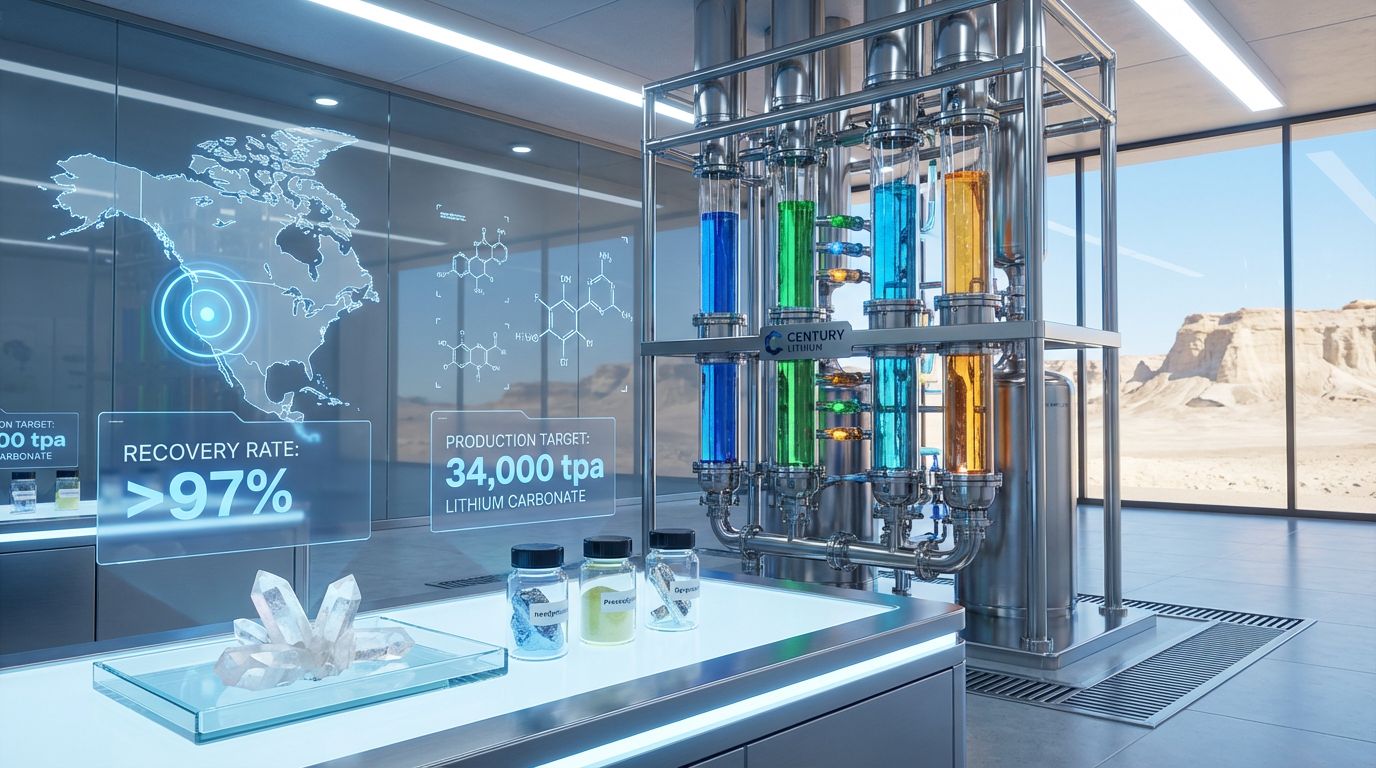
Century Lithium rare earth element recovery represents a significant advancement in selective metallurgy, achieving documented recovery rates exceeding 97% for rare earth elements from lithium leach solutions. This level of extraction efficiency demonstrates the viability of ion-exchange selectivity mechanisms in maintaining product separation without cross-contamination between lithium and REE processing streams.
The technical foundation rests on chloride-leach chemistry, where hydrochloric acid dissolution of claystone minerals creates acidic solutions containing lithium cations alongside rare earth elements in ionic form. The selective binding characteristics of specialised ion-exchange resins allow differentiation between Li⁺ cations (ionic radius ~0.76 Å) and REE³⁺ cations (ionic radius ~1.0 Å), creating sufficient chemical separation for commercial-grade product recovery.
Process Integration Advantages:
• Selective extraction methodology maintains lithium purity standards whilst concentrating rare earth elements
• Downstream compatibility with existing direct lithium extraction infrastructure reduces capital requirements
• Multi-element recovery from single feedstock source eliminates need for separate mining operations
• Shared processing infrastructure reduces overall facility footprint and environmental impact
The demonstration plant operations in Tonopah, Nevada have repeatedly validated battery-grade lithium carbonate production using Angel Island claystone feed, confirming technology reproducibility at pilot scale. Furthermore, ion-exchange technology achieving 97% selectivity levels has established precedent in uranium purification and lanthanide separation applications, providing technical confidence for commercial scalability assessment through ongoing lithium refinery innovation.
Comparative Analysis of Integrated Versus Traditional REE Operations
Century Lithium rare earth element recovery differs fundamentally from conventional rare earth mining through its integrated production model. Traditional REE operations focus exclusively on rare earth extraction from dedicated ore bodies, typically processing 1-5 million tonnes of ore annually to produce REE concentrates as the primary revenue source.
Production Scale Comparison:
| Parameter | Angel Island Project | Traditional REE Mine |
|---|---|---|
| Primary Product | 35,000 tpa lithium carbonate | REE concentrates only |
| Resource Base | 1+ billion tonne claystone | Typically 10-100 million tonnes |
| Mine Life | 40+ years projected | 15-50 years (varies by deposit) |
| REE Recovery Method | By-product from lithium processing | Primary ore extraction |
| Capital Structure | Shared infrastructure model | Dedicated REE processing facilities |
| Processing Approach | Integrated dual-stream | Single-product optimisation |
The economic framework underlying Angel Island demonstrates lithium-focused development priorities. Current feasibility study results show NPV of US$3.16 billion with internal rate of return of 17.2%, based entirely on lithium carbonate revenue projections. Phase 1 capital expenditure requirements total US$1.58 billion for lithium production infrastructure, with no economic contribution modelled from rare earth element by-products.
This economic structure reflects the reality that REE concentrations in the claystone remain modest and unproven at commercial scale. Whilst technical recovery capability exists, revenue modelling excludes REE contributions due to uncertainty regarding grades, tonnage potential, and market development requirements for by-product sales.
Traditional REE operations typically require US$1.5-2.5 billion in capital investment for integrated mine-to-magnet processing facilities, with internal rates of return generally ranging from 8-15% depending on product mix and market conditions. The shared infrastructure advantage of integrated lithium-REE operations theoretically provides 30-40% capital savings for rare earth processing infrastructure, though this estimate lacks published engineering validation.
Strategic Element Portfolio and Market Positioning
The rare earth element portfolio extractable through Century Lithium rare earth element recovery encompasses both light and heavy rare earth elements with distinct market applications and supply chain vulnerabilities. The disclosed element suite includes neodymium, praseodymium, dysprosium, gadolinium, lanthanum, and cerium, along with critical elements scandium and cesium.
What Are the Critical REE Applications and Market Context?
Heavy Rare Earth Elements (Strategic Priority):
• Dysprosium: Essential for high-temperature permanent magnets in wind turbines and electric vehicle traction motors; experiencing critical supply constraints with pricing premiums of US$15-50/kg
• Gadolinium: Required for medical imaging contrast agents and neutron absorption applications; specialised markets with moderate demand growth
Light Rare Earth Elements (High Volume Applications):
• Neodymium and Praseodymium: Primary components in permanent magnet manufacturing for renewable energy and automotive electrification; combined market demand exceeding 100,000 tonnes annually
• Lanthanum: Critical for battery cathode materials and catalytic converter applications; commodity pricing around US$5-15/kg
• Cerium: Highest abundance rare earth with applications in catalytic converters and polishing compounds; lower value but high-volume potential
Strategic Elements Beyond REE Classification:
• Scandium: Aerospace alloy applications and solid-state lighting technology; emerging demand with significant supply constraints
• Cesium: Specialised electronics and atomic clock applications; niche markets with limited tonnage requirements
Global rare earth oxide production totals approximately 210,000 tonnes annually, with 85-90% of processing capacity concentrated in China. This geographic concentration creates strategic vulnerability for North American manufacturing sectors dependent on rare earth inputs, particularly permanent magnet production for renewable energy and electric vehicle applications.
The U.S. Geological Survey designates dysprosium, gadolinium, neodymium, and praseodymium as Critical Minerals under federal supply chain security frameworks, potentially qualifying integrated projects for policy support and financing assistance through critical minerals development programs.
Economic Implications and Revenue Diversification Potential
Century Lithium rare earth element recovery presents theoretical opportunities for revenue diversification, though current project economics exclude REE contributions due to unproven commercial viability. The feasibility study's exclusion of rare earth revenue reflects management's assessment that element concentrations remain insufficient for economic modelling at current market pricing structures.
Revenue Structure Analysis:
The integration of rare earth by-product recovery could provide significant upside to base-case project economics, though investors should maintain realistic expectations about near-term commercial impact given modest REE concentrations and unproven market development.
Cost Structure Benefits from Integration:
• Marginal extraction costs due to shared processing infrastructure with lithium operations
• Reduced capital intensity compared to standalone REE development requiring dedicated mining and processing facilities
• Operating leverage potential from dual-product revenue streams reducing lithium price sensitivity
• Infrastructure optimisation through elimination of redundant processing equipment
The absence of REE revenue modelling in feasibility economics indicates that current concentrations and recovery volumes do not justify commercial investment in downstream separation and purification infrastructure. This assessment may evolve as pilot-scale testing advances and market conditions for critical minerals continue developing, particularly considering broader mining industry innovation trends.
Market Positioning Advantages:
Supply chain integration opportunities with downstream manufacturers could emerge if consistent product quality and delivery volumes can be demonstrated. Geographic location within North American supply chains provides strategic value for manufacturers seeking to reduce dependence on Asian rare earth processing capabilities.
However, competing with established REE suppliers requires proving both technical capability and cost competitiveness at commercial scale. The modest concentrations characteristic of claystone deposits present economic challenges compared to conventional REE ore bodies containing 2-6% total rare earth oxides.
North American Critical Mineral Security Implications
Century Lithium rare earth element recovery addresses strategic supply chain vulnerabilities through domestic production of elements critical to clean energy transitions and national security applications. Current market dynamics demonstrate concerning dependence on Chinese processing capabilities, with 85% of global rare earth processing concentrated in China despite diverse global mining operations.
How Does Supply Chain Vulnerability Assessment Impact North American Strategy?
The concentration of processing capability creates systemic risk for North American manufacturers of permanent magnets, battery materials, and defence technologies. Recent supply chain disruptions have highlighted the strategic importance of domestic critical mineral production capabilities, driving policy support for integrated development projects whilst considering broader US–China trade impact.
Strategic Contribution Potential:
• Domestic production of magnet-grade rare earth elements reducing import dependencies
• Integrated supply chain development supporting downstream manufacturing resilience
• Scalable model for other claystone deposits throughout the western United States
• Policy alignment with federal critical minerals initiatives and infrastructure investment priorities
The project's FAST-41 permitting status demonstrates federal recognition of strategic importance, potentially accelerating regulatory approvals and facilitating access to government financing programmes supporting critical mineral development.
However, meaningful impact on North American supply chain security requires successful commercialisation at scale with demonstrated product quality and delivery consistency. Technical achievements at pilot scale must translate to commercial operations capable of competing with established international suppliers on quality, reliability, and cost basis.
Technical Challenges and Commercial Scalability Assessment
Century Lithium rare earth element recovery faces significant technical challenges in scaling laboratory achievements to commercial operations whilst maintaining product quality specifications and economic viability. The complexity of managing dual-product streams creates operational risks that must be addressed through robust process design and quality control systems.
What Are the Key Metallurgical Complexity Management Issues?
Process Integration Risks:
• Maintaining 97% recovery efficiency at commercial throughput rates whilst managing solution chemistry across multiple extraction circuits
• Ensuring consistent product quality specifications for both lithium carbonate and rare earth concentrates
• Managing waste streams containing complex leach residues and non-recoverable elements
• Preventing cross-contamination between lithium and REE processing circuits that could compromise product purity
Infrastructure Requirements for Commercial Scale:
• Specialised separation equipment sized for commercial throughput rates rather than pilot-scale demonstration
• Quality control systems capable of monitoring dual-product specifications continuously
• Solution management systems handling complex chemistry across extended processing circuits
• Environmental controls for waste management of increased complexity compared to single-product operations
Market Development Challenges:
Critical consideration: REE by-product success depends on establishing reliable offtake agreements and meeting stringent purity specifications required for end-use applications in permanent magnet and battery manufacturing.
Commercial Viability Factors:
• Economic validation of modest REE concentrations compared to established rare earth ore bodies
• Market relationship development for by-product sales requiring different customer base than lithium markets
• Competition assessment against established REE suppliers with proven track records and existing customer relationships
• Product specification achievement meeting magnet-grade or battery-grade purity requirements consistently
The absence of published grades, tonnage projections, or revenue modelling for rare earth elements reflects ongoing uncertainty regarding commercial viability. Technical capability demonstration at pilot scale provides foundation for development, but economic assessment requires validation of sustainable production costs and market pricing assumptions, particularly considering trends in North American mining trends.
Investment Analysis and Strategic Positioning Framework
Century Lithium rare earth element recovery represents an asymmetric risk-reward opportunity within the broader lithium development narrative, requiring careful evaluation of base-case lithium economics versus speculative rare earth upside potential. The investment thesis must differentiate between proven lithium project fundamentals and unproven REE commercialisation prospects.
Investment Scenario Framework:
Base Case Analysis:
• Primary lithium project with established feasibility economics (NPV US$3.16 billion, IRR 17.2%)
• Proven demonstration plant operations validating lithium carbonate production capability
• FAST-41 permitting status providing regulatory pathway clarity
• REE recovery treated as speculative upside rather than core valuation driver
Upside Scenario Evaluation:
• Successful commercialisation of REE by-products providing material revenue enhancement
• Premium valuation recognition for diversified critical mineral production capability
• Strategic acquisition target status for integrated manufacturers seeking supply chain control
• Policy support acceleration through alignment with federal critical minerals priorities
Due Diligence Priority Matrix:
| Assessment Factor | Priority Level | Key Evaluation Metrics |
|---|---|---|
| Technical Validation | High | Recovery rates at scale, product purity achievement |
| Market Development | Medium | Offtake agreement progress, pricing assumptions |
| Regulatory Progress | High | Permitting timeline, environmental compliance status |
| Financial Modelling | Medium | Revenue sensitivity analysis, cost allocation methodology |
| Management Execution | High | Track record, development timeline adherence |
What Risk Assessment Framework Should Investors Consider?
Market cap of approximately C$50 million creates significant leverage to successful development, but also amplifies downside risk from execution challenges or market condition deterioration. The capital requirements totalling US$1.58 billion for Phase 1 development necessitate successful financing in challenging market conditions for mining development projects.
Industry Implications for Comparable Projects:
Century Lithium's integrated approach could establish precedent for other claystone lithium developers seeking to maximise resource value through critical element recovery. However, replication success depends on specific geological conditions, element concentrations, and market development capabilities that may not be universally applicable across different deposits.
The model's viability could influence North American critical mineral development strategies, particularly for projects containing multiple strategic elements within shared geological formations. Success would validate integrated development approaches, whilst commercial failure could discourage similar integrated strategies.
Balancing Technical Innovation with Commercial Reality
Century Lithium rare earth element recovery demonstrates genuine technical progress in dual-extraction metallurgy whilst highlighting the persistent gap between laboratory achievements and commercial viability in critical mineral development. The documented >97% recovery rates for rare earth elements from lithium processing streams represent legitimate metallurgical advancement, yet the exclusion of REE revenue from feasibility economics reflects realistic assessment of current commercial prospects through recent recovery achievements.
The strategic significance of domestic critical mineral production capabilities cannot be understated in the context of supply chain security concerns and clean energy transition requirements. However, technical capability must translate to economic sustainability and market competitiveness to achieve meaningful impact on North American supply chain resilience.
Investment Perspective Summary:
For investors, Century Lithium rare earth element recovery should be evaluated as asymmetric upside potential within a lithium-focused investment thesis. The base-case project economics provide foundation for development decisions, whilst REE capabilities offer speculative enhancement opportunities dependent on successful commercial scaling and market development.
Industry Development Implications:
The integrated approach pioneered by Century Lithium could influence broader industry strategies for maximising resource utilisation and addressing critical mineral supply chain vulnerabilities. Success would validate dual-stream processing concepts and encourage similar developments across North American claystone deposits.
However, commercial validation requires demonstration of sustainable production costs, consistent product quality, and successful market penetration against established suppliers. The pathway from technical achievement to commercial success remains challenging, requiring continued focus on execution fundamentals whilst managing investor expectations appropriately.
The project's ultimate contribution to North American critical mineral security will depend on scaling pilot-scale achievements to commercial operations capable of competing effectively in global markets whilst maintaining the technical advantages that distinguish integrated production from conventional single-commodity approaches.
Are You Positioning Your Portfolio for North American Critical Mineral Opportunities?
Discovery Alert's proprietary Discovery IQ model delivers instant notifications on significant ASX mineral discoveries, including lithium and rare earth developments that parallel North American strategic initiatives. With Century Lithium demonstrating 97% recovery rates in dual-stream processing, investors seeking exposure to critical mineral innovations can benefit from Discovery Alert's discoveries page showcasing historic examples of transformational mineral discoveries and their market impact.