July 27, 2026
The Regulatory Architecture Reshaping North America's Most Contested Resource Frontier
Few forces in modern economic history have accelerated regulatory transformation as decisively as supply chain vulnerability. When governments and corporations discovered, through a series of cascading shocks ranging from pandemic disruptions to export restrictions imposed by dominant suppliers, that their most advanced technologies depended on materials sourced from a handful of jurisdictions, the policy response was inevitable. Critical minerals demand moved from footnote to front page, and the regulatory frameworks governing their extraction began shifting with unusual speed.
Mexico sits at the epicentre of that shift. Its geological endowment, geographic proximity to the United States, and deep integration into North American manufacturing make it structurally central to any credible US supply chain diversification strategy. Yet the Mexico critical minerals regulatory shifts occurring since 2022 have fundamentally altered the investment landscape, introducing state ownership, shortened concession windows, and heightened compliance obligations that investors must now price into every project evaluation.
Understanding the full architecture of these changes — not just the headline lithium nationalisation, but the layered reforms affecting the entire sector — is essential for anyone allocating capital or assessing risk in Mexican mining.
When big ASX news breaks, our subscribers know first
What Critical Minerals Actually Are and Why Their Physical Role Matters
The term "critical minerals" carries different legal definitions across jurisdictions, but the underlying concept is consistent: non-fuel resources whose supply chains are vulnerable to disruption and whose absence would materially threaten a country's economic and national security. The energy security implications of this vulnerability have consequently driven an unprecedented wave of policy responses across major economies.
The physical reality behind that definition matters enormously for understanding why policy has moved so fast. These materials are not interchangeable industrial inputs. They are the foundational chemistry of next-generation technology:
- Lithium, cobalt, and nickel form the electrochemical basis of EV battery cells, with lithium-ion cells now powering everything from passenger vehicles to grid-scale storage systems
- Rare earth elements are non-substitutable in the permanent magnets driving EV motors, wind turbines, and precision-guided defence systems
- Copper remains the primary conductor in virtually every electrification application, with demand forecasts rising sharply as grid infrastructure expands globally
- Graphite functions as the anode material in lithium-ion batteries, with natural graphite sourced overwhelmingly from a small number of producing countries
- Semiconductors depend on high-purity silicon, gallium, and germanium, minerals whose refining capacity is heavily concentrated geographically
Control over these supply chains translates directly into leverage over the industries built on top of them. That strategic logic, more than any single policy announcement, explains the urgency behind every reform discussed below.
Mexico's Legislative Transformation: A Three-Layer Reform Stack
The Mexico critical minerals regulatory shifts of the past four years did not arrive as a single reform. They accumulated in three distinct legislative layers, each building on the last and collectively producing a sector environment that looks fundamentally different from the pre-2022 baseline.
Layer One: The 2022 Mining Law Amendment
The first structural change arrived through an amendment to Article 10 of Mexico's Mining Law, which established that the exploration, exploitation, and processing of lithium — along with any other minerals subsequently declared "strategic" by the state — constitute exclusive public utilities reserved for the Mexican government. This secondary legislation created the initial boundary between lithium and all other minerals, but its enforceability was limited by its status as ordinary law rather than constitutional provision.
The "strategic mineral" classification mechanism introduced here is worth noting independently. It creates a legal pathway through which the government could extend state control beyond lithium to additional minerals without requiring fresh constitutional amendment. That optionality has not yet been exercised, but it represents a latent policy instrument whose potential application investors in copper, graphite, and zinc cannot entirely discount.
Layer Two: The 2023 Mining Reform Package
While the 2022 reform targeted lithium specifically, the 2023 package restructured the broader concession framework in ways affecting every mineral category. Furthermore, the changes were comprehensive enough to warrant systematic comparison:
| Reform Dimension | Pre-2023 Framework | Post-2023 Framework |
|---|---|---|
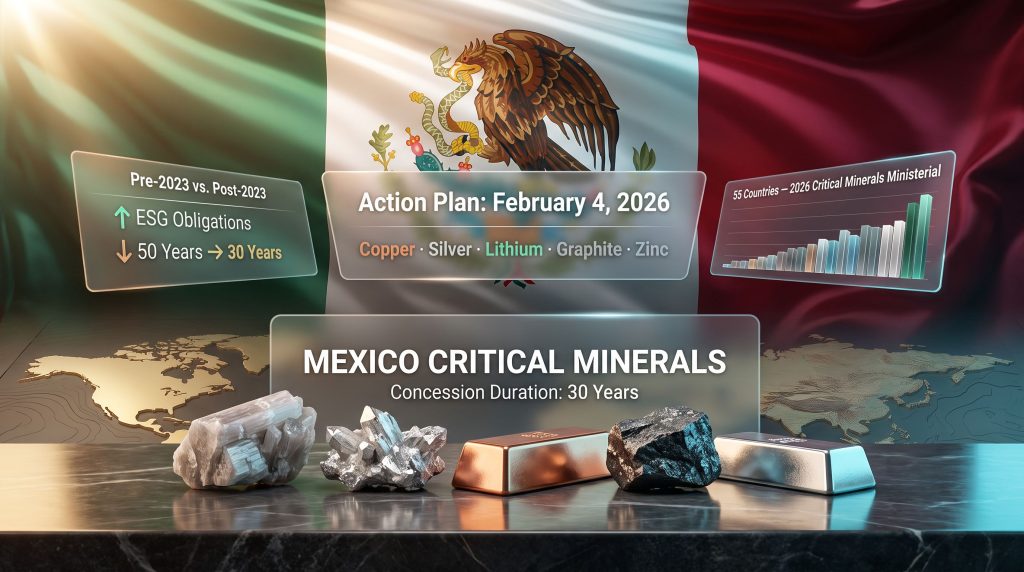
| Concession Duration | Up to 50 years | Reduced to 30 years |
| Allocation Mechanism | Administrative assignment | Public bidding system |
| Environmental Compliance | Baseline requirements | Strengthened ESG, water, and labour obligations |
| Cancellation Grounds | Limited | Broadened significantly |
| Mining in Protected Areas | Restricted | Further limited |
The reduction in concession duration from 50 to 30 years is not merely procedural. It compresses the time horizon within which investors must recover capital and generate returns, which directly affects project economics for large-scale, capital-intensive operations. Combined with the shift from administrative assignment to competitive bidding, these changes increase both cost and uncertainty at the project entry stage.
Critically, implementing regulations for these 2023 reforms remain incompletely issued as of mid-2026, according to multiple legal and sector analyses. That gap between legislative intent and operational regulatory detail creates genuine permitting unpredictability, as project developers cannot fully model compliance requirements that have not yet been formally defined.
Layer Three: The 2024 Constitutional Amendment
The most consequential reform arrived in October 2024, when Mexico modified Article 27 of the Constitution to formally reserve lithium exploration, extraction, and processing exclusively for the state. Elevating restrictions from secondary legislation to constitutional supremacy has two critical implications.
First, it makes reversal substantially more difficult, requiring supermajority legislative approval and a political consensus that does not currently exist. Second, it repositions lithium from a commercially managed commodity into an instrument of national sovereignty — a categorisation with entirely different political economy dynamics.
The amendment explicitly prohibits granting concessions, licences, or contracts to private parties for any lithium operations. To administer the resulting state monopoly, the government created Litio para México (LitioMx), a decentralised public entity with authority spanning the full lithium economic value chain from exploration through processing and commercialisation.
Key Distinction for Investors: The constitutional reform applies specifically to lithium. Copper, silver, zinc, graphite, and all other minerals continue to operate under the reformed concession framework established in 2023. These are legally and operationally separate regimes, and conflating them produces significant analytical errors in investment assessment.
The Scope Gap: Mexico Versus Canada and Australia
One important feature of Mexico's approach is what it does not include: a comprehensive national critical minerals strategy comparable to those operating in Canada or Australia. The current framework addresses lithium through constitutional state ownership and addresses all other minerals through the reformed concession law, however there is no single integrated policy instrument that prioritises, classifies, and provides investment certainty across multiple mineral categories simultaneously.
| Policy Dimension | Mexico | Canada | Australia |
|---|---|---|---|
| Lithium Ownership | State monopoly (constitutional) | Private with federal oversight | Private with state-level regulation |
| Comprehensive Critical Minerals Framework | Absent | National Critical Minerals Strategy | Critical Minerals Strategy with priority list |
| Concession Duration | 30 years (post-2023) | Varies by province | Varies by state |
| Foreign Investment Screening | Developing | Established (Investment Canada Act) | Established (FIRB) |
| Bilateral Coordination with US | Action Plan signed 2026 | Integrated via existing trade architecture | Minerals Security Partnership signatory |
This policy gap has practical consequences. Investors seeking regulatory certainty across a portfolio of mineral interests cannot point to a single Mexican framework document that establishes priority minerals, expedited permitting pathways, or investment protection mechanisms equivalent to those available in Canadian or Australian jurisdictions. The broader geopolitical mining landscape makes this absence of integrated strategy increasingly costly for project developers.
The US-Mexico Critical Minerals Action Plan: Architecture and Limitations
Washington's strategic response to critical mineral vulnerability has followed a coordination model rather than an ownership model, building alliances with resource-rich partners and backing them with financing instruments rather than asserting state control over deposits. The US critical mineral strategy has consequently prioritised bilateral action plans over unilateral ownership claims.
The 2026 Critical Minerals Ministerial, convened by the State Department and attended by representatives from 55 countries, operationalised that approach at scale. The summit launched the Forum on Resource Geostrategic Engagement (FORGE), the successor body to the Minerals Security Partnership, with South Korea holding the chair through June 2026. Eleven memoranda of understanding were signed by participating nations, and new US financing for strategic mineral projects was announced through the Pax Silica initiative.
Mexico was not among the MoU signatories — a fact that can be misread as evidence of peripheral status. The strategic minerals deal framework that Washington has deployed with key partners provides useful context here. The bilateral action plan signed on February 4, 2026, between the US Trade Representative and Mexico's Ministry of Economy tells a more accurate story. Mexico was one of only three countries to receive a dedicated bilateral action plan from the Ministerial, alongside Japan and the European Commission.
According to Reuters reporting on the US-Mexico critical minerals coordination, the action plan represents a foundational step toward developing coordinated trade policies — a significant diplomatic signal from both governments. The action plan's core commitments include:
- Priority project identification covering copper, silver, lithium, graphite, and zinc as initial focus minerals
- Trade policy instruments including exploration of border-adjusted price floors on critical mineral imports
- Geological data coordination between the US Geological Survey and Mexico's geological counterpart agency
- Plurilateral pathway consultation to fold bilateral mechanisms into a broader binding agreement
- Supply chain resilience protocols covering coordinated stockpiling, rapid-response frameworks, and joint mineral technology R&D
Two important caveats define the action plan's current status:
| Dimension | Current Status |
|---|---|
| Legal Binding Force | Non-binding policy framework |
| Implementation Window | 60 days from signing (deadline: April 5, 2026) |
| Public Reporting on Progress | Limited as of mid-2026 |
| Relationship to USMCA | Under active review for potential integration |
| Diplomatic Significance | High directional signal, not yet operational architecture |
The plan is significant as a directional commitment and a signal of diplomatic prioritisation. It is not yet a source of legal certainty for project developers.
Environmental Compliance and the Rising Cost of Entry
Beyond the headline changes to concession terms and lithium ownership, the 2023 reforms introduced a more granular set of obligations that collectively raise the cost and complexity of operating in Mexico's mining sector. In addition, CAMIMEX has identified specific opportunities within this evolving framework that may partially offset some compliance burdens for well-positioned operators.
- Strengthened water-use controls and operational restrictions within or adjacent to protected natural areas
- Expanded environmental restoration obligations requiring operators to demonstrate financial capacity to rehabilitate disturbed areas
- Enhanced waste liability requirements covering tailings management and site closure planning
- Broader labour compliance standards integrated into concession maintenance conditions
Mexico's environmental regulator SEMARNAT has also moved to halt mining environmental authorisations in natural protected areas (NPAs), a development that further contracts the effective footprint available for new project development in certain geologically prospective regions.
These changes are not temporary transitional measures. They reflect a structural recalibration of the social and environmental licence requirements for mining in Mexico, and investors who model project economics using pre-2022 compliance cost assumptions will systematically underestimate their actual cost of entry.
The next major ASX story will hit our subscribers first
Four Scenarios Investors Should Model Now
The current regulatory environment creates genuine bifurcation between possible outcomes. Investors should consequently model the following scenarios rather than assuming any single trajectory:
Scenario 1: Action Plan Converts to Binding Treaty
If bilateral mechanisms are successfully embedded into USMCA or an equivalent legal instrument, the risk profile for copper, graphite, and zinc investments in Mexico changes substantially. Treaty-level legal certainty would provide project developers with protections currently unavailable under the policy framework alone.
Scenario 2: Full Implementing Regulations Issued for 2023 Reforms
Resolution of the regulatory gap around concession allocation procedures, environmental compliance thresholds, and cancellation risk grounds would remove the most immediate source of operational uncertainty. Projects in permitting queues are most directly affected by this scenario.
Scenario 3: LitioMx Mandate Expands or Additional Minerals Declared Strategic
The 2022 Mining Law already contains the legal mechanism for declaring additional minerals as strategic state utilities. While no such declaration has occurred, investors in minerals with high geopolitical demand profiles should monitor policy signals from Mexico's Ministry of Economy for early indicators. The Mexico critical minerals regulatory shifts seen thus far suggest that further evolution remains entirely possible.
Scenario 4: USMCA Review Embeds Critical Mineral Obligations
The ongoing USMCA joint review represents the most structurally significant vehicle for converting diplomatic commitments into binding trade law obligations. Outcomes could affect concession terms, processing requirements, and export controls across multiple mineral categories.
Frequently Asked Questions
Does Mexico's lithium nationalisation affect all mining in the country?
No. The constitutional reservation applies exclusively to lithium. All other minerals continue to operate under the reformed 2023 concession framework, which carries its own set of changes but does not involve state ownership.
Is the US-Mexico Critical Minerals Action Plan legally binding?
Not currently. As of its February 4, 2026 signing, it is a diplomatic policy framework. Both governments have signalled interest in converting its mechanisms into binding legal architecture, however that process has not concluded.
What minerals are prioritised under the bilateral Action Plan?
Copper, silver, lithium, graphite, and zinc are identified as the initial focus minerals for joint development and coordination.
What is FORGE and how does it relate to Mexico?
FORGE (Forum on Resource Geostrategic Engagement) is the successor to the Minerals Security Partnership, launched at the 2026 Critical Minerals Ministerial. Mexico participated in the Ministerial and secured a bilateral action plan, though it was not among the eleven MoU signatories at the summit itself.
What is the most immediate regulatory risk for investors?
The incomplete issuance of implementing regulations for the 2023 mining reforms creates the highest near-term operational uncertainty, particularly around concession allocation, environmental compliance thresholds, and the broadened grounds for concession cancellation.
Key Takeaways for Investors and Industry Stakeholders
- Lithium is settled law: Constitutional state monopoly, LitioMx as sole authorised operator, and an explicit prohibition on private concessions make this a closed chapter for private capital in that specific mineral
- Non-lithium minerals retain investment viability but carry materially higher compliance costs, shorter concession windows, and greater regulatory scrutiny than pre-2022 conditions
- The regulatory gap is the most immediate obstacle: Incomplete implementing regulations create permitting unpredictability that is distinct from, and potentially more urgent than, the broader policy uncertainty
- Mexico's bilateral action plan signals tier-one strategic status in Washington's supply chain architecture, but diplomatic weight and legal certainty are not the same instrument
- Two metrics matter most: Whether the Action Plan converts to a binding treaty, and whether the USMCA joint review embeds critical mineral obligations into enforceable trade law
- The "strategic mineral" classification mechanism embedded in the 2022 Mining Law warrants ongoing monitoring as a potential instrument for extending state control beyond lithium if policy conditions shift
This article is for informational purposes only and does not constitute legal, financial, or investment advice. The regulatory environment described is evolving, and readers should conduct independent due diligence and consult qualified legal and financial advisers before making investment decisions related to Mexico's mining sector. Forecasts and scenario projections represent analytical assessments, not confirmed outcomes.
Want To Stay Ahead of Major ASX Mineral Discoveries as the Critical Minerals Race Intensifies?
While Mexico's regulatory shifts reshape North American supply chains, Discovery Alert's proprietary Discovery IQ model scans the ASX daily to deliver real-time alerts on significant mineral discoveries — turning complex data across 30+ commodities into clear, actionable opportunities the moment they are announced. Explore historic examples of exceptional discovery returns and begin your 14-day free trial at Discovery Alert to position yourself ahead of the market.