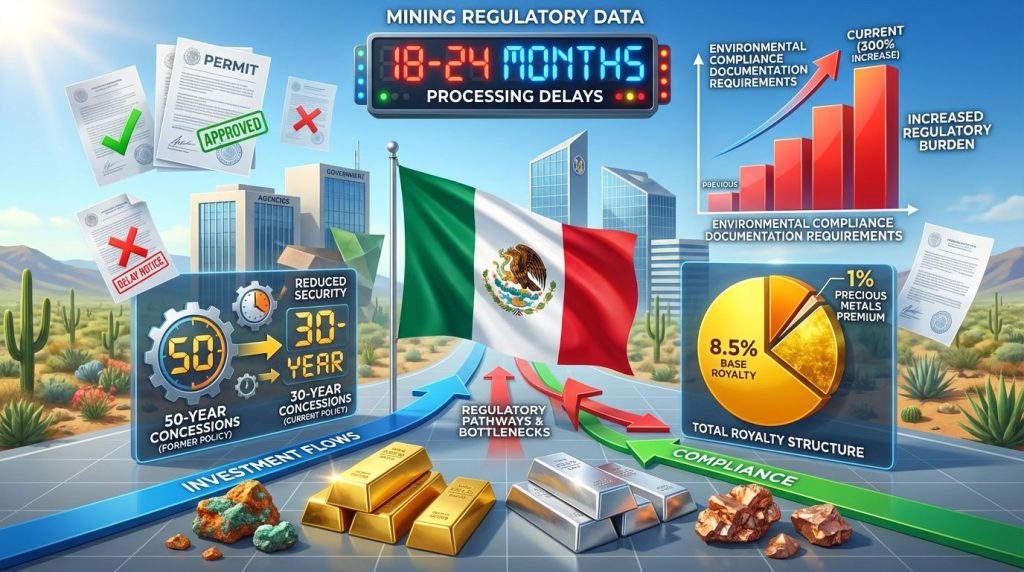
Mexico's mining sector faces unprecedented regulatory complexity as new legislative frameworks reshape the industry landscape. Traditional approaches to mineral extraction and project development encounter evolving environmental standards, enhanced fiscal obligations, and administrative restructuring that fundamentally alters investment calculations. Furthermore, this regulatory bottleneck in mexican mining creates systemic challenges requiring strategic recalibration across operational, financial, and legal dimensions.
The transformation extends beyond simple compliance requirements, creating systemic challenges that require strategic recalibration across operational, financial, and legal dimensions. Consequently, understanding these regulatory bottlenecks becomes essential for companies navigating Mexico's mining future, particularly as industry evolution trends continue to reshape global mining practices.
Understanding Mexico's Mining Regulatory Framework Evolution
Mexico's regulatory environment has undergone substantial transformation, moving from a relatively permissive framework to a comprehensive system emphasizing environmental protection, social responsibility, and enhanced government oversight. This evolution reflects broader policy shifts prioritizing sustainable development over rapid resource extraction.
Historical Context of Mining Regulation in Mexico
Prior to 2023, Mexico maintained mining regulations established in the 1990s that prioritized foreign investment attraction and rapid project development. The previous framework offered 50-year initial concession terms with similar renewal periods, creating investment certainty that supported large-scale capital deployment.
The regulatory architecture emphasized first-come-first-served allocation mechanisms, minimal environmental documentation requirements, and limited community consultation processes. This approach successfully attracted significant international investment but generated criticism regarding environmental impact management and local community benefit distribution.
Regional comparison data reveals Mexico's previous position as among Latin America's most investment-friendly mining jurisdictions. However, Mexico's mining industry under reform now faces substantial challenges as legal challenges and an uncertain future complicate operational planning.
Current Legal Structure and Institutional Framework
Contemporary Mexican mining regulation operates through a multi-tiered institutional framework involving federal mining authorities, environmental protection agencies, water management bodies, and social development institutions. This complexity creates coordination challenges that contribute significantly to regulatory bottlenecks in Mexican mining operations.
Federal responsibilities encompass concession allocation, royalty collection, and overall sector oversight, while environmental compliance involves separate agency coordination. In addition, water rights acquisition requires parallel processes with national water authorities, creating potential timeline conflicts for project developers.
The integration of environmental and social governance requirements into core mining regulation represents a fundamental shift. Moreover, this requires companies to demonstrate comprehensive impact mitigation strategies before receiving operational authorization, similar to developments in the broader mining claims framework elsewhere.
How Do Concession Term Reductions Impact Mining Investment Strategies?
The transition from 50-year to 30-year initial concession periods fundamentally alters project economics and investment risk assessment methodologies. This reduction directly impacts net present value calculations, debt structuring capabilities, and long-term strategic planning across the mining value chain.
Financial Implications of Shortened Concession Periods
Reduced concession timeframes compress cash flow generation windows, requiring higher annual returns to achieve acceptable project economics. Mining projects typically require 5-7 years for development and construction, leaving 23-25 years for revenue generation under the new framework compared to 43-45 years previously.
This compression particularly affects capital-intensive operations requiring significant upfront investment in processing facilities, infrastructure, and community development programs. Financial modeling now incorporates higher hurdle rates to compensate for increased regulatory risk and shortened payback periods.
Debt financing structures face particular challenges as lenders typically require longer security periods than the new concession terms provide. Consequently, project finance arrangements increasingly depend on renewal probability assessments, adding complexity to already sophisticated risk evaluation processes that require comprehensive mining investment strategies.
Competitive Bidding Process Transformation
The shift from first-come-first-served allocation to competitive bidding creates new strategic considerations for concession acquisition. Companies must now develop comprehensive technical, financial, and social impact proposals competing against multiple bidders for limited opportunities.
Evaluation criteria emphasize environmental protection commitments, community benefit programs, and technical execution capabilities beyond simple financial capacity. This multivariate assessment approach rewards companies with strong environmental, social, and governance track records while potentially disadvantaging purely financially-focused bidders.
Strategic preparation for bidding processes now requires dedicated teams combining technical, legal, environmental, and community relations expertise. Furthermore, this increases pre-acquisition costs significantly compared to previous straightforward application procedures.
| Concession Aspect | Pre-2023 Framework | Current Framework | Impact on Operators |
|---|---|---|---|
| Initial Term | 50 years | 30 years | Reduced project viability |
| Renewal Period | 50 years | 25 years | Limited expansion planning |
| Allocation Method | First-come-first-served | Competitive bidding | Increased acquisition costs |
| Transfer Requirements | Minimal oversight | Government approval | Restricted M&A activity |
What Environmental Compliance Challenges Are Delaying Project Approvals?
Environmental compliance requirements represent the most significant source of regulatory bottlenecks in mexican mining. Documentation requirements have increased substantially while regulatory guidance remains incomplete, creating substantial delays in project approval processes and increasing operational uncertainty for mining companies.
Prohibited Mining Activities and Their Operational Impact
New regulations prohibit open-pit mining operations without comprehensive environmental impact assessments demonstrating minimal ecological disruption. This requirement effectively eliminates certain extraction methods while demanding sophisticated mitigation strategies for approved operations.
Mercury-based extraction processes face complete prohibition, requiring companies using traditional processing methods to invest in alternative technologies. While environmentally beneficial, these transitions require substantial capital investment and technical retraining programs.
Protected area mining faces severe restrictions, with operations within 50 kilometres of national parks or ecological reserves requiring extensive environmental monitoring and mitigation programmes. These requirements effectively remove significant mineral reserves from development consideration, necessitating innovative approaches to mine reclamation innovation.
Documentation and Monitoring Requirements
Environmental compliance documentation has expanded to include baseline ecological studies, water impact assessments, air quality monitoring plans, and biodiversity protection strategies. Each component requires specialised technical expertise and extensive field data collection extending project development timelines.
Social impact assessment protocols now mandate detailed community consultation processes, socioeconomic baseline studies, and long-term community benefit programmes. However, these requirements, while promoting sustainable development, add 12-18 months to typical project approval timelines.
Financial guarantee mechanisms for environmental compliance require companies to establish dedicated funds covering potential restoration costs. These guarantees typically range from $5-25 million depending on project scale, creating additional capital requirements beyond traditional project financing needs.
Key Insight: Environmental compliance documentation requirements have increased by approximately 300% since 2023, with many companies reporting 18-24 month delays in permit processing due to incomplete regulatory guidance.
How Significant Is the Current Permit Processing Backlog?
Mexico's mining permit processing system faces substantial backlogs as regulatory authorities adjust to new requirements while managing existing application volumes. This administrative bottleneck creates cascading delays throughout the mining project development pipeline.
Backlog Analysis and Processing Timeline Projections
Current estimates suggest over 400 mining permit applications await processing through various stages of the approval system. Federal mining authorities report processing capacity limitations due to expanded review requirements and limited specialised personnel for complex environmental assessments.
Government targets call for backlog clearance by mid-2026, requiring substantial increases in processing capacity and regulatory staff training programmes. However, these targets assume no significant increase in new application volumes, which may prove unrealistic given industry development pressures.
Regional variations in processing efficiency create additional complications, with northern mining states generally experiencing longer delays. For instance, mine permitting bottlenecks have become a significant concern across Latin America, affecting not only Mexico but the entire region's mining competitiveness.
Strategic Approaches to Permit Management
Early engagement with regulatory authorities before formal application submission has become essential for minimising approval delays. Companies increasingly invest in pre-application consultations to identify potential issues and develop compliant proposals from project inception.
Documentation preparation best practices emphasise comprehensive baseline studies, detailed mitigation plans, and extensive community consultation records. Companies employing specialised environmental consulting teams report significantly faster approval processes than those attempting internal management of complex requirements.
Third-party consulting and legal support strategies have become standard practice for navigating regulatory complexity. Specialised firms with established regulatory relationships and technical expertise provide significant advantages in permit processing efficiency and success rates.
What Legal Challenges Are Mining Companies Facing?
Mexico's mining sector confronts unprecedented legal uncertainty as constitutional challenges to new regulations work through court systems. Meanwhile, companies must simultaneously comply with potentially unstable requirements, creating significant operational and investment risks.
Constitutional Litigation and Industry Response
Over 500 constitutional lawsuits have been filed challenging various aspects of Mexico's mining regulatory reforms, with cases distributed across multiple legal jurisdictions addressing different regulatory components. These challenges create uncertainty regarding long-term regulatory stability and enforcement consistency.
Key legal arguments focus on constitutional property rights violations, retroactive application of new requirements, and federal versus state regulatory authority conflicts. These fundamental constitutional questions require resolution at Mexico's highest judicial levels, creating multi-year uncertainty periods.
Timeline projections for legal resolution extend through 2027-2028, during which companies must navigate compliance requirements for potentially unconstitutional regulations. This situation creates impossible strategic planning conditions for long-term investment decisions.
Risk Mitigation Strategies for Legal Uncertainty
Insurance products specifically designed for regulatory risk have emerged as companies seek protection against potential regulatory changes or adverse legal decisions. These specialised policies cover permit cancellation, requirement changes, and compliance cost increases.
Contingency planning for adverse legal outcomes has become standard practice, with companies developing multiple operational scenarios based on different regulatory stability outcomes. These plans include asset protection strategies, alternative jurisdiction considerations, and portfolio optimisation approaches that often require insights from mining permitting insights.
Stakeholder engagement and government relations approaches emphasise building positive relationships with regulatory authorities while maintaining legal challenge rights. This delicate balance requires sophisticated political and legal strategy coordination.
How Do New Fiscal Obligations Affect Mining Economics?
Enhanced fiscal requirements under Mexico's reformed mining regulations significantly impact project economics through higher royalty rates, additional precious metals premiums, and expanded social compliance obligations. These changes alter fundamental investment calculations across the Mexican mining sector.
Royalty Structure Analysis
The base royalty rate of 8.5% on production value represents a substantial increase from previous levels, directly reducing project profitability and cash flow generation. This rate applies to all mineral production regardless of commodity type or market conditions, creating significant revenue implications.
An additional 1% premium on precious metals operations further increases fiscal burdens for gold and silver producers. This brings total royalty obligations to 9.5% for these historically profitable operations, specifically targeting high-value mineral extraction while potentially discouraging exploration in precious metals sectors.
Comparative analysis with other mining jurisdictions reveals Mexico's combined royalty burden ranks in the upper quartile globally. Furthermore, it compares to Peru and Chile but significantly exceeds traditional mining destinations like Canada or Australia, which may impact Mexico's competitiveness for new mining investment.
Social Compliance and Financial Guarantee Requirements
Community benefit sharing mechanisms require mining companies to allocate specified percentages of revenue toward local development programmes, infrastructure improvements, and social services. These obligations create additional operational complexity while reducing net profitability.
Environmental restoration bonding requirements mandate upfront financial guarantees covering potential site remediation costs. These bonds typically range from $5-25 million depending on operation scale and environmental sensitivity, creating substantial capital requirements beyond traditional project financing.
Inactive concession penalty structures impose financial consequences for undeveloped mineral rights, encouraging active development while potentially forcing premature project advancement or concession relinquishment. These penalties create additional carrying costs for exploration-stage properties.
| Fiscal Component | Rate/Requirement | Annual Impact (Large Mine) | Compliance Complexity |
|---|---|---|---|
| Base Royalty | 8.5% of production value | $15-50M depending on output | Medium |
| Precious Metals Premium | Additional 1% | $2-8M for gold/silver operations | Low |
| Environmental Guarantees | Variable by project size | $5-25M upfront bonding | High |
| Social Compliance | Community benefit sharing | $1-10M annually | High |
What Water Resource Constraints Are Limiting Mining Development?
Water availability requirements for mining concessions create substantial regulatory bottlenecks as Mexico's water scarcity issues intersect with mining development needs. These constraints particularly affect northern mining regions where water resources face competing agricultural, municipal, and industrial demands.
Regional Water Scarcity Impact on Mining Projects
Northern Mexico's arid climate and limited freshwater resources create fundamental challenges for water-intensive mining operations. Major mining states including Sonora, Chihuahua, and Coahuila face increasing water stress that directly impacts new project feasibility and existing operation expansion possibilities.
Integration with national water management policies requires mining companies to demonstrate water use efficiency, recycling capabilities, and minimal impact on local water supplies. These requirements often necessitate substantial investment in water treatment and recycling infrastructure beyond traditional operational needs.
Alternative water sourcing strategies including desalination, treated wastewater utilisation, and closed-loop processing systems have become essential. However, these technologies significantly increase operational costs and technical complexity for project approval in water-stressed regions.
Permitting Coordination Between Mining and Water Authorities
Multi-agency approval processes involving both mining and water authorities create coordination challenges that extend permit processing timelines. Water rights acquisition often proceeds independently of mining concession approval, creating potential conflicts and delays in project development schedules.
Timeline implications for project development include sequential rather than parallel processing of water and mining permits. This adds 6-12 months to typical approval processes, preventing comprehensive project planning until all regulatory approvals are secured.
Best practices for water rights acquisition emphasise early engagement with local water management authorities, comprehensive water impact assessments, and demonstrated commitment to regional water conservation programmes. Companies showing clear water stewardship receive preferential consideration in competitive allocation processes.
How Are International Mining Companies Adapting to Regulatory Changes?
International mining companies operating in Mexico have implemented diverse adaptation strategies responding to increased regulatory complexity and uncertainty. These approaches range from portfolio optimisation to operational excellence investments designed to maintain competitiveness despite challenging regulatory conditions.
Portfolio Optimization and Risk Management
Asset divestiture strategies target properties with highest regulatory risk exposure, particularly those facing complex environmental compliance requirements or uncertain permit status. Companies increasingly focus capital allocation on properties with existing permits and established community relationships.
Focus on advanced-stage projects with existing permits has intensified as companies avoid early-stage exploration requiring new concessions under reformed regulations. This strategic shift reduces regulatory risk while potentially limiting long-term reserve replacement opportunities.
Partnership structures with local operators provide access to established regulatory relationships, community connections, and specialised compliance expertise. These arrangements allow international companies to maintain Mexican exposure while reducing direct regulatory risk and operational complexity.
Operational Excellence and Compliance Investment
Enhanced environmental monitoring systems have become standard across Mexican mining operations as companies demonstrate proactive compliance with evolving environmental standards. These systems typically involve real-time monitoring, automated reporting, and predictive environmental impact modelling.
Community relations programme expansion addresses increased social compliance requirements through dedicated personnel, formal consultation processes, and structured benefit-sharing agreements. These programmes require substantial ongoing investment but provide essential regulatory compliance and social licence protection.
Regulatory affairs team strengthening has become a priority investment area as companies build internal expertise for navigating complex compliance requirements. Specialised teams typically include environmental scientists, community relations specialists, legal experts, and government relations professionals.
What Are the Long-Term Implications for Mexico's Mining Competitiveness?
Mexico's mining sector competitiveness faces fundamental challenges as regulatory complexity increases while global competition for mining investment intensifies. Understanding these long-term implications becomes essential for strategic planning across the industry value chain, particularly as the regulatory bottleneck in mexican mining continues to evolve.
Comparative Investment Attractiveness Assessment
Mexico's ranking among global mining destinations has declined significantly since regulatory reforms implementation, with the country now positioned in the lower half of major investment attractiveness indices. This deterioration reflects investor concern regarding regulatory stability, processing delays, and increased compliance costs.
Capital allocation trends in Latin American mining show increasing preference for jurisdictions with established regulatory frameworks and predictable approval processes. Countries like Chile and Peru, despite their own challenges, maintain competitive advantages through regulatory clarity and consistent application.
Infrastructure development impact on competitiveness remains positive, with Mexico's transportation networks, power systems, and port facilities continuing to provide advantages over many competing jurisdictions. However, regulatory bottlenecks increasingly offset these infrastructure benefits in investment decision processes.
Scenario Planning for Regulatory Evolution
Potential policy modifications under future administrations create additional uncertainty as Mexico's political landscape evolves. Companies must consider scenarios ranging from regulatory relaxation to further restriction tightening when developing long-term strategic plans.
Industry consolidation trends suggest smaller operators may exit the Mexican market due to regulatory compliance costs. Meanwhile, larger companies with greater resources may gain market share through acquisition opportunities, potentially reducing overall sector competitiveness while creating opportunities for well-positioned operators.
Technology adoption to address regulatory compliance challenges offers potential competitive advantages for companies investing in advanced monitoring, processing, and community engagement technologies. These investments may provide differentiation opportunities while ensuring regulatory compliance.
Mining industry veterans report consistent themes emerging from recent industry gatherings: project advancement continues despite regulatory uncertainty, though at a substantially slower pace than historical norms. Engineering teams maintain active project development, procurement specialists continue equipment negotiations, and investors cautiously evaluate opportunities while waiting for regulatory clarity.
The regional mining ecosystem demonstrates remarkable interconnection, with Canadian capital, US engineering expertise, and Mexican operational talent combining across borders to advance projects. This international cooperation provides resilience against regulatory bottlenecks in mexican mining while maintaining development momentum.
Companies with over 300 years of operational history emphasise adaptability across regulatory cycles, political changes, and technological evolution as core survival strategies. This long-term perspective provides context for current challenges while supporting continued industry development despite temporary regulatory obstacles.
Industry sentiment reflects cautious optimism that regulatory processing will accelerate as administrative capacity expands and procedures become standardised. However, this optimism remains tempered by recognition that fundamental regulatory philosophy changes require long-term adaptation rather than temporary adjustment.
The collective momentum of mining equipment manufacturers, engineering firms, operators, and service providers creates powerful industry resilience even during challenging regulatory periods. This community approach to problem-solving and mutual support enables continued progress despite individual company challenges.
Disclaimer: This analysis is based on publicly available information and industry observations. Regulatory requirements and processing timelines may vary significantly by location, project type, and specific circumstances. Companies should consult with qualified legal and technical advisors for project-specific guidance regarding Mexican mining regulations.
Looking for Investment Opportunities in Emerging Mining Markets?
While Mexico's regulatory complexity creates challenges for miners, savvy investors understand that market disruptions often reveal opportunities in neighbouring jurisdictions with clearer frameworks. Discovery Alert's proprietary Discovery IQ model delivers real-time alerts on significant ASX mineral discoveries, instantly empowering subscribers to identify actionable opportunities ahead of the broader market whilst regulatory bottlenecks elsewhere create competitive advantages for Australian mining companies.