June 3, 2026
Middle East Energy Diplomacy Under Unprecedented Geopolitical Pressure
Global energy markets face an unprecedented confluence of supply disruption risks, maritime chokepoint vulnerabilities, and diplomatic uncertainty that extends far beyond traditional geopolitical calculations. Furthermore, the recent developments where Trump defends concessions to Iran have added another layer of complexity to regional energy security frameworks. Understanding how diplomatic concessions function within energy security frameworks requires analysing multiple interconnected systems: shipping insurance markets, naval deterrence capabilities, regional power balances, and economic leverage mechanisms.
Energy chokepoint control represents one of the most significant variables in global economic stability, with approximately 40% of seaborne oil trade transiting through narrow waterways where single-point failures can cascade across entire supply chains. Recent diplomatic developments highlight how temporary coordination agreements over strategic waterways can serve as both negotiating tools and risk mitigation strategies, even when underlying territorial disputes remain unresolved.
When big ASX news breaks, our subscribers know first
Strategic Waterway Management and Temporary Sovereignty Arrangements
Understanding Interim Maritime Coordination Mechanisms
Recent diplomatic frameworks have introduced novel approaches to managing contested waterways through time-limited coordination protocols. These arrangements typically involve shared operational oversight during negotiation periods, allowing commercial traffic to resume while maintaining face-saving positions for all parties involved.
The two-week coordination agreement announced in April 2026 exemplifies this approach, where Iranian Foreign Minister Abbas Araqchi confirmed that safe passage through critical shipping lanes would occur via coordination with Iranian armed forces, subject to technical limitations. This framework acknowledges practical control whilst avoiding permanent sovereignty concessions, particularly as Trump agrees to two-week ceasefire deal with Iran following intense negotiations.
Such arrangements draw from historical precedents in international maritime law, including:
- Suez Canal Crisis Resolution (1956): International coordination mechanisms established temporary operational frameworks
- Strait of Malacca Security Initiatives: Multi-national coordination for piracy prevention
- Baltic Sea Maritime Cooperation: Joint management during Cold War tensions
Technical Implementation Challenges
Maritime industry experts indicate that effective implementation requires detailed technical protocols addressing vessel identification, traffic separation schemes, and emergency response procedures. The International Maritime Organisation's involvement becomes critical for establishing standardised communication protocols and safety management systems.
Key technical considerations include:
- Vessel Traffic Service (VTS) coordination between multiple naval authorities
- Insurance coverage modifications for transiting vessels during interim periods
- Emergency response protocols for maritime incidents in contested waters
- Communication procedures between commercial vessels and military assets
As of April 8, 2026, shipping association Bimco reported that the industry was still awaiting technical details from relevant parties on safe transit procedures, indicating the complexity of implementing such arrangements operationally.
Economic Leverage Dynamics in Energy Diplomacy
Sanctions Architecture and Relief Mechanisms
Modern sanctions regimes create complex economic interdependencies that can serve as both pressure mechanisms and negotiating tools. The scope of potential sanctions relief encompasses multiple economic sectors beyond energy, including financial services, technology transfer, and trade financing. However, the OPEC meeting impact on global oil pricing adds another dimension to these negotiations.
Current economic constraints on Iranian energy exports illustrate these dynamics:
| Economic Indicator | Current Range | Pre-Sanctions Baseline |
|---|---|---|
| Daily Oil Exports | 500,000-1.5M barrels | 2.5M barrels |
| Annual Energy Revenue | $15-45 billion | $80-120 billion |
| Refining Capacity Utilisation | 65-75% | 90-95% |
The economic modelling suggests that comprehensive sanctions relief could restore $50-80 billion annually in energy revenues, representing significant economic leverage for diplomatic negotiations. However, these projections depend on global market conditions, OPEC production coordination, and infrastructure readiness.
Insurance Market Risk Assessment
Maritime insurance markets play a crucial role in determining commercial viability of energy transport through contested regions. War risk premiums can increase shipping costs by $500,000-$2 million per vessel depending on cargo value and route risk assessment.
Following ceasefire announcements, insurance market responses have been cautious. Maritime security firm Ambrey noted that risks would likely ease during diplomatic talks but warned of continued exposure for unauthorised transits and vessels affiliated with specific nations.
Key insurance considerations include:
- Hull and machinery coverage modifications for high-risk transits
- Cargo insurance premiums adjusted for political risk exposure
- Crew kidnap and ransom policies for personnel in contested waters
- Business interruption coverage for supply chain disruptions
Congressional Authority and Executive Diplomatic Powers
Legislative Oversight of Peace Negotiations
The constitutional framework governing executive agreements versus treaty ratification creates significant constraints on diplomatic flexibility. Senator Lindsey Graham (R-South Carolina) has emphasised that Congress must have input on any comprehensive peace agreement, despite previously defending unilateral military action. This occurs whilst Trump defends concessions to Iran as necessary diplomatic steps, according to recent reporting on the administration's position.
This position reflects broader Congressional concerns about:
- War Powers Resolution compliance for ongoing military operations
- Case-Zablocki Act requirements for executive agreement reporting
- Congressional Review Act applicability to sanctions relief measures
- Treaty Clause implications for permanent territorial arrangements
Defence Establishment Strategic Assessment
Pentagon officials have characterised recent military operations as achieving strategic objectives that enabled negotiation from a position of strength. Defence Secretary Pete Hegseth's assessment that military pressure forced Iranian concessions represents the defence establishment's view of successful coercive diplomacy.
However, Iranian Supreme National Security Council statements present a different narrative, framing ceasefire agreements as victories for Iranian diplomatic strategy. This divergence in interpretation reflects deeper disagreements about negotiating leverage and strategic outcomes.
Regional Energy Infrastructure Vulnerability Analysis
Attack Timeline and Resilience Assessment
Energy infrastructure attacks during diplomatic negotiations highlight the fragility of ceasefire arrangements and the continued vulnerability of critical facilities. Recent incidents demonstrate that formal agreements may not immediately translate to operational security, particularly given ongoing global trade tensions affecting regional stability.
Regional Infrastructure Impact Assessment:
| Facility | Capacity | Attack Status | Recovery Timeline |
|---|---|---|---|
| Lavan Refinery | 55,000 b/d | Targeted April 8 | Under assessment |
| Kuwait Installations | Multiple sites | 28 drone incidents | Ongoing defence |
| UAE Air Defence | Regional coverage | Missile threats intercepted | Operational |
The timing of these attacks, occurring hours after ceasefire announcements, suggests that operational control over militant groups may be limited or that spoiler factions seek to undermine diplomatic progress.
Shipping Industry Response Patterns
Commercial shipping responses to diplomatic developments provide real-time indicators of market confidence in security arrangements. Vessel tracking data shows limited resumption of traffic despite ceasefire announcements.
Specific examples include:
- Greek-owned bulk carrier NJ Earth: Among first vessels to attempt strait transit
- Liberia-flagged Daytona Beach: Commercial vessel testing security arrangements
- QatarEnergy LNG carriers: Two vessels U-turned after approaching strait, indicating continued caution
The reluctance of LNG operators to resume normal routing patterns reflects the high-value nature of these cargoes and the potentially catastrophic consequences of incident escalation.
Market Price Dynamics and Volatility Patterns
European Energy Market Reactions
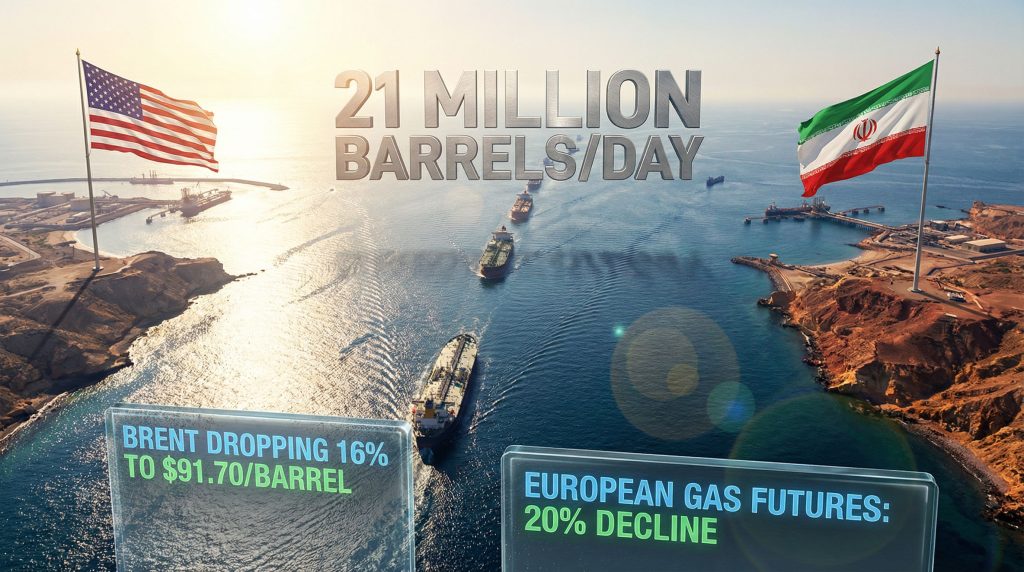
European gas futures demonstrated immediate sensitivity to diplomatic developments, with TTF contracts falling approximately 20% to €42.90/MWh at market opening on April 8, 2026, before recovering to around €44/MWh within hours. Consequently, this volatility pattern reflects broader concerns about energy export challenges affecting global markets.
This price volatility reflects several market dynamics:
- Risk premium adjustments based on supply security perceptions
- Alternative sourcing costs for European energy imports
- Storage inventory management during price uncertainty periods
- Hedging strategy modifications by major energy consumers
Crude Oil Price Response Analysis
Crude oil markets showed similar volatility patterns, with June ICE Brent contracts dropping 16% to $91.70/barrel before recovering to approximately $95.47/barrel as traders reassessed supply disruption risks. This mirrors broader patterns seen in oil price crash analysis during similar diplomatic developments.
The price recovery suggests that markets remain sceptical about long-term stability, treating diplomatic announcements as temporary risk reduction rather than fundamental supply security improvements.
Historical comparison shows TTF contracts last traded at €31.51/MWh on February 27, 2026, indicating that even with diplomatic progress, energy prices remain well above pre-crisis levels.
The next major ASX story will hit our subscribers first
Alternative Energy Routing and Supply Chain Resilience
Strategic Petroleum Reserve Implications
Major energy consuming nations maintain strategic reserves specifically to address supply disruption scenarios. The current diplomatic uncertainty tests these buffer systems and influences release timing decisions.
Global Strategic Reserve Capacity:
- United States: 650+ million barrels capacity
- European Union: 90-day import equivalent requirement
- China: Estimated 500+ million barrels across sites
- Japan: 200+ day import coverage target
Reserve utilisation during diplomatic negotiations serves multiple purposes: market stabilisation, negotiating leverage demonstration, and preparation for potential supply interruption scenarios.
Maritime Route Diversification
Shipping companies have developed alternative routing strategies to maintain supply chain continuity during chokepoint closures. These alternatives typically involve longer transit times and higher transportation costs but provide operational flexibility.
Primary alternative routes include:
- Cape of Good Hope routing: Adds 14-21 days transit time for Middle East exports
- Suez Canal utilisation: For reduced Persian Gulf dependence
- Pipeline infrastructure: Iraq-Turkey, Kazakhstan-China alternatives
- Rail transport systems: Central Asia to European markets
Risk Scenario Modelling for Investment Decisions
Best Case Diplomatic Resolution
A comprehensive diplomatic agreement could establish permanent operational frameworks for waterway management whilst providing sanctions relief mechanisms. This scenario would likely include:
- Formal International Maritime Organisation oversight of strait operations
- Graduated sanctions relief tied to compliance milestones
- Joint maritime security cooperation between regional powers
- Investment protection agreements for energy infrastructure
Under this scenario, insurance premiums could normalise within 6-12 months, and alternative energy projects might see reduced investment priority as supply security improves. However, investors should consider implementing robust investment strategies to navigate this uncertainty.
Moderate Case: Limited Arrangement Extension
More likely outcomes involve extending temporary arrangements whilst addressing specific technical issues. This approach would maintain current uncertainty levels whilst providing operational predictability for commercial operations.
Key characteristics include:
- Rolling coordination agreements with 30-90 day terms
- Sector-specific sanctions relief for humanitarian and technical goods
- Enhanced monitoring mechanisms through international organisations
- Conditional investment frameworks with political risk insurance requirements
Worst Case: Negotiation Breakdown and Escalation
Diplomatic failure could result in expanded military operations and broader energy supply disruptions. This scenario carries severe economic consequences across global energy markets.
Potential impacts include:
- Complete strait closure lasting weeks or months
- Regional refinery targeting expanding infrastructure damage
- International coalition formation with expanded economic sanctions
- Strategic reserve releases coordinated across major consumers
Investment implications would include massive capital flight from regional energy projects and acceleration of alternative energy development programmes globally.
Technology Transfer and Infrastructure Investment Opportunities
Iranian Energy Sector Modernisation Potential
Sanctions relief could enable significant technology transfer opportunities in upstream and downstream energy sectors. Iranian fields require enhanced recovery technologies and refining capacity upgrades after years of limited international investment.
Potential areas for development include:
- Enhanced oil recovery systems for mature field development
- Natural gas processing facilities for export capacity expansion
- Renewable energy integration for domestic consumption reduction
- Digital oilfield technologies for operational efficiency improvements
Regional Infrastructure Coordination Projects
Diplomatic resolution could enable broader regional energy infrastructure projects that have been delayed by political tensions. These mega-projects typically require multi-year development timelines and significant capital commitments.
Examples include:
- Trans-Caspian gas pipeline connecting Central Asian supplies
- Regional power grid integration for renewable energy sharing
- LNG export facility development in multiple Gulf states
- Petrochemical complex expansion serving Asian markets
International Maritime Law and Precedent Setting
Implications for Other Maritime Disputes
The diplomatic framework established for strait management could influence approaches to similar conflicts worldwide. Several regions face comparable challenges where energy security intersects with territorial disputes, particularly as Trump defends concessions to Iran establishes new precedents for resolving such conflicts.
Potential Applications:
- South China Sea shipping lanes: Managing competing territorial claims affecting energy transport
- Arctic shipping routes: International cooperation frameworks for seasonal navigation
- Red Sea coordination: Multi-national security arrangements for commercial traffic
- Black Sea transit arrangements: Managing tensions affecting grain and energy exports
Multilateral Coordination Mechanisms
International organisations play crucial roles in providing neutral frameworks for implementing temporary coordination arrangements. The International Maritime Organisation's involvement establishes precedents for technical standard-setting and operational oversight.
Key organisational functions include:
- Navigation safety standards for contested waterways
- Environmental protection protocols during military tensions
- Search and rescue coordination between rival naval forces
- Commercial dispute resolution mechanisms for shipping incidents
Investment Risk Management During Diplomatic Transitions
Portfolio Diversification Strategies
Energy investors must adapt portfolio strategies to account for heightened geopolitical uncertainty whilst maintaining exposure to potential diplomatic dividend opportunities.
Risk Management Approaches:
- Geographic diversification across multiple energy-producing regions
- Technology hedging through renewable energy investments
- Currency exposure management for sanctions-affected markets
- Political risk insurance utilisation for infrastructure projects
Timing Considerations for Energy Infrastructure Investment
Investment timing becomes critical when diplomatic windows may open or close rapidly. Early positioning can capture significant returns if diplomatic resolution succeeds, but carries substantial downside risks if negotiations fail.
Strategic timing factors:
- Sanction relief probability assessment based on negotiation progress
- Infrastructure readiness for rapid capacity expansion
- Market share positioning during competitor uncertainty
- Regulatory approval timelines for international project development
Monitoring Framework for Future Diplomatic Developments
Critical Indicators for Negotiation Progress
Successful navigation of this diplomatic environment requires systematic monitoring of multiple indicator categories that signal negotiation direction and implementation success.
Key metrics include:
- Vessel transit volumes through contested waterways
- Insurance premium trends for regional shipping routes
- Energy infrastructure attack frequency and targeting patterns
- International mediation engagement levels from neutral parties
Market Signals for Policy Direction Changes
Financial markets often provide early warning signals of diplomatic momentum shifts through asset price movements and trading volume patterns.
Primary market indicators:
- Energy futures curve structures indicating long-term supply expectations
- Regional equity market performance in energy-dependent economies
- Currency exchange rate stability for sanctions-affected countries
- Credit default swap pricing for sovereign and corporate energy debt
The intersection of energy security, diplomatic negotiation, and market dynamics creates unprecedented complexity for policy makers and investors alike. Success requires understanding not just the immediate tactical considerations, but the broader strategic frameworks that will determine long-term energy market stability.
Disclaimer: This analysis is based on publicly available information as of April 2026 and should not be considered investment advice. Geopolitical developments can change rapidly, and investors should consult qualified professionals before making investment decisions in volatile markets.
Looking for Energy Investment Opportunities During Market Volatility?
As geopolitical tensions reshape global energy markets, Discovery Alert's proprietary Discovery IQ model delivers real-time alerts on significant ASX mineral discoveries, helping investors navigate uncertainty by identifying opportunities in energy-related commodities and mining ventures. Stay ahead of market movements with immediate insights into actionable discoveries that could benefit from energy sector developments, and begin your 14-day free trial today to secure your competitive advantage.