Mining operations across Latin America face increasing regulatory scrutiny as governments strengthen environmental enforcement mechanisms. Chile's sophisticated regulatory framework presents both opportunities and challenges for copper producers navigating complex compliance requirements. The intersection of water scarcity, community concerns, and operational efficiency creates a multifaceted landscape where environmental stewardship directly impacts operational continuity and financial performance. Recent developments highlight how Minera Tres Valles environmental charges in Chile exemplify the complex regulatory challenges facing the sector.
Chile's Environmental Enforcement Framework: Understanding Mining Compliance Challenges
Chile's environmental regulatory architecture operates through multiple interconnected agencies, each with distinct jurisdictions and enforcement capabilities. The National Service of Geology and Mining (SERNAGEOMIN) maintains primary oversight of mining operations under the Ministry of Mining. Meanwhile, the Environmental Evaluation System (SEIA) governs environmental impact assessments through Law 19,300, originally enacted in 1994 and significantly amended in 2010.
SERNAGEOMIN's Regulatory Authority and Enforcement Powers
SERNAGEOMIN's enforcement powers extend across all phases of mining operations, from exploration through closure. The agency conducts regular inspections, reviews compliance reports, and maintains authority to issue operational suspensions when environmental risks are identified. Furthermore, companies must utilise comprehensive mineral exploration insights to ensure compliance throughout all operational phases.
The regulatory framework requires mining operations to maintain comprehensive environmental management systems. These systems must demonstrate continuous compliance with established thresholds for water consumption, particulate emissions, and habitat protection measures. Consequently, failure to maintain adequate monitoring infrastructure itself constitutes a regulatory violation.
Environmental Impact Assessment Requirements for Copper Operations
Chile's Environmental Evaluation System categorises projects into three tiers based on environmental risk and operational scale. Major copper extraction projects typically fall under Category 1, requiring comprehensive Environmental Impact Assessments (EIA) before receiving operational permits. Therefore, understanding permitting insights becomes crucial for successful project development.
The EIA process mandates detailed baseline environmental characterisation, impact prediction modelling, and comprehensive mitigation planning. Project proponents must demonstrate technical and financial capacity to implement proposed environmental controls throughout the operational lifecycle. The review period typically extends 12-24 months for complex copper projects, with additional extensions possible when technical clarifications are required.
Water Usage Monitoring in Arid Mining Regions
Water governance in Chile's arid mining regions involves multiple regulatory layers. The Directorate General of Waters (DGA) maintains jurisdiction over groundwater extraction permits, while SERNAGEOMIN oversees mining-specific water usage compliance. This dual oversight structure requires operators to navigate overlapping monitoring requirements and reporting obligations.
Mining operations must install monitoring wells to track groundwater levels quarterly. These measurements feed into sustainability assessments that determine whether extraction rates exceed natural recharge capabilities. When extraction exceeds permitted volumes or causes measurable aquifer depletion, operators face immediate compliance actions.
What Environmental Violations Trigger Formal Charges in Chilean Mining?
Environmental violations in Chilean mining are classified by severity and environmental impact potential. Law 19,300 and its implementing regulations establish clear categories of non-compliance that trigger formal enforcement actions. Understanding these categories helps operators implement targeted compliance strategies and risk management protocols.
Categories of Environmental Non-Compliance
Water extraction violations and aquifer protection breaches represent the most common category of environmental charges in Chile's arid mining regions. These violations include:
• Extracting groundwater beyond permitted volumes
• Failing to maintain required monitoring well infrastructure
• Contaminating surface or groundwater sources through operational activities
• Operating without valid water extraction permits
Tailings management and containment failures constitute high-severity violations due to their potential for catastrophic environmental impact. Modern waste management solutions can help prevent such failures. Regulatory authorities maintain zero tolerance for:
• Structural integrity breaches in tailings storage facilities
• Unauthorised discharge of mining waste materials
• Inadequate containment measures that allow seepage into groundwater
• Failure to maintain required geotechnical monitoring systems
Air quality standards and emissions monitoring violations focus on particulate matter control and atmospheric protection. Mining operations must comply with:
• National Primary Air Quality Standards for PM10 and PM2.5 concentrations
• Real-time monitoring system maintenance and data reporting requirements
• Dust suppression protocols during transport and processing activities
• Emergency response procedures during high-wind events
Biodiversity impact assessments and habitat protection violations address ecosystem disruption and species conservation. Enforcement focuses on:
• Unauthorised habitat modification beyond approved operational boundaries
• Failure to implement species mitigation measures outlined in environmental permits
• Non-compliance with restoration timelines and habitat replacement requirements
• Inadequate monitoring of protected species populations in operational areas
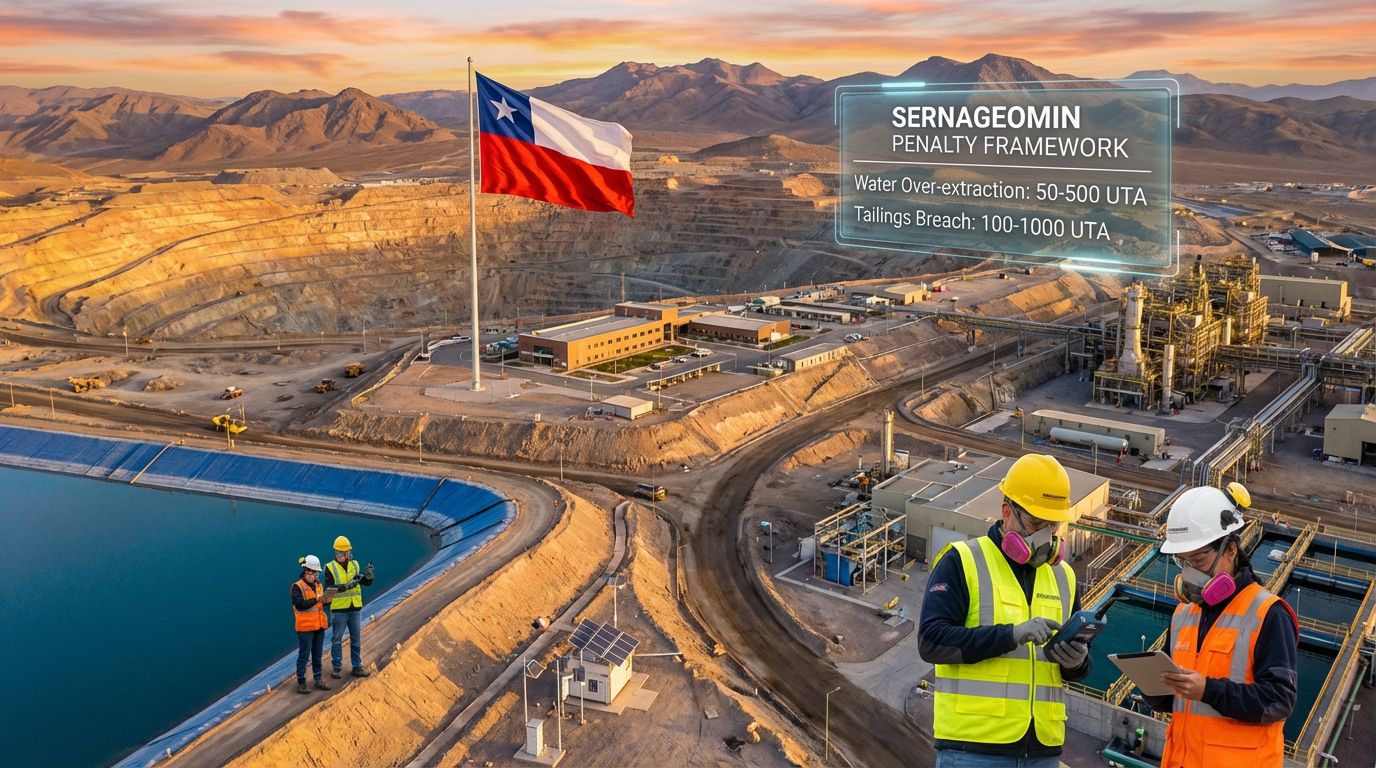
Penalty Structure and Fine Calculations
Chilean environmental law provides for graduated penalties based on violation severity, environmental impact, and compliance history. Administrative sanctions can include warnings, monetary fines, operational restrictions, and permit revocation. The penalty framework incorporates both deterrent and remedial elements.
The appeal process allows operators to contest initial penalty decisions within a 30-day window. Administrative appeals are reviewed by the issuing authority, whilst judicial appeals proceed to Regional Environmental Courts established under Law 20,600. Environmental Court proceedings typically require 6-18 months for resolution, depending on case complexity.
Civil liability provisions require operators to fully remediate environmental damage regardless of administrative penalties imposed. This dual liability structure means that monetary fines represent only partial resolution of environmental violations. Comprehensive restoration obligations can extend years beyond initial penalty assessment.
How Do Mining Companies Navigate Chile's Environmental Review Process?
Mining companies must develop sophisticated environmental management capabilities to successfully navigate Chile's regulatory framework. The process begins years before operational commencement and continues throughout the mine lifecycle. Successful navigation requires technical expertise, community engagement, and proactive compliance planning.
Pre-Operational Environmental Impact Studies
Environmental Impact Assessment preparation requires multidisciplinary teams including hydrogeologists, ecologists, air quality specialists, and social scientists. Baseline studies must demonstrate comprehensive understanding of existing environmental conditions across multiple seasonal cycles. This characterisation phase typically requires 18-24 months of data collection before EIA submission.
The technical analysis must predict operational impacts using validated modelling techniques. Hydrological modelling demonstrates water balance sustainability, whilst air dispersion modelling predicts particulate transport patterns. Ecological assessments identify sensitive species and habitat connectivity requirements. Each technical component requires peer review and regulatory validation.
Impact mitigation planning constitutes the critical bridge between impact prediction and regulatory approval. Mitigation measures must demonstrate technical feasibility, financial viability, and measurable effectiveness. Regulatory authorities increasingly require performance bonds to guarantee mitigation implementation.
Ongoing Monitoring and Reporting Requirements
Operational monitoring systems must provide real-time data on key environmental parameters. Water monitoring includes groundwater levels, surface water quality, and consumption tracking across operational areas. Air quality monitoring stations provide continuous particulate matter measurements with automated reporting to regulatory databases.
Quarterly compliance reports synthesise monitoring data into regulatory formats specified by SERNAGEOMIN and environmental authorities. These reports must demonstrate continued compliance with permit conditions and identify any deviations requiring corrective action. Late or incomplete reporting constitutes independent violations triggering additional penalties.
Annual compliance certification requires third-party environmental auditing. Independent auditors verify monitoring system calibration, data quality, and compliance status. This certification process provides regulatory assurance whilst identifying potential compliance gaps before formal violations occur.
Community Consultation and Social Licence Obligations
Community consultation requirements have expanded significantly under Chile's enhanced indigenous rights legislation. Law 21,600, enacted in 2023, requires "free, prior and informed consent" consultation when mining projects potentially affect indigenous territories. This consultation process can extend project timelines substantially.
Public participation processes must demonstrate meaningful community engagement throughout project development. Mining companies must establish ongoing communication mechanisms, respond to community concerns, and provide regular operational updates. Social impact monitoring tracks community indicators including employment, health, and cultural preservation.
Consultation documentation must meet strict regulatory standards for completeness and authenticity. Regulatory authorities review consultation records as part of permit evaluation and ongoing compliance assessment. Inadequate consultation can result in permit suspension or revocation.
Regional Mining Environmental Challenges in Coquimbo Province
Coquimbo Province presents unique environmental challenges that intensify regulatory scrutiny and operational complexity. The region's extreme aridity, competing water demands, and ecological sensitivity create conditions where environmental compliance directly affects operational viability. Mining companies including Minera Tres Valles face heightened regulatory attention in this environmentally sensitive region.
Water Scarcity and Aquifer Management Issues
Coquimbo's designation as an arid zone creates fundamental water allocation challenges. Annual precipitation averages 50-100mm across northern areas, whilst evapotranspiration rates exceed 2,000mm annually. This severe water deficit means that mining operations compete directly with agricultural and domestic users for limited groundwater resources.
Aquifer depletion monitoring reveals concerning trends across mining-intensive areas. Groundwater levels have declined 0.5-2.0 metres annually since the early 2000s in sectors with concentrated mining activity. The Choapa River Basin, where major copper operations are located, faces particularly acute water stress conditions.
Mining operations must demonstrate sustainable water management through comprehensive hydrogeological assessments. These studies must prove that extraction rates remain within aquifer recharge capabilities over extended operational periods. When sustainability cannot be demonstrated, operators must develop alternative water sources including desalination or recycled water systems.
Desert Ecosystem Protection Requirements
The Atacama Desert's unique ecosystems require specialised protection measures under Chilean environmental law. Endemic plant communities adapted to extreme aridity face particular vulnerability to mining-related disturbances. Regulatory authorities mandate comprehensive ecological baseline studies before approving new operations.
Xerophytic vegetation assemblages support specialised fauna including endemic lizard species and small mammals adapted to desert conditions. Mining operations must avoid direct impact to these communities whilst implementing habitat connectivity measures. Restoration obligations require establishment of equivalent habitat quality in alternative locations.
Underground water-dependent ecosystems represent critical conservation priorities. These "oasis" systems depend on limited groundwater discharge and face immediate threat from aquifer drawdown. Mining operations near these systems face enhanced monitoring requirements and operational restrictions.
Agricultural Land Use Conflicts
Water allocation disputes between mining and agricultural interests have intensified as drought conditions persist. Approximately 60% of Coquimbo's historical water allocation supported agricultural activities, but mining expansion has shifted this balance substantially. Small-scale farmers particularly struggle to compete with mining companies for water access rights.
The Directorate General of Waters maintains authority over water allocation decisions, but must balance competing sectoral demands. Mining operations typically offer higher economic returns per unit of water consumed, creating pressure to reallocate water rights from agricultural to mining uses. This reallocation generates significant community opposition and legal challenges.
Legal frameworks provide limited protection for established agricultural water users. Water rights markets allow mining companies to purchase agricultural water allocations, effectively converting farming areas to mining-dependent economies. This transition creates long-term social and economic disruption in traditional agricultural communities.
Case Study Analysis: Environmental Compliance Patterns in Chilean Copper Mining
Chilean copper mining operations demonstrate varied approaches to environmental compliance, with outcomes reflecting operational scale, environmental sensitivity, and management commitment. Large-scale operations typically invest heavily in preventive compliance measures, whilst smaller operators may face greater enforcement exposure. These patterns provide insights for operators across the sector.
Recent Environmental Challenges for Minera Tres Valles
Minera Tres Valles environmental charges in Chile highlight the complex regulatory challenges facing medium-scale copper producers. The company's operations in Coquimbo Province demonstrate how regional environmental sensitivities create heightened compliance risks. Furthermore, understanding industry evolution trends helps contextualise these challenges.
Recent developments have seen the company face environmental investigations regarding water usage and operational permits. These challenges reflect broader sectoral issues where environmental charges against mining operations increasingly focus on aquifer protection and sustainable resource management. Consequently, the case demonstrates the importance of proactive environmental management.
The regulatory response to Minera Tres Valles' situation illustrates how Chilean authorities prioritise environmental protection over operational continuity. This approach reflects growing public concern about mining impacts on water resources and ecosystem integrity. The company's experience provides valuable lessons for similar operations across the region.
Comparative Compliance Records Across Major Operations
Major Chilean copper operations demonstrate varying compliance performance based on operational characteristics and management approaches. Newer operations typically incorporate advanced environmental controls from initial design, whilst older operations must retrofit compliance systems to meet evolving regulatory requirements.
Compliance costs represent significant operational expenses across the sector. Environmental management systems, monitoring infrastructure, and remediation activities typically consume substantial capital and operational budgets. These investments reflect both regulatory requirements and risk management priorities.
Environmental compliance investments in Chilean copper mining have shifted from reactive penalty management to proactive risk prevention, reflecting both regulatory evolution and operational efficiency considerations.
What Happens When Mining Companies Face Environmental Charges?
Environmental charges against mining companies trigger complex legal and operational processes that can significantly impact business continuity. Understanding these processes helps operators prepare appropriate response strategies whilst minimising operational disruption. The Chilean system provides multiple procedural safeguards whilst maintaining strong environmental protection enforcement.
Investigation and Evidence Gathering Process
Environmental investigations typically begin with regulatory inspections, community complaints, or monitoring data anomalies. SERNAGEOMIN investigators conduct site visits to collect physical evidence, interview personnel, and review operational records. Investigation scope depends on violation severity and potential environmental impact.
Evidence collection follows strict procedural requirements to ensure legal validity. Investigators must document sampling procedures, maintain chain of custody for physical samples, and provide operators with copies of collected documentation. Technical analysis of environmental samples requires certified laboratory procedures and peer review validation.
The investigation phase typically requires 30-60 days for completion, though complex cases may extend substantially longer. Operators receive formal notification of investigation findings and specific violation allegations. Response preparation requires coordination between technical, legal, and operational teams.
Legal Defence Strategies and Mitigation Measures
Effective legal defence requires comprehensive technical analysis of violation allegations and procedural compliance review. Technical defences may challenge sampling procedures, analytical methods, or regulatory interpretation. Procedural defences focus on investigation protocols and notification requirements.
Mitigation strategies demonstrate operator commitment to environmental protection and compliance improvement. Voluntary remediation measures, enhanced monitoring systems, and operational modifications can influence penalty severity. Regulatory authorities typically consider mitigation efforts when determining appropriate sanctions.
Legal representation specialising in environmental mining law provides crucial expertise in defence strategy development. These specialists understand regulatory interpretation patterns and precedent decisions that influence case outcomes. Early legal engagement improves defence preparation and negotiation positioning.
Operational Continuity During Regulatory Reviews
Mining operations may continue during investigation phases unless specific suspension orders are issued. Suspension authority rests with SERNAGEOMIN or environmental courts when imminent environmental risk is demonstrated. Emergency suspension orders can halt operations immediately without prior notice.
Operational modifications may be required during investigation periods to address immediate environmental concerns. These modifications might include enhanced monitoring, operational restrictions, or temporary activity suspension in specific areas. Compliance with modification requirements influences ongoing operation authorisation.
Financial planning must account for potential operational disruptions and penalty obligations. Environmental liability insurance may provide coverage for certain penalty types and remediation costs. Reserve establishment for environmental contingencies represents standard risk management practice.
Industry Response: Proactive Environmental Management Strategies
Chilean mining companies increasingly adopt proactive environmental management approaches to minimise regulatory exposure and operational risk. These strategies reflect both regulatory pressure and operational efficiency considerations. Leading operators invest heavily in prevention rather than reactive compliance management.
Technology Solutions for Real-Time Monitoring
Advanced monitoring technologies enable continuous environmental parameter tracking and automated regulatory reporting. Internet-of-Things sensors provide real-time data on water levels, air quality, and structural integrity across operational areas. Automated data transmission eliminates manual reporting delays and reduces compliance errors.
Satellite monitoring systems track operational footprint expansion and ecosystem changes across mine sites. These systems provide early warning of potential environmental impacts and support adaptive management strategies. Integration with operational planning systems enables proactive impact prevention.
Predictive analytics identify compliance risks before violations occur. Machine learning algorithms analyse monitoring data patterns to predict equipment failures, environmental threshold exceedances, and operational risks. This predictive capability enables preventive interventions that maintain continuous compliance.
Community Engagement and Transparency Initiatives
Comprehensive community engagement programmes build social licence and reduce regulatory risk. Regular community meetings, environmental data sharing, and grievance mechanisms address concerns before formal complaints arise. Transparent communication builds trust that supports operational continuity.
Independent environmental monitoring by community representatives provides additional assurance of operational compliance. Community monitors receive technical training and equipment to conduct basic environmental assessments. This participatory approach increases community confidence in environmental protection measures.
Local hiring and procurement programmes demonstrate commitment to community benefit. Mining companies prioritise local employment opportunities and supplier relationships that create economic interdependence. These economic relationships often improve community support for continued operations.
Insurance and Financial Risk Management
Environmental liability insurance provides financial protection against compliance costs and remediation obligations. Specialised mining environmental policies cover regulatory penalties, cleanup costs, and third-party claims. Insurance availability and pricing reflect operator risk profiles and compliance history.
Financial reserves for environmental contingencies enable rapid response to compliance issues. Reserve calculations consider potential penalty ranges, remediation costs, and operational disruption impacts. Adequate reserves support compliance investments and penalty payments without operational financing disruption.
Risk management frameworks integrate environmental compliance into operational decision-making. Environmental risk assessments influence operational planning, capital allocation, and strategic development decisions. This integration ensures environmental considerations receive appropriate priority in business planning.
Future Regulatory Trends in Chilean Mining Environmental Policy
Chilean environmental regulation continues evolving to address climate change, water scarcity, and indigenous rights. Understanding regulatory trends enables mining companies to prepare for future compliance requirements and investment needs. Proactive adaptation to regulatory evolution provides competitive advantage and operational certainty.
Enhanced Water Protection Legislation
Water protection legislation increasingly emphasises aquifer sustainability and ecosystem protection. Proposed regulations would strengthen extraction permit requirements and expand monitoring obligations. Mining operations in water-stressed regions face particular scrutiny under evolving regulatory frameworks.
Groundwater protection zones around sensitive ecosystems may restrict mining activities and water extraction. These zones would provide additional protection for water-dependent habitats whilst limiting mining expansion opportunities. Existing operations within proposed protection zones may face operational restrictions or enhanced monitoring requirements.
Water efficiency standards for mining operations reflect growing resource scarcity concerns. Regulatory authorities consider implementing mandatory water recycling percentages and efficiency benchmarks. These standards would require operational modifications and technology investments across the mining sector.
Climate Change Adaptation Requirements
Climate change adaptation planning becomes mandatory for major mining projects under proposed regulations. Operators must demonstrate operational resilience to climate-related risks including extreme weather events, temperature changes, and precipitation variability. Additionally, implementing decarbonisation benefits supports both compliance and operational efficiency.
Greenhouse gas emission reporting and reduction requirements align Chilean mining with global climate commitments. Carbon footprint assessments and reduction targets may become standard permit conditions. These requirements drive investment in renewable energy, operational efficiency, and emission control technologies.
Climate risk disclosure requirements provide transparency regarding operational vulnerability and adaptation measures. Public reporting of climate risks and adaptation strategies enables stakeholder assessment of long-term operational viability. These disclosures influence investment decisions and community support levels.
Indigenous Rights and Consultation Protocols
Enhanced indigenous consultation requirements reflect Constitutional recognition of indigenous rights and international treaty obligations. Consultation protocols become more comprehensive and require demonstrated community consent for operations affecting traditional territories. These requirements extend project development timelines substantially.
Cultural impact assessments address mining effects on indigenous cultural practices and sacred sites. Mining operations must avoid direct impacts to culturally significant areas whilst implementing protective measures for adjacent cultural resources. Consultation with traditional authorities becomes mandatory for impact assessment validation.
Benefit-sharing agreements ensure indigenous communities receive equitable compensation for mining activities on traditional territories. These agreements may include employment preferences, revenue sharing, and cultural preservation funding. Agreement negotiation requires extensive consultation and may significantly influence project economics.
Conclusion: Navigating Chile's Environmental Compliance Landscape
The case of Minera Tres Valles environmental charges in Chile demonstrates the increasing complexity of environmental compliance in the Chilean mining sector. As regulatory frameworks evolve to address water scarcity, climate change, and indigenous rights, mining companies must adopt comprehensive environmental management strategies.
Minera Tres Valles environmental charges in Chile exemplify how regional environmental sensitivities combine with regulatory enforcement to create significant compliance challenges. The company's experience highlights the importance of proactive environmental management and community engagement. Success requires technical excellence, legal expertise, and operational adaptability.
Looking forward, Chilean mining environmental regulation will continue strengthening to address emerging challenges. Companies that invest in preventive compliance measures, advanced monitoring technologies, and community engagement will be better positioned for long-term operational success. The regulatory landscape rewards environmental leadership whilst penalising reactive compliance approaches.
FAQ: Chilean Mining Environmental Compliance
What triggers an environmental investigation of a mining operation?
Environmental investigations can be triggered by several factors including routine regulatory inspections, community complaints, monitoring data anomalies, or incidents such as equipment failures or environmental releases. SERNAGEOMIN conducts regular compliance inspections, whilst emergency investigations respond to specific environmental concerns or violations.
How long do environmental reviews typically take?
Environmental review timelines vary significantly based on case complexity and violation severity. Simple administrative violations may be resolved within 60-90 days, whilst complex cases involving multiple violations or significant environmental impact can extend 6-18 months. Appeals to Environmental Courts may add additional months to the resolution timeline.
Can mining companies continue operations during investigations?
Mining operations may generally continue during investigation phases unless specific suspension orders are issued. SERNAGEOMIN or environmental courts can order operational suspension when imminent environmental risk is demonstrated. Emergency suspension orders can be implemented immediately without prior notice when public health or environmental safety is threatened.
What role do local communities play in environmental monitoring?
Local communities play increasingly important roles in environmental monitoring through formal complaint procedures, participatory monitoring programmes, and consultation processes. Community members can file environmental complaints that trigger regulatory investigations, participate in monitoring activities with technical training, and engage in ongoing consultation regarding operational environmental impacts.
This analysis of Chilean mining environmental compliance is intended for educational purposes and does not constitute legal advice. Environmental regulations are subject to change, and specific compliance requirements should be verified with qualified legal and regulatory specialists.
Further Exploration:
Readers interested in learning more about Chilean mining environmental regulations can explore additional educational content from industry publications and regulatory agencies that provide comprehensive coverage of Latin American mining compliance frameworks.
Ready to Invest in the Next Major Mineral Discovery?
Discovery Alert instantly alerts investors to significant ASX mineral discoveries using its proprietary Discovery IQ model, turning complex mineral data into actionable insights. Begin your 30-day free trial today to position yourself ahead of the market and discover why historic discoveries can generate substantial returns by visiting Discovery Alert's dedicated discoveries page.