June 3, 2026
Mexico's mineral exploration landscape reflects complex interplay between constitutional frameworks, economic constraints, and geopolitical positioning that extends far beyond immediate policy discussions. Understanding the mineral exploration importance requires examining how Mexican Geological Survey exploration limits operate under resource limitations while balancing national strategic objectives against private sector capabilities.
Understanding Mexico's State-Controlled Mineral Exploration Framework
The Constitutional Foundation of Exploration Restrictions
Mexico's Constitution Article 27 establishes the nation's ownership of mineral resources in the subsoil, creating the legal foundation for state-controlled exploration authority. This constitutional framework differentiates between exploration rights, which became limited primarily to the Mexican Geological Survey (SGM) following 2023 reforms, and exploitation concessions that remain available to private entities under specific conditions.
The constitutional approach reserves subsoil minerals to the state, with exploitation rights granted through concessions rather than ownership transfers. This distinguishes Mexico's system from countries with privatised mineral rights, creating a bifurcated framework where SGM controls the exploration phase while private entities may participate in exploitation stages under concession arrangements.
Furthermore, technical procedures for private sector participation require navigating extended concession processes, with constitutional authority providing the legal basis for increasingly restrictive exploration access implemented through statutory reforms.
How the 2023 Mining Law Reform Reshaped Private Sector Access
The 2023 Mining Law reform concentrated exploration authority with SGM, effectively restricting private companies' independent exploration capacity. Following implementation, Mexico's mining investment attractiveness remained depressed until 2024, when the country rose to 49th place in the Fraser Institute's Mining Investment Attractiveness Index, up from 74th in 2023.
The Geological Potential Index within the Fraser ranking increased dramatically from 37.50 to 64.29 points between 2023-2024, while the Policy Perception Index showed more modest improvement from 35.02 to 39.78 points during the same period.
Minister of Economy Marcelo Ebrard announced plans to accelerate mining permit approvals to support large-scale exploration and meet rising global demand for critical minerals. However, understanding mining permitting basics remains crucial, as securing supply chains represents a national priority. Three new mining permits covering land-use authorisations and environmental impact approvals had already received approval by late 2025.
However, President Claudia Sheinbaum confirmed that no new mining concessions will be granted during her administration, emphasising sustainable development and strategic oversight. This indicates the 2023 reforms represent a structural shift rather than temporary policy adjustment.
Private companies now face a transformed operating environment including:
- Restricted exploration rights requiring SGM partnerships
- Increased royalty obligations
- Tighter environmental standards
- Extended permit processing timelines
SGM's Role as Mexico's Primary Exploration Entity
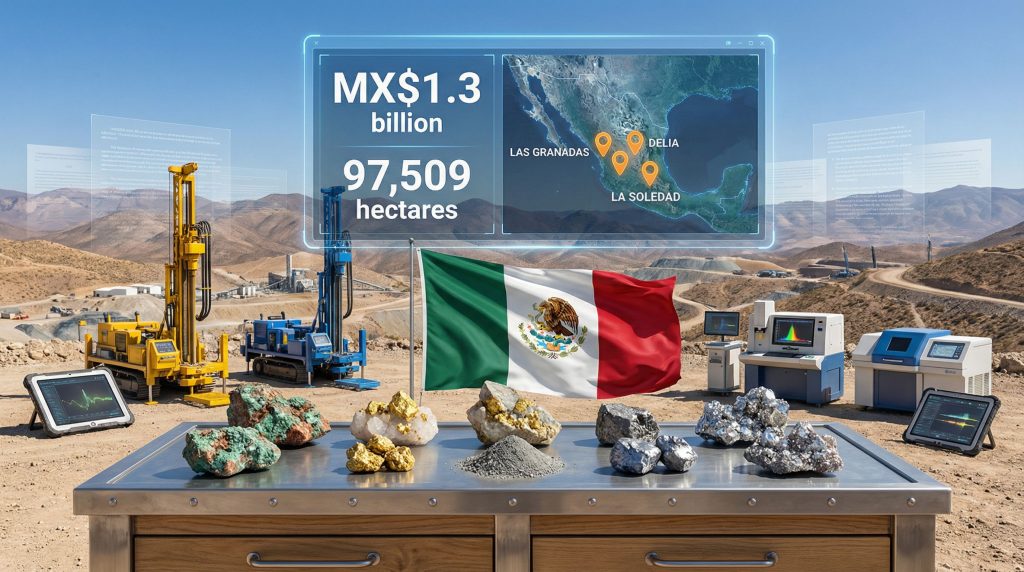
SGM operates as a decentralised agency within Mexico's Ministry of Economy, employing more than 1,300 personnel with an annual operating budget of MX$1.3 billion (approximately USD $75-80 million at December 2025 exchange rates). The organisation provides over 48 exploration services focused on critical and strategic minerals, plus additional research services for industry stakeholders.
SGM Director Flor de María Harp emphasised that Mexico requires a larger SGM organisation to accelerate exploration timelines, despite the substantial institutional scale. She noted that exploration processes increase in intensity and cost as they progress, with many projects halted when geological, analytical, or geophysical results do not support mineralisation potential, reflecting the inherent high-risk nature of exploration work.
The organisation conducts exploration across multiple commodity types including precious metals (gold, silver), base metals (copper, lead, zinc), and strategic minerals (molybdenum, tungsten). SGM utilises specialised geophysical, geological, and analytical services to advance exploration projects through multiple phases from reconnaissance through advanced exploration.
Current operational capacity centres on three major exploration orders assigned in 2025, covering a cumulative 97,509 hectares across distinct Mexican regions:
| Project | Location | Area (Hectares) | Target Commodities |
|---|---|---|---|
| Las Granadas | State of Mexico | 75,907 | Lead, zinc, copper, gold, silver |
| Delia | Sonora | 15,366 | Gold |
| La Soledad | Durango-Sinaloa | 6,236 | Copper, molybdenum, gold, tungsten |
When big ASX news breaks, our subscribers know first
What Are the Current Operational Limits Facing SGM in 2026?
Budget Constraints vs. Exploration Ambitions
SGM's MX$1.3 billion annual budget represents a fixed allocation for 2026, with no workforce expansion planned beyond the current 1,300+ employees. The organisation has identified 97,509 hectares as its maximum operational threshold, reflected in the cumulative coverage of three priority projects.
Harp stated that given SGM's operational capacity, the organisation will move forward with these three orders and may request additional projects depending on results. She emphasised that these areas cover large extensions requiring detailed study, indicating that SGM has reached a practical capacity threshold where expansion beyond current assignments would require additional resources.
The budget allocation must cover multiple operational categories:
- Personnel costs (estimated 70-75% of budget)
- Laboratory and analytical services
- Field operations and logistics
- Geophysical survey equipment maintenance
- Data management systems
- Institutional overhead
SGM maintains that exploration cost intensity increases at advanced stages, requiring proportionally greater resource allocation for fewer hectares as projects progress from reconnaissance to advanced exploration phases. The 97,509-hectare operational threshold reflects practical limits in field team deployment, geological mapping capacity, and analytical laboratory throughput.
The project distribution demonstrates resource prioritisation weighted toward the largest initiative:
- Las Granadas: 75,907 hectares (78% of total operational area)
- Delia: 15,366 hectares (16% of total operational area)
- La Soledad: 6,236 hectares (6% of total operational area)
Geographic Prioritisation Strategy Behind Project Selection
The three priority projects selected for 2026 implementation span distinct Mexican regions, reflecting a national strategic approach prioritising regional mineral potential identification. The weighted allocation toward Las Granadas receiving 78% of hectare commitment indicates that the State of Mexico project represents SGM's highest strategic priority.
Las Granadas targets polymetallic systems in central Mexico's geological formations, focusing on deeper or previously unexplored mineralised zones despite the region's historical mining activity. Delia concentrates on gold deposits in Sonora's established mining district, where exploration efforts likely focus on expanding known deposits or identifying new mineralised bodies adjacent to existing operations.
La Soledad targets copper and molybdenum systems in Durango-Sinaloa's porphyry copper geology, representing Mexico's traditional copper-producing region. This geographic distribution aligns with distinct geological frameworks:
- Central Mexico polymetallics: Complex geological formations with multi-metal potential
- Sonora gold systems: Established mining districts with proven mineralisation
- Durango-Sinaloa porphyry copper: Traditional copper-producing geology with existing infrastructure
Technical Capacity Bottlenecks in Large-Scale Surveys
SGM's technical capacity constraints emerge from limitations in specialised equipment deployment, analytical laboratory throughput, and qualified personnel distribution across multiple concurrent projects. The organisation's geological mapping capabilities must accommodate diverse mineralisation styles across 97,509 hectares while maintaining quality standards for resource assessment.
Advanced exploration phases require sophisticated geophysical surveys, extensive drilling programmes, and comprehensive analytical testing that strain organisational capacity. Laboratory facilities must process samples from polymetallic systems (Las Granadas), gold deposits (Delia), and porphyry copper systems (La Soledad) simultaneously, each requiring different analytical protocols and equipment specifications.
In addition, field operations face logistical challenges coordinating across three distinct geographic regions with varying infrastructure access, climate conditions, and regulatory environments. The State of Mexico's proximity to major population centres contrasts sharply with remote areas in Sonora and the mountainous terrain spanning Durango-Sinaloa borders.
Data management systems must integrate geological, geophysical, and geochemical information from multiple projects whilst maintaining data quality standards for eventual resource assessment and potential private sector collaboration.
How Do Mexico's Three Priority Exploration Projects Compare Strategically?
Las Granadas (State of Mexico): Multi-Metal Potential Analysis
Las Granadas represents SGM's largest exploration commitment at 75,907 hectares, targeting lead, zinc, copper, gold, and silver in central Mexico's complex geological formations. The project's scale reflects sophisticated geological modelling requirements across diverse mineralisation zones, with polymetallic systems demanding comprehensive analytical approaches.
"With 75,907 hectares targeting lead, zinc, copper, gold, and silver, Las Granadas represents Mexico's largest current exploration commitment, requiring sophisticated geological modelling across diverse mineralisation zones."
The central Mexico location provides infrastructure advantages including proximity to transportation networks, electrical power, and skilled labour pools. However, the region's development density creates environmental and social complexity not present in more remote exploration areas.
Polymetallic exploration requires:
- Multi-element analytical protocols for diverse metal suites
- Complex geological modelling to understand mineralisation controls
- Varied sampling strategies for different deposit types
- Infrastructure impact assessment in developed regions
Furthermore, the project's strategic importance extends beyond immediate exploration outcomes, potentially demonstrating SGM's capability to identify substantial mineral resources in historically developed mining regions through advanced exploration techniques.
Delia (Sonora): Gold-Focused Exploration in Established Mining Territory
Delia's 15,366-hectare gold-focused exploration occurs within Sonora's established mining district, where approximately 40% of Mexico's historical gold production has originated. The project leverages existing geological knowledge and mining infrastructure whilst seeking to expand known deposits or identify new mineralised bodies.
Sonora's geological framework includes multiple gold deposit types from epithermal systems to orogenic gold deposits, requiring targeted exploration approaches based on deposit-specific characteristics. Moreover, understanding drilling results interpretation becomes crucial in this established mining territory.
The established mining territory provides advantages including:
- Existing infrastructure: Roads, power, processing facilities
- Skilled workforce: Experienced mining professionals and contractors
- Geological knowledge: Extensive historical data and regional understanding
- Regulatory familiarity: Established permitting and operational frameworks
Gold exploration in established districts focuses on near-mine exploration around existing operations, district-scale targeting using regional geological models, and advanced geophysical techniques to identify buried mineralisation. The project's success could demonstrate effective state-led exploration in mature mining regions.
La Soledad (Durango-Sinaloa): Critical Minerals Strategy for Copper and Molybdenum
La Soledad's 6,236 hectares target copper, molybdenum, gold, and tungsten across Durango-Sinaloa borders, focusing on porphyry copper systems in Mexico's traditional copper-producing region. The project aligns with critical minerals strategy emphasising copper demand for renewable energy infrastructure and molybdenum's strategic metal classification.
Porphyry copper exploration requires specialised techniques including:
- Large-scale geophysical surveys to identify buried intrusive systems
- Geochemical analysis for alteration haloes and metal zonation patterns
- Structural geology mapping to understand intrusive emplacement controls
- Extensive drilling programmes to test large-tonnage, low-grade mineralisation
The project's cross-state boundaries create administrative complexity whilst the mountainous terrain presents logistical challenges for equipment deployment and sample transportation. However, the region's historical copper production provides geological confidence and infrastructure foundation.
Strategic mineral considerations include:
- Copper: Critical for renewable energy and electrical infrastructure
- Molybdenum: Strategic metal for steel alloys and chemical applications
- Tungsten: Critical material for industrial and defence applications
What Economic Factors Drive SGM's Exploration Limitations?
Investment Decline Patterns: From $500M to $400M
Mexico's exploration sector investment declined from over US$500 million in 2023 to an estimated US$400 million in 2025, reflecting global market pressures and domestic regulatory uncertainty. This 20% decline coincides with implementation of 2023 Mining Law reforms that concentrated exploration authority with SGM whilst imposing stricter environmental and operational obligations on private firms.
The investment reduction reflects multiple factors:
- Regulatory uncertainty following 2023 Mining Law reform
- Global commodity price volatility affecting exploration budgets
- Increased operational costs due to stricter environmental standards
- Limited private exploration access concentrating activity with SGM
Companies adopted more cautious approaches as higher financial and legal risks emerged from increased royalties, tighter environmental standards, and extended permit processing times. The state-led exploration model creates investment concentration rather than diversified private sector exploration across multiple projects and regions.
In addition, global market pressures include base metal price volatility, precious metal demand fluctuations, and critical mineral supply chain disruptions affecting exploration investment allocation decisions. Mexico competes internationally for exploration capital with jurisdictions offering more favourable regulatory frameworks and established private sector access.
Risk-Return Analysis in State-Led vs. Private Exploration Models
State-led exploration through SGM creates different risk-return profiles compared to private sector models. SGM's approach emphasises national strategic objectives over financial returns, potentially pursuing projects with longer development timelines or lower commercial viability that serve broader economic goals.
State-Led Exploration Characteristics:
- Strategic focus: Critical minerals and national security considerations
- Extended timelines: Less pressure for rapid commercial development
- Comprehensive coverage: Systematic exploration across large areas
- Public benefit: Knowledge generation and resource assessment for national planning
Private Exploration Characteristics:
- Commercial focus: Emphasis on economic viability and investor returns
- Accelerated timelines: Market pressure for rapid resource definition
- Selective targeting: Concentration on highest-probability prospects
- Capital efficiency: Optimisation of exploration spending for maximum discovery potential
SGM's MX$1.3 billion budget spread across 97,509 hectares creates different risk distribution compared to private exploration concentrated on smaller, higher-grade targets. The state model provides geological knowledge generation benefits whilst potentially sacrificing commercial development speed.
Global Market Pressures Affecting Mexico's Exploration Timeline
International mineral market dynamics significantly influence SGM's project prioritisation and development timelines. Furthermore, understanding the broader context of mining industry evolution helps explain how critical mineral demand driven by renewable energy infrastructure, electric vehicle adoption, and energy storage systems creates urgency for copper, lithium, and rare earth element development.
Geopolitical considerations include:
- Supply chain security: Reducing dependence on concentrated mineral sources
- USMCA alignment: Coordinating mineral development with North American partners
- Chinese competition: Responding to aggressive Chinese mineral investment globally
- Strategic stockpiling: Building national mineral reserves for economic security
Global copper demand projections indicate substantial supply deficits through 2030, creating strategic importance for projects like La Soledad's porphyry copper exploration. Similarly, gold market volatility and safe-haven demand influence Delia project prioritisation within SGM's resource allocation decisions.
Mexico's Fraser Institute ranking improvement from 74th to 49th position demonstrates enhanced geological potential recognition whilst policy perception remains constrained. This creates tension between recognised mineral endowment and regulatory framework accessibility for development acceleration.
How Might Private Sector Integration Reshape Exploration Capacity?
Hybrid Partnership Models Under Consideration
SGM Director Flor de María Harp indicated that private sector involvement in exploration should occur under conditions where private companies can decide and contribute to combined models. This suggests openness to hybrid arrangements whilst maintaining state direction over exploration strategy and resource allocation.
Potential partnership structures include:
- Joint venture arrangements: SGM retains controlling interest with private sector technical and financial contributions
- Service provider models: Private companies provide specialised exploration services under SGM contracts
- Risk-sharing agreements: Private sector assumes exploration costs in exchange for development rights
- Technology transfer partnerships: Private sector provides advanced exploration techniques with knowledge sharing requirements
Hybrid models could address SGM's capacity constraints whilst maintaining state control over strategic mineral exploration. Private sector technical capabilities, specialised equipment, and financial resources could accelerate project timelines without compromising national sovereignty over mineral resources.
International precedents include Australia's joint venture approaches, Canada's provincial partnership models, and Chile's public-private exploration initiatives. These frameworks demonstrate potential for maintaining state strategic objectives whilst leveraging private sector efficiency and innovation.
Regulatory Framework for Private Collaboration Agreements
Current regulatory framework requires modification to accommodate hybrid partnership models whilst ensuring state strategic objectives remain paramount. The 2023 Mining Law reform concentrated exploration authority with SGM, necessitating additional legislation or regulatory interpretation to enable structured private sector collaboration.
Key regulatory considerations include:
- Intellectual property rights: Ownership and sharing of geological data and discoveries
- Financial responsibility: Cost allocation and risk distribution between public and private partners
- Environmental compliance: Responsibility assignment for environmental standards and remediation
- Development rights: Transition mechanisms from exploration to exploitation phases
Partnership agreements require clear frameworks for decision-making authority, technical standards, financial contributions, and project milestone requirements. Regulatory clarity could encourage private sector participation whilst maintaining SGM's strategic direction over exploration priorities.
Environmental and social responsibility frameworks need definition for hybrid arrangements, ensuring private sector partners meet Mexico's environmental standards and community engagement requirements established under current regulations.
International Best Practices in State-Private Exploration Partnerships
International experience provides models for effective state-private exploration partnerships balancing national strategic objectives with private sector efficiency. Mexico's mining policy framework demonstrates the complexities involved, whilst Australia's joint venture frameworks allow state participation whilst leveraging private sector technical capabilities and financial resources.
Canada's Provincial Models:
- Quebec: SOQUEM (state corporation) partners with private companies
- Ontario: Northern Ontario Heritage Fund supports exploration partnerships
- British Columbia: Geoscience BC facilitates public-private geological research
Chile's Approach:
- CODELCO partnerships: State copper company collaborates with international partners
- ENAMI support: State enterprise supports small-scale mining development
- Geological survey cooperation: SERNAGEOMIN provides data whilst private sector conducts exploration
Norway's Model:
- State participation: Government maintains ownership stakes in major projects
- Technology requirements: Private operators must use Norwegian technology and services
- Knowledge sharing: Mandatory data contribution to national geological databases
These international frameworks demonstrate potential for maintaining state strategic control whilst accessing private sector capabilities for accelerated exploration and development.
What Are the Broader Implications for Mexico's Critical Minerals Strategy?
Supply Chain Security vs. Exploration Pace Trade-offs
Mexico's state-controlled exploration approach prioritises supply chain security and strategic oversight over rapid exploration pace, creating fundamental trade-offs with commercial development timelines. Moreover, recognising the Mexican Geological Survey exploration limits is crucial, as SGM's comprehensive approach to 97,509 hectares across three projects emphasises systematic resource assessment over accelerated discovery targeting.
Critical mineral supply chain considerations include:
- Domestic production capacity: Reducing import dependence for strategic materials
- Processing infrastructure: Developing value-added mineral processing capabilities
- Strategic stockpiles: Building national reserves for economic and defence security
- Regional integration: Coordinating with USMCA partners for North American mineral security
The exploration pace limitation through SGM's capacity constraints potentially delays critical mineral development during period of increasing global demand. Copper demand for renewable energy infrastructure, lithium requirements for battery production, and rare earth elements for technology applications create urgency conflicting with methodical state-led exploration timelines.
Supply chain security benefits include comprehensive geological knowledge development, systematic resource assessment, and national control over strategic mineral discoveries. However, delayed development timelines may reduce Mexico's competitive position in emerging critical mineral markets.
Geopolitical Positioning in North American Mineral Markets
Mexico's exploration approach reflects broader geopolitical positioning within North American mineral supply chains and global resource competition. The USMCA framework creates opportunities for coordinated mineral development supporting regional supply chain security against concentrated global production sources.
North American Strategic Considerations:
- U.S. critical mineral requirements: Supporting American supply chain diversification goals
- Canadian resource coordination: Leveraging complementary geological endowments
- Chinese competition response: Developing alternative supply sources to reduce dependence
Mexico's geographical advantages include proximity to major North American markets, existing trade relationships, and geological diversity supporting multiple critical mineral types. The state-controlled exploration model ensures national strategic objectives align with broader regional security considerations.
However, exploration pace limitations may reduce Mexico's ability to capitalise on geopolitical opportunities requiring rapid development responses. Furthermore, Mexico's mining restrictions threaten access to key technology minerals, whilst global mineral market dynamics, particularly Chinese investment and development speed, create competitive pressures conflicting with methodical SGM exploration timelines.
Regional cooperation opportunities include joint exploration initiatives, technology sharing agreements, and coordinated infrastructure development supporting North American mineral supply chain integration.
Long-term Competitiveness Challenges from Exploration Delays
SGM's capacity constraints and methodical exploration approach create potential long-term competitiveness challenges as global mineral markets emphasise development speed and private sector innovation. The 97,509-hectare operational threshold limits Mexico's ability to pursue multiple large-scale exploration opportunities simultaneously.
Competitiveness Risk Factors:
- Technology advancement: Private sector innovation in exploration techniques and data analysis
- Capital access: International mining companies' superior financial resources for rapid development
- Market responsiveness: Private sector ability to adjust quickly to commodity price signals
- Global partnerships: International operators' established relationships and market access
Mexico's Fraser Institute ranking improvement to 49th position demonstrates enhanced geological potential recognition, but policy perception constraints at 39.78 points indicate continued regulatory uncertainty affecting long-term investment attraction.
Delayed exploration timelines may result in:
- Missed market opportunities: Critical mineral demand peaks during extended development periods
- Technology obsolescence: Geological techniques and processing methods advancing faster than SGM capacity
- Infrastructure degradation: Mining-related infrastructure requiring maintenance without corresponding development
- Talent migration: Skilled exploration professionals relocating to more active jurisdictions
The next major ASX story will hit our subscribers first
Common Questions on Mexico's Exploration Framework
Can Private Companies Still Secure Independent Exploration Rights?
Following the 2023 Mining Law reform, private companies face significant restrictions on independent exploration activities. The regulatory framework concentrates exploration authority with SGM whilst private entities may participate in exploitation phases under concession arrangements or through partnership agreements with the state geological survey.
Private operators seeking exploration involvement must navigate:
- SGM partnership requirements: Collaboration agreements with state exploration entity
- Limited concession availability: President Sheinbaum confirmed no new mining concessions during current administration
- Service provider opportunities: Providing specialised exploration services under SGM contracts
- Joint venture possibilities: Risk-sharing arrangements with state-controlled exploration direction
Current regulatory interpretation restricts private sector independent exploration whilst maintaining exploitation concession availability for qualified operators meeting environmental, financial, and technical requirements.
What Is the Typical Duration of SGM Exploration Initiatives?
SGM exploration projects typically require multiple years from initiation through resource assessment completion, with timelines varying significantly based on project complexity, geological characteristics, and technical challenges. The three current priority projects entered 2026 as continuing initiatives from 2025 assignments.
Exploration timeline factors include:
- Project scale: Larger projects like Las Granadas (75,907 hectares) requiring extended systematic coverage
- Geological complexity: Polymetallic systems demanding comprehensive analytical approaches
- Logistical access: Remote locations creating equipment deployment and sample transportation challenges
- Environmental permitting: Regulatory compliance requirements for advanced exploration activities
SGM Director Harp noted that exploration intensity and costs increase as projects progress, with many initiatives halted when geological, analytical, or geophysical results do not support mineralisation potential. This high-risk characteristic creates inherent timeline uncertainty independent of organisational capacity constraints.
How Does SGM Handle Exploration Data Post-Project?
SGM maintains comprehensive geological databases incorporating exploration data from completed projects, with information accessibility governed by national geological survey protocols and intellectual property frameworks. Data generated through state-funded exploration becomes part of Mexico's geological knowledge base supporting future mineral development planning.
Post-project data management includes:
- Geological database integration: Incorporation into national geological information systems
- Academic research support: University and research institution access for scientific studies
- Industry consultation: Private sector access under specific confidentiality and licensing agreements
- International cooperation: Data sharing with regional geological surveys and international organisations
Exploration data ownership remains with SGM and Mexican state, though access mechanisms exist for legitimate research, development, and collaboration purposes. Private sector partners in hybrid arrangements negotiate specific data access rights through partnership agreement terms.
Potential Policy Trajectories Through 2026 and Beyond
Scenario 1: Accelerated Private Sector Integration
This trajectory envisions expanded hybrid partnership models enabling private sector technical capabilities and financial resources whilst maintaining SGM strategic direction. Enhanced collaboration could address capacity constraints limiting current 97,509-hectare operational threshold.
Implementation Elements:
- Regulatory framework development: New legislation enabling structured public-private partnerships
- Pilot project establishment: Testing hybrid models on selected exploration areas
- Technology transfer requirements: Private sector knowledge sharing with SGM capabilities
- Performance incentive structures: Reward systems encouraging efficient exploration and discovery
This scenario could accelerate exploration timelines whilst preserving state control over strategic mineral discoveries. Private sector involvement might expand operational capacity beyond current budget and personnel constraints.
Potential Outcomes:
- Increased exploration coverage: Expansion beyond 97,509-hectare current limit
- Technology advancement: Access to private sector exploration innovation
- Accelerated development: Faster transition from exploration to exploitation phases
- Enhanced competitiveness: Improved international ranking and investment attraction
Scenario 2: Expanded SGM Capacity and Funding
This pathway emphasises strengthening state exploration capabilities through increased funding, personnel expansion, and technical capacity enhancement. SGM Director Harp's observation that Mexico needs a larger SGM to accelerate exploration suggests potential for institutional growth.
Capacity Enhancement Elements:
- Budget expansion: Increasing beyond current MX$1.3 billion annual allocation
- Personnel growth: Expanding beyond 1,300+ employees with specialised technical roles
- Equipment acquisition: Advanced geophysical and analytical capabilities
- Infrastructure development: Regional facilities and laboratory capacity
Enhanced SGM capacity could enable simultaneous operation of additional major projects whilst maintaining comprehensive state control over exploration strategy and resource assessment.
Implementation Requirements:
- Congressional budget approval: Securing increased funding through legislative process
- Institutional restructuring: Expanding organisational capacity and regional presence
- Technical recruitment: Attracting skilled geological and engineering professionals
- Technology integration: Implementing advanced exploration and data management systems
Scenario 3: Regional Specialisation Approach
This framework envisions SGM developing regional specialisation based on geological characteristics and strategic priorities, optimising resource allocation through focused expertise development rather than broad national coverage.
Specialisation Strategy:
- Northern Mexico focus: Porphyry copper and precious metal systems expertise
- Central Mexico emphasis: Polymetallic and strategic mineral specialisation
- Southern Mexico development: Rare earth and industrial mineral capabilities
- Coastal regions: Marine mineral and offshore exploration capacity
Regional specialisation could maximise SGM's limited resources through concentrated expertise whilst maintaining national exploration coverage through sequential regional focus periods.
Strategic Advantages:
- Technical expertise concentration: Deep specialisation in regional geological systems
- Infrastructure optimisation: Efficient equipment and personnel deployment
- Knowledge development: Advanced understanding of specific mineralisation types
- Partnership facilitation: Specialised capabilities attractive to international collaborators
This approach balances resource constraints against comprehensive national exploration objectives whilst building competitive advantages in specific geological domains aligned with Mexico's mineral endowment and strategic priorities.
This analysis reflects current regulatory frameworks and publicly available information regarding Mexico's exploration sector. Mineral exploration involves substantial risks, and project outcomes depend on geological, technical, and market factors beyond current assessment capabilities. Readers should consult qualified professionals for investment decisions related to Mexican mining sector opportunities.
Looking to Capitalise on Major Mineral Discoveries?
Discovery Alert's proprietary Discovery IQ model instantly identifies significant ASX mineral discoveries as they're announced, giving subscribers a crucial market edge over traditional research methods. With proven examples from discoveries like De Grey Mining and WA1 Resources generating exceptional returns, understanding why major mineral discoveries can lead to substantial market gains becomes essential—explore Discovery Alert's dedicated discoveries page and begin your 30-day free trial today to position yourself ahead of the market.